What happens to prefrontal signaling during transient postoperative behavioral changes?
An adult-mouse study links transient postoperative behavior with prelimbic endocannabinoid dynamics, CB1-receptor pharmacology and thalamic-associated populations, with effects depending on time and cellular scope.

Recovery of food seeking and exploration need not occur together after surgery and anesthesia. An adult-mouse study published in Frontiers in Aging Neuroscience on December 1, 2022 uses a composite behavioral score to examine transient postoperative delirium-related changes. It follows endocannabinoid signaling in prelimbic cortex (PrL) and MD-associated thalamic populations. Signal changes and behavioral effects vary over time and across populations rather than shifting uniformly.
After anesthesia and surgery, early composite scores increase. PrL receptor blockade and activation of related populations lower scores at selected times. Benefits from an MD-input-associated recipient population are clearest at the earlier timepoint, while the complete synaptic mechanism remains unresolved.
Contents · 7 sections
Behavioral changes concentrate early after surgery
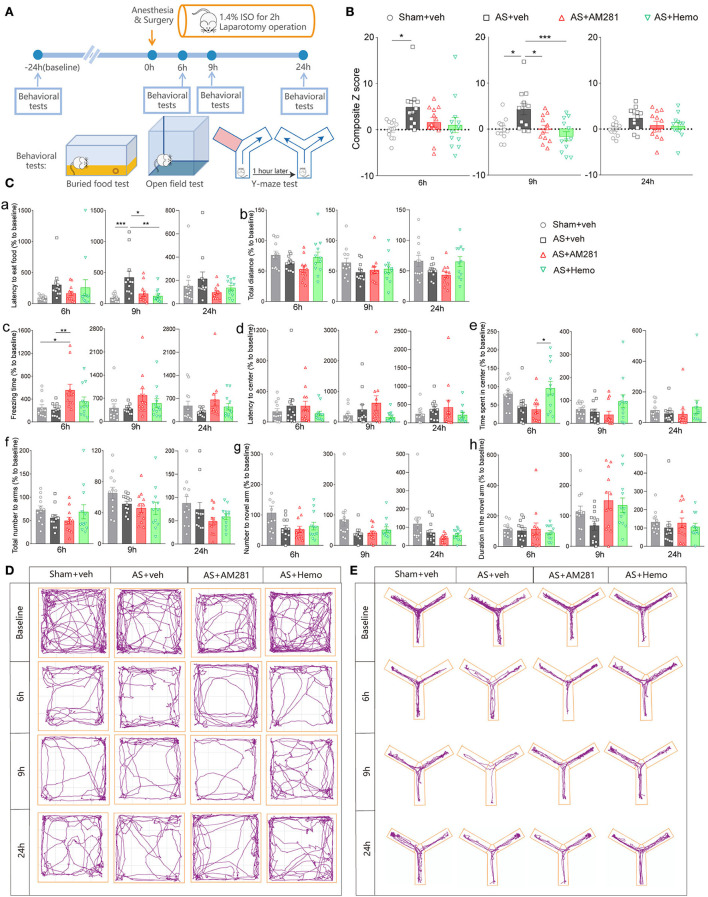
A composite Z score combines food finding, open-field behavior and Y-maze exploration to describe deviations from earlier behavior. Scores rise six and nine hours after anesthesia plus surgery, while the corresponding twenty-four-hour comparison is nonsignificant, identifying a transient window.
Systemic CB1-related blockade lowers the composite score with both tested antagonists at nine hours. This does not mean uniform behavioral recovery: one antagonist group shows increased early freezing, while many locomotor and exploration outcomes do not change significantly.
Source: Liu Y et al. · Frontiers in aging neuroscience · CC BY
Original figure and English caption ↗
Endocannabinoid-associated signaling fluctuates
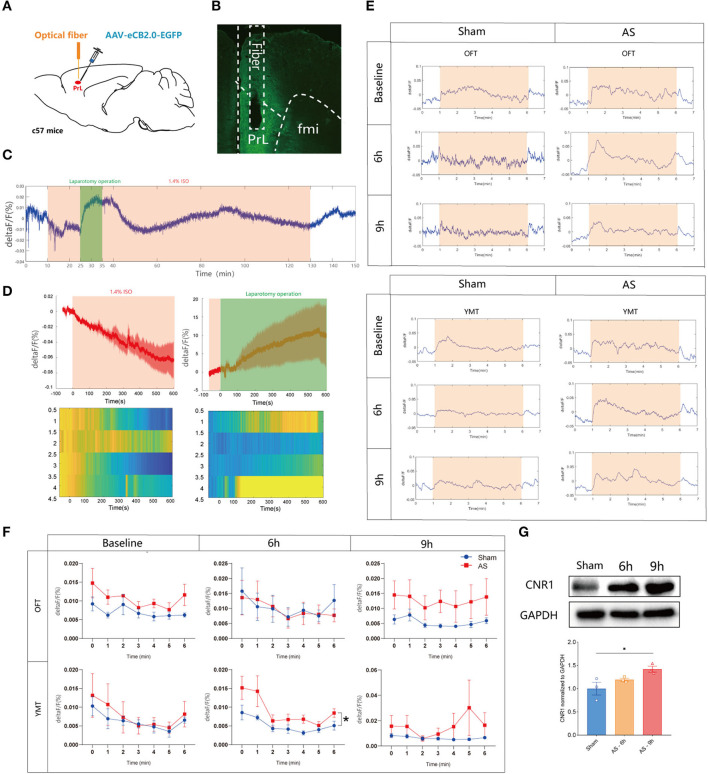
PrL sensor fluorescence initially falls during anesthesia, rises during surgery, then fluctuates and gradually returns toward baseline after anesthesia ends. The trajectory reveals different signaling states across anesthesia, surgery and recovery.
During postoperative testing, the clearest between-group signal increase occurs in the Y maze at six hours, not significantly at nine hours; open-field differences are also nonsignificant. Total PrL CB1-receptor protein is higher at nine hours, offering another timescale of association.
Source: Liu Y et al. · Frontiers in aging neuroscience · CC BY
Original figure and English caption ↗
Local PrL pharmacology narrows the regional question
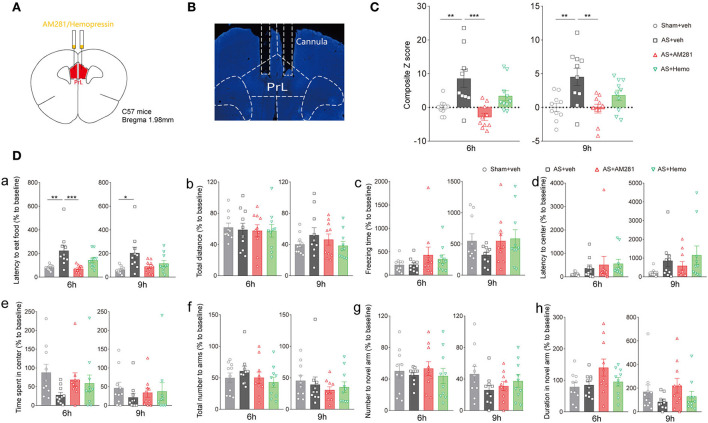
Within PrL, AM281 lowers composite scores at six and nine hours, whereas hemopressin has no significant effect. Selected food-finding latency improves, while many activity and exploration measures remain nonsignificant.
The drug difference raises questions about receptor accessibility and local scope. CB1 receptors occur in different cells and cellular locations, which this pharmacological comparison does not isolate individually. It supports regional involvement in the behavioral changes.
Source: Liu Y et al. · Frontiers in aging neuroscience · CC BY
Original figure and English caption ↗
PrL populations show different time-dependent effects
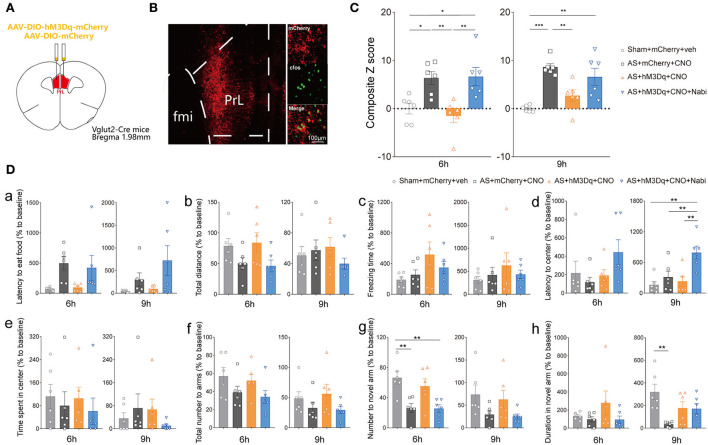
Increasing PrL glutamatergic-associated activity lowers composite scores at six and nine hours. With the exogenous cannabinoid nabilone, the improvement weakens and selected exploratory responses change. Pharmacological signaling and population activity jointly influence outcomes.
GABA-associated activation also lowers the score at nine hours, but not significantly at six hours, and does not show the same nabilone-related effect. The populations therefore differ in timing and pharmacological context, with downstream processes unresolved.
Source: Liu Y et al. · Frontiers in aging neuroscience · CC BY
Original figure and English caption ↗
Thalamic-associated populations extend the question across regions
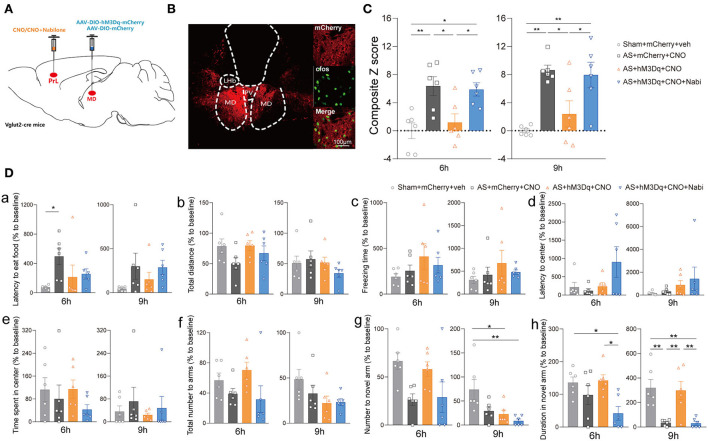
MD has extensive prefrontal connections. Increasing MD glutamatergic-associated activity lowers composite scores at six and nine hours, with weaker improvement during PrL nabilone exposure. Later novel-arm time also increases, while many other outcomes remain nonsignificant.
The affected MD population can influence more than one output. A tested hippocampal-associated activation does not significantly improve the corresponding outcome, focusing attention on the MD-related network without excluding other hippocampal functions or PrL connections.
Source: Liu Y et al. · Frontiers in aging neuroscience · CC BY
Original figure and English caption ↗
An MD-input-associated PrL population contributes early
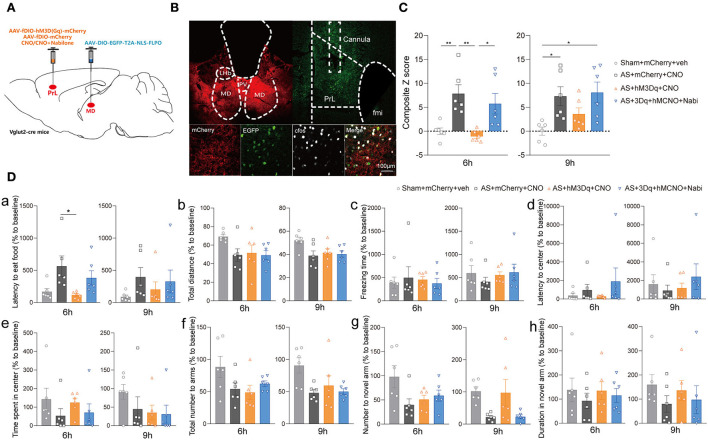
Activating PrL cells associated with MD glutamatergic input lowers the composite score and shortens food-finding latency at six hours, without significant corresponding improvement at nine hours. Nabilone coadministration weakens the early score benefit.
The results move from regional populations toward an input-associated recipient population in PrL. These cells also receive other information and send their own outputs, leaving the precise synaptic sites of endocannabinoid action to be established directly.
Source: Liu Y et al. · Frontiers in aging neuroscience · CC BY
Original figure and English caption ↗
Time and behavioral components remain part of the mechanism
Different components do not share one postoperative timetable. The earlier recipient-population effect precedes later receptor-protein changes and GABA-associated effects. Together, these findings frame recovery as a dynamic process rather than a uniform rise or fall in one signal.
These animal readouts model delirium-related processes without capturing every aspect of clinical consciousness and cognitive fluctuation. Receptor location, synaptic changes and contributions from other inputs remain unresolved questions about postoperative network recovery.