When light touch becomes aversive: a spinal gate changes
A mouse study links Mrgprd-associated sensory cells to punctate hypersensitivity after nerve injury and to spinal input integration and potassium-current changes.
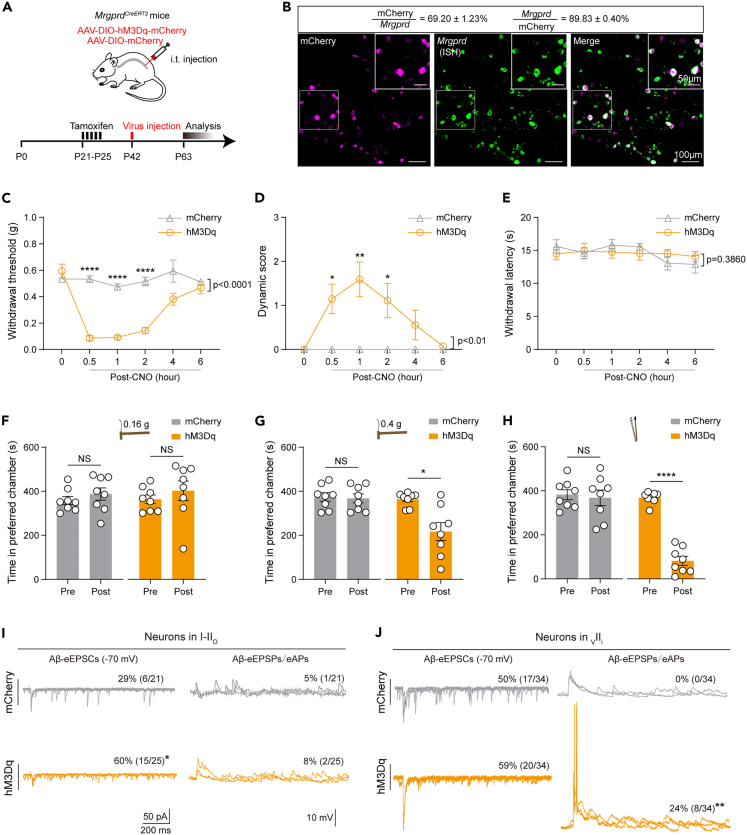
Light touch normally remains light touch, yet nerve injury can make it provoke pronounced avoidance. Does the change begin at peripheral endings or in the spinal cord receiving their signals? An iScience study published on April 27, 2023 examines peripheral sensory cells marked by Mrgprd. In mice, these cells contribute to the development and maintenance of injury-related punctate hypersensitivity and alter how spinal cells process other sensory inputs. A nociceptor pathway can thereby influence whether touch signals pass through a spinal “gate.”
Removing Mrgprd-associated cells attenuates injury-related punctate hypersensitivity and corresponding place avoidance, while brush and thermal responses persist. Increasing their activity makes some spinal cells more responsive to Aβ or C inputs and reduces potassium currents.
Contents · 7 sections
Removing one population separates punctate and brush responses
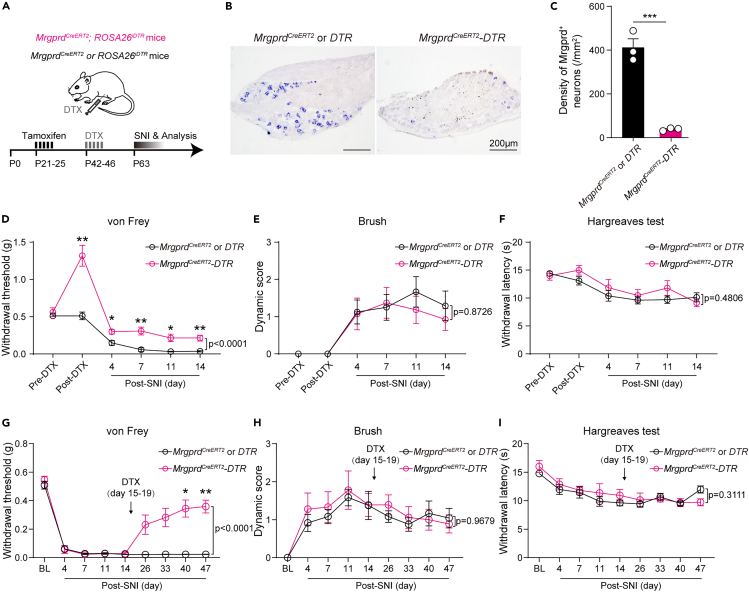
Mrgprd marks a subset of non-peptidergic nociceptors whose cell bodies lie in dorsal root ganglia and whose endings reach peripheral tissue. The study targets adult-expressing cells to reduce confounding from transient developmental expression. Ablation markedly reduces Mrgprd-positive cells without corresponding losses in the other sensory-marker groups tested.
After nerve injury, filament withdrawal thresholds fall, indicating responses to lighter punctate stimulation. Ablation attenuates this change and also raises thresholds when hypersensitivity is already established. Dynamic brush and thermal hypersensitivity do not change significantly, revealing different dependencies for different sensory responses.
Source: Wang L et al. · iScience · CC BY-NC-ND
Original figure and English caption ↗
Beyond paw withdrawal, choices about stimulus location change
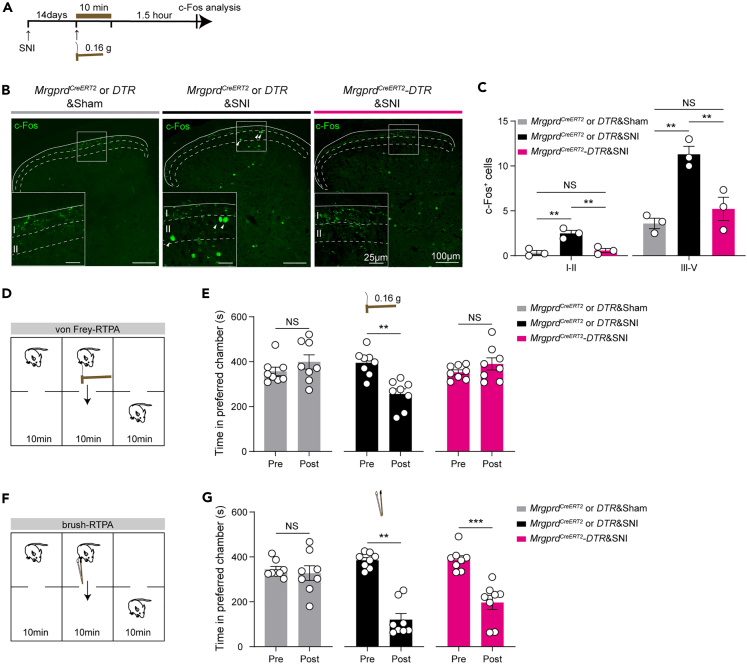
Beyond reflex withdrawal, do mice avoid the location of light stimulation? In injured mice, a previously preferred compartment becomes less attractive after punctate stimulation. Following ablation, time in that compartment no longer declines significantly. Brush-associated avoidance remains present.
Spinal activity labeling shows a corresponding difference. The same light punctate stimulus recruits more c-Fos-positive cells in superficial and deeper dorsal-horn regions after injury; ablation attenuates this increase. Behavioral choice and tissue labeling together implicate this peripheral population in the spinal processing of punctate input.
Source: Wang L et al. · iScience · CC BY-NC-ND
Original figure and English caption ↗
Can an incoming touch signal trigger the next spinal spike?
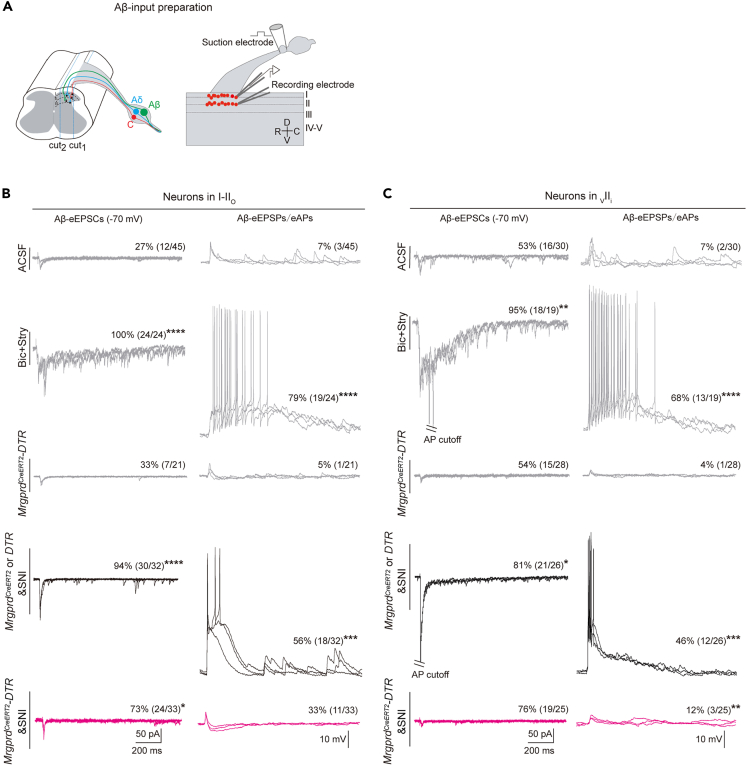
Low-threshold Aβ fibers mainly convey touch. Normally, their spinal input often fails to make superficial dorsal-horn cells fire. After injury, many more cells respond. The gate therefore concerns not merely whether a message arrives, but whether it can trigger an output spike.
After ablation, the fraction of vIIi cells—the ventral inner part of dorsal-horn lamina II—firing to Aβ input declines significantly. Excitatory input responses also become less frequent superficially, although the decrease in spike-producing cells there is not significant. The effect differs across spinal layers rather than closing the entire touch pathway.
Source: Wang L et al. · iScience · CC BY-NC-ND
Original figure and English caption ↗
Stronger mechanical stimulation reveals another gate
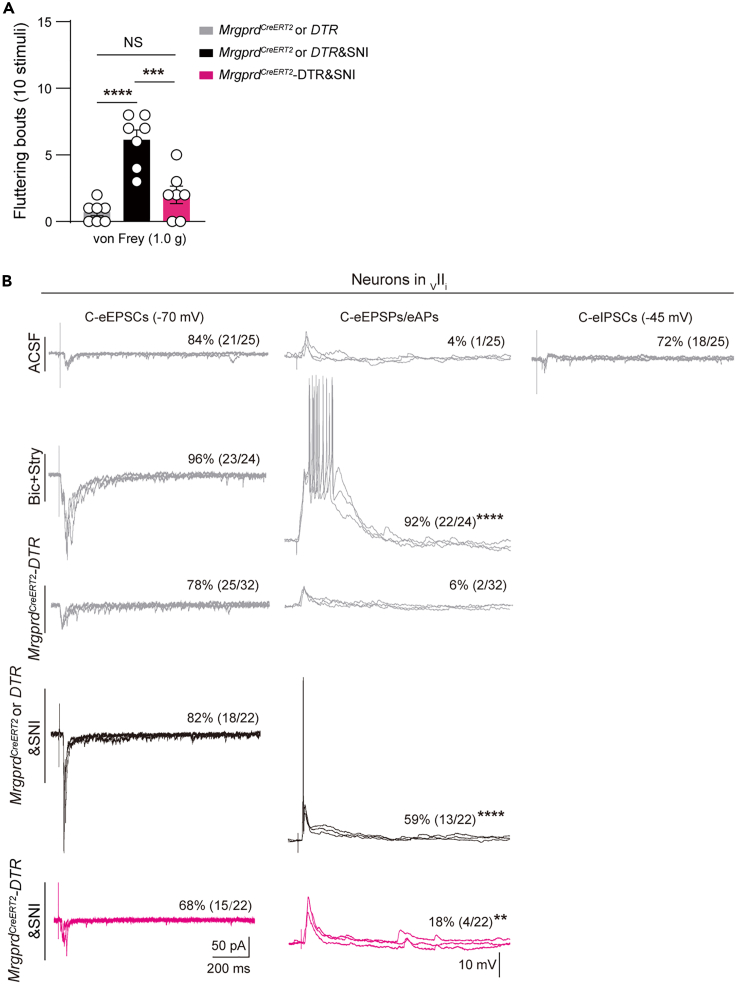
Stronger punctate stimulation also produces delayed paw fluttering after injury, which ablation reduces. Spinal recordings reveal that C-fiber input can generate synaptic responses normally but rarely triggers vIIi spikes. Injury markedly increases that output opportunity.
About six in ten recorded cells in injured mice fire to C input, falling to fewer than two in ten after ablation. Alongside the Aβ findings, this implicates Mrgprd-associated cells in both easier passage of touch signals and greater output from nociceptive input.
Source: Wang L et al. · iScience · CC BY-NC-ND
Original figure and English caption ↗
Increasing activity also makes brushing aversive
In mice without nerve injury, prior activation of Mrgprd-associated cells transiently increases punctate and brush sensitivity without significantly changing thermal responses. Some light mechanical conditions also produce place avoidance, while the lightest tested punctate condition does not significantly change post-stimulation occupancy.
Brush sensitivity adds a contrast with the ablation experiments. A population’s contribution to an ongoing response differs from the range of responses produced by increasing its activity. Recordings show more Aβ-driven vIIi spiking after activation, whereas the superficial change chiefly involves input responses.
Source: Wang L et al. · iScience · CC BY-NC-ND
Original figure and English caption ↗
C-fiber signals more readily produce output too
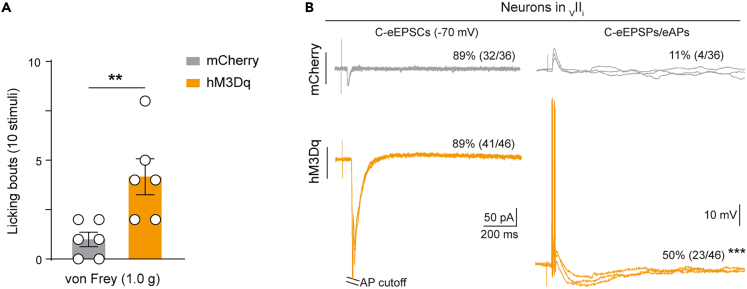
After increasing activity in this peripheral population, stronger mechanical stimulation produces more paw licking, while the fraction of vIIi cells firing to C input rises from roughly one tenth to one half. Peripheral activity can thus alter spinal responses to subsequent inputs rather than simply adding an isolated sensory event.
Source: Wang L et al. · iScience · CC BY-NC-ND
Original figure and English caption ↗
A loosened gate can reflect a weaker cellular brake
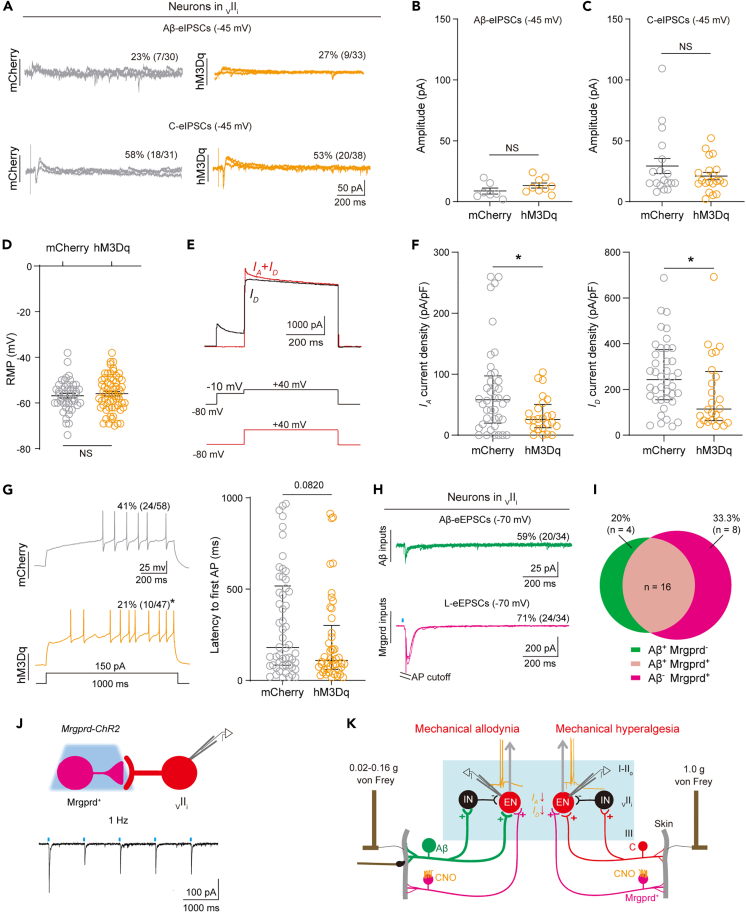
Does the gate open because inhibition weakens? The proportions and amplitudes of measured Aβ- and C-related inhibitory responses in vIIi do not change significantly, and resting potentials remain similar. Potassium currents offer another clue: activation reduces two measured current densities and the fraction of cells with delayed firing.
Potassium currents provide part of a cell’s brake against excitation; weakening that brake can allow formerly subthreshold input to trigger spikes. Many sampled cells receive both Mrgprd-associated and Aβ inputs, supporting a model in which one peripheral pathway changes passage conditions for another. Both sexes are included. The findings concern injury and experimentally increased activity; the mediators and precise recipient identities remain unresolved, and sustained spontaneous pain differs from these brief stimulus-evoked responses.
Source: Wang L et al. · iScience · CC BY-NC-ND
Original figure and English caption ↗