Can pain sensitivity and affect-related behavior be modulated separately?
Pain sensitivity and negative behavioral measures can coexist without changing together. In male mice, ventral pallidal cholinergic cells and their amygdala projection influence these measures on different time scales.
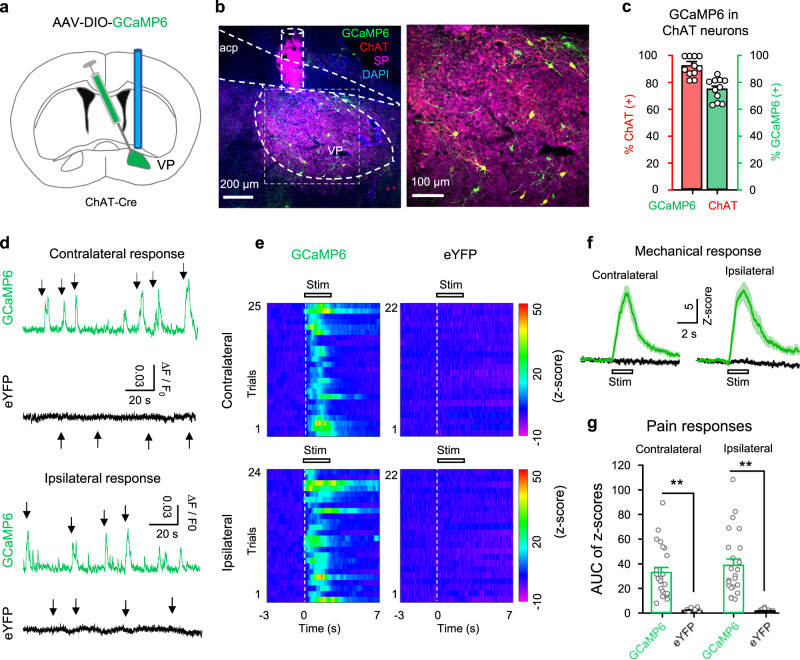
Persistent pain can accompany less exploration and greater immobility in selected tasks. Do sensitization and these behavioral changes depend on identical brain processes? A study published in Nature Communications on April 17, 2023 examined ventral pallidal, VP, cholinergic cells and their projection to the basolateral amygdala, BLA, in male mice. Acute manipulation altered mechanical and thermal responses. After repeated modulation, selected affect-related behavioral changes outlasted stimulation, whereas sensitization did not show the same persistent change.
VP cholinergic circuitry becomes more active in persistent-pain models. Acute suppression attenuates sensitization, while repeated suppression improves selected pain-associated anxiety- and depression-like measures. Sensitization was not significantly reduced after repeated suppression ended, revealing distinct temporal scopes.
Contents · 7 sections
VP cells become more excitable alongside sensitization
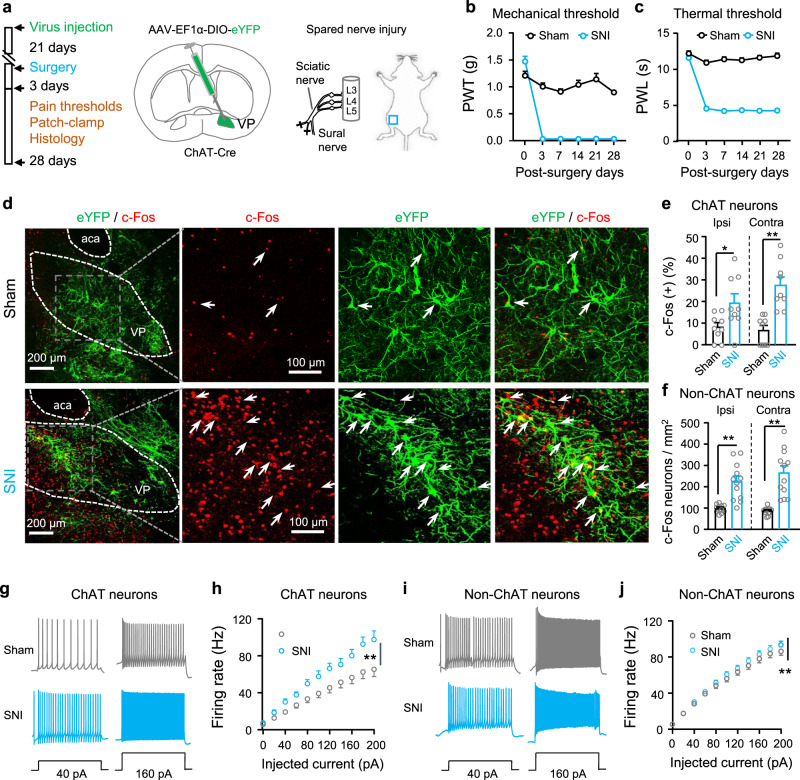
Peripheral nerve injury lowered mechanical withdrawal thresholds and shortened heat-withdrawal latency for weeks. Activity-related labeling increased bilaterally in VP, including both choline acetyltransferase, ChAT, cells and non-ChAT cells. Both populations showed greater evoked firing under matched current input.
Evoked acetylcholine release was also enhanced after injury. Blocking nicotinic acetylcholine receptors reduced excessive non-ChAT activity, linking cholinergic signaling with neighboring cells in the subcortical adaptation associated with persistent sensitization.
Source: Ji YW et al. · Nature communications · CC BY
Original figure and English caption ↗
Activating cholinergic cells increases bilateral sensitivity
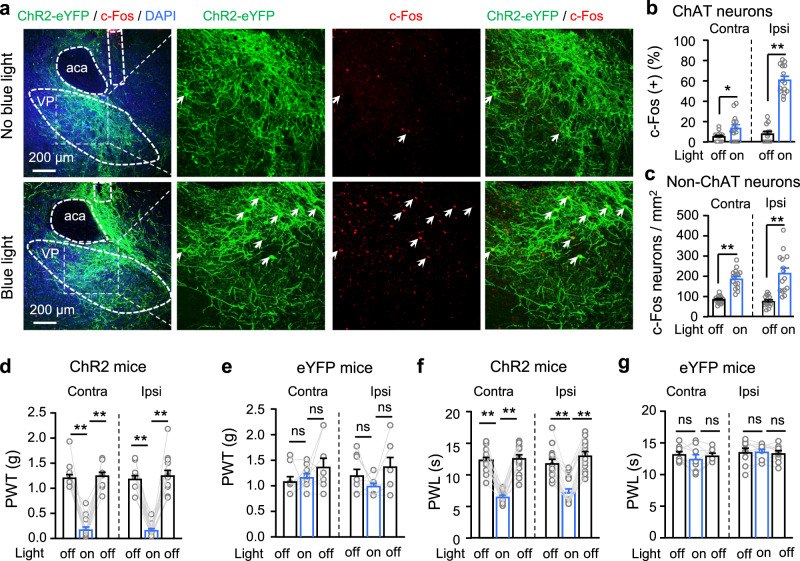
In uninjured mice, activating ChAT cells in one VP lowered mechanical thresholds and shortened heat-withdrawal latency in both hind paws. Measures returned toward their previous levels after stimulation, linking cellular activity with immediate, reversible nociceptive responses.
Local pharmacological comparisons likewise linked enhanced acetylcholine signaling with increased mechanical sensitivity and showed attenuation by nicotinic-receptor blockade. The direction of cholinergic pain modulation therefore depends on its regional context.
Source: Ji YW et al. · Nature communications · CC BY
Original figure and English caption ↗
Repeated activation leaves behavioral changes without persistent sensitization
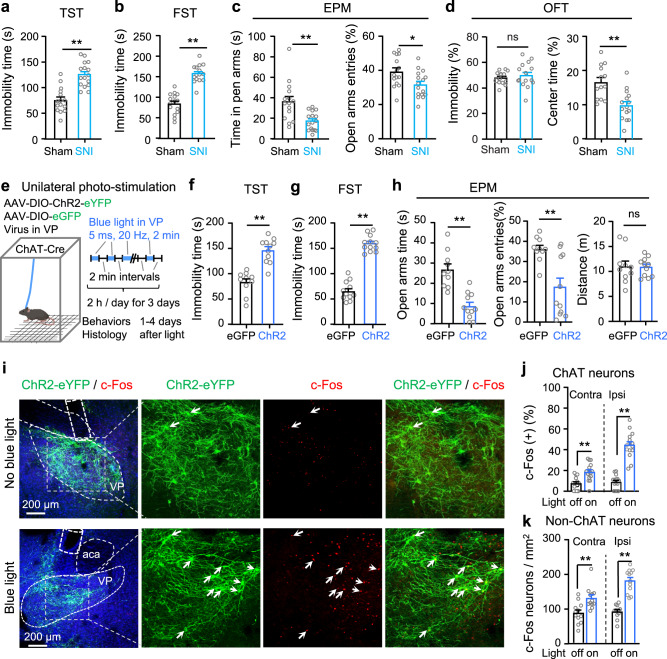
Injured mice showed increased tail-suspension and swimming immobility and reduced exposed-space exploration. Repeated VP cholinergic activation in uninjured mice produced selected behavioral changes in similar directions after stimulation ended, alongside persistent activity-marker increases.
Several days after stimulation ended, mechanical thresholds, thermal responses and locomotor measures did not differ significantly. Affective-task changes thus separated temporally from acute sensitization, showing that one population can influence distinct outcomes without making all measures persistently shift together.
Source: Ji YW et al. · Nature communications · CC BY
Original figure and English caption ↗
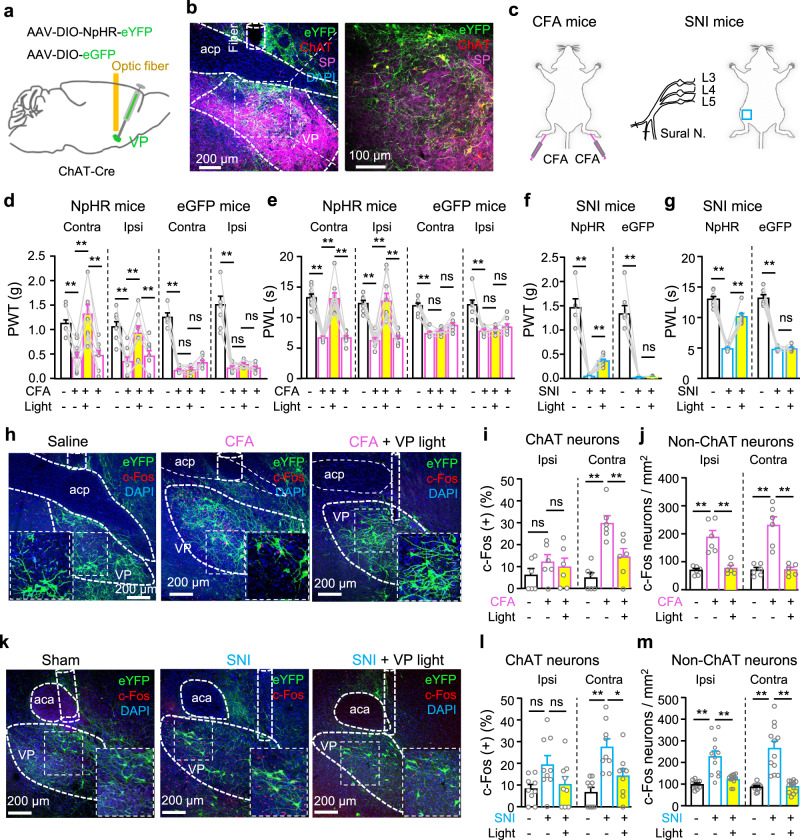
Suppressing activity raises response thresholds in pain states
Acute VP cholinergic suppression raised mechanical thresholds and lengthened heat-withdrawal latency in inflammatory and nerve-injury pain models. Corresponding measures in uninjured mice did not change significantly, indicating a different functional contribution in sensitized states.
Activity labeling decreased with suppression, including changes in local non-ChAT cells. These findings do not restrict every effect to direct monosynaptic connections; contributions of local networks and distant outputs remain to be resolved.
Source: Ji YW et al. · Nature communications · CC BY
Original figure and English caption ↗
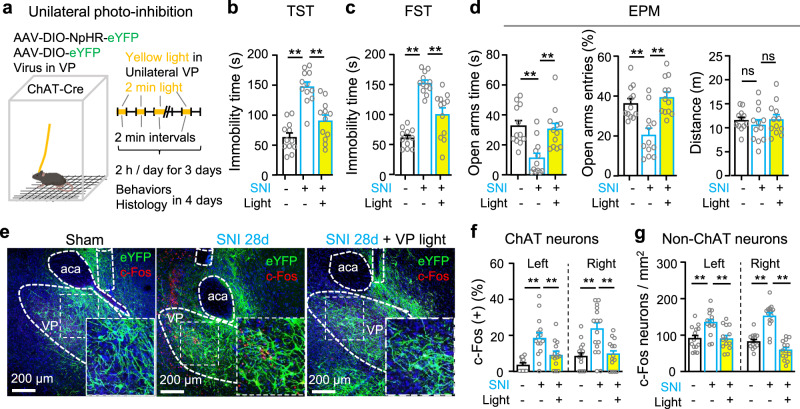
Selected behavioral improvements outlast repeated suppression
After nerve injury, repeated suppression reduced tail-suspension and swimming immobility and increased open-arm time and entries after suppression ended. Corresponding travel distance did not change significantly, while VP activity labeling remained lower.
The benefit had contextual limits. Sensitization measured after suppression ended was not significantly reduced, and comparable suppression did not improve tested anxiety- or depression-like measures in two chronic-stress models. The findings therefore point to a pain-associated contribution rather than a universal affective effect.
Source: Ji YW et al. · Nature communications · CC BY
Original figure and English caption ↗
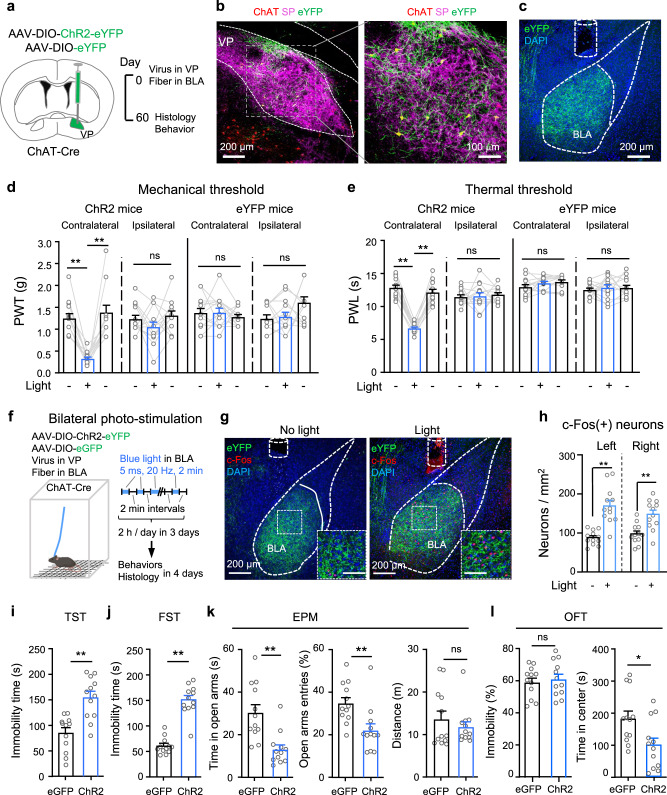
An amygdala projection reveals clearer laterality
VP cholinergic cells project densely to BLA. Activating their terminals in one BLA altered mechanical and thermal responses in the contralateral hind paw without significant ipsilateral changes. This differs from bilateral effects of VP cell-body activation, revealing separable scopes of local and distant contributions.
Repeated bilateral terminal activation also changed selected affect-related behaviors after stimulation ended, without significant changes in tested sensitization or locomotion. BLA cellular responses remained heterogeneous: some cells were excited, others inhibited or weakly responsive.
Source: Ji YW et al. · Nature communications · CC BY
Original figure and English caption ↗
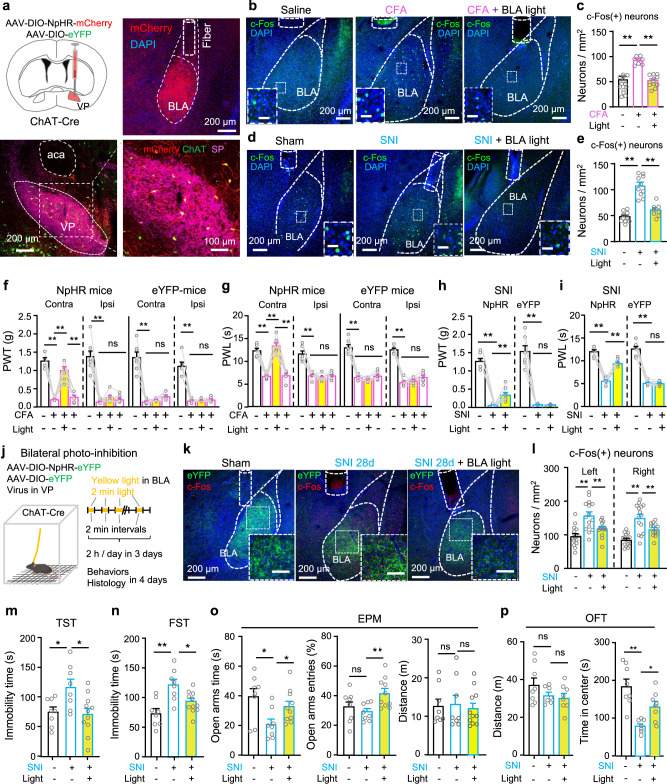
Sensitization and affect-related improvement need not share one time course
In pain models, acute VP–BLA terminal suppression attenuated contralateral sensitization, whereas repeated bilateral suppression improved selected anxiety- and depression-like measures after stimulation ended. Post-suppression sensitization did not improve significantly, demonstrating state- and time-dependent contributions.
These male-mouse findings sharpen the relationship between sensitization and negative behavioral measures. Which downstream cells mediate each effect, how local and distant outputs interact, and whether findings extend to females or humans remain unresolved. They identify circuit nodes for investigation without establishing clinical efficacy.
Source: Ji YW et al. · Nature communications · CC BY
Original figure and English caption ↗