Two tones, two responses: the auditory cortex’s striatal output
In a learned-tone task in male mice, auditory-input-associated striatal D1 cells contribute to differential freezing, while nigral responses stand out for the threat-predictive tone.
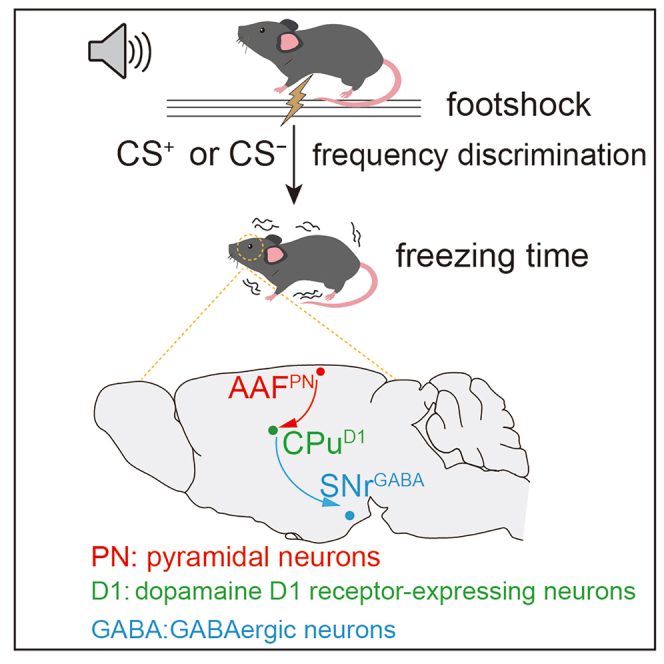
Two equally loud tones linked to different experiences evoke different mouse responses. An iScience study follows anterior auditory field, or AAF, input to caudate putamen, or CPu, and onward to substantia nigra pars reticulata, or SNr. Auditory-recipient striatal D1 cells contribute prominently to differential freezing, linking sound processing with a defined basal-ganglia population.
After inhibiting AAF-recipient CPu D1 cells, tone-freezing differences are no longer significant; D2 inhibition preserves them. Manipulation of SNr-output-associated populations also alters differential responses, with clearer nigral calcium responses to 12 kHz.
Contents · 7 sections
Learning produces differential tone responses
Adult males associate a 12-kHz tone with shock while a 2-kHz tone is unpaired. Greater later freezing to the former provides a learned frequency-cue distinction. Frequencies and prior meanings differ.
Testing uses settings distinct from training, with the two tones presented in different contexts. Freezing means immobility apart from breathing and describes learned defensive responses. The task compares behavioral differentiation of experienced cues.
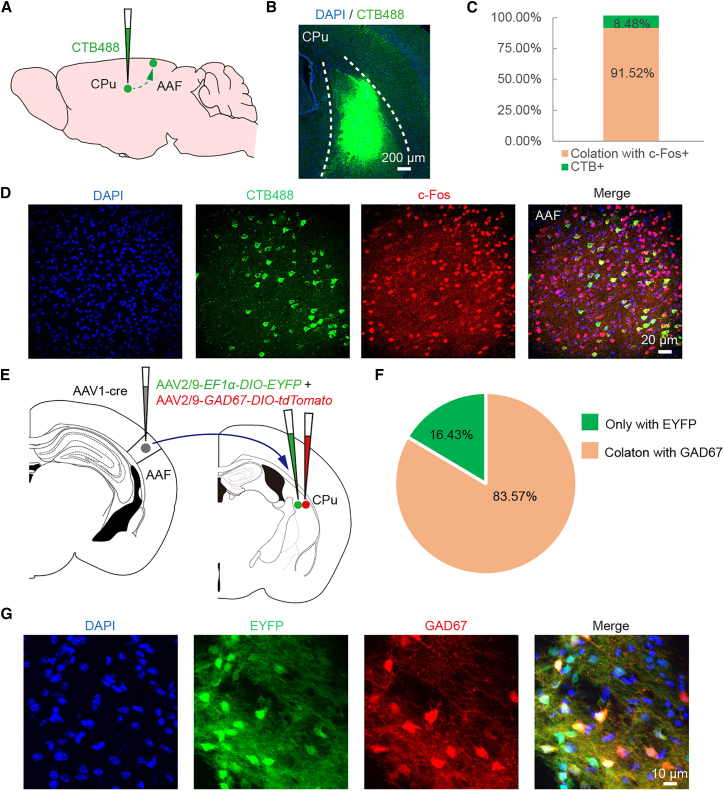
After the task, most CPu-projecting AAF cells carry c-Fos. Forward labeling identifies many GABA-associated striatal recipients, motivating tests of their contribution.
Source: Wang ZQ et al. · iScience · CC BY-NC-ND
Original figure and English caption ↗
Lower recipient activity makes responses more similar
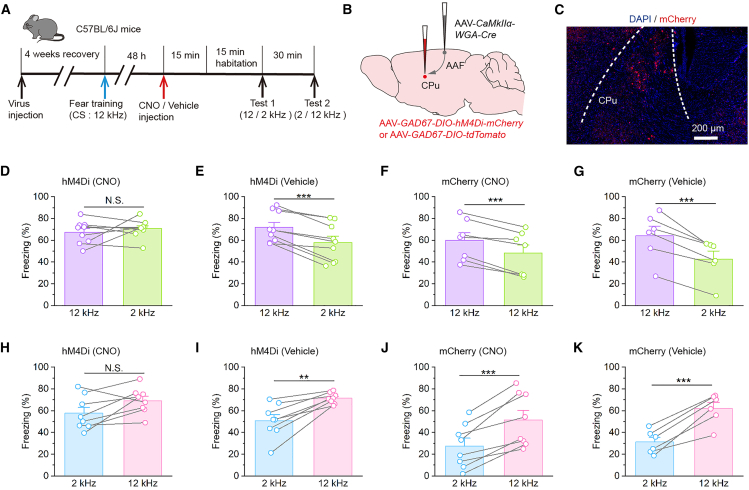
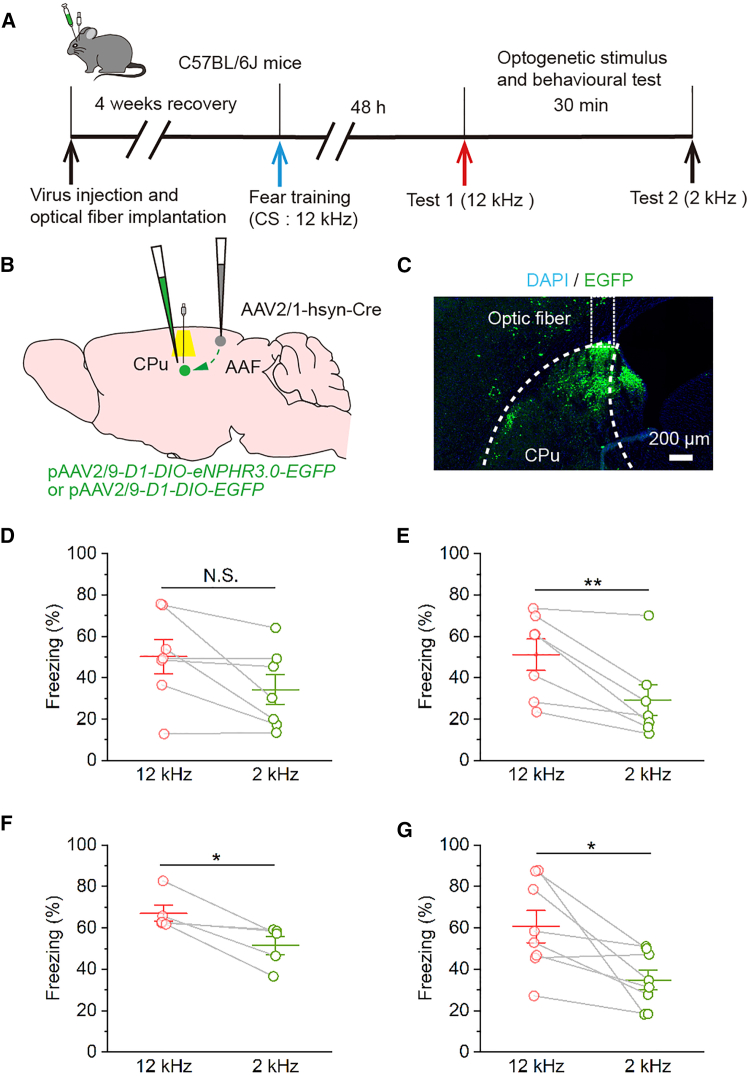
After learning, inhibition of AAF-recipient striatal GABA cells leaves tone-freezing differences nonsignificant, whereas controls retain a difference. The manipulation concerns retrieval-test expression of learned cue discrimination.
Different tone orders yield similar inhibition outcomes, relating responses to cue identity and experience rather than presentation order alone.
Source: Wang ZQ et al. · iScience · CC BY-NC-ND
Original figure and English caption ↗
D1 and D2 populations differ
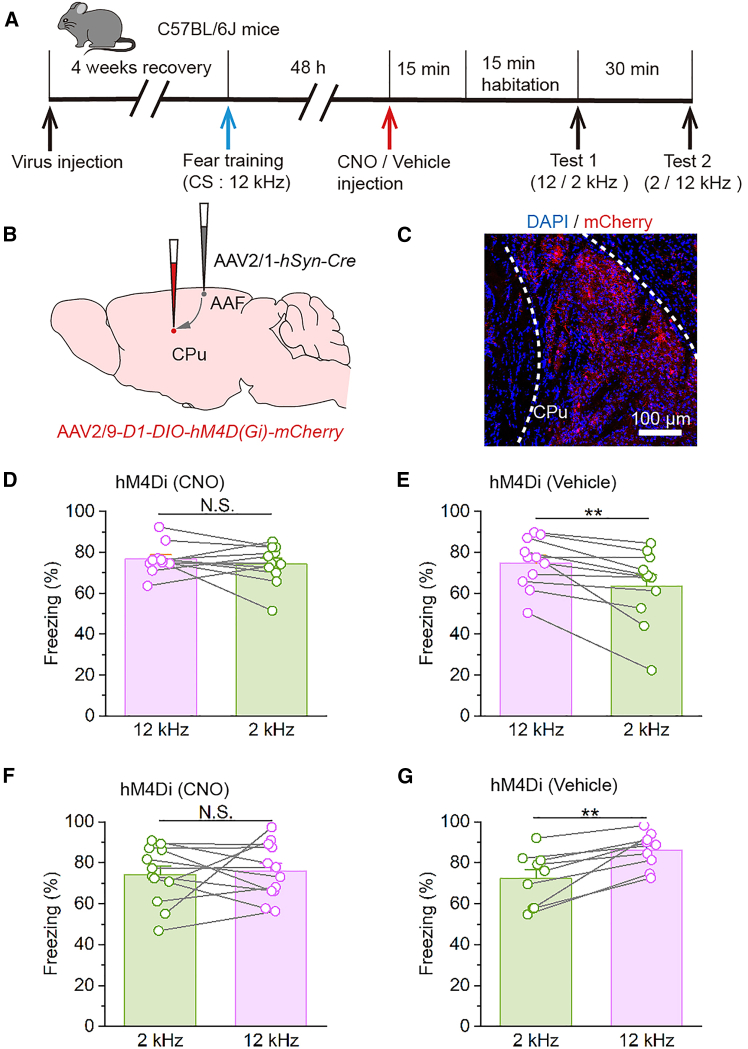
D1- and D2-receptor medium spiny neurons are principal striatal GABA populations. Inhibiting AAF-recipient D1 cells removes significant tone differentiation, while D2 inhibition preserves it.
The same auditory source engages recipient classes with distinct task contributions. D1-cell function extends into learned auditory-cue behavior, guiding downstream tracing.
Source: Wang ZQ et al. · iScience · CC BY-NC-ND
Original figure and English caption ↗
Photoinhibition also alters differential responses
Test-time photoinhibition of D1 recipients also weakens differential freezing, while unilluminated conditions retain differentiation. Brief optical and chemogenetic results align.
These findings concern expression after learning cue meanings. Striatal recipients lie between auditory input and behavior, with their state influencing differential responses.
Source: Wang ZQ et al. · iScience · CC BY-NC-ND
Original figure and English caption ↗
Auditory input joins striatal–nigral output
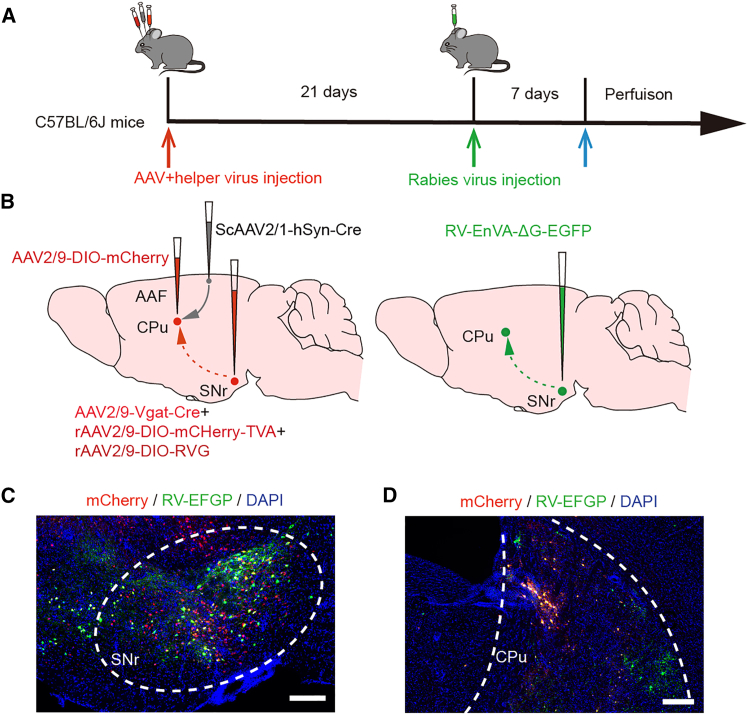
D1-related terminals reach SNr, and retrograde tracing labels CPu. Combining AAF forward labeling with SNr GABA-associated monosynaptic tracing yields colabeled CPu cells, joining both ends anatomically.
SNr is a basal-ganglia output node. Researchers next select CPu D1 cells associated with both input and output to test their behavioral contribution.
Source: Wang ZQ et al. · iScience · CC BY-NC-ND
Original figure and English caption ↗
Inhibition and removal alter cue responses
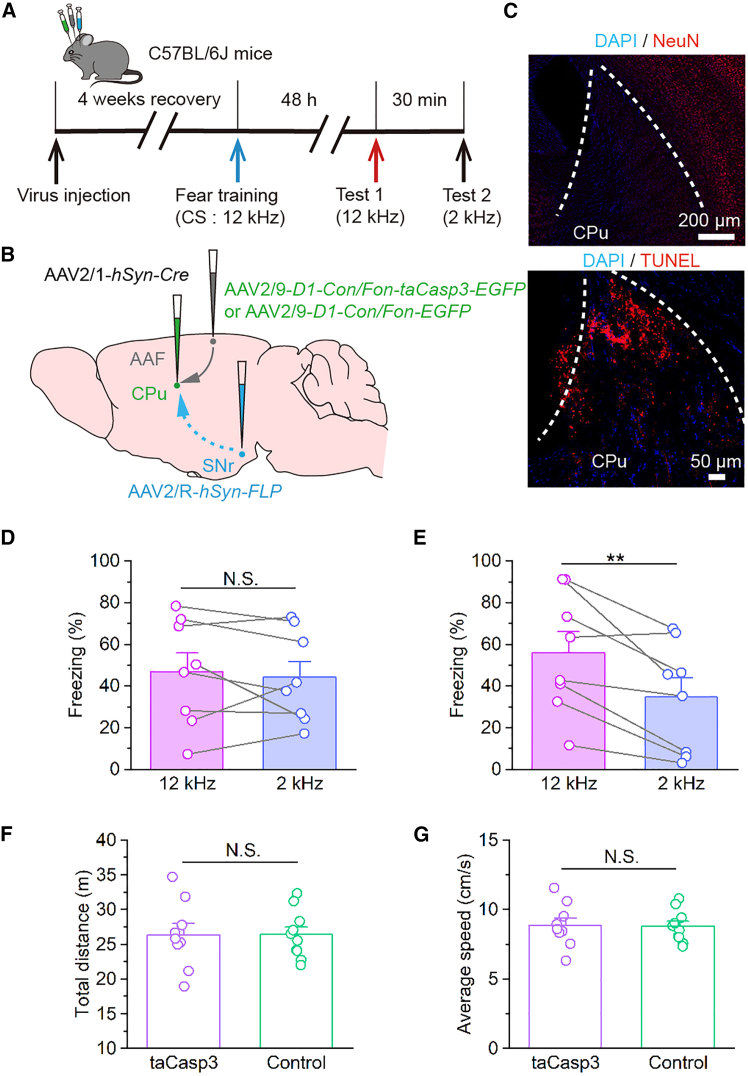
Chemogenetic inhibition of the associated CPu D1 population makes freezing differences nonsignificant. Apoptotic removal yields a similar pattern, aligning reversible and cell-removal evidence.
Open-field distance and speed do not significantly change after ablation. Comparable locomotion accompanies altered differential tone responses, supporting a task-related contribution.
Source: Wang ZQ et al. · iScience · CC BY-NC-ND
Original figure and English caption ↗
The threat-predictive tone has clearer responses
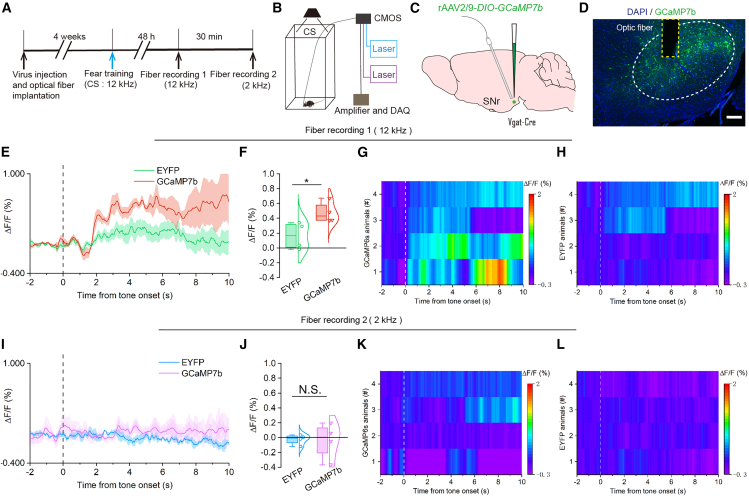
SNr calcium responses to 12 kHz exceed fluorescence controls, while the 2-kHz comparison is nonsignificant, revealing distinct responses to learned cues.
The male-mouse study links differential tone responses with auditory cortex, striatal D1 cells and nigral-associated output, revealing cellular contributions to expressing distinct defensive responses after learning.
Source: Wang ZQ et al. · iScience · CC BY-NC-ND
Original figure and English caption ↗