Two amygdala inputs divide mechanical sensitivity and aversion
In male mice, insular input affects mechanical sensitivity and place avoidance. Mediodorsal thalamic input changes avoidance without a significant change in mechanical threshold.
Pain can trigger withdrawal and avoidance of environments associated with discomfort. Do the same signals drive both? A study published in Journal of Biological Chemistry on June 27, 2022 examines basolateral amygdala, or BLA, in male mice with inflammatory pain. Insular cortex, or IC, and mediodorsal thalamus, or MD, both provide excitatory input, yet changing these inputs produces different combinations of mechanical thresholds and place preference.
IC–BLA input contributes to mechanical sensitivity and aversion-related behavior, whereas MD–BLA input primarily affects place aversion. The two inputs differ functionally despite sharing a target.
Contents · 7 sections
Inflammation leaves amygdala cells more responsive
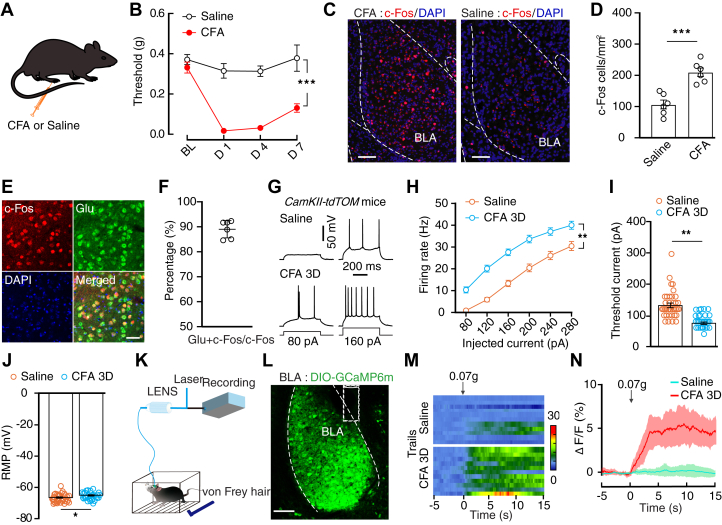
Mice with inflammatory pain withdraw to weaker mechanical stimulation. BLA activity labeling increases, and many activated cells carry glutamate-associated markers. Recorded excitatory cells also fire more readily.
A mild stimulus that produces little calcium response in controls evokes a stronger BLA population response in mice with inflammatory pain. Increased bodily sensitivity and neural responsiveness identify a shared node for further investigation.
Source: Meng X et al. · The Journal of biological chemistry · CC BY
Original figure and English caption ↗
Changing BLA activity changes withdrawal and place choice
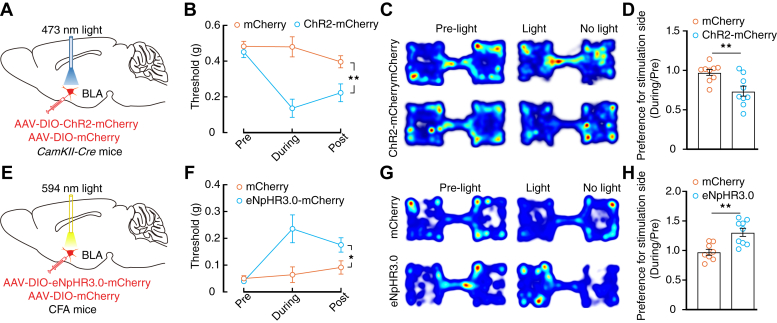
Activating BLA excitatory cells lowers mechanical thresholds in normal mice and produces avoidance of the activation-associated side. Inhibiting the population in mice with inflammatory pain raises thresholds and promotes preference for the inhibition-associated side.
Threshold measures whether a weak stimulus elicits withdrawal; place choice measures approach to or avoidance of an associated environment. Both change here but remain distinct behavioral dimensions, motivating separation of BLA’s incoming signals.
Source: Meng X et al. · The Journal of biological chemistry · CC BY
Original figure and English caption ↗
Stronger excitation supports cellular hyperresponsiveness
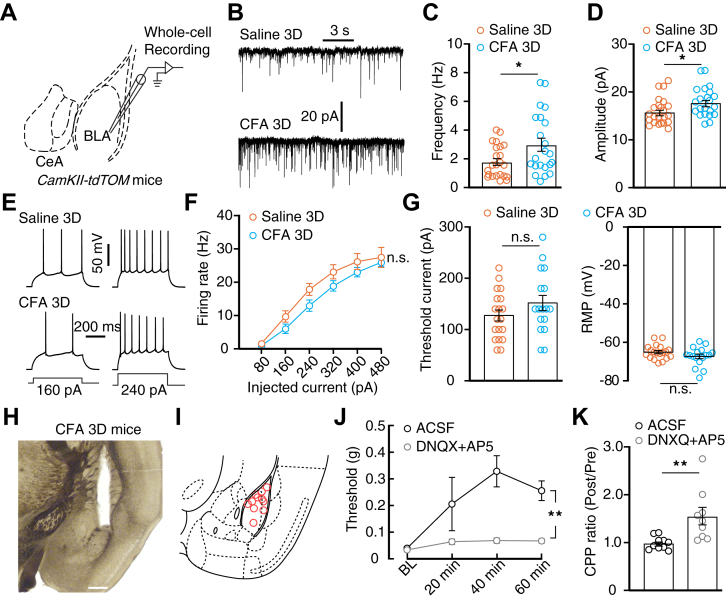
Miniature excitatory synaptic events in BLA cells become more frequent and larger in inflammatory pain. After local excitatory transmission is reduced, group differences in firing responses and several membrane properties are no longer significant, implicating enhanced input in the hyperresponsive state.
Reducing this transmission locally also accompanies higher mechanical thresholds and preference for the associated environment. Because BLA receives multiple inputs, reducing overall excitation leaves open which inputs contribute to sensitivity and which to avoidance.
Source: Meng X et al. · The Journal of biological chemistry · CC BY
Original figure and English caption ↗
Insula and thalamus converge on the same target
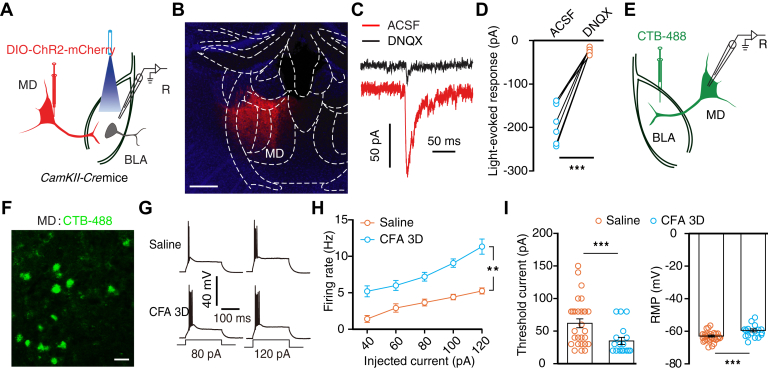
Tracing links BLA excitatory cells to several upstream regions. The study focuses on IC and MD, where labeled BLA-projecting cells predominantly overlap with glutamate markers. Their inputs evoke excitatory synaptic responses in BLA.
Both BLA-projecting IC and MD cells fire more readily in inflammatory pain. Shared cellular responsiveness need not imply shared behavioral effects. The study therefore compares each input’s contributions to withdrawal and place choice.
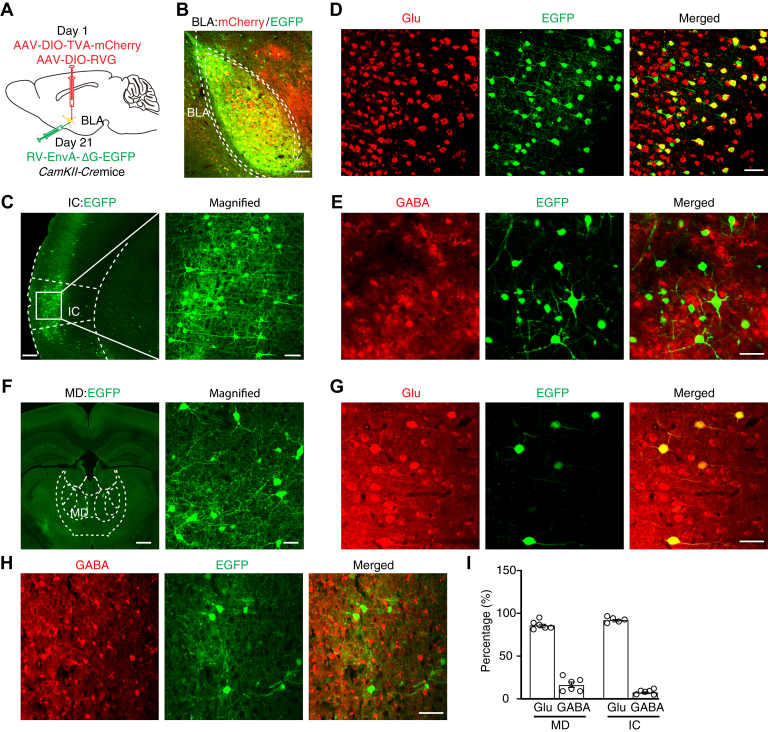
Source: Meng X et al. · The Journal of biological chemistry · CC BY
Original figure and English caption ↗
Insular input changes sensitivity and avoidance together
Enhancing IC-associated terminals in BLA lowers mechanical thresholds in normal mice and induces real-time place aversion. Subsequent testing also reveals avoidance of the associated side, linking this input to immediate responses and later place choice.
In mice with established inflammatory pain, suppressing the terminals raises thresholds and induces preference for the associated side. Across these backgrounds, IC–BLA input contributes to both withdrawal sensitivity and spatial choice.
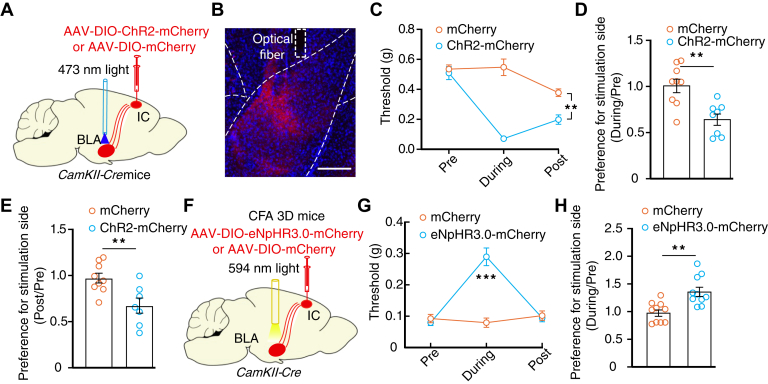
Source: Meng X et al. · The Journal of biological chemistry · CC BY
Original figure and English caption ↗
Thalamic input changes avoidance without a significant threshold effect
MD–BLA input gives a different answer. Terminal activation induces real-time and conditioned place aversion in normal mice without significantly changing mechanical thresholds. Suppression in inflammatory pain induces place preference, again without a significant threshold effect.
The difference is not simply that one input is active and the other silent, but which behaviors change when each is engaged. Excitatory signals converging on BLA can influence different components of pain-related behavior.
Withdrawal alone can therefore miss part of the change. With MD-associated input suppressed, mice retain low mechanical thresholds but prefer the inhibition-associated environment. Place choice offers a complementary perspective: withdrawal sensitivity and aversion-related behavior can change through different input connections.
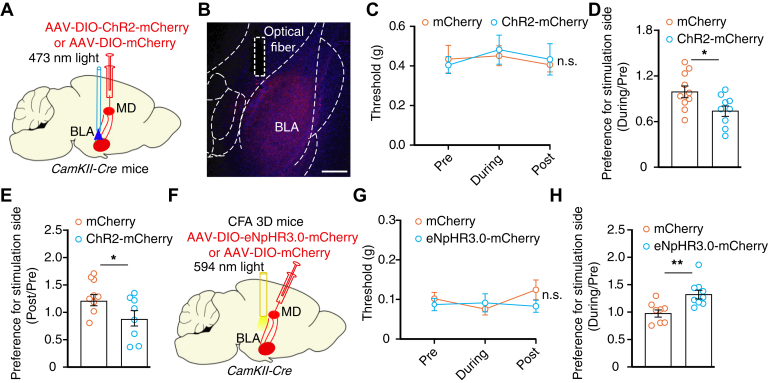
Source: Meng X et al. · The Journal of biological chemistry · CC BY
Original figure and English caption ↗
Separating pain-related behaviors reveals division within a shared node
This male-mouse study identifies a division under inflammatory pain and the tested mechanical and place behaviors. IC input contributes to both, while MD input primarily affects aversion in these comparisons. Other modalities, disease stages and inputs may have different relationships.
Anatomical convergence does not require every pain-related behavior to change together. Examining withdrawal and avoidance separately turns a broadly pain-associated region into a network node whose contributions can be understood by input source.