One visual-cortical spreading wave leaves sensitivity and avoidance
In awake male mice, a single cortical spreading event accompanies bilateral mechanical sensitivity, light avoidance and longer-lasting open-space avoidance, with distinct recovery timelines.
Visual changes often accompany migraine aura. Cortical spreading depression, CSD, is an important experimental clue: neuronal and glial depolarization propagates slowly and is followed by suppressed activity. What follows a single visual-cortical event in an awake animal? A study published in The Journal of Headache and Pain in 2025 induces CSD optogenetically in one primary visual cortex of male mice, observing mechanical sensitivity, light avoidance and anxiety-like behavior with different time courses.
After a single visual-cortical CSD, bilateral periorbital and hind-paw mechanical thresholds fall transiently while open-space avoidance lasts longer. Sumatriptan improves both response classes, but hind-paw thresholds remain below baseline.
Contents · 6 sections
Changes propagate forward from visual cortex
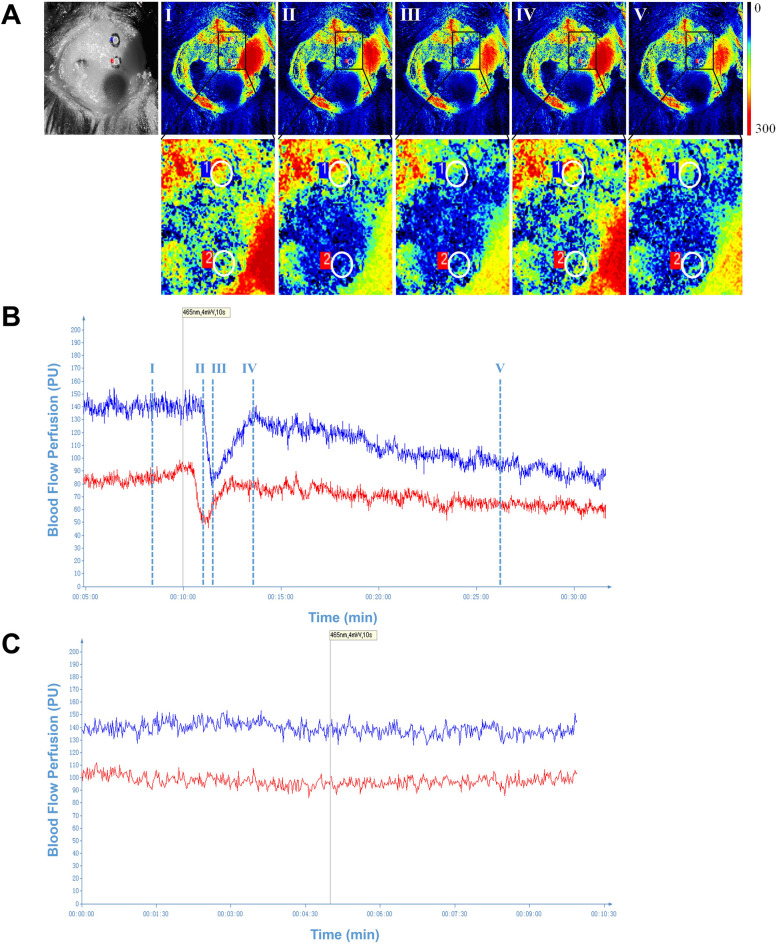
Excitatory cells in the right visual cortex express a light-sensitive protein. Brief illumination is followed by reduced ipsilateral cortical flow, transient normalization and prolonged low perfusion. The sequence travels from the sampled sensory-cortical area toward motor cortex, consistent with a spreading CSD event.
The flow sequence propagates at roughly five millimeters per minute, with neighboring cortical regions changing in succession. A brief trigger unfolds into propagation and recovery over time, providing a spatially and temporally structured event against which later behavior can be compared.
Contralateral sampled regions do not show significant flow changes, and controls without the light-sensitive protein lack the same sequence. Flow verification is performed under anesthesia, while events for behavioral testing are induced in awake, freely moving mice. These distinct settings form the model’s evidence framework.
Source: Yuan H et al. · The journal of headache and pain · CC BY-NC-ND
Original figure and English caption ↗
A local event is followed by bilateral sensory changes
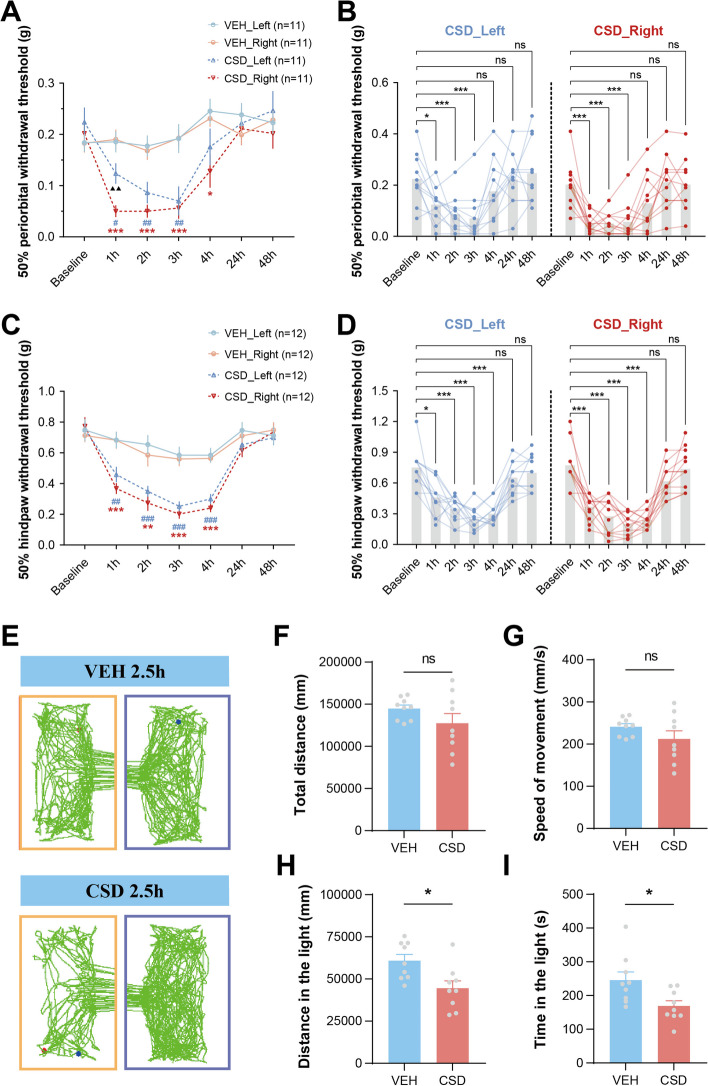
Although CSD begins in one cortex, mechanical sensitivity develops in both periorbital regions and hind paws. One hour later, the ipsilateral periorbital threshold is lower than the contralateral threshold, followed by bilateral changes. The site of initiation and the behavioral distribution do not coincide.
Lower thresholds persist over the first few hours and return to baseline within twenty-four hours. Hind-paw changes extend the observations beyond the face, connecting a unilateral visual-cortical event with responses in distant body regions.
A lower mechanical threshold means that lighter touch evokes withdrawal. Measuring both periorbital skin and hind paws places facial and bodily sensitivity in the same comparison, making distant tactile responses part of the event’s subsequent effects.
Source: Yuan H et al. · The journal of headache and pain · CC BY-NC-ND
Original figure and English caption ↗
Bright and exposed spaces are explored less
Two and a half hours after the event, mice move less and stay shorter in the light compartment, while overall distance and speed remain similar. They remain active but choose differently between environments. Light avoidance is a behavior related to light sensitivity in the model.
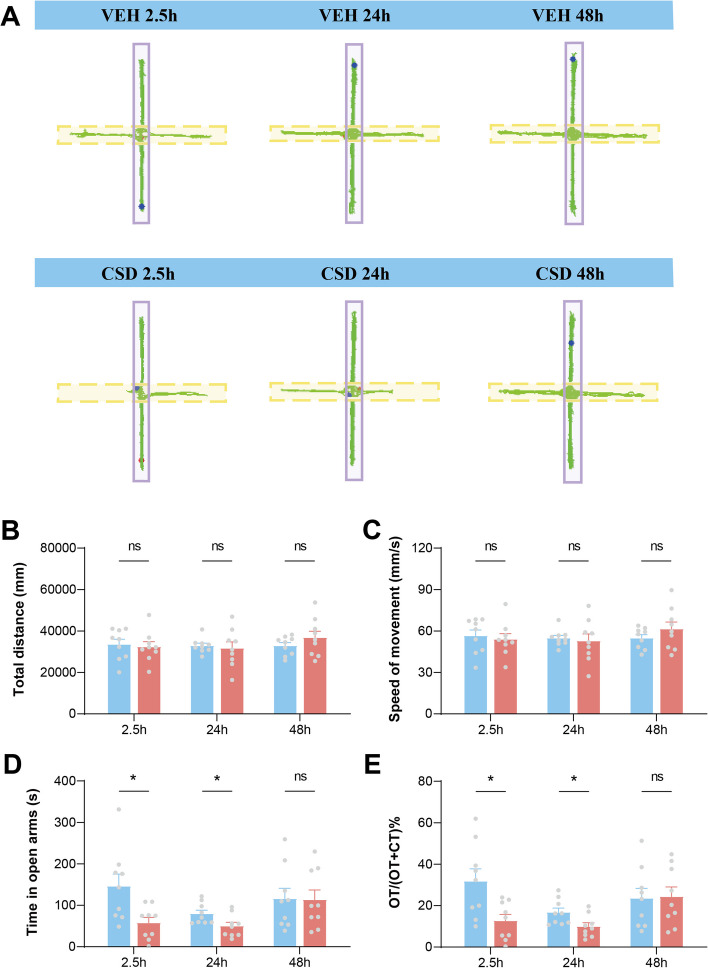
In the elevated maze, mice spend less time in open arms and show a lower open-arm time proportion, without significant overall movement changes. Choices in bright and exposed spaces complement altered stimulus thresholds, describing a combined sensory and avoidance pattern.
Source: Yuan H et al. · The journal of headache and pain · CC BY-NC-ND
Original figure and English caption ↗
Spatial avoidance persists after thresholds recover
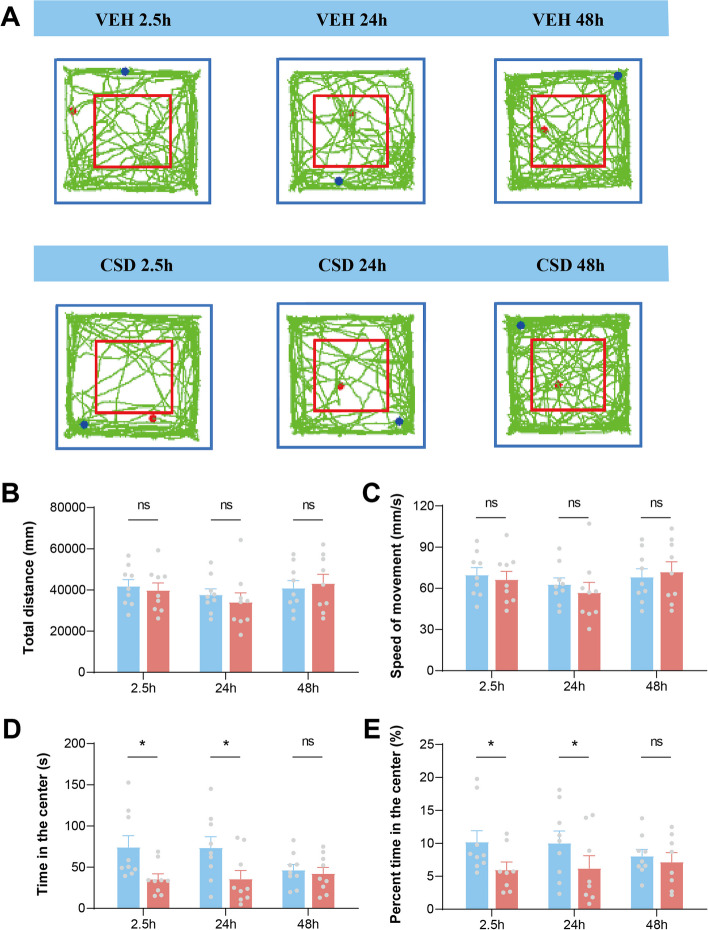
At twenty-four hours, mechanical thresholds have recovered but open-arm occupancy remains lower. Open-field center time also decreases, while distance and speed remain similar. These two exposed-space measures indicate anxiety-like avoidance lasting longer than measured mechanical sensitivity.
By forty-eight hours, the corresponding maze and open-field differences are no longer significant. Recovery depends on the outcome, giving the duration of the model’s effects a concrete meaning: thresholds and spatial choices follow distinct timelines.
Source: Yuan H et al. · The journal of headache and pain · CC BY-NC-ND
Original figure and English caption ↗
Improvement differs across body regions
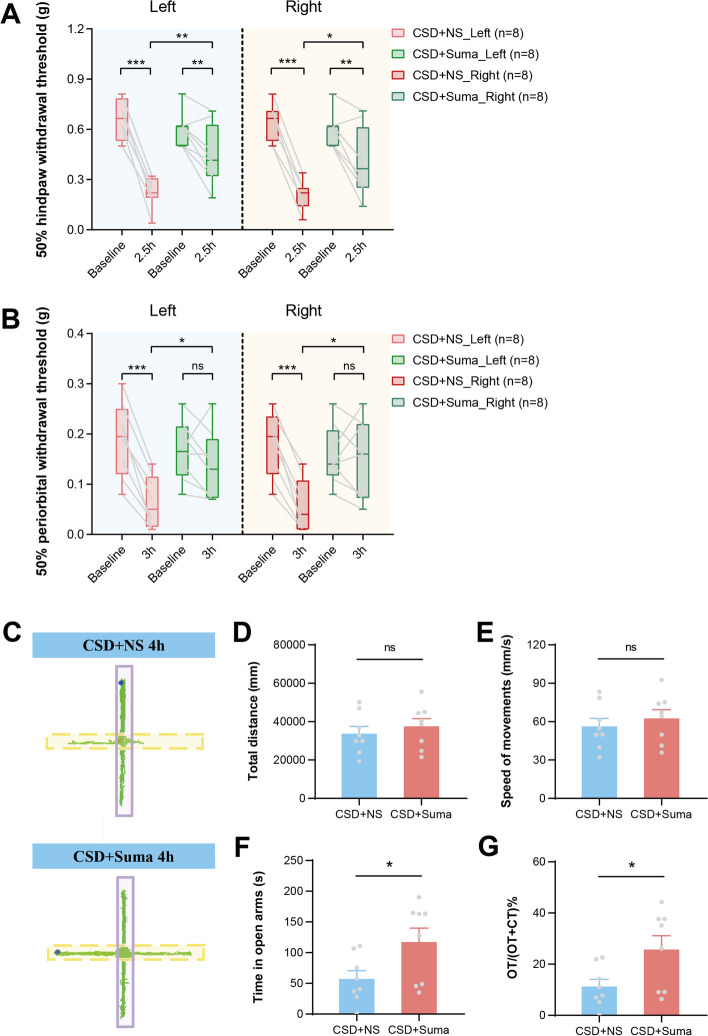
Sumatriptan after induction raises both periorbital and hind-paw thresholds relative to saline. Periorbital thresholds no longer differ significantly from baseline, but hind-paw thresholds remain significantly lower. This response provides another line of evidence for model sensitivity and shows region-dependent improvement.
At four hours, the treated group spends more time in open arms with a higher time proportion, without significant distance or speed changes. Avoidance improves alongside thresholds, but the comparison does not directly establish that pain alone causes avoidance.
Source: Yuan H et al. · The journal of headache and pain · CC BY-NC-ND
Original figure and English caption ↗
One cortical event has effects at several levels
A single event brings mechanical sensitivity, light avoidance and exposed-space choices into the same investigation while preserving their distinct recovery rates. Later sensory changes may involve extracortical networks and peripheral signals, but the study principally establishes the behavioral pattern rather than tracing a complete molecular pain pathway.
These findings concern male mice, awake induction, a particular cortical origin and defined tests. They show that a spreading cortical event can influence regions beyond its origin and persist across different time windows, making the connection between a local brain event, bodily sensitivity and spatial choice more concrete.