How one cell ensemble influences pain sensitivity and sleep
A mouse study identifies an accumbens ensemble recruited during chronic pain that regulates reflexive sensitivity and NREM sleep. Downstream recipient cells show distinct functions in preoptic area and VTA.
After nerve injury, mice become more sensitive to mechanical and thermal stimuli and spend more time awake. Do these changes share a neural node? A study published in Nature Communications on August 5, 2023 identifies accumbens cells active during chronic pain. They respond to mechanical stimulation and fire more during waking. Increasing or reducing their activity changes sensitivity and NREM sleep. Further tracing shows how a shared upstream ensemble can engage distinct downstream cellular functions.
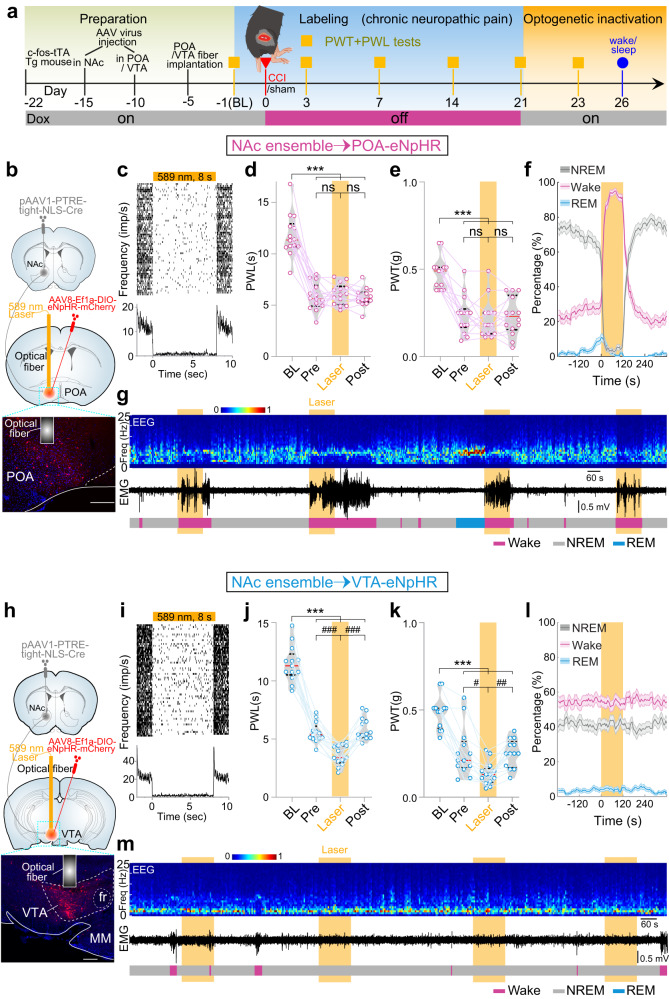
Activating the chronic-pain-recruited accumbens ensemble increases mechanical and thermal sensitivity and reduces NREM, while inhibition has opposite effects. Inhibiting preoptic recipient cells chiefly changes sleep, whereas inhibiting VTA recipient cells chiefly changes tested nociceptive responses.
Contents · 8 sections
Cells active during nociceptive stimulation and waking
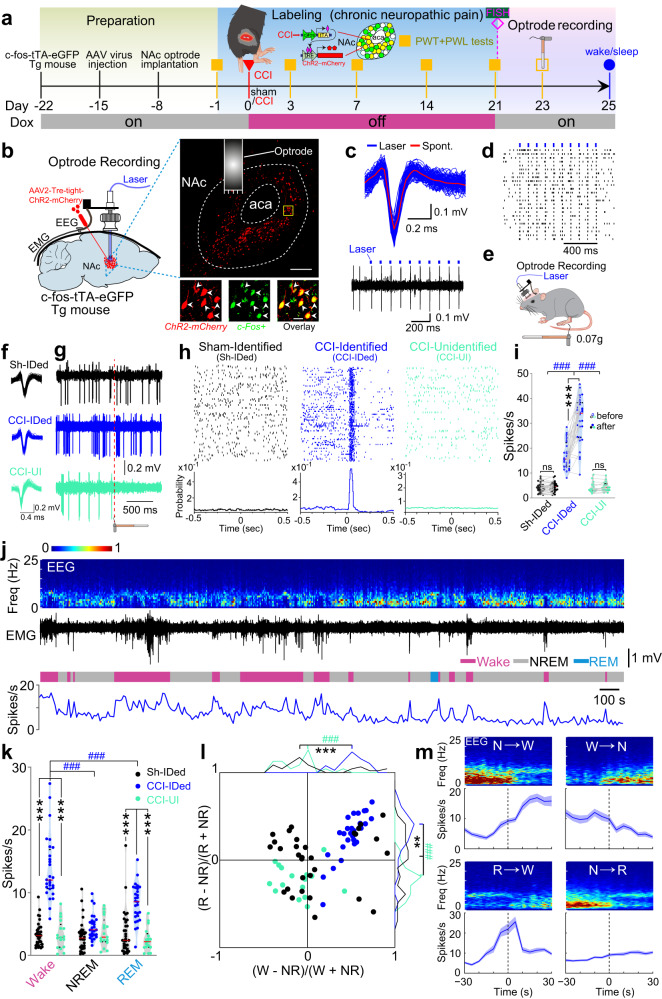
The team labels accumbens cells active over weeks after nerve injury and records identifiable members. Gentle mechanical stimulation evokes withdrawal in injured mice and increased firing in these cells, unlike unidentified cells and sham controls.
The same population fires more during waking, increasing activity on waking from NREM or REM and decreasing on entering sleep. The label captures a population recruited during the injury period whose activity relates to both stimulus responses and vigilance state.
Source: Sun H et al. · Nature communications · CC BY
Original figure and English caption ↗
Increasing ensemble activity shifts both measures
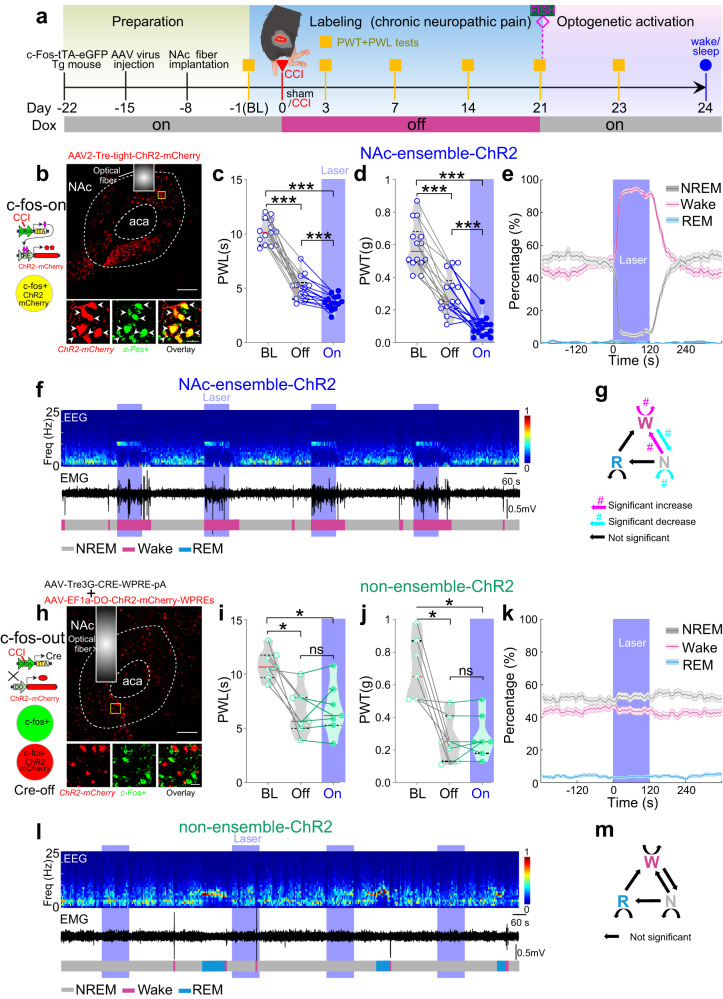
Activating the ensemble lowers mechanical withdrawal thresholds and thermal withdrawal latency in injured mice, shifts NREM toward waking and leaves REM largely unchanged. Sham mice lack the same tested effects, without obvious changes in locomotion or withdrawal movement.
By comparison, activating cells outside the labeled population does not significantly alter vigilance states; nociceptive measures are also similar between stimulation-on and stimulation-off conditions. The functional group is defined by activity during chronic pain rather than recruitment of the entire accumbens.
Source: Sun H et al. · Nature communications · CC BY
Original figure and English caption ↗
A recruitable ensemble persists after inflammation subsides
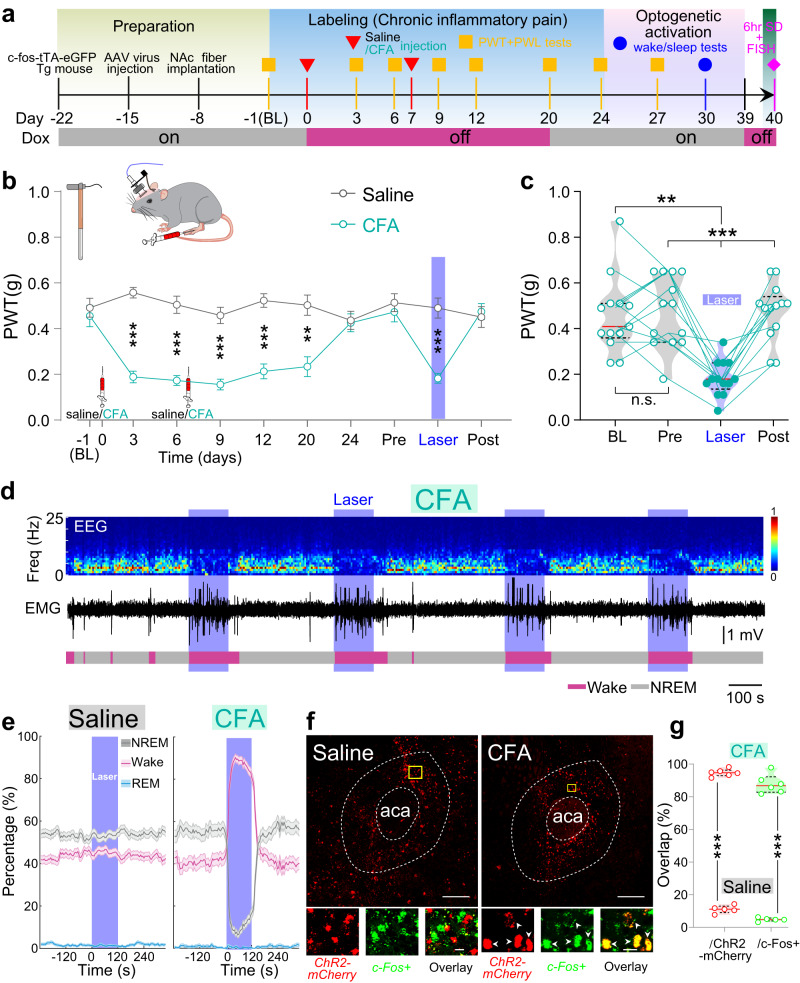
In a chronic inflammatory-pain model, mechanical thresholds first fall and later return to levels similar to saline controls. Activating the previously recruited ensemble then lowers thresholds again, increases waking and reduces NREM without a significant REM change.
Sleep deprivation also recruits most labeled cells and brings renewed mechanical and thermal sensitivity in recovered mice. The population remains available after behavioral recovery, linking an inflammatory history with a later sleep challenge.
Source: Sun H et al. · Nature communications · CC BY
Original figure and English caption ↗
Inhibition shifts NREM and sensitivity in the opposite direction
Inhibiting the ensemble in nerve-injured mice increases mechanical thresholds and thermal withdrawal latency, without significant differences from pre-injury baseline. NREM increases and waking decreases, while REM remains largely unchanged.
Sleep organization also changes: transitions from waking to NREM and persistence of NREM become more likely, while NREM-to-wake transitions decrease. Bidirectional interventions establish a functional contribution beyond the association seen in natural recordings.
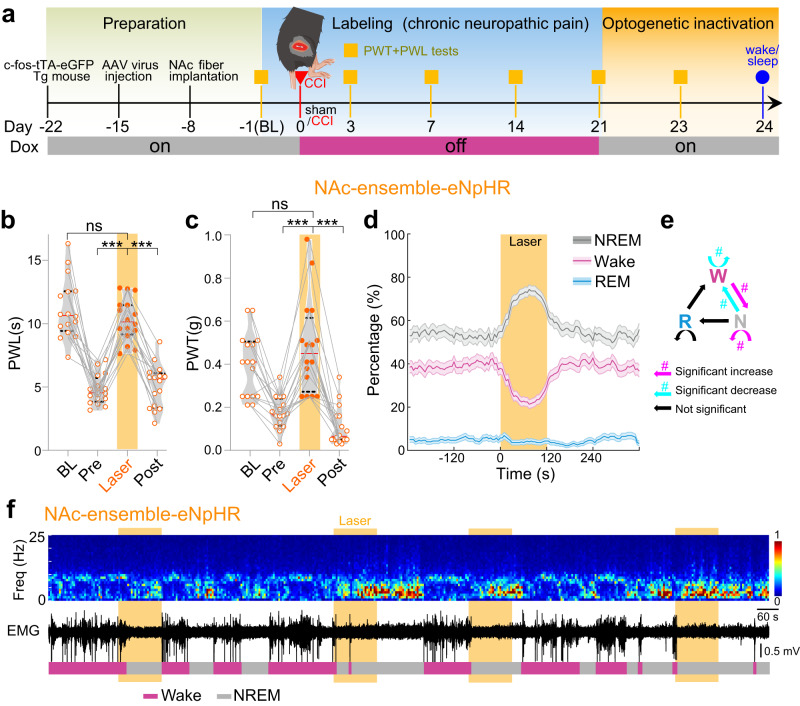
Source: Sun H et al. · Nature communications · CC BY
Original figure and English caption ↗
Mostly D1-expressing, but not exclusively D1
Most ensemble cells express dopamine D1 receptors, with a smaller D2 component. Broader activation of accumbens D1 cells increases mechanical and thermal sensitivity and waking while reducing NREM and REM. D1-cell inhibition improves tested sensitivity and increases NREM.
The D1 population broadly follows the labeled ensemble’s direction, but cell type and active ensemble are different classifications: one follows receptor expression, the other recruitment during chronic pain. D2 results make this distinction especially clear.
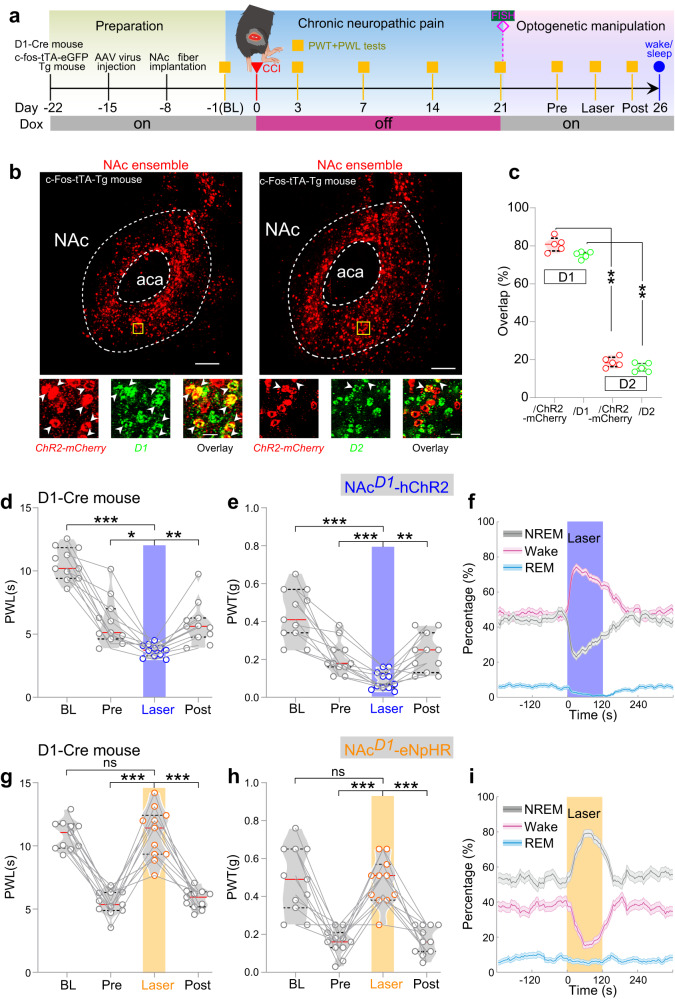
Source: Sun H et al. · Nature communications · CC BY
Original figure and English caption ↗
D2 cells show opposite effects at two population levels
Activating the broader D2 population improves mechanical and thermal withdrawal measures, increases NREM and reduces waking and REM. Activating only the chronic-pain-recruited D2 subset instead increases mechanical and thermal sensitivity and waking, reduces NREM and leaves REM without significant change.
D2 labeling alone therefore does not predict the direction of an effect. A smaller active ensemble can act opposite to a broader population sharing its marker; function depends on both cellular identity and the context of recruitment.
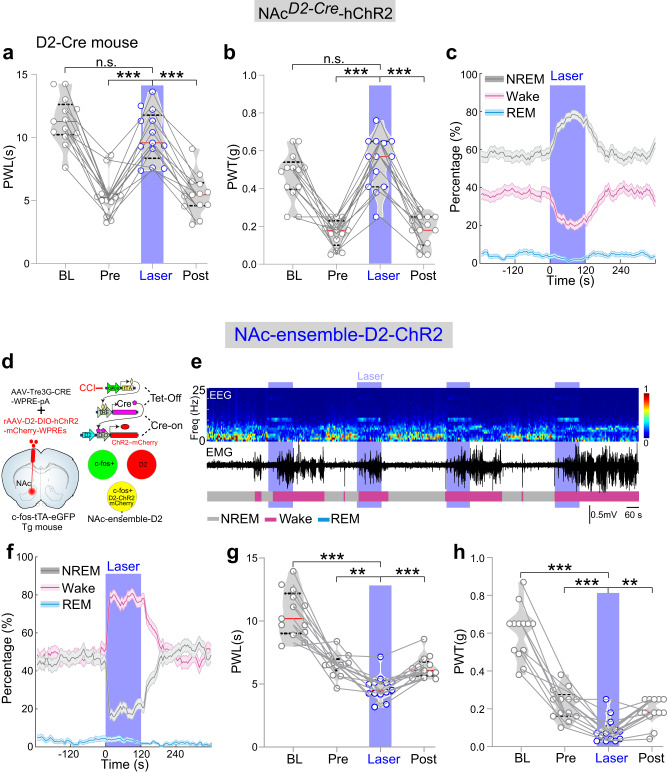
Source: Sun H et al. · Nature communications · CC BY
Original figure and English caption ↗
One upstream ensemble reaches several targets
The ensemble expresses Vgat and sends outputs to preoptic area, POA, ventral tegmental area, VTA, and other regions. Retrograde tracing shows that some cells project to both POA and VTA, rather than forming entirely separate populations.
About a third of the labeled ensemble connects with both targets. Shared upstream cells can carry several branches, motivating tests of whether recipient cells at each destination differently affect nociception and sleep.
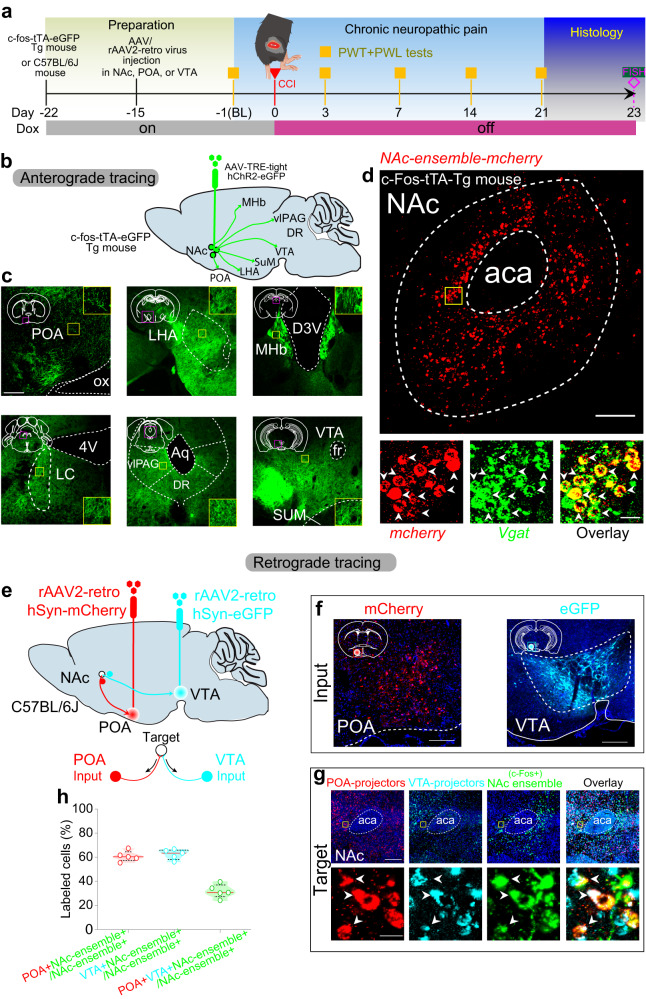
Source: Sun H et al. · Nature communications · CC BY
Original figure and English caption ↗
Recipient cells divide a shared input into distinct effects
Inhibiting POA cells receiving ensemble input reduces NREM and increases waking while mechanical and thermal withdrawal measures remain similar. Inhibiting VTA recipient cells increases sensitivity without significant changes in tested NREM, REM or waking proportions. Recipient location separates the functions.
In the POA experiment, increased waking is not accompanied by further lowering of withdrawal thresholds; VTA inhibition changes nociceptive responses while vigilance proportions remain similar. This dissociation reveals shared upstream involvement alongside distinct downstream regulation. The findings come from adult mice of both sexes in nerve-injury and inflammatory models. Shared upstream cells with distinct downstream contributions support an inhibitory-regulation model, allowing sensitivity and sleep to change together while separating their effects at the recipient-cell level.
Source: Sun H et al. · Nature communications · CC BY
Original figure and English caption ↗