How does the cortex restrain scratching? A descending pathway from anterior cingulate to midbrain
A rat study follows projections from rostral anterior cingulate cortex to the periaqueductal gray, showing how local inhibitory neurons are recruited to suppress itch processing.
Itch provokes a powerful desire to scratch, often escalating into a vicious itch-scratch cycle in chronic dermatological conditions. Within the cerebral cortex, the anterior cingulate cortex (ACC) is a critical hub for sensory and affective processing: while previous studies have shown that the caudal ACC (cACC) facilitates histaminergic and chronic itch, whether and how excitatory pyramidal neurons in the rostral ACC (rACC) exert descending inhibitory control over brainstem itch relays has remained unclear. Published in Cell Reports on December 11, 2024, a study led by Prof. Jian-Feng Sui, Prof. Hong-Li Li, and Assoc. Prof. Guang-Yan Wu at the Army Medical University ("An excitatory neural circuit for descending inhibition of itch processing") combined c-Fos Tet-Off activity tagging, fiber photometry, cell-type-specific rabies virus monosynaptic tracing, optogenetics, and transneuronal WGA-Cre chemogenetics in rats to demonstrate that itch-tagged rACC pyramidal neurons (rACC) send monosynaptic excitatory projections preferentially to periaqueductal gray GABAergic neurons (PAG GABA) to suppress both histaminergic and non-histaminergic itch.
Calcium activity in itch-tagged rACC pyramidal neurons (rACC) decreases during scratching trains in rats; reactivating these neurons or their PAG projections preferentially excites postsynaptic PAG GABA neurons—while suppressing PAG Glu neurons via feedforward inhibition—to potently inhibit scratching behavior across pruritogen models.
Contents · 6 sections
Itch-Tagged rACC Pyramidal Neurons Exhibit Scratching-Locked Decreases in Calcium Activity
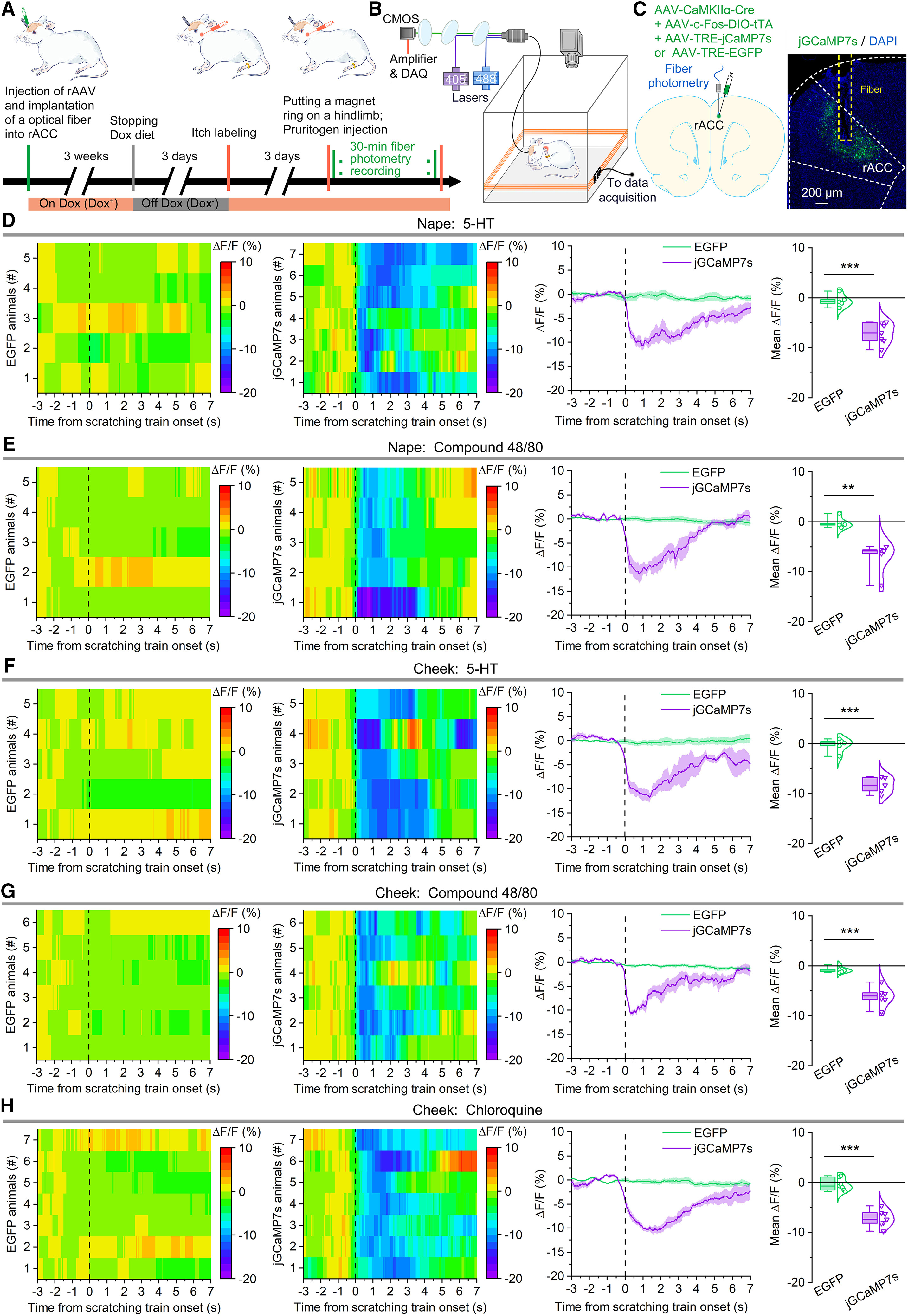
After finding that global rACC pyramidal neurons (rACC) show decreased calcium activity during scratching and bidirectionally suppress or promote scratching upon chemogenetic/optogenetic activation or inhibition without altering balance beam, open field, or rotarod motor performance (Figures S2–S7), the authors selectively targeted the itch-responsive rACC ensemble using a c-Fos Tet-Off system in rats.
By co-injecting rAAV2/9-CaMKIIα-Cre, rAAV2/9-c-Fos-DIO-tTA, and rAAV2/9-PTRE-tight-jGCaMP7s into the rACC and removing doxycycline (Off Dox) for 3 days prior to intradermal cheek 5-HT injection, the team labeled itch-responsive rACC neurons with jGCaMP7s. Fiber photometry revealed that calcium signals (ΔF/F) in itch-tagged rACC neurons dropped significantly during scratching trains evoked by nape injection of 5-HT or compound 48/80, as well as cheek injection of 5-HT, compound 48/80, or chloroquine.
Source: Guang-Yan Wu et al. · Cell Reports · © Elsevier Inc.
Original figure and English caption ↗
Chemogenetic Reactivation of Itch-Tagged rACC Neurons Potently Suppresses Histaminergic and Non-histaminergic Itch
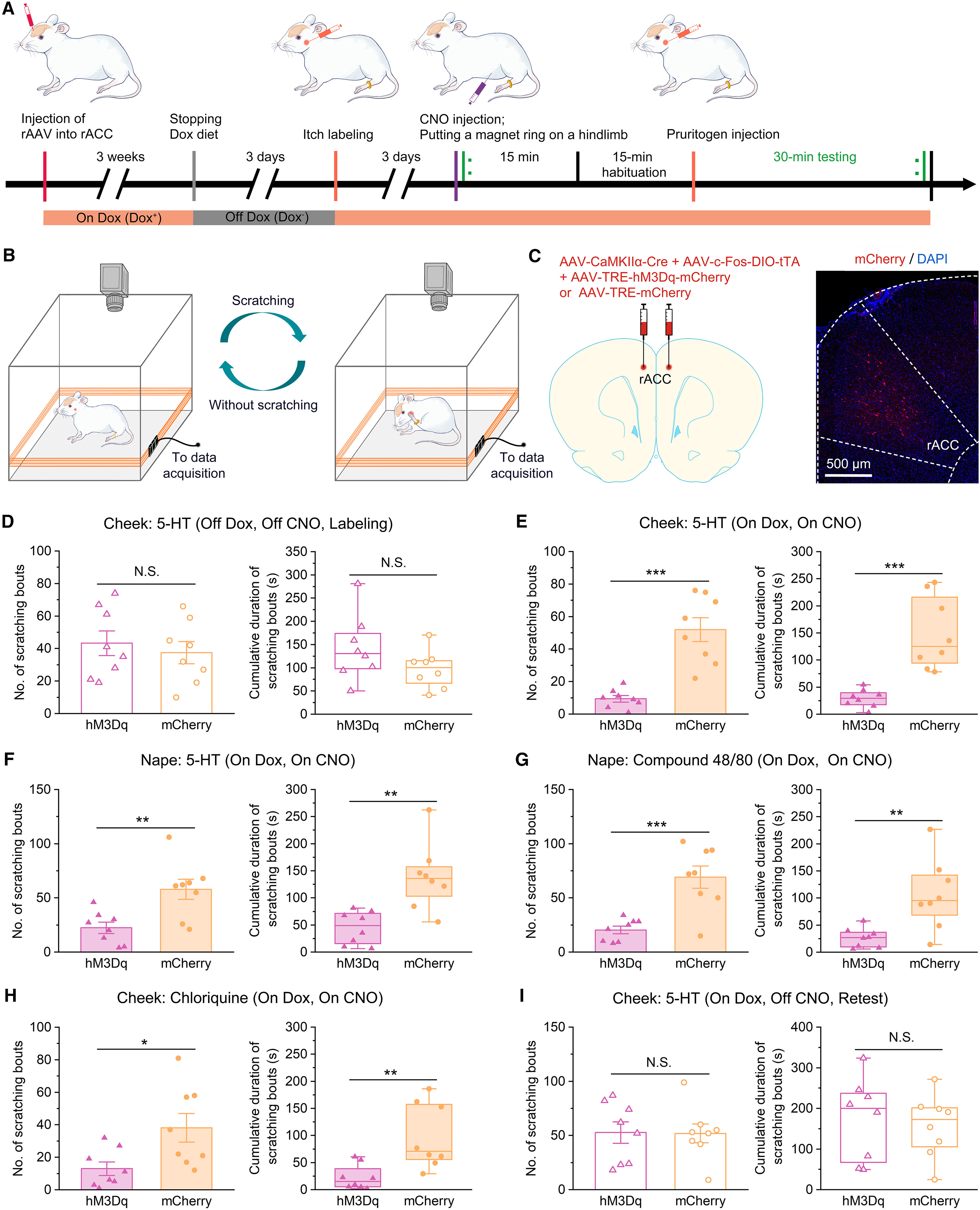
Using the c-Fos Tet-Off strategy to express hM3Dq-mCherry or hM4Di-mCherry in 5-HT-activated rACC neurons, the authors tested whether manipulating this specific cortical ensemble gates itch behavior. Systemic CNO administration to reactivate itch-tagged rACC neurons significantly reduced both scratching bouts and cumulative scratching duration evoked by cheek 5-HT, nape 5-HT, nape compound 48/80, and cheek chloroquine, whereas no differences occurred in the absence of CNO.
Conversely, chemogenetic inhibition (hM4Di + CNO) of itch-tagged rACC neurons significantly increased scratching bouts and duration across all tested pruritogens (Figure S8), confirming that itch-tagged rACC neurons exert broad inhibitory control over acute itch processing.
Source: Guang-Yan Wu et al. · Cell Reports · © Elsevier Inc.
Original figure and English caption ↗
Layer 5 rACC Pyramidal Neurons Project Densely to the PAG and Are Recruited by Pruritogenic Stimuli
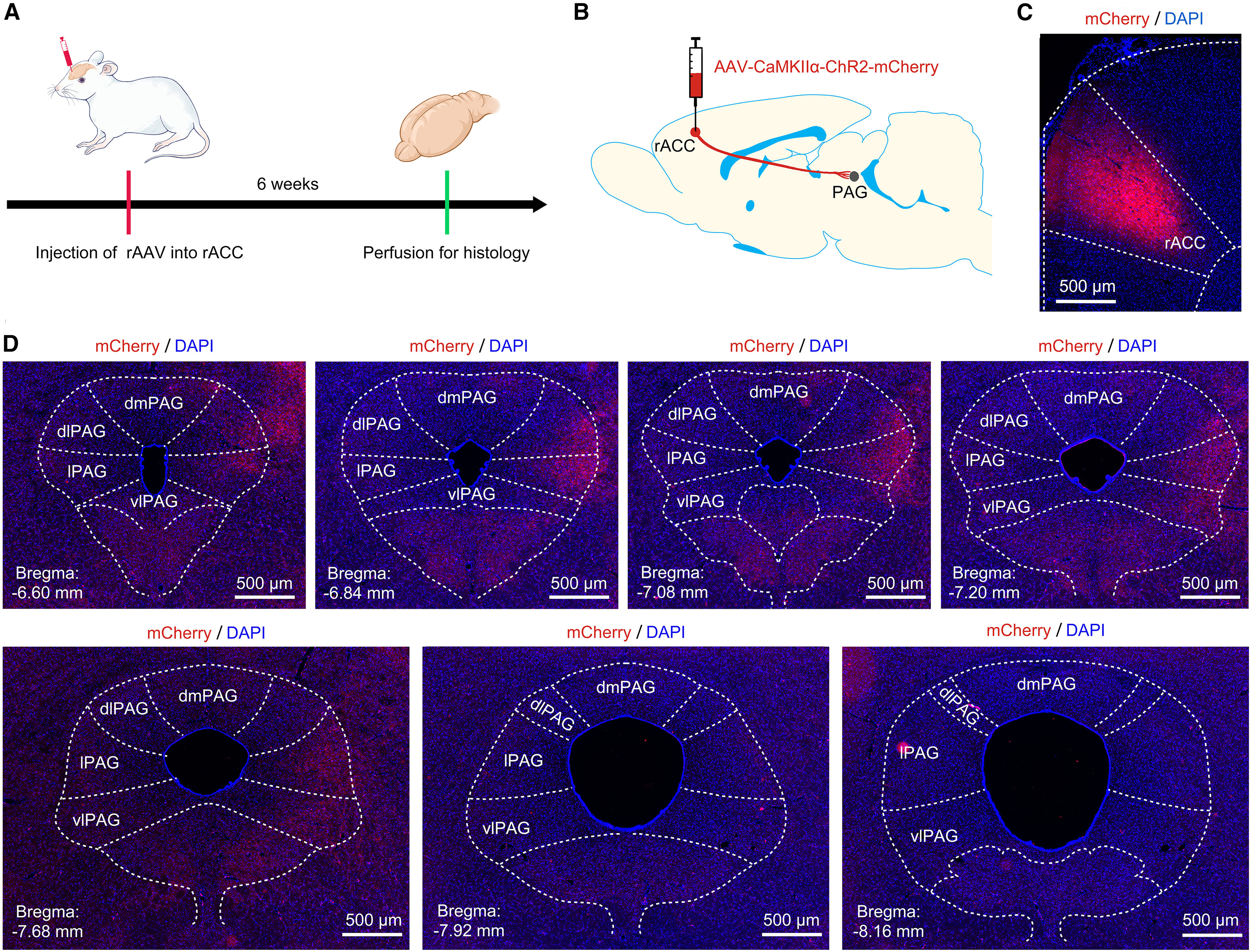
Anterograde tracing with rAAV2/9-CaMKIIα-ChR2-mCherry in the rACC revealed dense mCherry-positive axonal arborizations throughout rostral-to-caudal coronal levels of the periaqueductal gray (PAG). Retrograde CTB-555 injection into the PAG labeled layer 5 rACC neurons that colocalized with CaMKIIα rather than GAD67 (Figure S9) and exhibited elevated c-Fos colocalization following itch stimulation (Figure S10).
Projection-specific chemogenetic activation of PAG-projecting rACC neurons significantly suppressed scratching evoked by 5-HT, compound 48/80, and chloroquine, whereas chemogenetic inhibition of this pathway facilitated scratching (Figures S11–S12).
Source: Guang-Yan Wu et al. · Cell Reports · © Elsevier Inc.
Original figure and English caption ↗
Selective Reactivation of Itch-Tagged PAG-Projecting rACC Neurons Suppresses Scratching
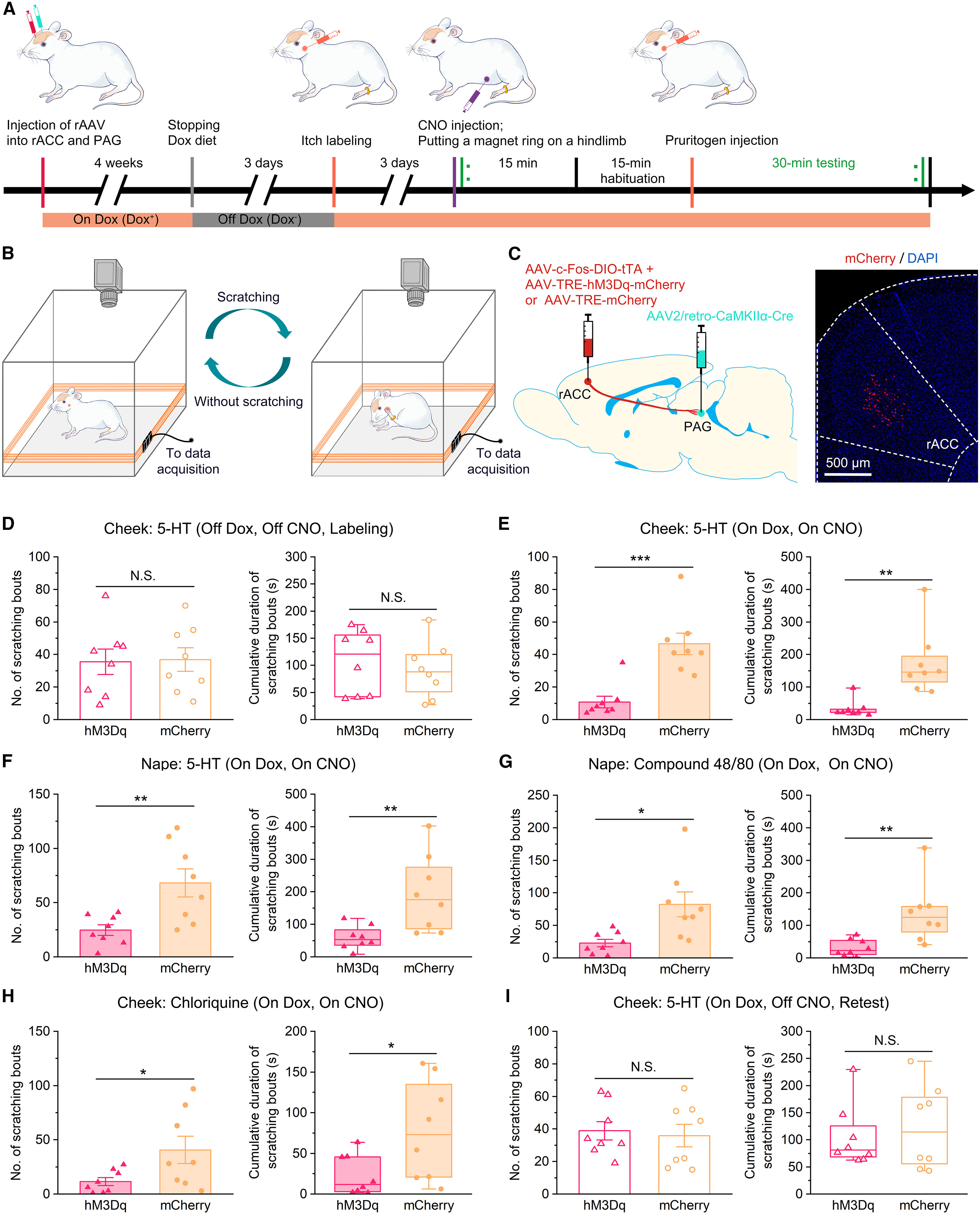
To selectively manipulate itch-responsive rACC neurons that project to the PAG, the authors injected retrograde rAAV2-retro-CaMKIIα-Cre into the bilateral PAG and Cre-dependent rAAV2/9-c-Fos-DIO-tTA plus rAAV2/9-PTRE-tight-hM3Dq-mCherry (or hM4Di-mCherry) into the bilateral rACC.
Chemogenetic reactivation of itch-tagged PAG-projecting rACC neurons significantly suppressed scratching bouts and cumulative duration induced by 5-HT, chloroquine, and compound 48/80 (with no effect in the absence of CNO), whereas chemogenetic inhibition of this projection-specific ensemble markedly increased scratching responses (Figure S13).
Source: Guang-Yan Wu et al. · Cell Reports · © Elsevier Inc.
Original figure and English caption ↗
Itch-Activated rACC Neurons Form Monosynaptic Projections Preferentially Onto PAG GABAergic Neurons
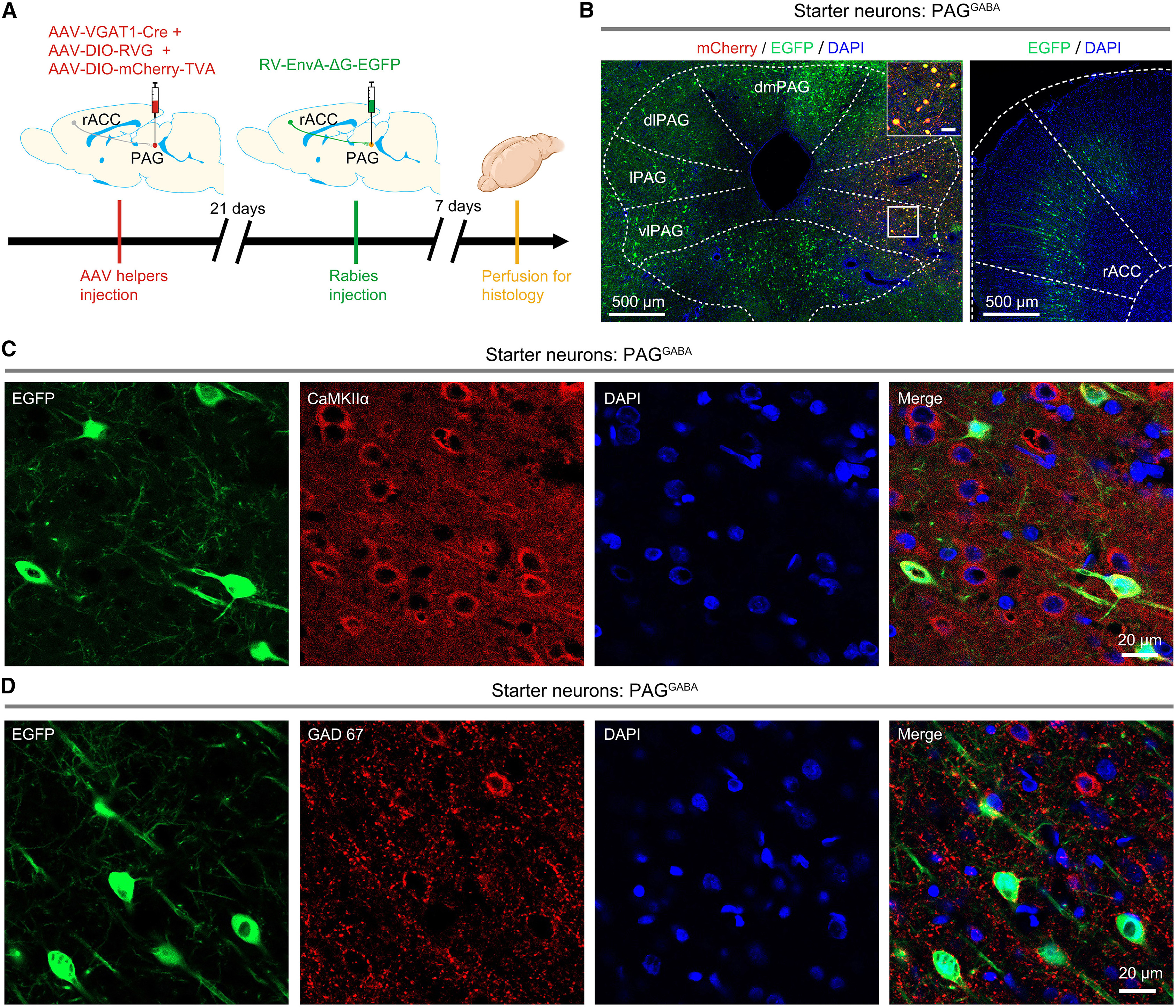
Because PAG GABAergic neurons (PAG GABA) inhibit itch whereas PAG glutamatergic neurons (PAG Glu) facilitate itch, the authors mapped cell-type-specific monosynaptic connectivity using EnvA-pseudotyped rabies virus (RV-EnvA-ΔG-EGFP) in the PAG driven by either rAAV2/9-VGAT1-Cre or rAAV2/9-VGLUT2-Cre.
Both PAG GABA and PAG Glu starter neurons received direct monosynaptic inputs from CaMKIIα+ (and GAD67-negative) pyramidal neurons in the rACC. Crucially, following itch stimulation, a significantly higher percentage of c-Fos/EGFP double-positive rACC neurons was traced from PAG GABA starter neurons than from PAG Glu starter neurons (Figure S15), demonstrating preferential innervation of inhibitory PAG GABA neurons by itch-activated rACC neurons.
Source: Guang-Yan Wu et al. · Cell Reports · © Elsevier Inc.
Original figure and English caption ↗
Optogenetic Stimulation of Itch-Tagged rACC Neurons Excites PAG GABA and Suppresses PAG Glu Neurons to Inhibit Itch
Combining optogenetic stimulation (10 Hz and 20 Hz blue light) of ChR2-expressing itch-tagged rACC neurons with fiber photometry in the PAG revealed a dual microcircuit effect: optical activation of itch-tagged rACC neurons robustly increased jGCaMP7s calcium signals in PAG GABA neurons (Figure 6) while decreasing calcium signals in PAG Glu neurons via local feedforward inhibition (Figure S16).
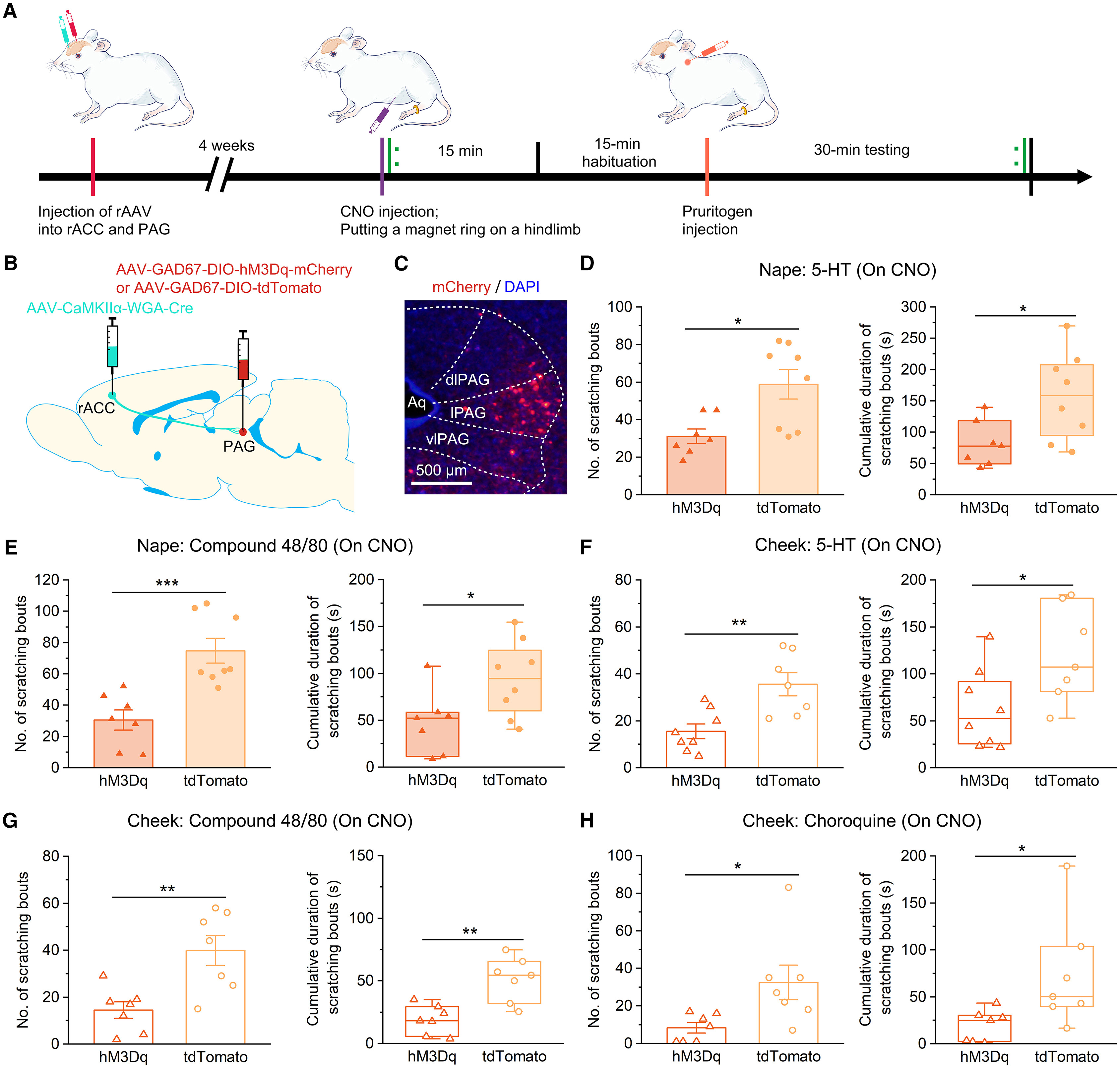
Finally, injecting anterograde transneuronal rAAV2/9-CaMKIIα-WGA-Cre into the bilateral rACC and Cre-dependent rAAV2/9-GAD67-DIO-hM3Dq-mCherry (or hM4Di) into the PAG demonstrated that selectively activating rACC-innervated PAG GABA neurons potently suppressed scratching bouts and duration evoked by nape and cheek 5-HT, compound 48/80, and chloroquine (Figure 7), whereas inhibiting them exacerbated scratching (Figure S17).
Source: Guang-Yan Wu et al. · Cell Reports · © Elsevier Inc.
Original figure and English caption ↗