A brainstem inhibitory pathway regulates sensitivity after hormone withdrawal
A female mouse study finds weaker dorsal-raphe GABA-cell responses after ovarian hormone withdrawal. Activating these cells and their parabrachial output raises mechanical withdrawal thresholds.
How do changes in the hormonal environment affect sensory regulation in the brain? A study published online in PAIN in 2024 identifies weaker responses in dorsal-raphe, DRN, GABAergic neurons in female mice after ovarian hormone withdrawal. The region is often studied for its serotonin cells, but GABA cells also send outputs elsewhere. The team connects cellular activity, estradiol effects and lateral parabrachial nucleus, LPBN, input to examine mechanical sensitivity.
DRN GABA cells and their LPBN output regulate mechanical sensitivity. Hormone withdrawal lowers cellular excitability, activation improves sensitivity, and local estradiol increases excitability and measured thresholds.
Contents · 6 sections
Changes concentrate in mechanical responses
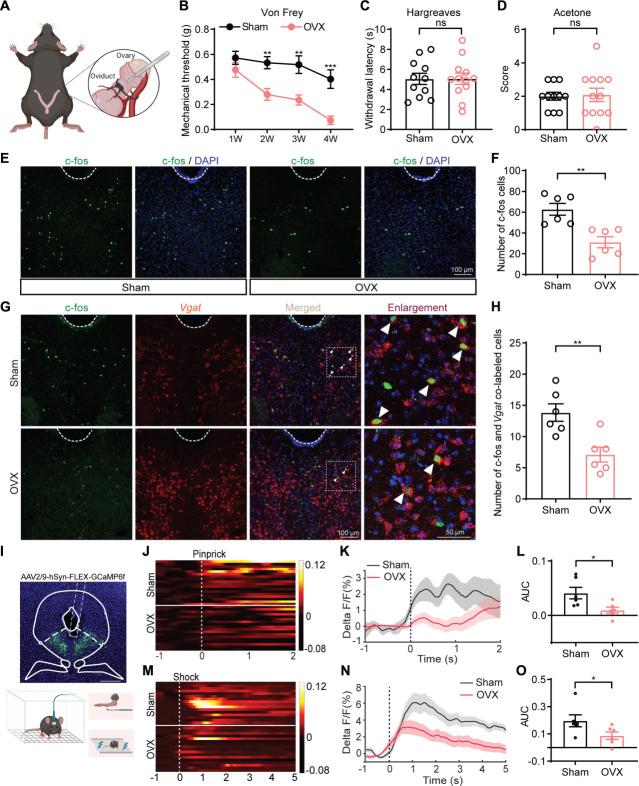
In the ovarian hormone-withdrawal model, mice withdraw their hind paw more readily from mechanical stimulation, while thermal and cold responses remain largely similar. Tested anxiety-like behaviors in the open field, maze and light–dark box also do not clearly change. Sensitivity changes selectively across modalities.
After mechanical stimulation, activity labeling in DRN decreases. The reduction is also present in GABA cells, and their population calcium responses to noxious stimuli are weaker than controls. Greater measured sensitivity accompanies reduced responses in this population.
DRN contains multiple cell types. Most activity labeling in this study does not fall on serotonin cells, while GABA-cell response changes are prominent. This narrows attention to a population rather than explaining behavior from whole-region activity alone.
Source: Wu H et al. · Pain · CC BY-NC-ND
Original figure and English caption ↗
The inhibitory cells become harder to recruit
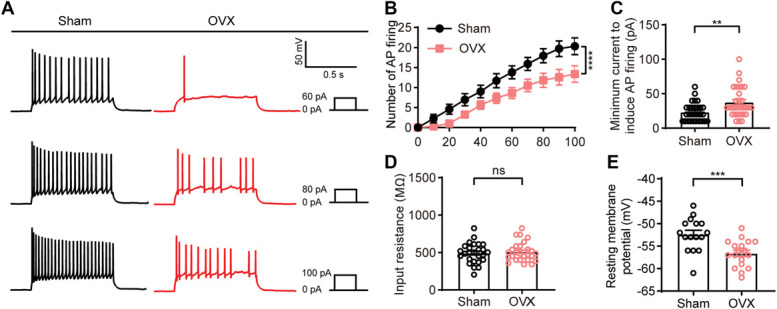
Slice recordings show fewer spikes, a greater drive required to start firing, and a more negative resting potential in DRN GABA cells after hormone withdrawal. Their intrinsic excitability changes alongside smaller stimulus-related responses.
Miniature excitatory and inhibitory current amplitudes and frequencies remain largely similar, as does input resistance. Relative to those tested synaptic inputs, the cells’ conversion of input into firing shows a more prominent difference.
Source: Wu H et al. · Pain · CC BY-NC-ND
Original figure and English caption ↗
Estradiol and progesterone have different effects
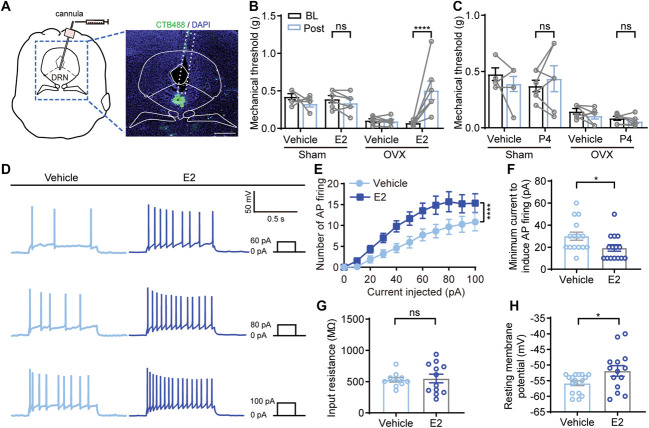
In this study, systemic estradiol also alleviates mechanical sensitivity in the model. Local DRN estradiol raises mechanical thresholds in hormone-withdrawn mice without a comparable clear change in controls. Progesterone does not significantly alter thresholds in either group. Different ovarian hormones therefore have different effects under these tested conditions.
Estradiol also increases firing in DRN GABA cells from the withdrawal model, lowers the drive needed for spiking and shifts resting potential toward greater excitability. Input resistance remains similar. Behavioral improvement and increased cellular excitability accompany the same type of intervention.
Source: Wu H et al. · Pain · CC BY-NC-ND
Original figure and English caption ↗
Activity changes shift behavior in opposite directions
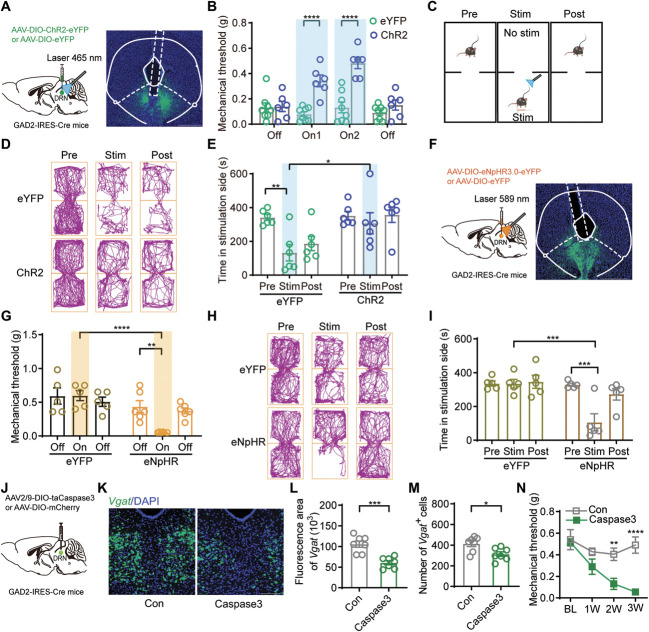
Activating DRN GABA cells raises mechanical thresholds in hormone-withdrawn mice. Even in a location paired with mechanical stimulation, mice spend more time on the side where the cells are also activated. Place choice and threshold changes together support reduced sensitivity and associated aversion.
Suppressing the population in control mice lowers mechanical thresholds. Suppression alone does not produce clear place preference or aversion, but pairing it with initially innocuous touch reduces time on that side. Lower cellular activity changes the behavioral consequence of a tactile context.
A second inhibitory approach produces threshold changes in the same direction, and longer-term reduction of the population also increases mechanical sensitivity. Short-term activity modulation and cell reduction converge on a contribution to mechanical sensory regulation.
Source: Wu H et al. · Pain · CC BY-NC-ND
Original figure and English caption ↗
GABA output reaches lateral parabrachial nucleus
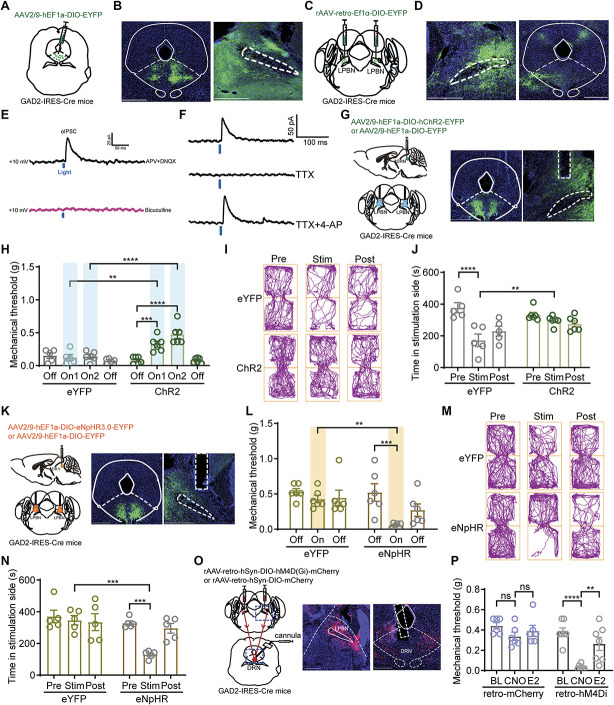
The population’s influence extends beyond DRN. Tracing identifies projections to LPBN, where terminal recruitment evokes direct inhibitory synaptic currents in slices. Recorded connections are more common in excitatory cells and also occur in a subset of inhibitory cells.
Increasing this long-range output raises mechanical thresholds in hormone-withdrawn mice and increases time in a place paired with activation and mechanical stimulation. Reducing output lowers thresholds, and pairing suppression with touch induces avoidance in controls. Population and terminal interventions produce converging behavioral results.
Source: Wu H et al. · Pain · CC BY-NC-ND
Original figure and English caption ↗
Connecting hormonal change with cells and circuitry
Reducing activity in LPBN-projecting DRN GABA cells produces mechanical sensitivity in control mice, and local estradiol eases that change. Most DRN GABA cells express estrogen-receptor-alpha transcripts, providing a possible cellular link for hormonal modulation.
This adult female mouse study connects mechanical sensitivity after ovarian hormone withdrawal with brainstem inhibitory-cell activity and long-range output. Activating inhibitory cells can reduce measured sensitivity, with their output destination central to the account. How hormones change particular ion channels and firing capacity remains unresolved.