Why do two outputs from the subiculum affect seizures in opposite ways?
In mice, suppressing subicular input to anterior thalamus reduces hippocampal seizures, while suppressing input to entorhinal cortex can worsen them. Location, terminal activity and HCN-related bursting distinguish the populations.
Do excitatory cells in one region all push seizures in the same direction? A study published in Nature Communications on August 25, 2022 finds a counterintuitive answer in the subiculum, SUB, a major hippocampal output region. Suppressing one pyramidal-cell output, toward anterior thalamus, ANT, eases seizures; suppressing another, toward entorhinal cortex, EC, worsens them. Mouse kindling and chronic-seizure experiments examine the populations’ locations, activity and ion-channel properties, showing why a region-wide intervention does not capture every circuit contribution.
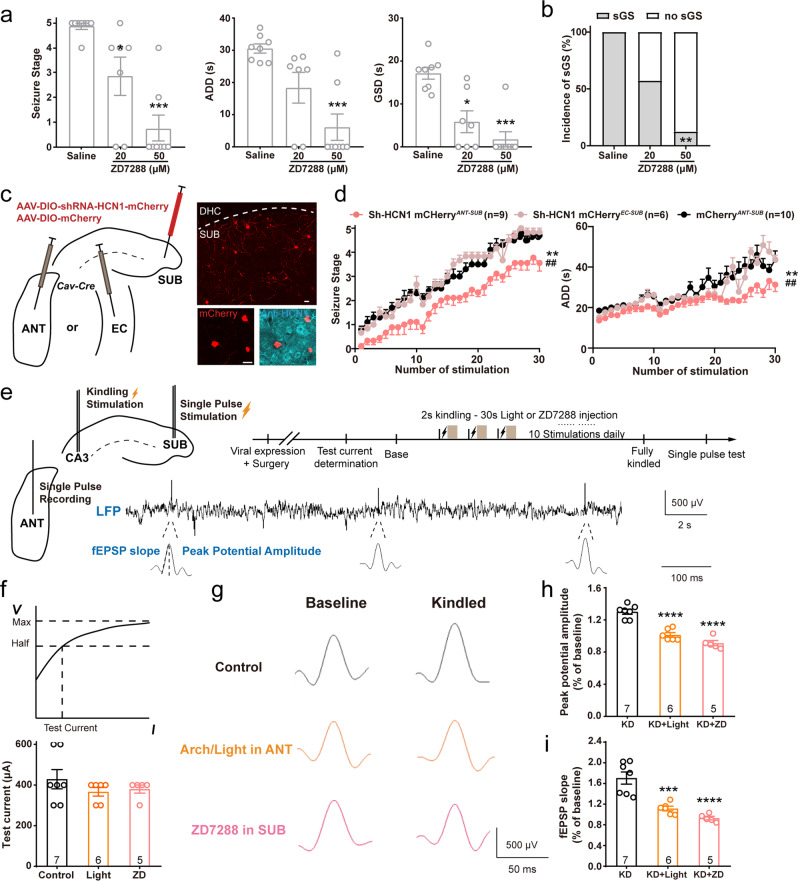
Suppressing SUB-to-ANT and SUB-to-EC inputs produces opposite outcomes. ANT-projecting cells lie predominantly deeper and show stronger HCN-related bursting. Reducing HCN1 in this population slows kindling development, while the corresponding EC-projecting intervention has no significant effect.
Contents · 6 sections
Higher regional activity masks internal differences
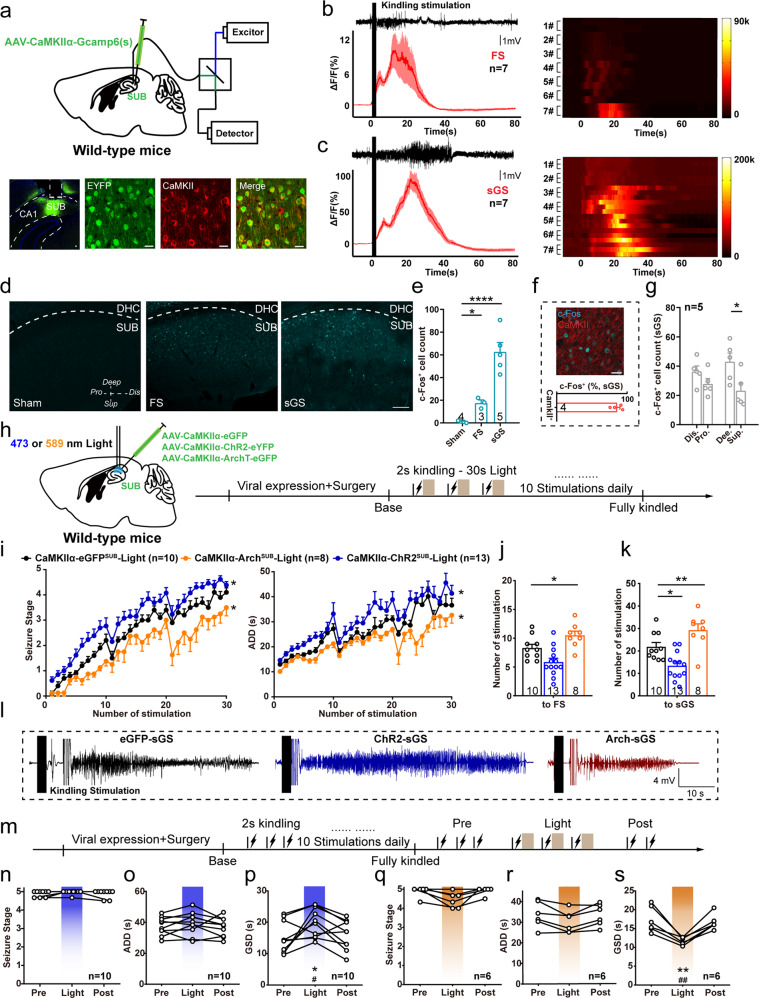
Subicular pyramidal-population calcium rises during focal and secondarily generalized kindling seizures, with larger increases during generalization. Slower c-Fos labeling also reveals stronger deep-layer recruitment after generalization than in superficial cells.
Increasing activity across a broader pyramidal population accelerates kindling, while suppression slows it. In fully kindled mice, broad activation mainly prolongs generalized-seizure duration without significantly changing seizure stage or after-discharge duration. Effects already differ by phase and outcome.
Kindling development and seizure expression after full kindling are distinct processes. The former follows increasing susceptibility to severe seizures, while the latter examines the severity and duration of established events. An input can be tested separately in each phase.
Source: Fei F et al. · Nature communications · CC BY
Original figure and English caption ↗
Anterior-thalamic output contributes to amplification
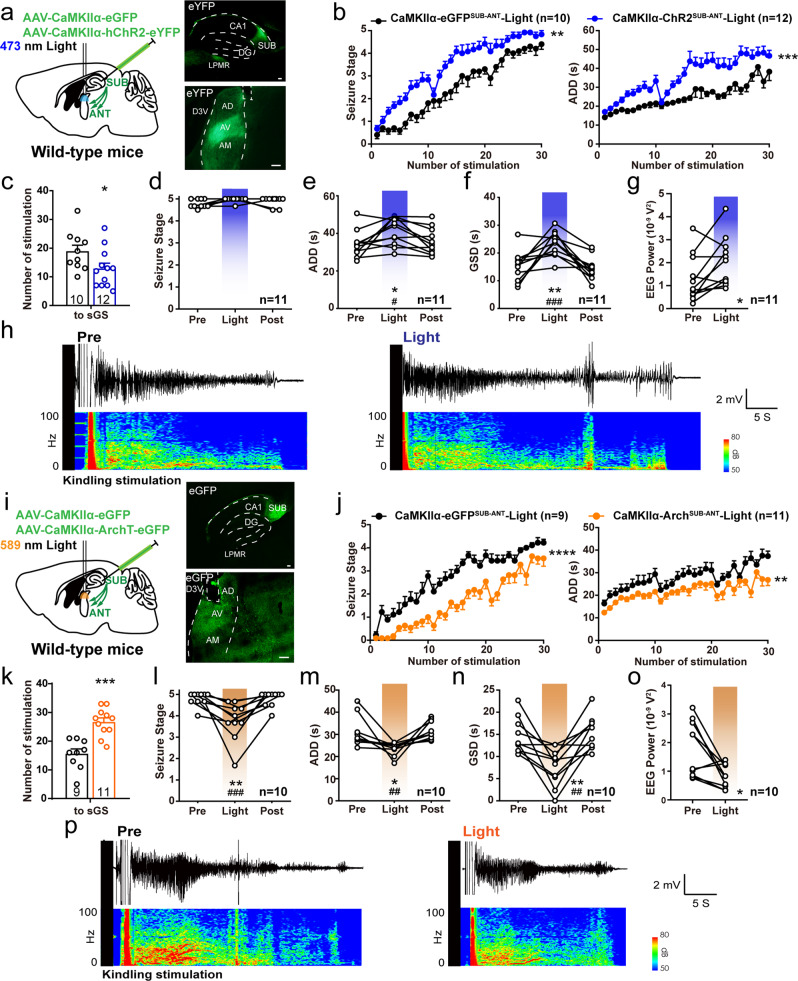
ANT is one of the subicular output targets. Activating subicular terminals there accelerates kindling and, after full kindling, prolongs after-discharges and generalized seizures while increasing absolute hippocampal EEG power.
Suppressing the same terminals slows kindling and reduces seizure stage, durations and EEG power after full kindling. The excitatory output acts as an amplification component, with enhancement and suppression producing opposing effects.
Source: Fei F et al. · Nature communications · CC BY
Original figure and English caption ↗
Entorhinal-output suppression produces the opposite result
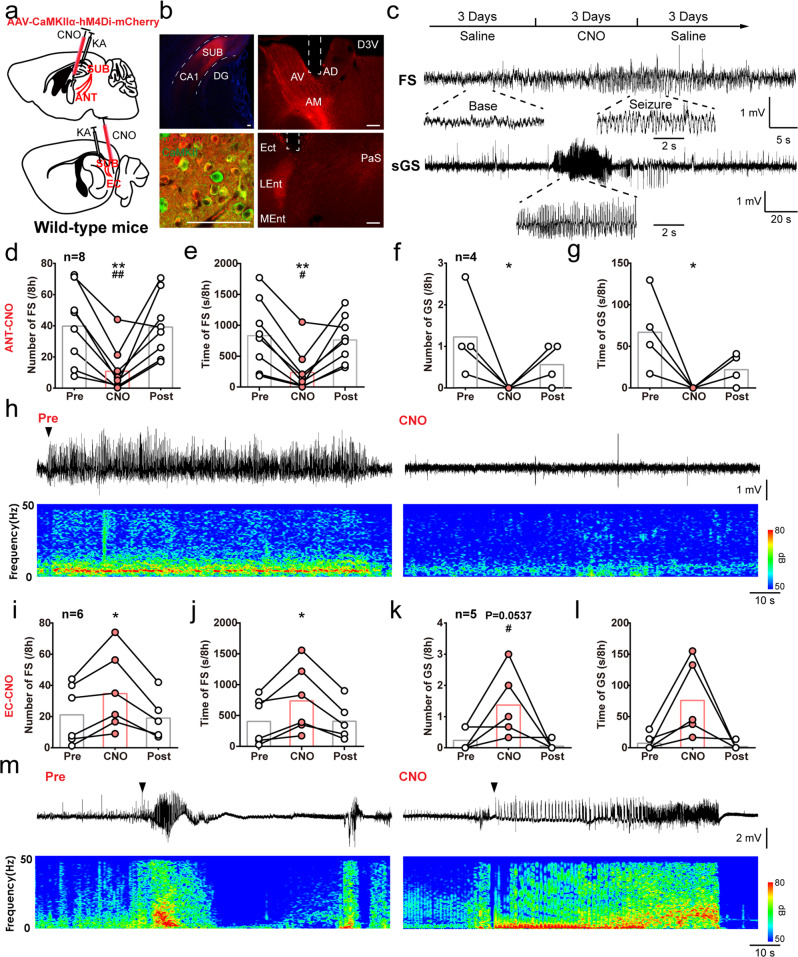
Suppressing subicular EC terminals accelerates kindling and prolongs after-discharges and generalized seizures after establishment. Suppressing terminals in mammillary bodies or accumbens has no significant effect on measured kindling development. Subicular outputs are not interchangeable routes.
In the chronic kainate model, ANT-terminal suppression reduces focal and generalized seizures. EC-terminal suppression increases focal-seizure counts and total duration; generalized-seizure counts trend upward relative to pre-intervention without significance. The models support route-dependent effects alongside outcome-specific differences.
Source: Fei F et al. · Nature communications · CC BY
Original figure and English caption ↗
Different depths accompany different terminal dynamics
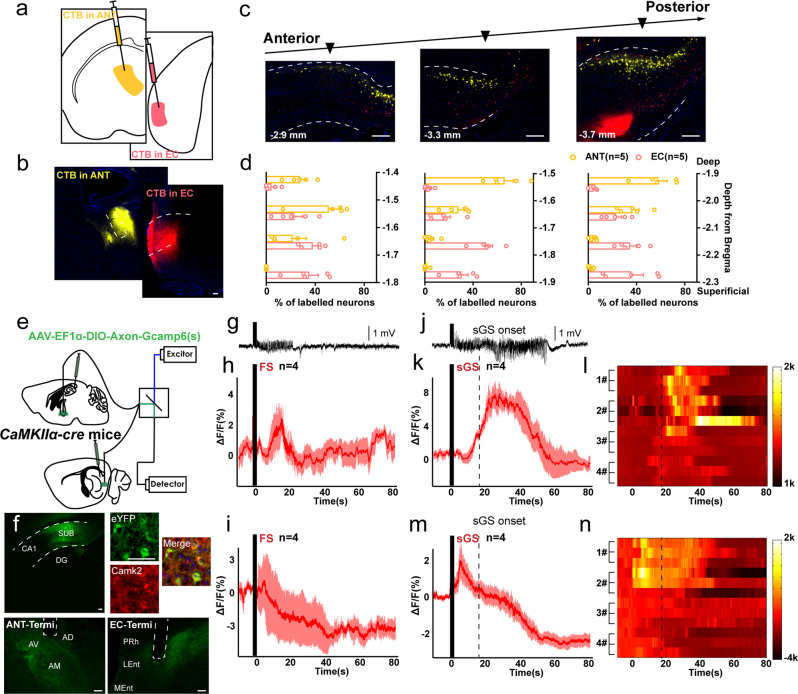
Retrograde tracing places ANT-projecting cells predominantly deep and EC-projecting cells more superficially, with pronounced spatial separation. Focusing on defined outputs rather than the whole region reveals structural differences.
Terminal calcium rises in ANT but falls in EC during focal seizures. During generalization, ANT shows a delayed rise, while EC briefly increases and then falls, sometimes remaining low beyond seizure termination. Excitatory identity does not produce synchronized dynamics across outputs.
Source: Fei F et al. · Nature communications · CC BY
Original figure and English caption ↗
Similar average firing can conceal different bursting
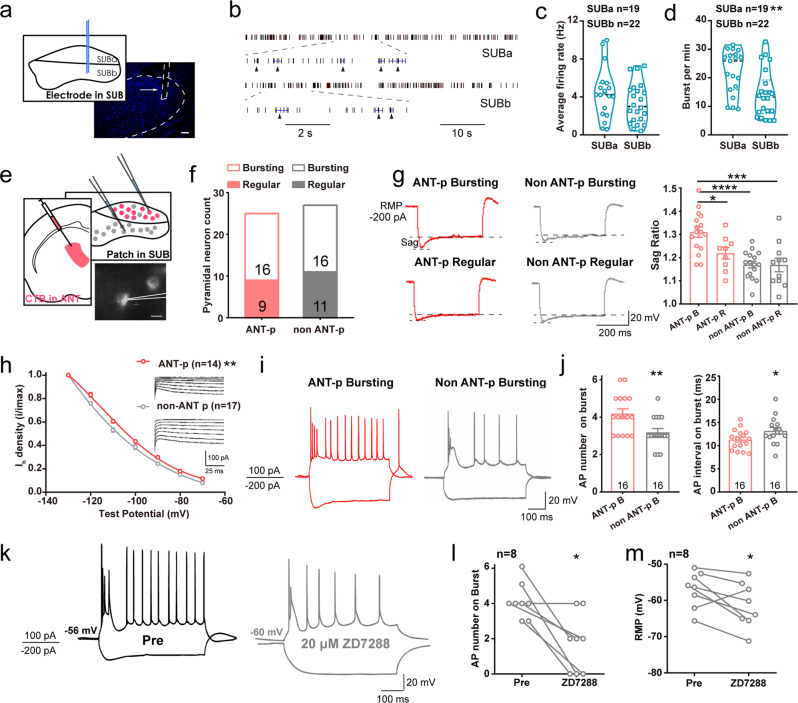
Units recorded in deep and superficial regions have similar average firing rates, while deep units burst more often. Identified ANT-projecting cells in slices include stronger bursters with more action potentials and shorter intervals per burst.
The differences involve hyperpolarization-activated current, Ih, and HCN channels. Stronger channel-related responses accompany denser bursting, which pharmacological blockade weakens. The distinction concerns how spikes cluster as well as how many occur, adding a cellular explanation for output-specific effects.
Other currents also influence bursting. Supplementary experiments implicate T-type calcium channels in burst and seizure measures. Dense firing emerges from multiple cellular mechanisms, with projection identity locating their contribution within a network.
Source: Fei F et al. · Nature communications · CC BY
Original figure and English caption ↗
Projection-specific intervention resolves a broader target
Reducing HCN1 in ANT-projecting subicular cells slows kindling, while the corresponding EC-projecting intervention has no significant effect. Fully kindled mice also show stronger SUB-to-ANT evoked field responses; input suppression or subicular HCN-related blockade during kindling weakens this enhancement.
The findings connect projection identity, bursting and transmission changes. In mainly adult male mice, one excitatory region contains outputs with opposing contributions. Whether EC input limits seizures through feedback inhibition remains an unresolved proposal; output diversity already changes how regional activity is interpreted.
Source: Fei F et al. · Nature communications · CC BY
Original figure and English caption ↗