Which circuit supports continued cocaine taking despite adverse consequences?
In rats, punishment-resistant cocaine taking is associated with anterior-insula hyperactivity. Anterior-insula cells receiving orbitofrontal input provide a population-level point for regulating this behavior.
When obtaining a reward carries a cost, some individuals stop while others continue. A rat study published in Science Advances on December 23, 2022 examines this difference when cocaine taking has adverse consequences. It connects anterior insula (aIC) activity, stronger orbitofrontal cortex (OFC) input-related transmission and the function of recipient aIC cells. The focus is persistent behavior in a defined setting, distinct from the initial reward produced by a drug.
Punishment-resistant rats show increased aIC activity and stronger OFC-input-related transmission. Suppressing aIC or its OFC-input-associated recipient population reduces resistant taking, while activation promotes continued taking under the tested conditions.
Contents · 7 sections
Differences emerge when a cost is introduced
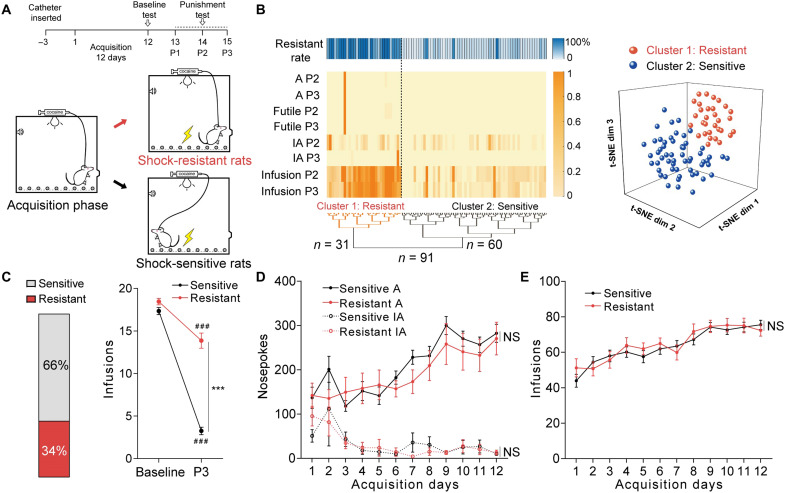
Before punishment, later-resistant and sensitive rats show similar cocaine-taking behavior. Once taking carries an adverse consequence, about one third are classified as resistant, while the others reduce taking more strongly. Resistant rats also reduce intake from baseline, but less markedly.
Prior intake, effort-related responding, extinction and cue-related reinstatement do not differ significantly between groups, and hotplate thresholds are similar. These comparisons focus attention on adjustment to adverse consequences rather than simply a higher earlier intake.
Source: Chen Y et al. · Science advances · CC BY-NC
Original figure and English caption ↗
Anterior-insula activity accompanies continued taking
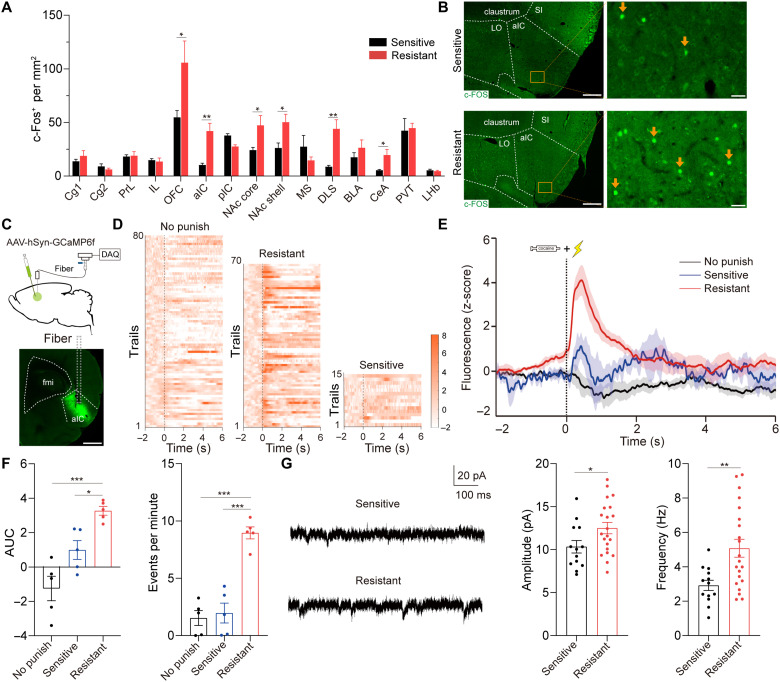
Resistant rats show more c-Fos labeling in aIC, with increases in OFC and several other regions, while the posterior-insula comparison is nonsignificant. Its activity change and links with bodily signals, motivation and behavioral adjustment direct attention to aIC.
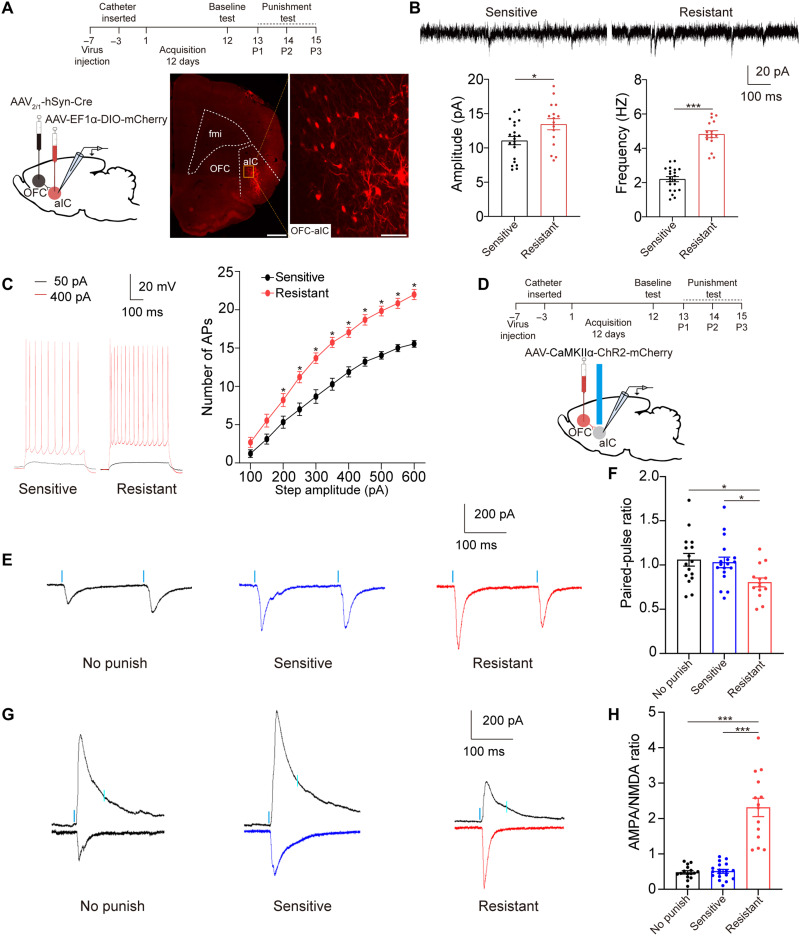
During continued taking despite adverse consequences, resistant rats have larger aIC calcium responses than sensitive and unpunished groups. Their aIC cells also show more frequent and larger spontaneous excitatory currents. Population dynamics and cellular inputs both indicate greater activity.
Source: Chen Y et al. · Science advances · CC BY-NC
Original figure and English caption ↗
Reducing aIC activity reduces resistant taking
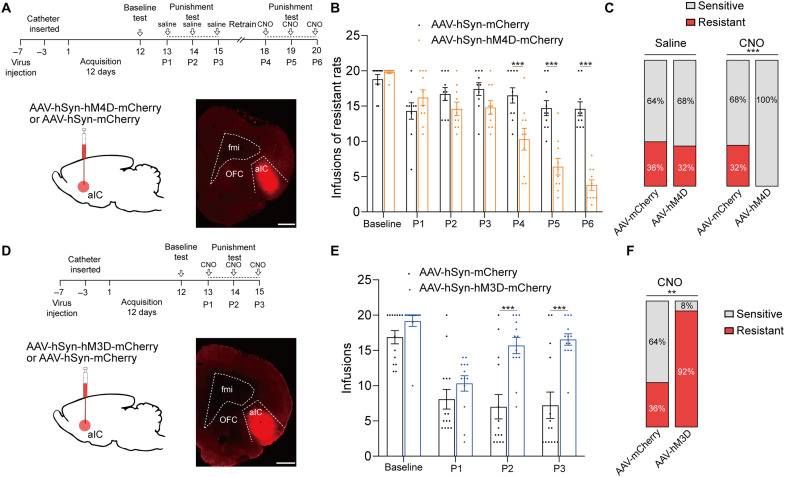
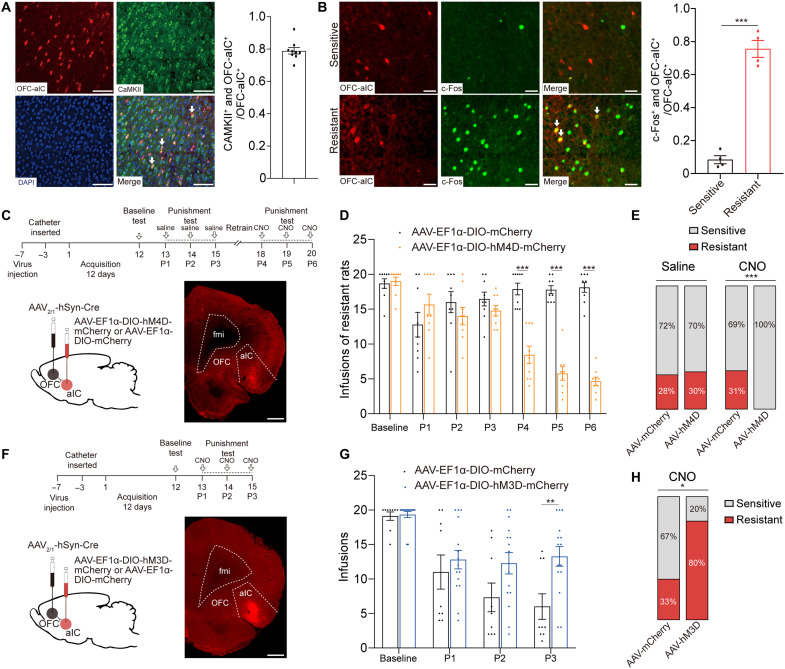
Suppressing aIC activity reduces later taking in previously resistant rats, which shift into the punishment-sensitive category. Taking in already-sensitive rats does not change significantly, nor do the corresponding locomotor or hotplate-threshold measures.
Increasing aIC activity instead makes more rats continue taking under the tested conditions. The bidirectional results support a functional contribution beyond passive tracking. The classification changes concern the intervention setting, leaving longer-term outcomes unresolved.
Source: Chen Y et al. · Science advances · CC BY-NC
Original figure and English caption ↗
An excitatory-associated population contributes
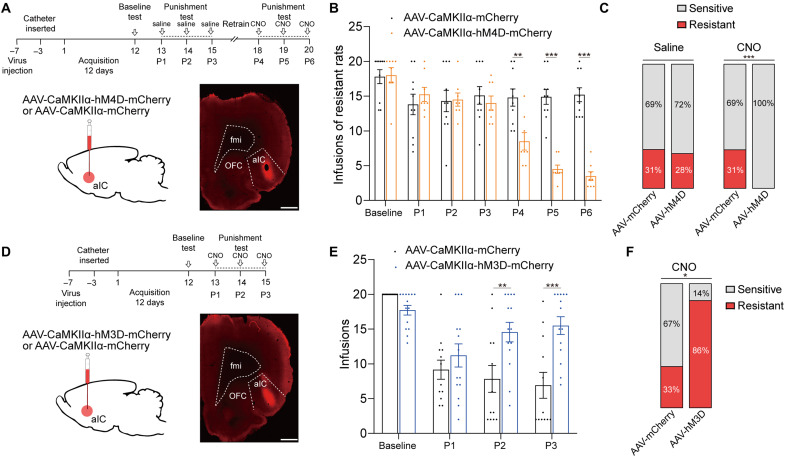
aIC contains different cell types. Targeting an excitatory-associated population produces a corresponding pattern: suppression reduces taking in resistant rats, without a significant effect in sensitive rats, while activation promotes continued taking despite adverse consequences.
This narrows the regional finding to a population without assigning the entire function to one finer cell identity. Reward, cost-related responses and action selection may interact within this network, prompting examination of its upstream connections.
Source: Chen Y et al. · Science advances · CC BY-NC
Original figure and English caption ↗
An OFC-input-associated connection is stronger
OFC, associated with outcome value and behavioral updating, sends input to aIC. Recipient aIC cells in resistant rats receive more excitatory currents and fire more readily in response to applied current. These measures concern overall input to the recipient cells and their excitability, respectively.
Input-evoked measurements show a lower paired-pulse ratio and a higher AMPA-to-NMDA response ratio in resistant rats. These findings fit stronger synaptic transmission and bring an OFC-associated connection into the behavioral picture.
Source: Chen Y et al. · Science advances · CC BY-NC
Original figure and English caption ↗
Manipulating recipient cells changes continued taking
Most OFC-input-recipient aIC cells bear an excitatory-associated marker, and more overlap activity labeling in resistant rats. Suppressing these recipient cells reduces taking in previously resistant rats, without a significant taking change in sensitive rats.
Activating the recipient population increases taking in the later test and the proportion classified as resistant. The manipulated cells reside in aIC and may act through other inputs and outputs as well. The result identifies an input-associated population rather than isolating one synapse.
Source: Chen Y et al. · Science advances · CC BY-NC
Original figure and English caption ↗
What changes when taking continues despite a cost?
Activating another input-associated population linked with cingulate cortex does not significantly increase resistant taking in the tested setting. Upstream connections may therefore contribute differently within a broader aIC network. Altered weighting of reward and adverse outcomes is an interpretation proposed by the authors.
The rat findings connect neural activity, synaptic changes and behavioral adjustment without directly measuring subjective value judgments or capturing all aspects of human addiction. Distinguishing initial reward, cost-resistant taking and longer-term relapse can clarify the network’s contributions across stages.