Where reward meets place: two sides of IPAC
Why does a place become linked with a drug experience? Rat research identifies distinct lateral and medial IPAC activity during morphine-associated place learning, with inputs linked to reward and spatial memory.
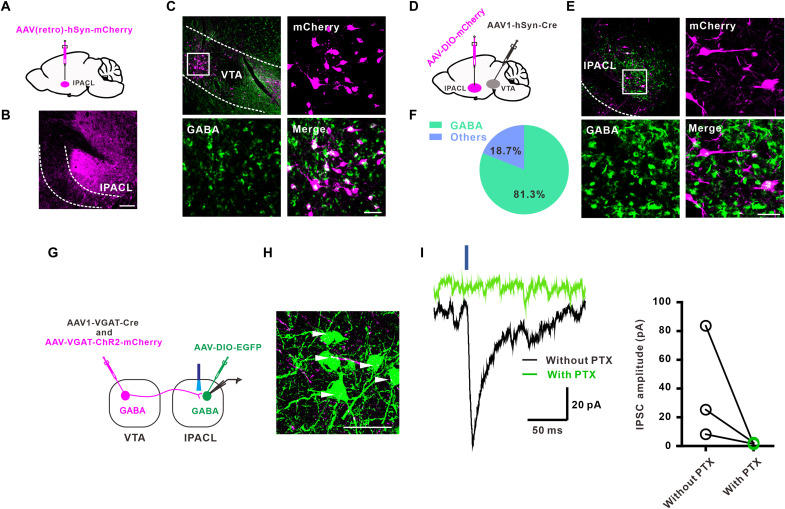
A room begins as an environment but can acquire attraction through repeated association with an experience. How does the brain form a drug-related place association? A study published in Science Advances on June 23, 2023 examined the interstitial nucleus of the posterior limb of the anterior commissure, IPAC, in male rats. Its lateral and medial populations showed different activity directions and timing during morphine-conditioned place preference acquisition. Inputs from VTA and the accumbal shell linked these differences with reward-related responses and spatial-memory findings.
Lateral IPAC activity increased early, while medial activity declined after repeated pairing. VTA GABAergic input was linked with lateral disinhibition, and accumbal-shell D1 input with stronger medial inhibition. Manipulating either input affected acquisition of place preference.
Contents · 6 sections
Medial and lateral IPAC receive different inputs
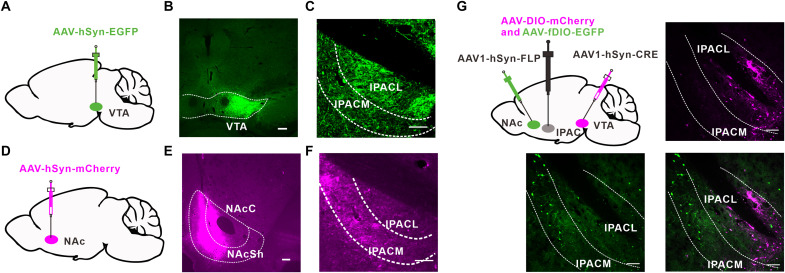
IPAC lies near the junction of several motivation- and emotion-related regions and has medial and lateral divisions. Tracing placed VTA input mainly laterally and accumbal input mainly medially. Cellular labeling and electrical responses further linked these inputs with VTA GABAergic and accumbal-shell D1-labeled populations.
Most associated IPAC cells were GABAergic, with other cell types also present. D1 denotes a dopamine-receptor marker, not dopamine release from these accumbal cells into IPAC. Electrical evidence instead supported inhibitory transmission, distinguishing source identity from signaling direction.
Source: Liu HM et al. · Science advances · CC BY-NC
Original figure and English caption ↗
Lateral activity rises early, but activation alone is insufficient
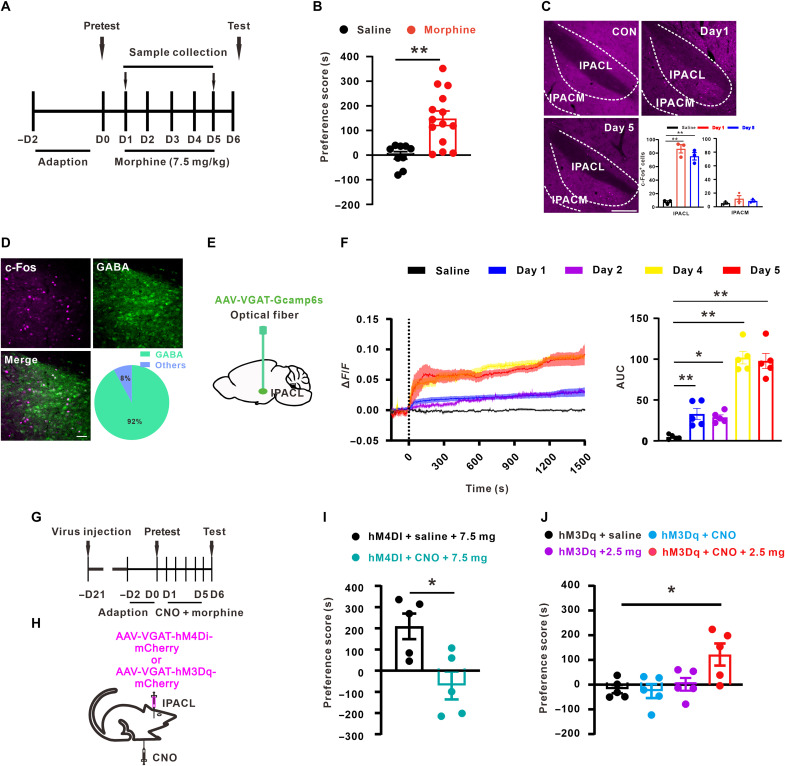
Lateral IPAC GABAergic calcium signals increased early during conditioning, alongside greater activity-marker labeling. Suppressing this population reduced preference for the morphine-paired compartment, whereas activation facilitated acquisition under a weaker drug-association condition.
Activation without the corresponding drug association did not by itself create compartment preference. The population therefore contributed within an experience–environment association rather than automatically assigning attraction to a location.
Place preference captures how animals subsequently allocate time across compartments. It turns experience-associated contextual attraction into a behavioral comparison, offering a window onto associative learning.
Source: Liu HM et al. · Science advances · CC BY-NC
Original figure and English caption ↗
Medial changes emerge after repeated experience
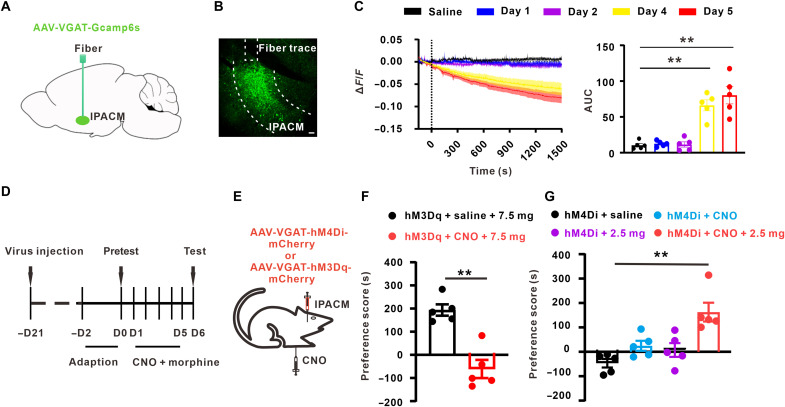
Medial IPAC followed a different time course. Calcium signals did not decline comparably during initial pairings but fell after repeated conditioning. Increasing medial activity reduced acquisition, whereas decreasing it facilitated preference under weaker association conditions.
The medial change also depended on pairing: unpaired comparisons did not show the same decline. Lateral signals increased with drug exposure in both paired and unpaired conditions without a significant difference between them, distinguishing immediate drug-related responses from association-dependent changes.
Source: Liu HM et al. · Science advances · CC BY-NC
Original figure and English caption ↗
Reduced VTA input accompanies greater lateral responsiveness
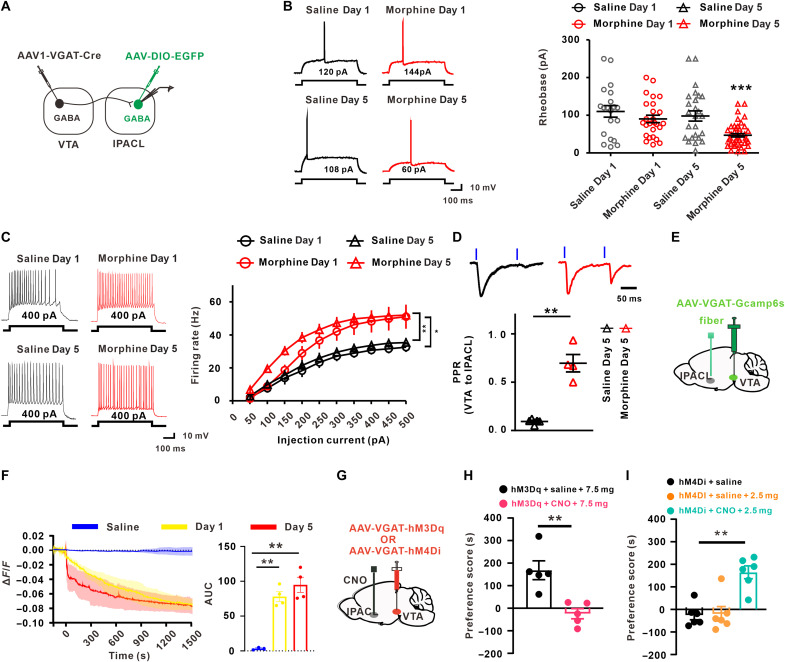
Lateral cells associated with VTA input showed greater evoked firing after conditioning and a lower firing threshold current at the later stage. VTA terminal calcium signals declined, while paired-pulse measures changed in a direction supporting reduced inhibitory input and lateral disinhibition.
Strengthening the input reduced acquisition, whereas suppressing it facilitated preference under weaker association conditions. Supplementary comparisons also linked this input to sucrose preference, while tested novel-object and water-maze measures did not significantly change, supporting a reward-related contribution.
Source: Liu HM et al. · Science advances · CC BY-NC
Original figure and English caption ↗
Stronger accumbal input accompanies lower medial activity
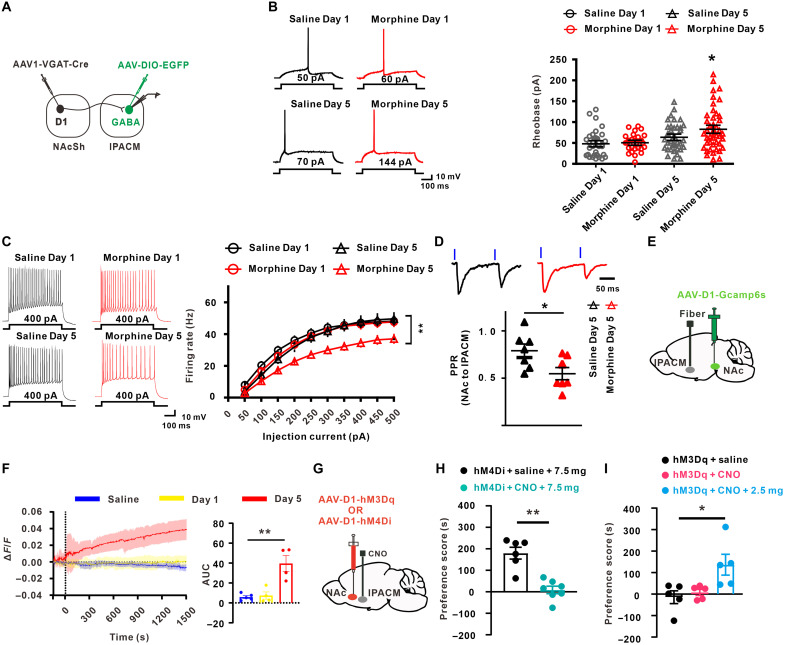
After repeated pairing, accumbal-shell D1 terminal signals in medial IPAC increased, while associated medial cells required more current to fire and produced fewer evoked spikes. Greater inhibitory input therefore aligned with reduced downstream activity, emerging later rather than in early comparisons.
Reducing the input impaired acquisition, while strengthening it facilitated acquisition under weaker association conditions. Supplementary sucrose-preference and novel-object measures did not change significantly, whereas selected water-maze spatial measures did. These findings support differentiated contributions without equating spatial performance with every form of contextual memory.
Source: Liu HM et al. · Science advances · CC BY-NC
Original figure and English caption ↗
Distinct components contribute to an experience–place association
The study separates place-preference acquisition into distinct activity and input changes. Reward-related responses and spatial memory may contribute through different IPAC divisions. Evidence comes from male-rat conditioned place preference, without direct tests of self-administration, relapse or human treatment, or proof that all integration occurs within individual cells.