A cortical detour helps ACC sustain auditory-response enhancement
In mice, strong ACC activation enhances auditory cortical responses for an hour, whereas direct ACC terminals do not produce the same lasting effect. An indirect connection through lateral rhinal cortex contributes to its induction.
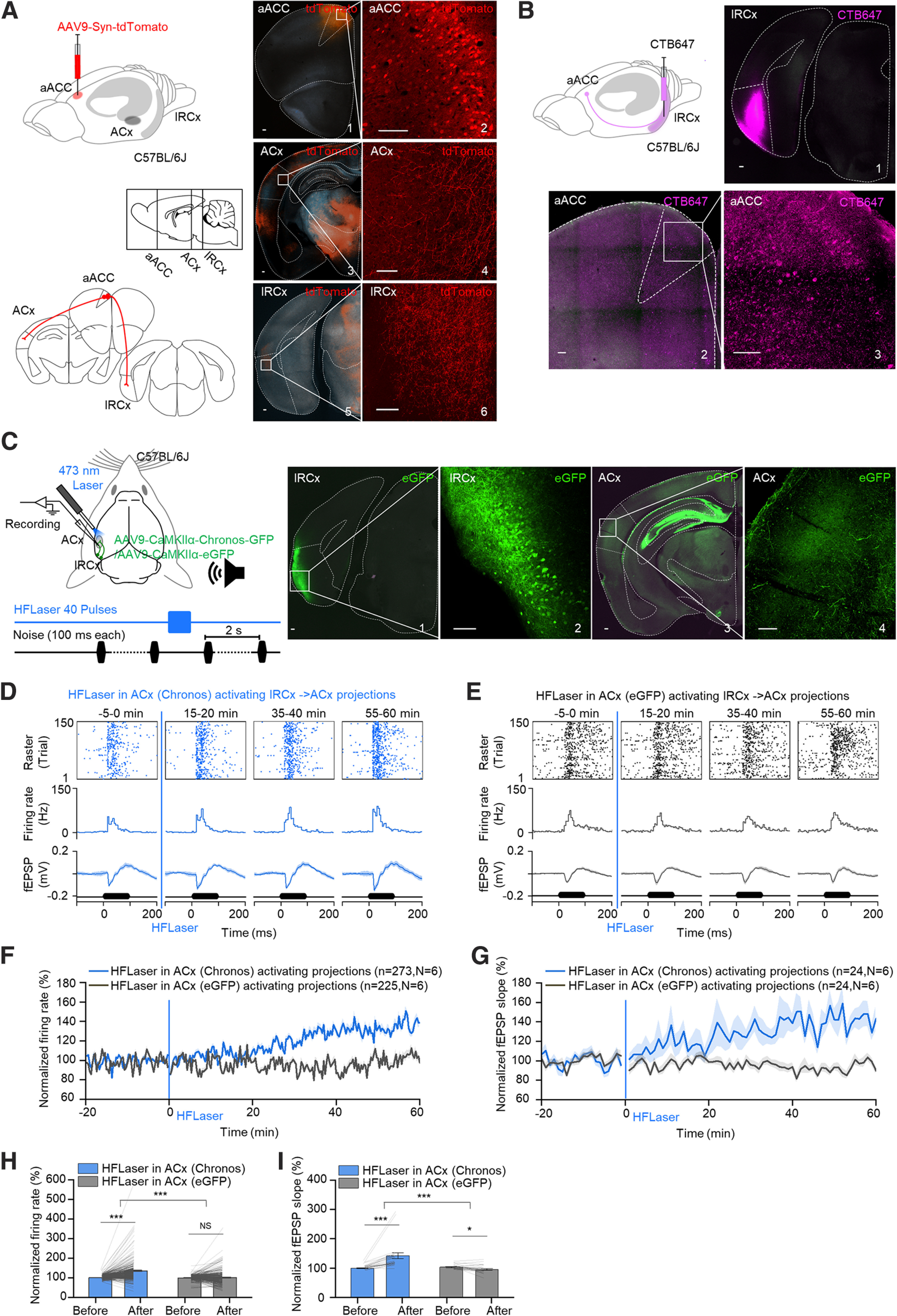
Why can the same sound evoke a larger response after a strong episode of brain activity? A study published in Journal of Neuroscience on May 9, 2023 compares two routes from anterior ACC (aACC) to auditory cortex. Unexpectedly, the lasting enhancement is not reproduced by activating the direct projection but involves an intermediate region, lateral rhinal cortex (lRCx).
Strong activation of aACC cells, aACC terminals in lRCx, or lRCx terminals in auditory cortex produces lasting auditory-response enhancement. With lRCx silenced, aACC activation no longer induces enhancement. Separate male-mouse tests also show increased sound-evoked running one hour later.
Contents · 7 sections
The shortest projection does not reproduce the lasting effect
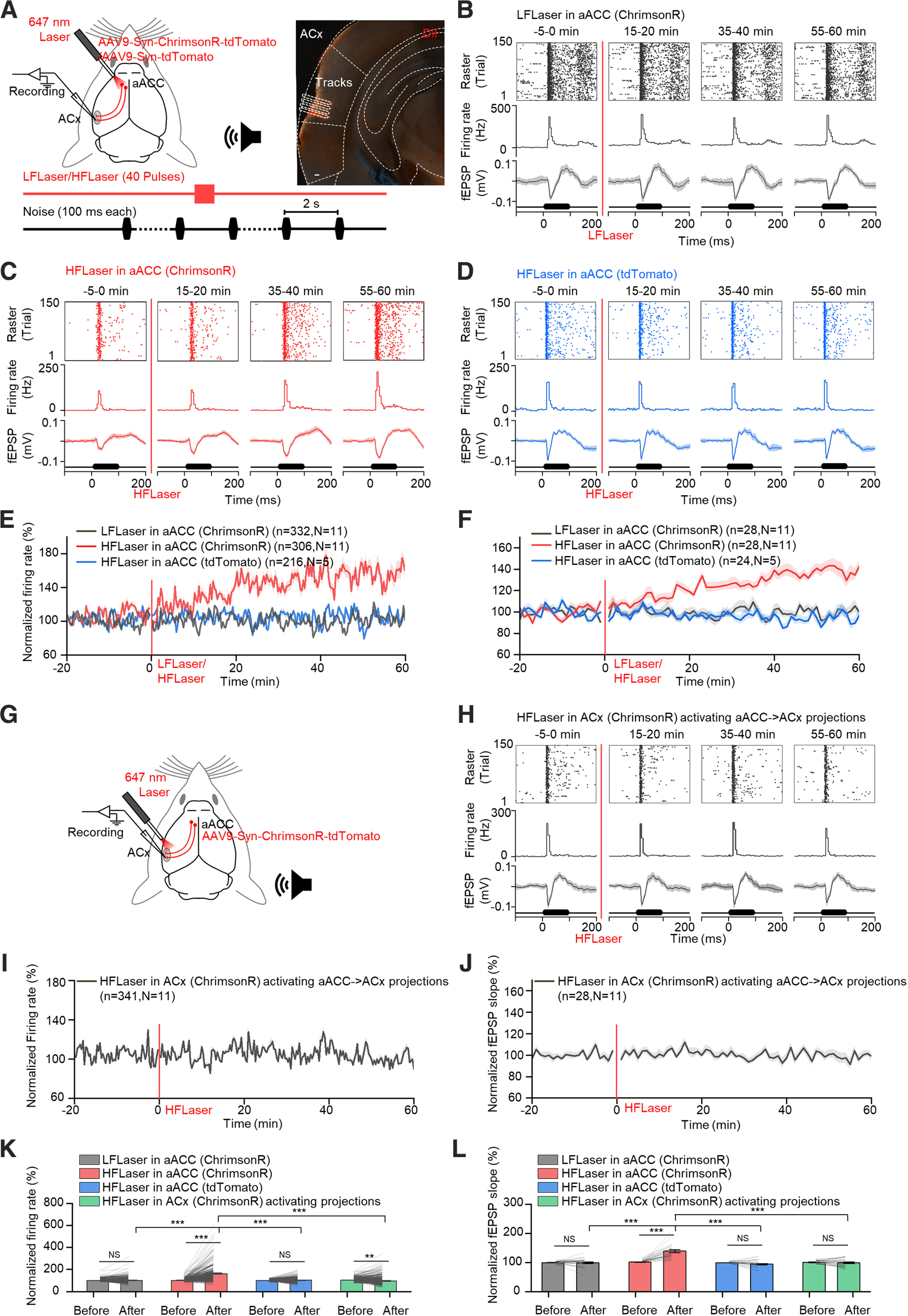
Earlier work found that direct aACC projections can briefly enhance auditory cortical responses. This study examines a longer timescale. In anesthetized mice, strong aACC cell activation gradually increases sound-evoked field-potential slopes and population firing, with enhancement retained at the end of the hour-long observation.
Low-frequency activation and illumination in control animals do not produce the same enhancement. Crucially, stimulating aACC terminals within auditory cortex also fails to induce lasting enhancement. The difference between cell-body and direct-output activation motivates a search for an indirect connection.
Field potentials reflect pooled electrical activity, whereas population firing counts action potentials within the recording range. In the study, field-potential enhancement often precedes increased firing. Changes in input integration and spike output thus follow distinct time courses, with the two readouts describing how enhancement develops.
Source: Liang Y et al. · The Journal of neuroscience : the official journal of the Society for Neuroscience · CC BY
Original figure and English caption ↗
lRCx output can enhance auditory cortical responses
Traced aACC fibers reach lRCx as well as auditory cortex, and retrograde labeling confirms the upstream connection. lRCx also sends excitatory output toward auditory cortex, providing an anatomical basis for an intermediate route.
Activating lRCx terminals in auditory cortex likewise produces progressively stronger sound-evoked field potentials and population firing, lasting into the later recording period. Input from this other cortical area can therefore generate a persistent effect similar in direction to aACC cell activation.
Source: Liang Y et al. · The Journal of neuroscience : the official journal of the Society for Neuroscience · CC BY
Original figure and English caption ↗
The routes largely arise from different labeled cells
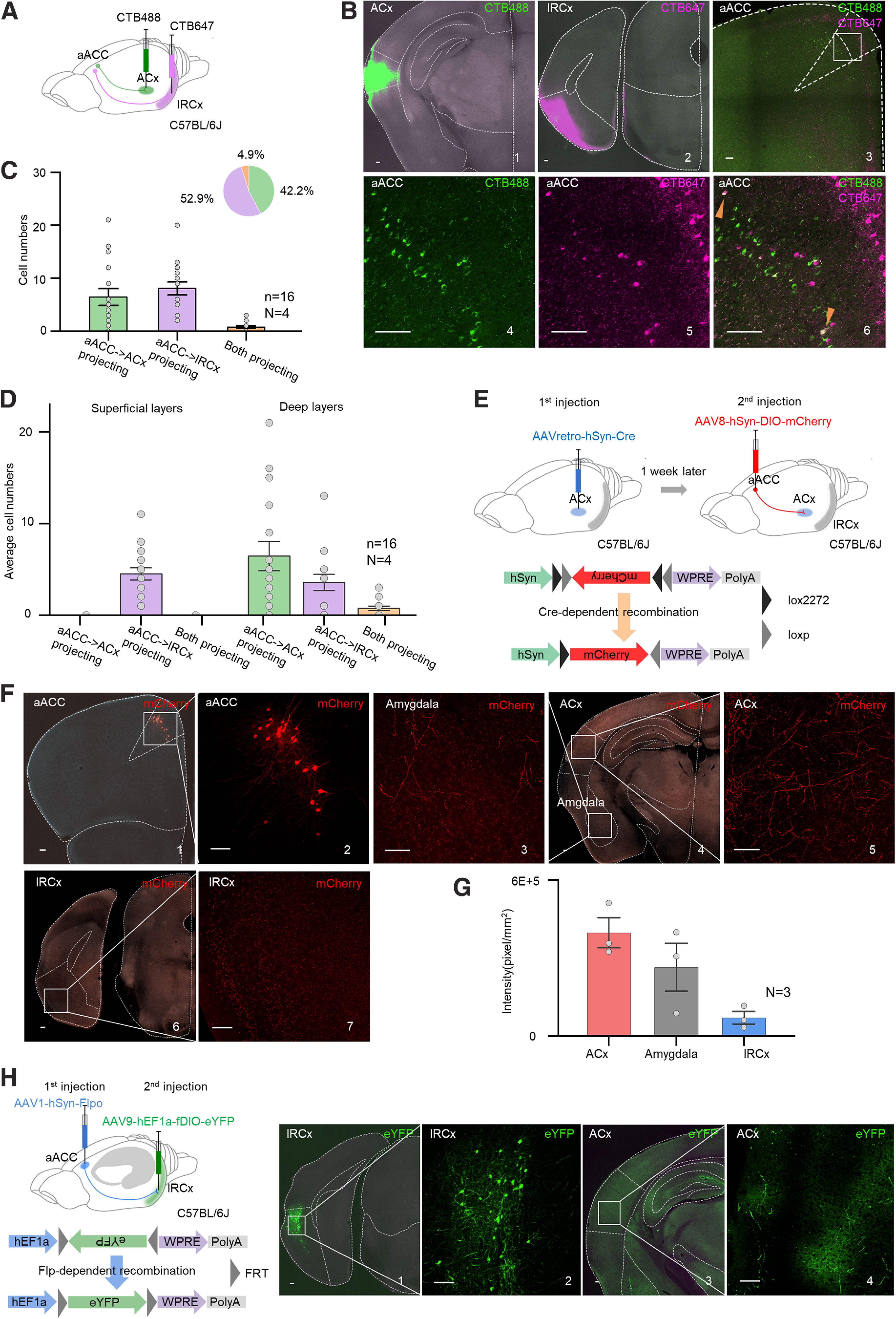
Dual tracing finds that most labeled aACC cells project to either auditory cortex or lRCx, with about 5% carrying both labels. Auditory-cortex-projecting cells are concentrated in deep layers, while lRCx-projecting cells occupy superficial and deep layers.
Labeling lRCx cells associated with aACC input reveals their fibers in auditory cortex. This links the anatomical observations: aACC can influence lRCx, and the input-associated lRCx population can send output toward auditory cortex.
Source: Liang Y et al. · The Journal of neuroscience : the official journal of the Society for Neuroscience · CC BY
Original figure and English caption ↗
Enhancement is not induced when lRCx is silenced
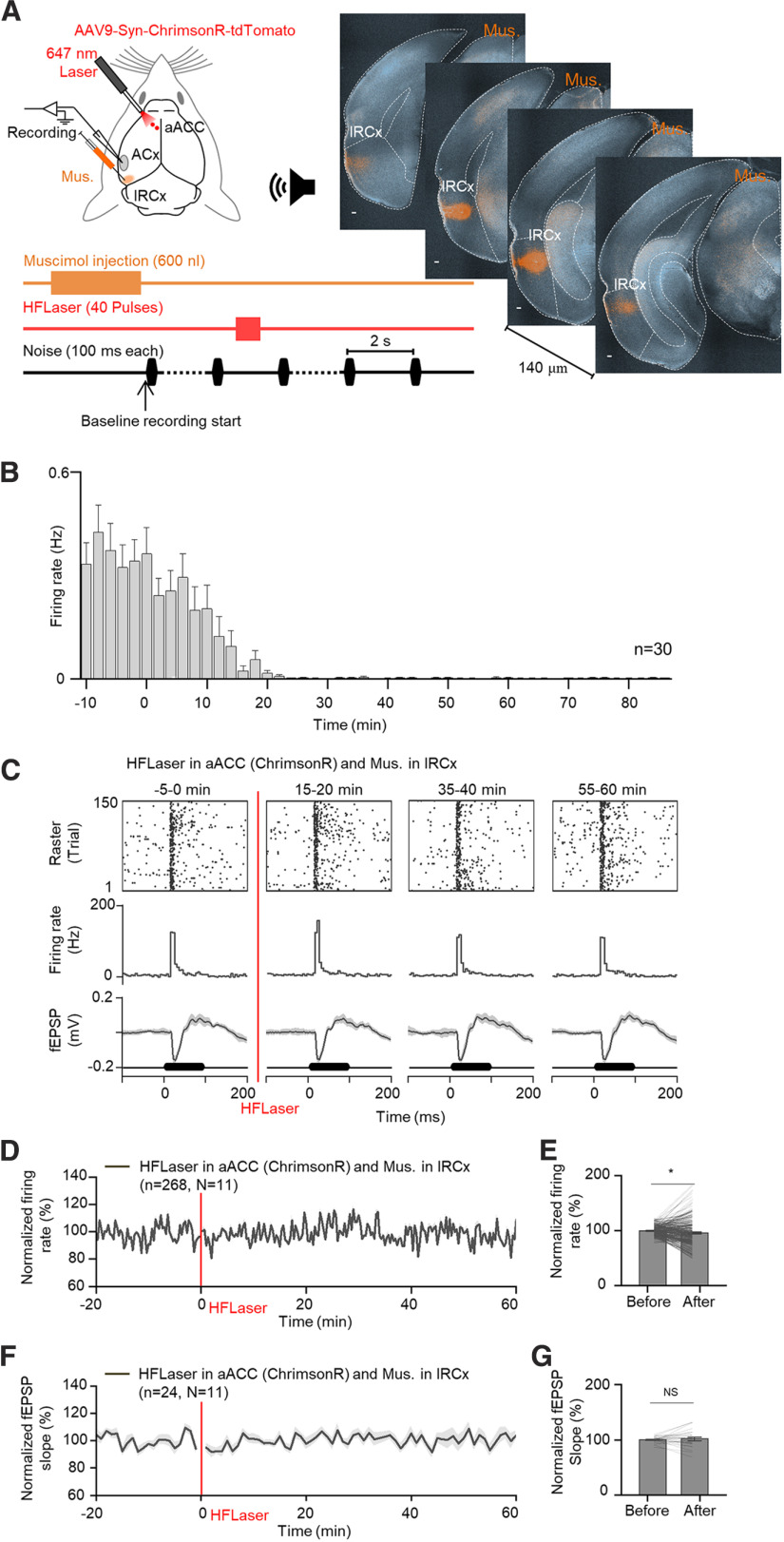
Anatomy alone does not establish involvement in lasting enhancement. The researchers silence lRCx before activating aACC cells. Auditory cortex then fails to develop the previous enhancement: field-potential slopes do not significantly increase, and population firing decreases slightly.
This identifies lRCx as a functional contributor to induction. It does not locate the final site of persistence, because the intermediate and auditory cortical networks can continue to interact. Nonetheless, active lRCx is important under these induction conditions.
Source: Liang Y et al. · The Journal of neuroscience : the official journal of the Society for Neuroscience · CC BY
Original figure and English caption ↗
aACC terminals in lRCx can induce enhancement
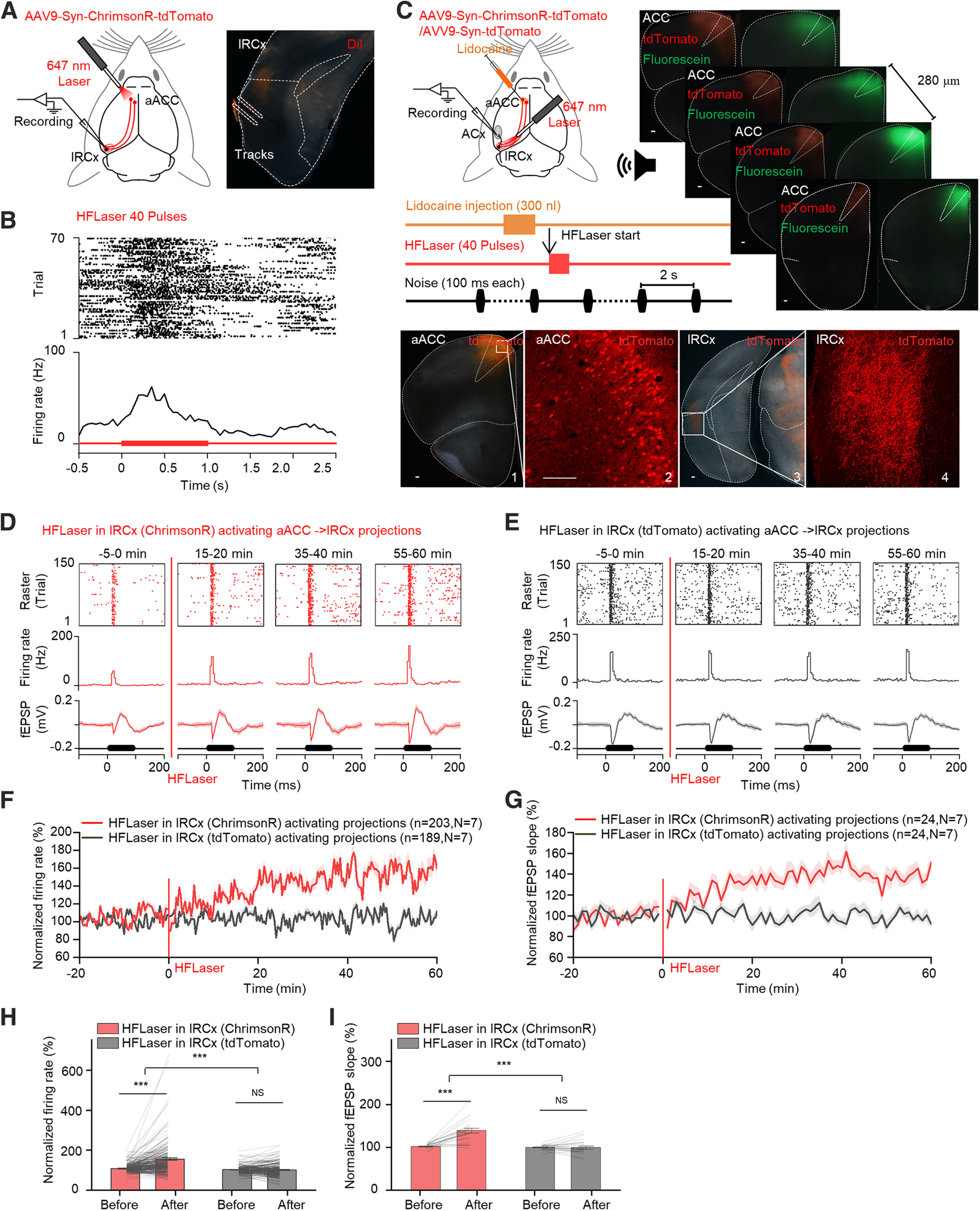
aACC activation evokes activity in lRCx. The researchers then reduce aACC somatic activity while activating aACC terminals in lRCx, and auditory cortex still develops persistent enhancement. Continued aACC somatic activity is therefore not required for this induction result.
Upstream-terminal activation, downstream-terminal activation and intermediate-region silencing provide complementary evidence. lRCx is more than a connection on a map: its participation changes how auditory cortex subsequently responds to sound.
Source: Liang Y et al. · The Journal of neuroscience : the official journal of the Society for Neuroscience · CC BY
Original figure and English caption ↗
Sound-evoked running increases one hour later
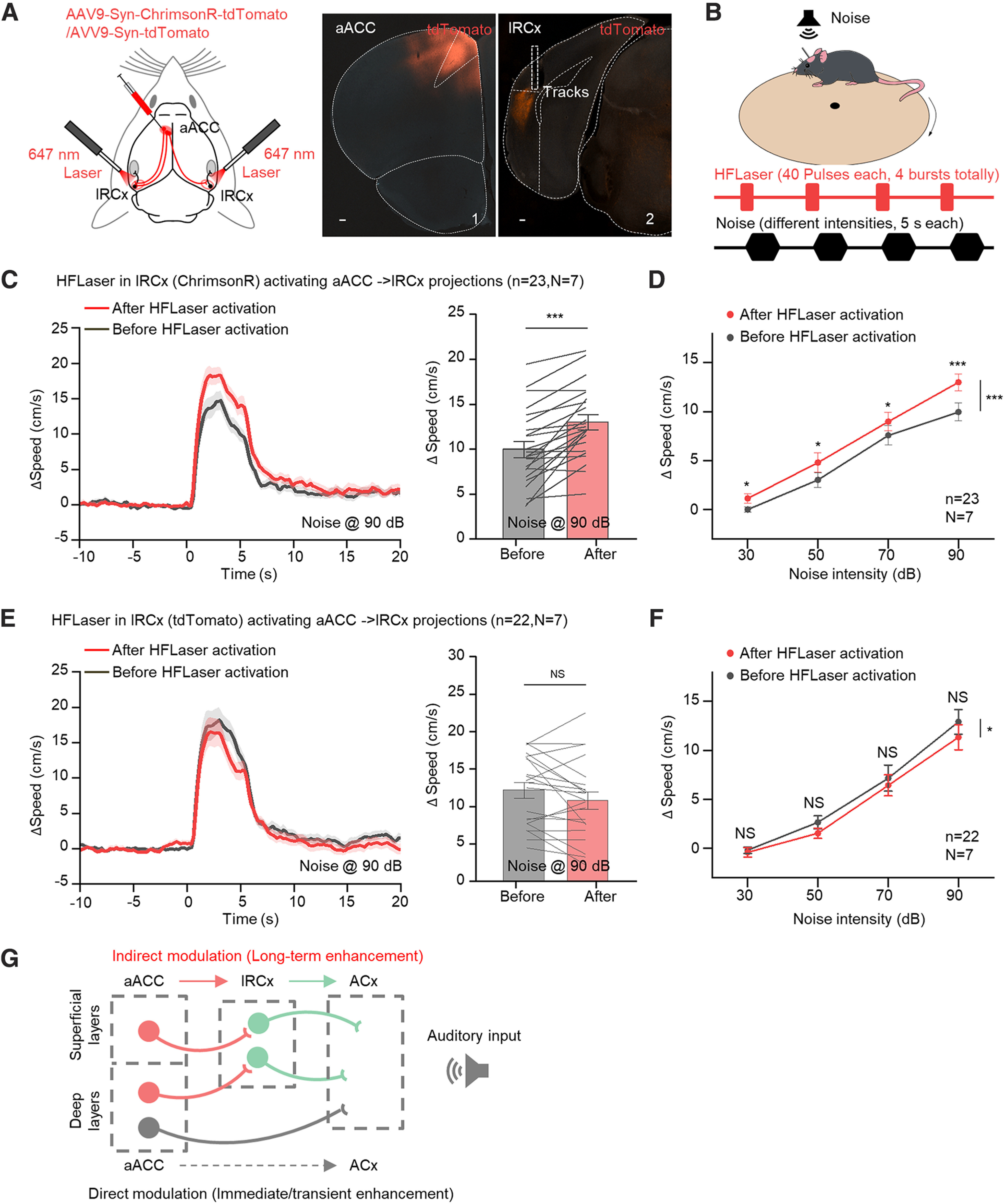
A separate adult-male-mouse experiment links the auditory effect to action. One hour after pairing sound with aACC terminal activation in lRCx, the increase in running speed evoked by the same sound is greater across the tested sound intensities. Controls do not show a matching increase.
The study links persistent neural-response changes with sound-evoked behavior. The behavioral measure is running, rather than frequency discrimination or hearing threshold. Electrophysiological observations include both sexes, whereas the behavioral findings concern males.
Source: Liang Y et al. · The Journal of neuroscience : the official journal of the Society for Neuroscience · CC BY
Original figure and English caption ↗
The route of modulation relates to how long it lasts
The study suggests that sensory cortical modulation depends on the route as well as input strength. Earlier work found a brief direct-route effect; the longer-lasting change here involves another cortical area. Different network arrangements can influence the same target over different timescales.
The molecular mechanism and the natural experiences that recruit this connection remain unresolved. The clearest result is that an indirect cortical connection through lRCx contributes to hour-scale auditory enhancement and accompanies stronger subsequent sound-evoked action.