Once movement begins, why does striatum stay involved? Continuous circuit support during a rat’s reach
A lifted paw drops and a turn widens: observations at different moments of a practiced behavior reveal how dorsolateral striatum supports initiation and ongoing movement.
A practiced action can feel automatic: once started, the body follows a familiar sequence. Can the brain step back after movement begins? A 2026 Science Advances study examined rats at different moments of a practiced water-reward task: paw lift, lever release, turning and nose poke. Brief reductions of dorsolateral striatal (DLS) activity changed the animal’s trajectory. The clearest scene was a lifted paw dropping—then lifting again while the intervention was still underway.
DLS helps several practiced actions start promptly and proceed efficiently. Its contribution varies by movement: paw lifts and turns are more sensitive, while the final nose poke is relatively preserved.
Contents · 7 sections
A practiced sequence offers several windows
Rats approached a lever, held it with a paw, released it following a sound and turned toward the water port. The sequence combines forelimb movement, a cued response and whole-body locomotion. Performing these actions in one familiar setting provides clear windows for comparing movement phases.
DLS sits at the input side of basal ganglia, with spiny projection neurons as a major population. Most analyzed putative projection cells changed firing around at least one task event, with different groups active near lifting, holding, releasing or reward collection. The next question was when this activity actually influenced movement.
Firing tracks movement and bodily state
Paw and head position, direction and speed provided a reference for firing. State variables such as position generally explained signals better than speed alone. Some cells preceded movement changes and others followed, without a uniform population lead or lag. DLS activity intertwined several kinds of information about movement and bodily state.
During freely performed behavior, paw lifting, head lowering and turning often overlap. A signal predicting a trajectory can reflect a change already underway. Moment-specific interventions provided another view: how would the practiced action proceed with this activity temporarily reduced?
The rat approaches, but the paw lift is delayed
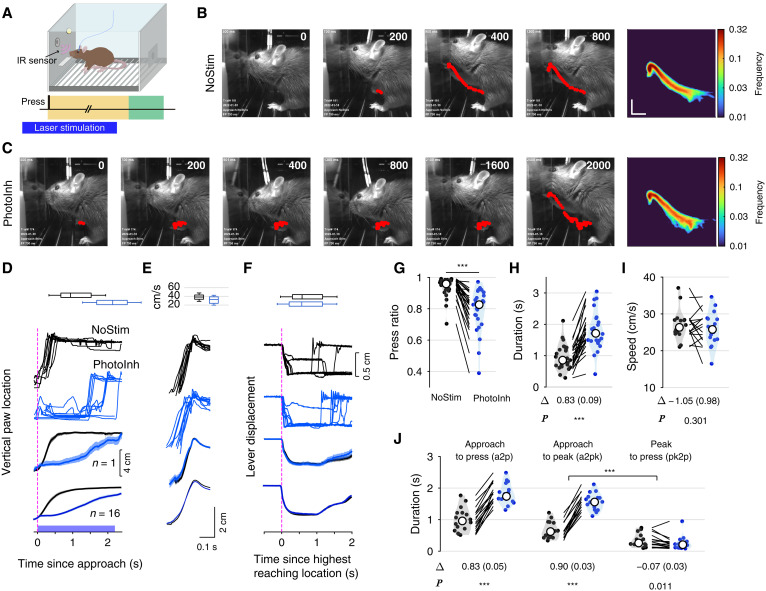
Reducing DLS activity as rats approached the lever lengthened the approach-to-press interval and reduced completion within the available time. Across twenty-five rats, the estimated average increase was about 0.83 seconds—a noticeable pause in the practiced sequence.
The delay appeared mainly before the paw reached its highest point; the later press remained largely smooth. Once lifting began, paw speed showed no significant population change. A longer wait and a slower movement diverged: DLS particularly supported timely entry into the action.
Source: Cao J et al. · Science advances · CC BY-NC
Original figure and English caption ↗
A paw drops mid-reach
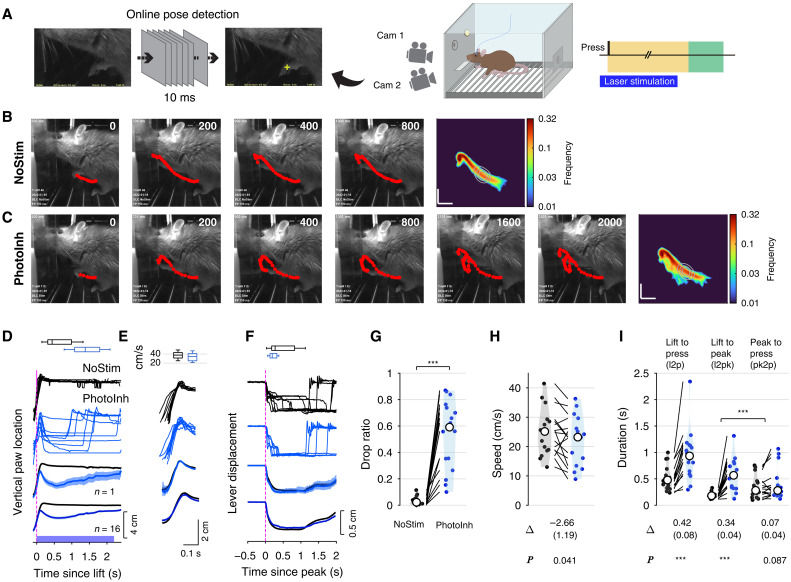
When intervention began after the paw left the floor, the reaching paw could drop, pause or begin another reach. Across sixteen rats, the median paired increase in paw-drop proportion was about 0.50. DLS contribution therefore extended into movement execution.
The interruption was not the end. Rats often lifted again while DLS activity remained suppressed, and subsequent pressing was largely preserved. Other networks may support completion, while DLS helped make the process continuous. Bilateral interventions generally had stronger effects than unilateral ones, reflecting distributed support.
Source: Cao J et al. · Science advances · CC BY-NC
Original figure and English caption ↗
A slower, wider turn—but a relatively preserved nose poke
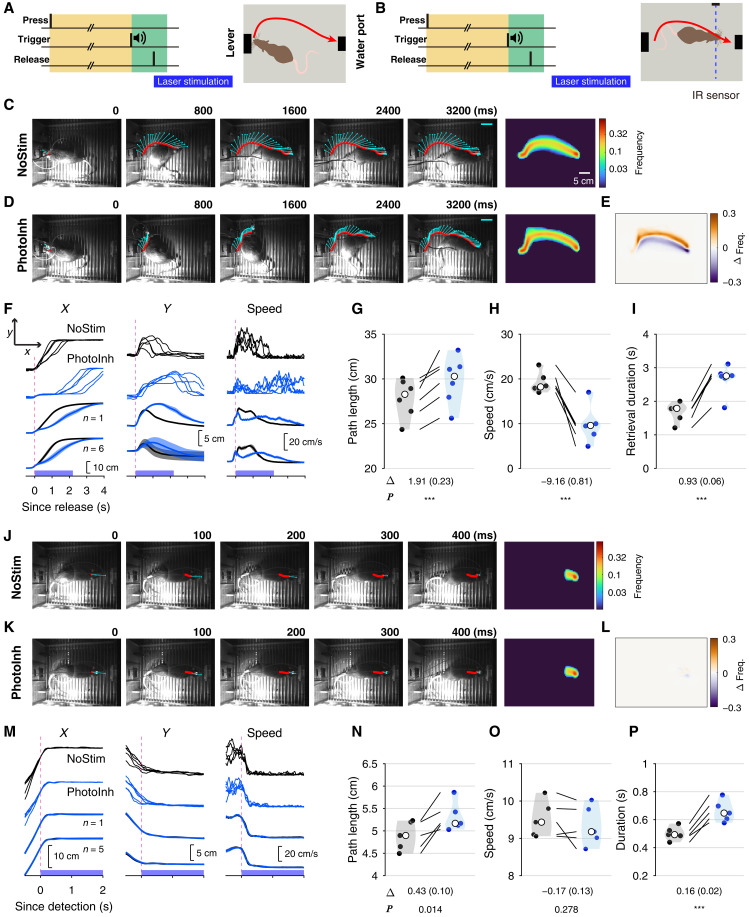
Reducing activity near the cue slowed lever release, with smaller effects after repeated experience. Starting after release instead slowed the reward-bound turn, widened its path and increased distance. Both speed and direction changed, linking DLS with efficient organization of whole-body movement.
Near the water port, the pattern changed. Many cells fired strongly around the nose poke, yet intervention just before it had smaller effects. Speed did not change significantly, with only modest increases in path and completion time. Strong task-related firing did not always translate into a strong dependence of that immediate movement.
Source: Cao J et al. · Science advances · CC BY-NC
Original figure and English caption ↗
Network output does not change uniformly
How did altered DLS activity reach basal-ganglia output? Recordings in substantia nigra pars reticulata (SNr) showed increased firing in some cells and decreased firing in others. These changes appeared rapidly and largely persisted. Output shifted in different directions across populations rather than uniformly across the region.
When rats released the lever again, the SNr disturbance had not fully disappeared, consistent with recovery supported by other circuits. Comparable intervention in dorsomedial striatum (DMS) produced no clear paw-initiation change and smaller locomotor effects. Movement type and regional location together shaped the outcome.
Practiced movement still needs ongoing support
The study highlights a phase easily overlooked in practiced behavior: after initiation, circuits still help movement proceed, with different needs across actions. Restarting a dropped reach, altered turning and relatively preserved nose poking create a richer striatal picture than a simple movement switch.
The evidence comes from practiced rat behavior and interventions involving several projection populations. Confined turning, regional boundaries and the contributions of different outputs remain relevant. The work offers clues to how basal ganglia coordinate ongoing actions and how state feedback works with movement progression.