Nitrous-oxide place preference involves two neural signals
After repeated nitrous-oxide exposure, male mice prefer the associated context. Dopamine, D1 receptors and BDNF link rapid responses with molecular changes in this behavior.
An experience can leave its setting attractive after the experience itself has ended. Drug-reward studies often start with this contextual preference: does an animal spend more time in a space associated with a substance? A 2025 study in Translational Psychiatry examines nitrous oxide, commonly called laughing gas. After observing place preference in male mice, the researchers follow rapid neural responses and brain-derived neurotrophic factor, BDNF, along the dopamine network linking the ventral tegmental area, VTA, and nucleus accumbens, NAc.
Nitrous-oxide place preference accompanies increased calcium signals in VTA dopamine neurons and dopamine-sensor signals in NAc. NAc D1 blockade, inhibition of BDNF downstream mediators, or VTA BDNF reduction weakens preference; D2 blockade has no significant effect.
Contents · 6 sections
The setting remains attractive after exposure
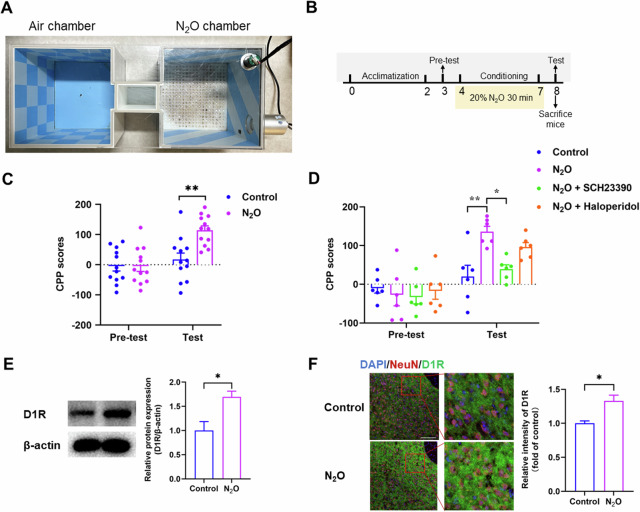
Two environments are paired with nitrous oxide and air, respectively. Following repeated pairings, mice prefer the nitrous-oxide-associated side in a test without gas delivery. Conditioned place preference links exposure with later contextual choice. It measures spatial preference rather than directly recording subjective pleasure.
The team next blocks either of two dopamine-receptor classes in NAc during conditioning. D1 blockade reduces preference, whereas D2 blockade has no significant effect. Repeated exposure also increases NAc D1-receptor protein and fluorescence intensity. The two receptor classes do not have identical roles in this task.
Source: Li WQ et al. · Translational psychiatry · CC BY-NC-ND
Original figure and English caption ↗
Two signals rise rapidly during exposure
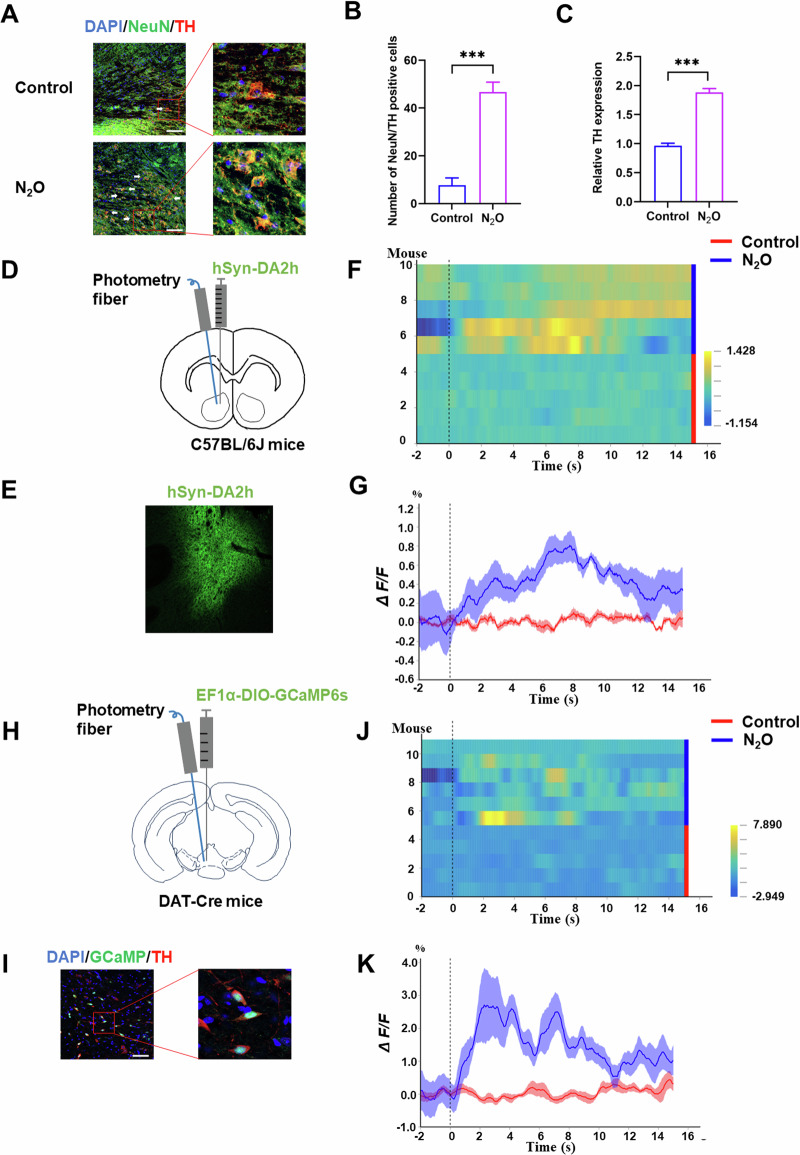
VTA supplies dopamine to this reward network, while NAc receives related input. Separate recordings examine the two nodes: NAc dopamine-sensor signals rise progressively during exposure, and VTA dopamine-neuron calcium signals rise rapidly and fluctuate during exposure. Both chemical signaling and cellular activity respond over a short interval.
Tissue analysis after repeated exposure also finds more cells jointly labeled for NeuN and tyrosine hydroxylase, TH, in VTA, along with increased TH transcripts. TH participates in dopamine synthesis and is commonly used to identify related cells. These findings describe labeling changes rather than generation of new cells. Rapid responses and later tissue changes describe different temporal aspects of the network.
Source: Li WQ et al. · Translational psychiatry · CC BY-NC-ND
Original figure and English caption ↗
BDNF-related changes extend beyond expression
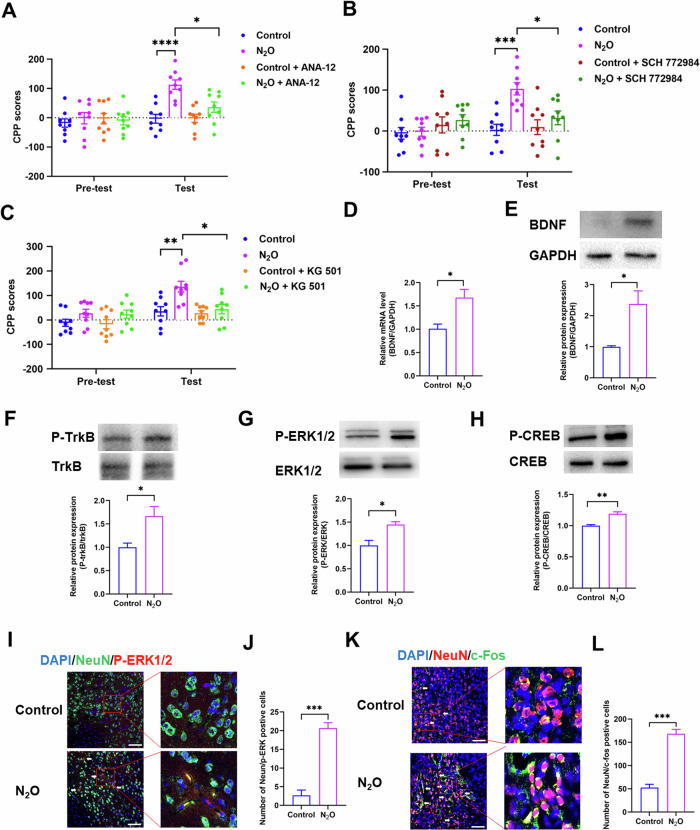
Dopamine describes a rapid response; BDNF raises another question: how does repeated exposure change cellular signaling states? VTA BDNF transcripts and protein increase, as do phosphorylation ratios for TrkB, ERK and CREB in NAc. These molecules participate in receptor responses, intracellular signaling and regulation of gene expression.
If these changes contribute to contextual preference, weakening them should alter behavior. Inhibiting TrkB-, ERK- or CREB-related actions in NAc reduces nitrous-oxide-associated preference. Under air exposure, the same interventions do not significantly alter place preference. The intervention results complement the expression findings.
Source: Li WQ et al. · Translational psychiatry · CC BY-NC-ND
Original figure and English caption ↗
Reducing VTA BDNF weakens preference
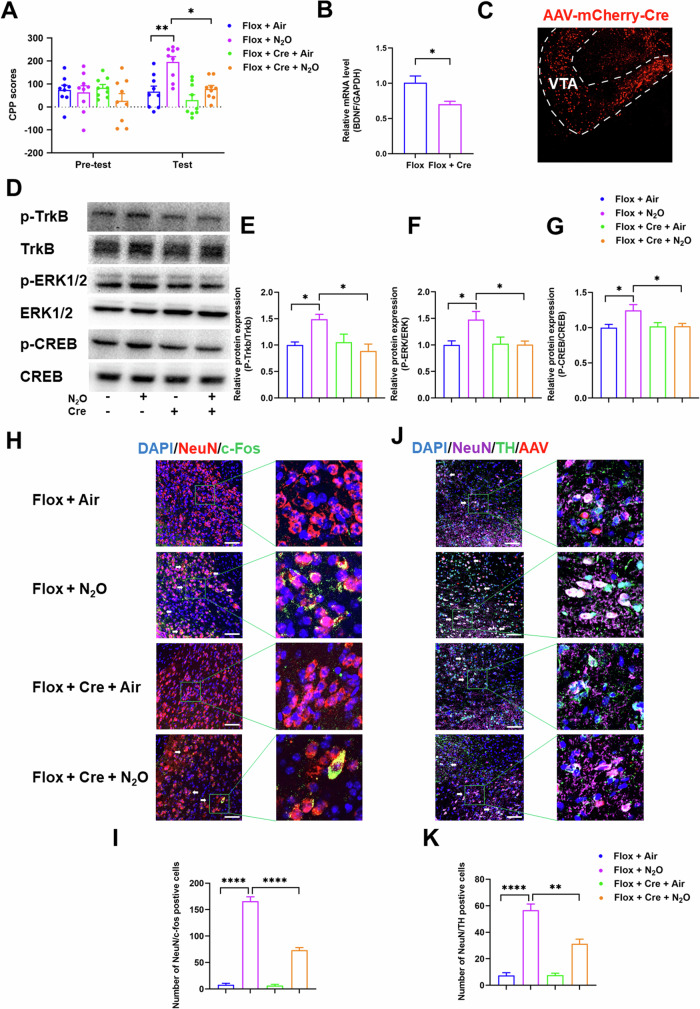
The team then locally reduces BDNF in VTA. Under nitrous oxide, place-preference scores fall to about half those of controls; under air, the groups do not differ significantly. The intervention lowers expression rather than completely removing BDNF, allowing the researchers to examine the network response.
At the same time, increased NAc TrkB, ERK and CREB phosphorylation is suppressed, c-Fos-positive cells decline, and fewer VTA cells are jointly labeled for NeuN and TH. Behavioral and tissue changes at both nodes support a role for VTA BDNF in forming the nitrous-oxide-associated preference.
Source: Li WQ et al. · Translational psychiatry · CC BY-NC-ND
Original figure and English caption ↗
Combining interventions does not simply add their effects
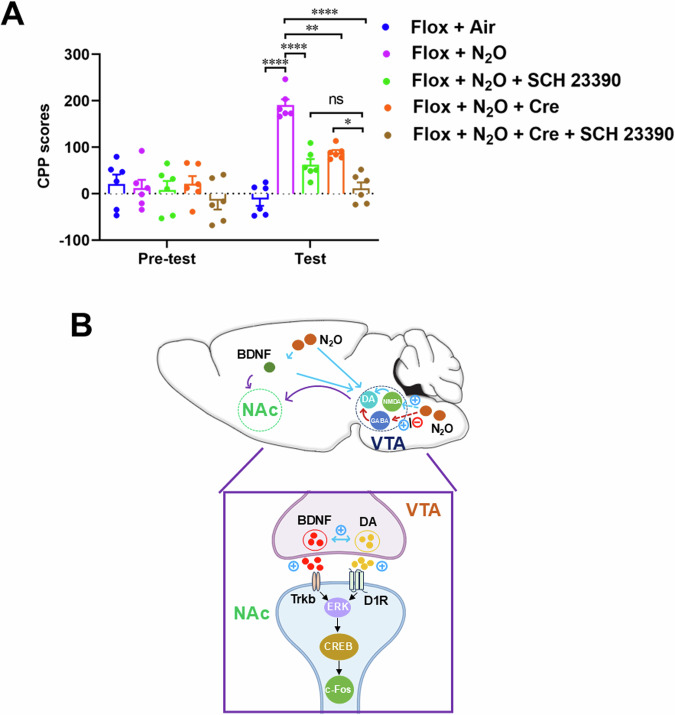
Finally, the study combines VTA BDNF reduction with NAc D1 blockade. Preference is lower than with BDNF reduction alone, but not significantly different from D1 blockade alone. This suggests that their roles may be linked, with D1 blockade already reducing preference substantially and added BDNF reduction producing no significant further change.
The authors propose that BDNF may act upstream of D1-related effects. The evidence supports involvement in the same behavioral process, while their precise order remains a mechanistic interpretation: the study does not directly track BDNF release from VTA to NAc or manipulate each source cell type. Some links remain unobserved.
Source: Li WQ et al. · Translational psychiatry · CC BY-NC-ND
Original figure and English caption ↗
How exposure leaves a context worth approaching
The study brings several scales together: rapid dopamine-related responses during exposure, molecular changes after repeated pairing, and later contextual choice. Its direct evidence comes from conditioned place preference in young male mice and describes one component of nitrous-oxide reward-related learning.
Reward here involves more than a transient dopamine increase. Interventions involving D1 receptors and BDNF-related signaling both change later contextual preference, showing how rapid responses and intracellular regulation contribute to behavior. Between exposure and contextual memory, the network undergoes changes that shape a later choice.