From interference to multitasking: how does motor cortex coordinate two tasks at once?
A mouse study tracks dual-task learning in secondary motor cortex, showing how population coordination gives way to orthogonal separation as multitasking becomes fluent.
Performing two tasks simultaneously often triggers mutual interference, yet practice can markedly improve multitasking proficiency. How higher-order cortical circuits resolve resource competition during parallel task processing has remained unclear. Recently, a research team led by Prof. Ya Ke at The Chinese University of Hong Kong and Prof. Wing-Ho Yung at City University of Hong Kong (with Shuting Wang as first author, together with Yun Zhu and Chunyue Li) published a research article titled "Dynamic coordination and segregation mechanisms in higher cortex for parallel task processing" in *Neuron*. By combining a head-fixed forelimb lever-holding and auditory Go/No-Go dual-task paradigm in mice with longitudinal two-photon calcium imaging in the secondary motor cortex (M2), optogenetic perturbations, and recurrent neural network (RNN) modeling, the authors demonstrate that efficient multitasking relies on a rapid early coordination mechanism mediated by non-shared lever neurons followed by training-induced representational segregation.
Task-shared neurons in the secondary motor cortex act as cellular bottlenecks by prioritizing lever control over auditory discrimination during early dual-tasking, whereas selective suppression of non-shared lever neurons mediates rapid early task coordination before M2-dependent training orthogonalizes and segregates task representations.
Contents · 5 sections
From Single-Task Mastery to Dual-Tasking: Asymmetric Early Interference
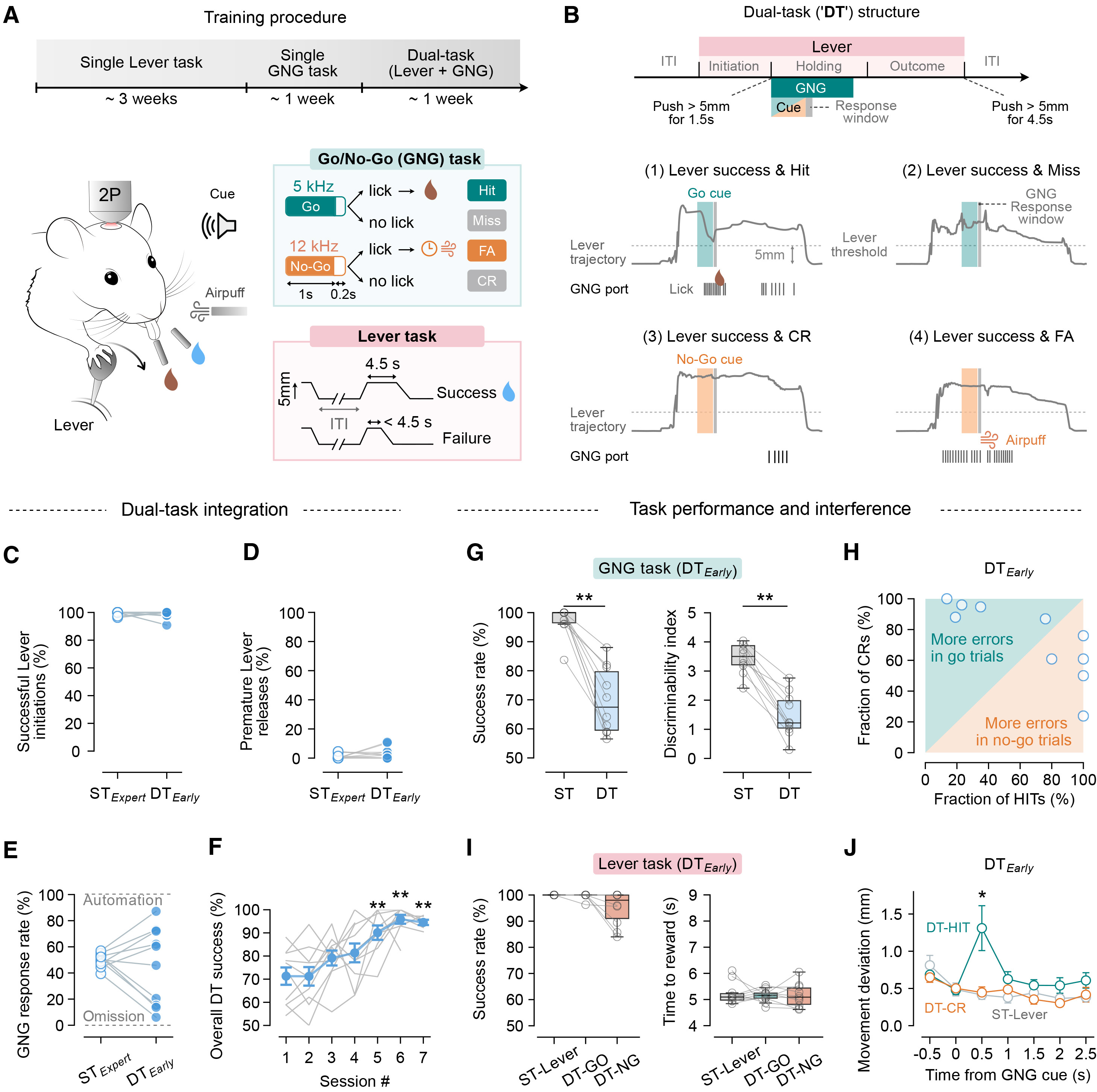
To dissect parallel task processing at cellular resolution, the authors developed a head-fixed mouse dual-task (DT) paradigm combining a continuous forelimb motor task with a discrete sensorimotor decision task (Figures 1A and 1B). In the lever task, mice pushed a joystick past a 5 mm threshold with their right forelimb and held it stably for 4.5 s to earn sucrose from a left spout. In the auditory Go/No-Go (GNG) task, mice discriminated a 1 s tone—licking a right spout for chocolate milk after a 5 kHz Go cue (HIT) while withholding licks after a 12 kHz No-Go cue (correct rejection, CR) to avoid an airpuff punishment (false alarm, FA). After reaching expert performance (>90% success) in both single tasks separately, mice entered dual-task training (DTT), in which the auditory cue was presented 1.5 s into the lever-holding period.
Behavioral quantification showed that mice immediately engaged in both component tasks during early dual-task training (DTEarly), maintaining high lever-initiation and low premature-release rates comparable to single-task expert performance (STExpert; Figures 1C–1E). Nevertheless, dual-tasking induced pronounced, asymmetric interference: GNG accuracy and discriminability dropped sharply in DTEarly (Figures 1G and 1H), whereas overall lever success rate and time to reward remained intact (Figure 1I), accompanied by a transient lever trajectory deviation ~0.5 s after Go cue onset (Figure 1J). Across 7 sessions of DTT, overall dual-task success steadily improved (Figure 1F).
Source: Shuting Wang et al. · Neuron · © Elsevier Inc.
Original figure and English caption ↗
Shared Neurons Create a Bottleneck While Non-Shared Neurons Mediate Early Coordination
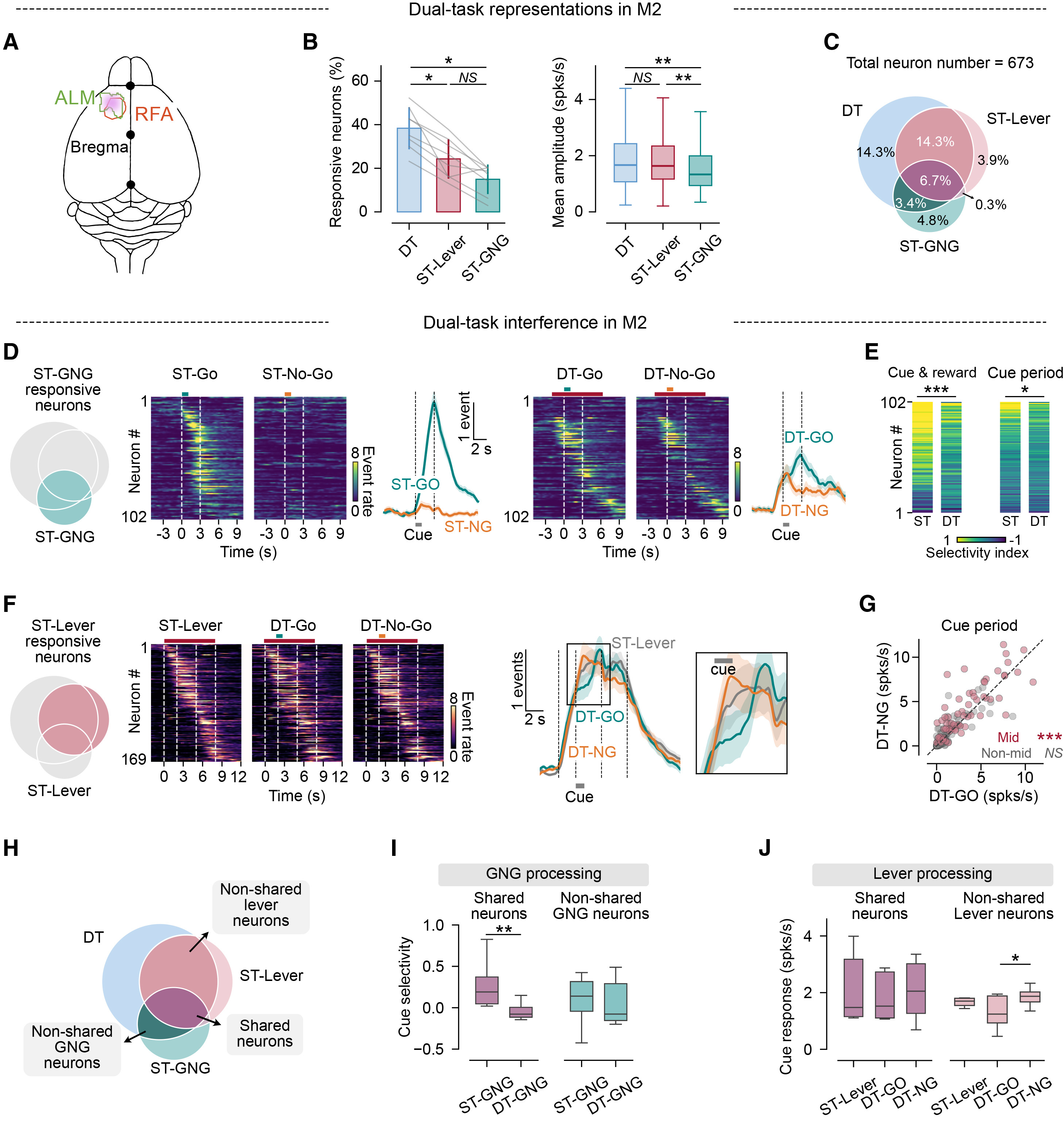
Focusing on the overlap zone between the anterolateral motor cortex (ALM) and rostral forelimb area (RFA) within left secondary motor cortex (M2), the authors performed chronic two-photon calcium imaging in layer 2/3 across 673 longitudinally tracked neurons from 8 mice (Figures 2A–2C). In DTEarly, ST-GNG-responsive neurons exhibited a marked reduction in Go versus No-Go cue selectivity (Figures 2D and 2E). Subdividing neurons into task-shared and non-shared populations revealed that this loss of GNG selectivity occurred selectively in task-shared neurons (66.2% of GNG-responsive cells)—particularly mid-recruited lever neurons temporally overlapping with the GNG window—whereas non-shared GNG neurons preserved their selectivity (Figures 2H and 2I).
Onset-timing and generalized linear model (GLM) analyses demonstrated that task-shared neurons exhibited a strong allocation bias toward the ongoing lever task during dual-tasking, acting as cellular bottlenecks that compromised GNG encoding (Figures 3A and 3B). Unexpectedly, non-shared lever neurons (68.1% of lever-responsive cells) selectively reduced their firing during DT-Go compared with DT-NG trials (Figures 2F, 2G, and 2J). Population coding direction (CD) projections revealed that this Go-specific activity reduction in non-shared lever neurons shifted population trajectories downward to separate correct DT-HIT from DT-CR trials, compensating for the failure of shared neurons (Figures 3C–3E); shuffling non-shared lever neurons significantly impaired DT decoding (Figure 3F), and larger DT-Go lever trajectory deviations positively correlated with higher GNG accuracy (r = 0.519, p = 0.0191; Figure 3G). Orthogonalizing against spontaneous licking modes (CDLick) further confirmed that this rapid coordination mechanism could not be explained by simple motor-motor competition (Figure 4).
Source: Shuting Wang et al. · Neuron · © Elsevier Inc.
Original figure and English caption ↗
Dual-Task Learning Requires M2 Activity and Multi-Level Population Reorganization
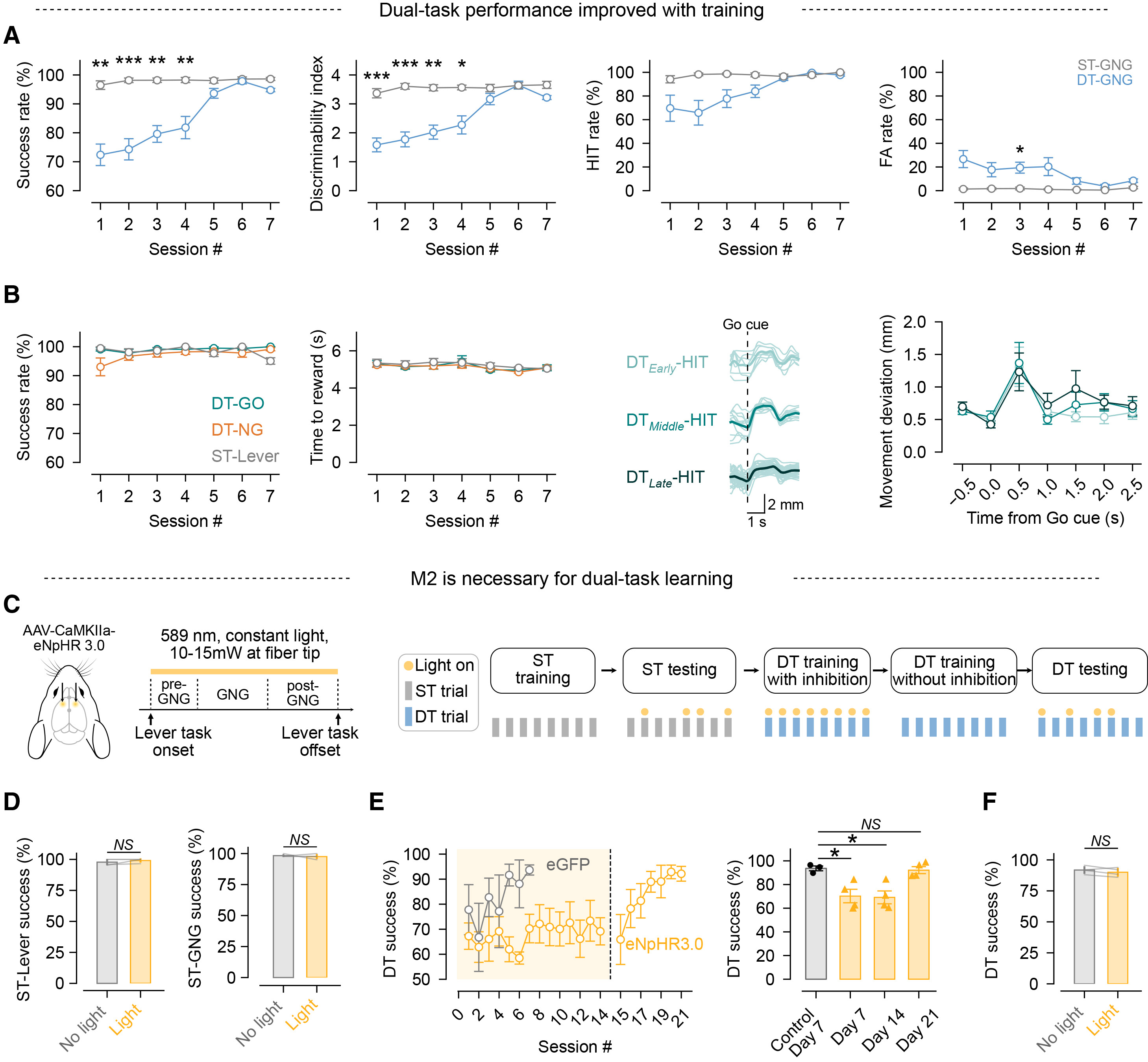
Across 7 sessions of DTT, mice significantly improved their DT-GNG success rate, HIT rate, and discriminability while reducing false alarms, whereas transient Go-trial lever deviations persisted (Figures 5A and 5B). To test whether M2 is causally required for this learning process, the authors bilaterally expressed AAV-CaMKIIα-eNpHR3.0 in M2 and delivered 589 nm light during trials (Figure 5C). Moderate M2 photoinhibition did not impair expert single-task lever or GNG performance (Figure 5D) or expert post-training DT execution (Figure 5F), but completely abolished training-dependent improvements in DT success—even after twice as many training sessions—until illumination was discontinued (Figure 5E). Stronger suppression via ChR2 activation of M2 parvalbumin (PV) interneurons impaired both single- and dual-task execution as well as DT learning, establishing a causal role for M2 in adaptive multitasking.
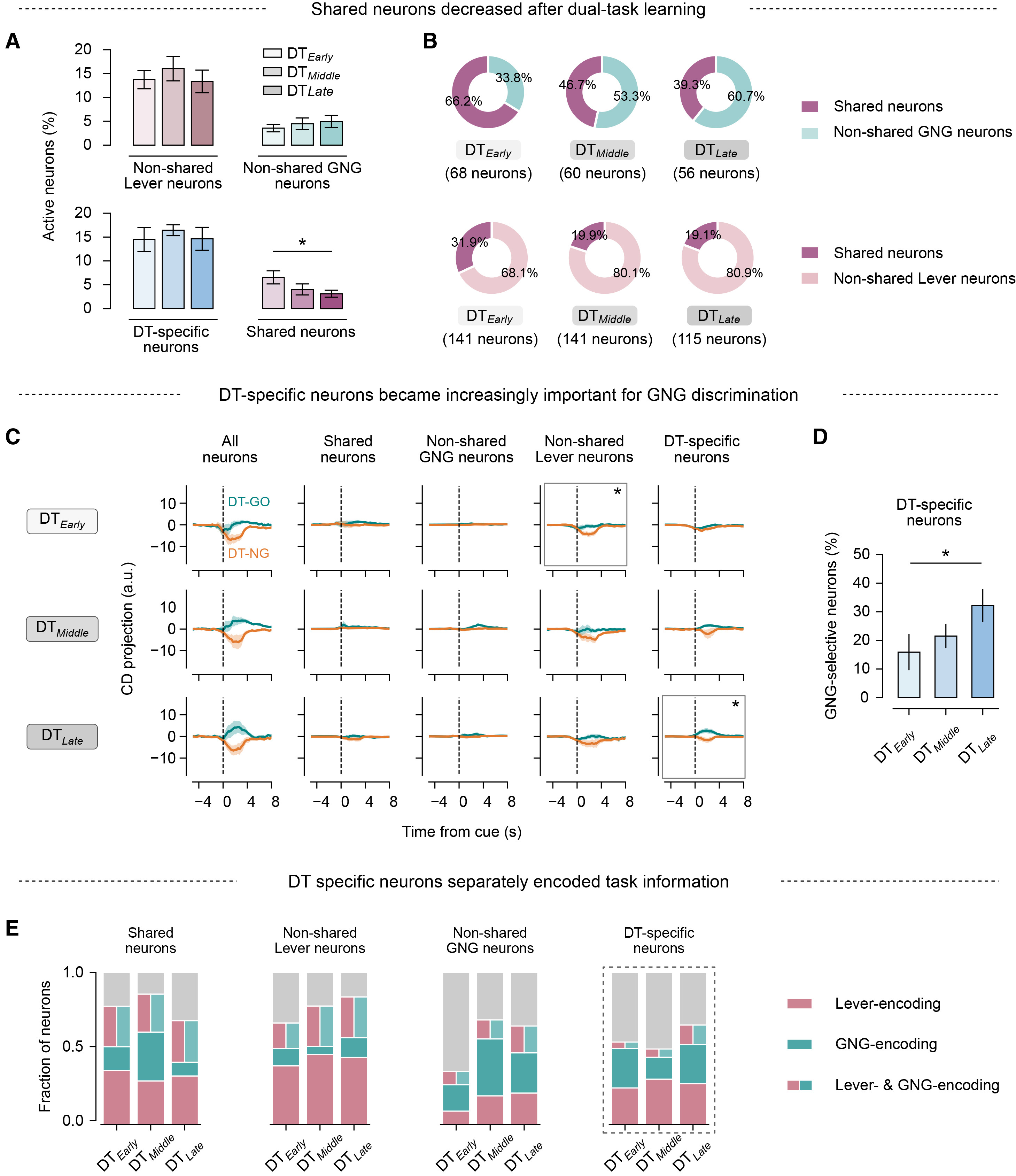
Longitudinal tracking across early (DTEarly), middle (DTMiddle), and late (DTLate) training stages revealed a multi-level reorganization of M2 ensembles (Figure 6). First, the proportion of task-shared neurons declined significantly with training (from 66.2% to 39.3% among GNG-responsive neurons and from 31.9% to 19.1% among lever-responsive neurons), leaving non-shared neurons as the dominant contributors (Figures 6A and 6B). Second, the primary neural substrate supporting population DT-GNG discrimination shifted from non-shared lever neurons in DTEarly to newly recruited DT-specific neurons in DTLate (Figure 6C). Third, the fraction of GNG-selective DT-specific neurons increased significantly after training (Figure 6D), and GLM variance partitioning showed that individual DT-specific neurons specialized in encoding either lever or GNG variables rather than mixing both (Figure 6E).
Source: Shuting Wang et al. · Neuron · © Elsevier Inc.
Original figure and English caption ↗
Convergent Evolution in Biological and Artificial Networks: From Negative Correlation to Orthogonalization
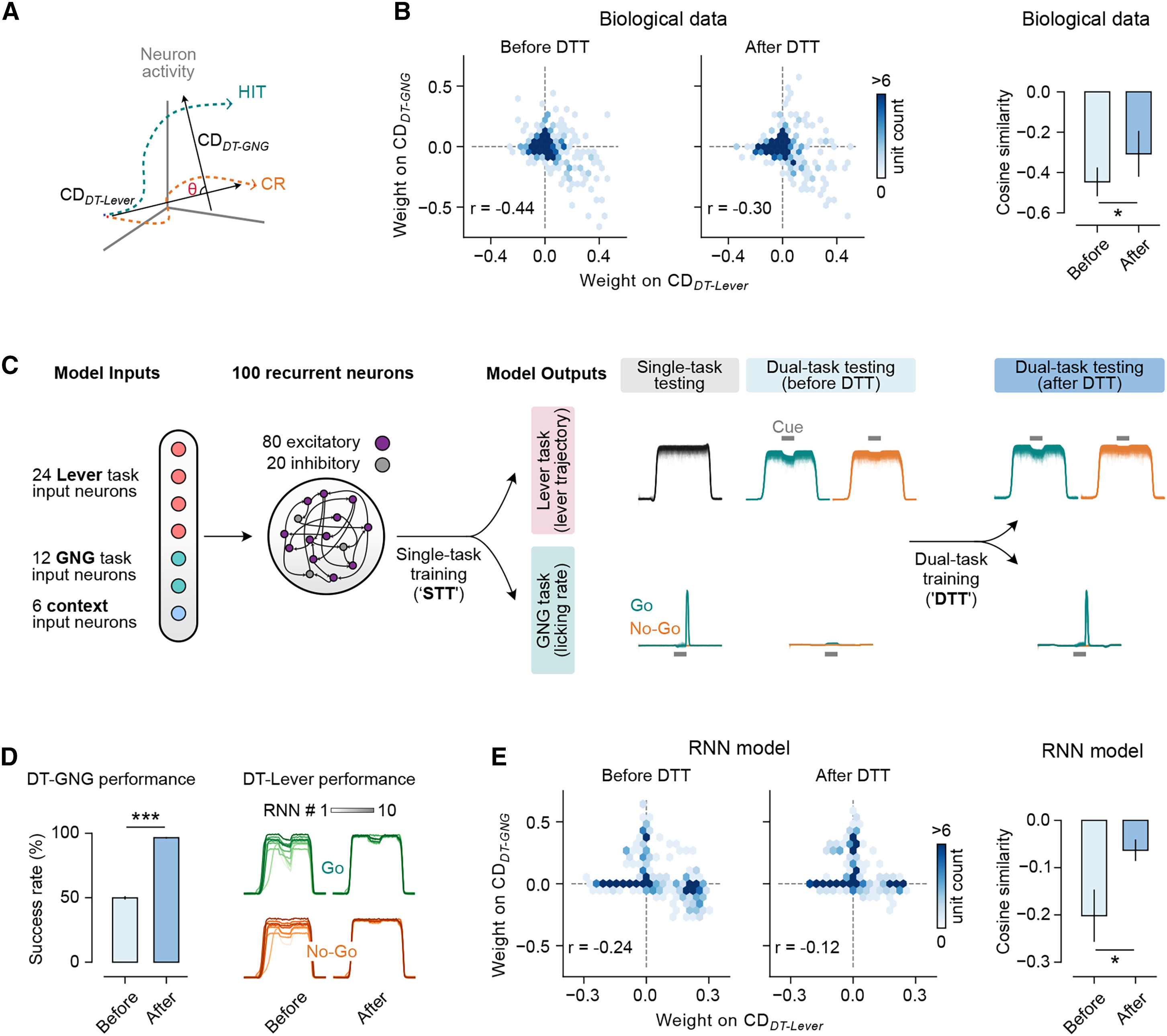
To quantify geometric alignment between the two tasks in population activity space, the authors computed the cosine similarity between the dual-task lever coding direction (CDDT-Lever) and GNG coding direction (CDDT-GNG) (Figure 7A). Before DTT, neuronal weights on the two coding dimensions were negatively correlated (r = -0.44; Figure 7B), reflecting the early coordination regime in which reduced activity of non-shared lever neurons during Go trials aided GNG discrimination. After DTT, the cosine similarity shifted significantly toward zero (r = -0.30; Figure 7B), demonstrating that training orthogonalizes task representations into more independent subspaces.
To test whether this transition represents a general computational principle, the authors trained rate-based recurrent neural networks (RNNs; 80 excitatory and 20 inhibitory units receiving lever, GNG, and context inputs) using the same staged curriculum (Figure 7C). Prior to DTT, single-task-trained RNNs recapitulated key mouse behaviors—exhibiting reduced DT-GNG accuracy and selective Go-trial lever deviations—along with negatively correlated CDDT-Lever and CDDT-GNG unit weights (r = -0.24; Figures 7D and 7E). Subsequent dual-task training restored RNN GNG accuracy while shifting the cosine similarity between lever and GNG coding dimensions toward zero (r = -0.12; Figures 7D and 7E), a pattern that held across varying regularization, dropout, and network-size parameters.
Source: Shuting Wang et al. · Neuron · © Elsevier Inc.
Original figure and English caption ↗
Reverse-Engineering the Principle: Combining Coordination and Segregation Accelerates Learning
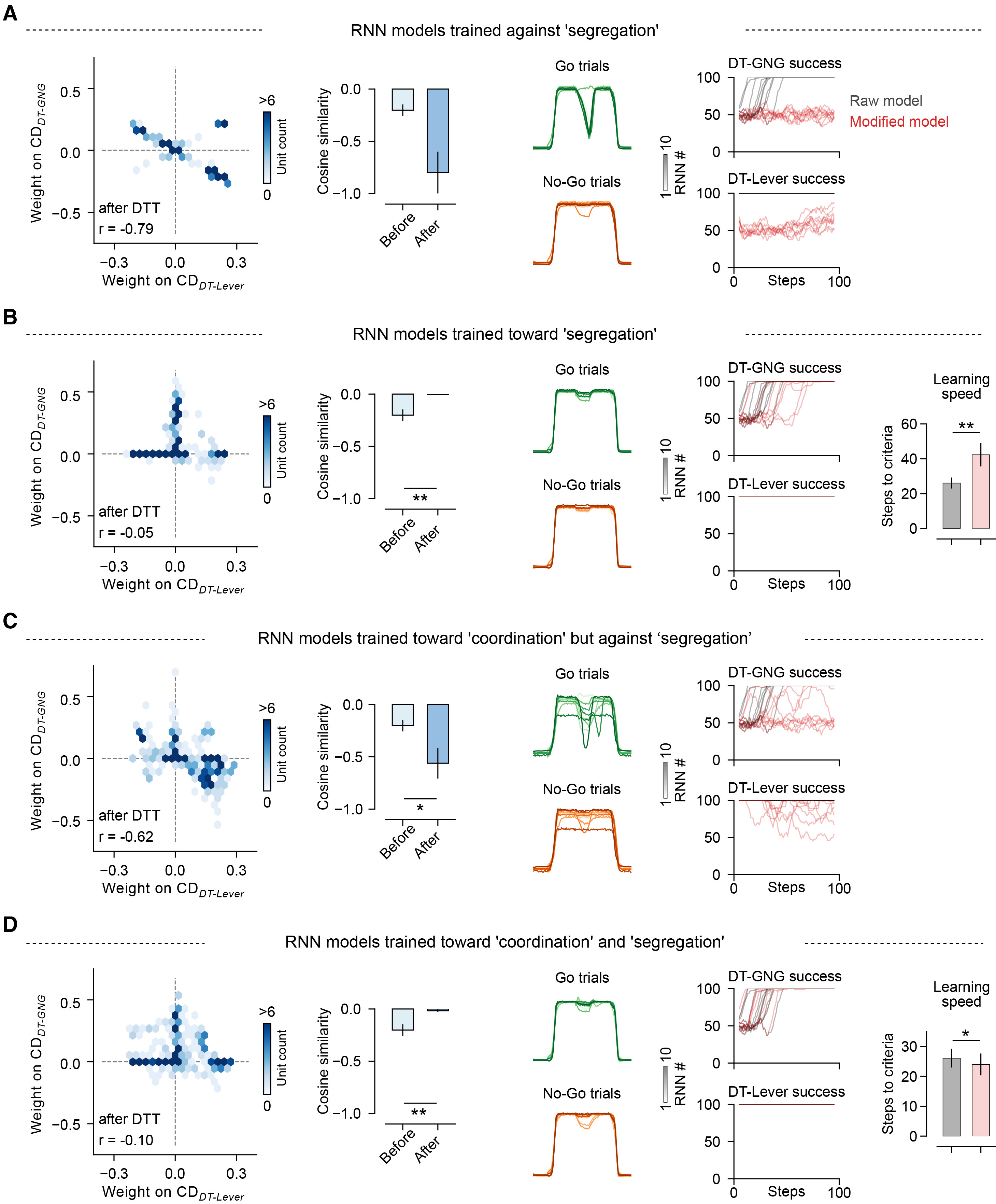
To test the causal contributions of coordination and segregation, the authors reverse-engineered the RNN by adding cosine-similarity constraints between CDDT-Lever and CDDT-GNG directly into the training loss function (Figure 8). Forcing lever and GNG representations to remain correlated ('against segregation') prevented DT-GNG improvement and exacerbated Go-trial lever deviations (Figure 8A). Conversely, enforcing global orthogonalization across all network units ('toward segregation') enabled successful DT learning but significantly slowed the learning speed compared with unconstrained networks (Figure 8B).
Reasoning that uniform orthogonalization disrupted the adaptive early coordination mediated by oppositely tuned units, the authors implemented a hybrid loss regime: 'coordination units' (units with opposite weight signs on CDDT-Lever and CDDT-GNG) were updated solely by task performance, whereas the remaining units received an orthogonalization loss (Figures 8C and 8D). Preserving early coordination while promoting representational segregation in the remaining population enabled RNNs to master the dual task significantly faster than control networks (Figure 8D). Together, these findings reveal how higher cortex resolves multitasking conflicts—combining rapid early coordination with progressive representational segregation to balance flexibility and specialization.
Source: Shuting Wang et al. · Neuron · © Elsevier Inc.
Original figure and English caption ↗