What deserves notice? Two striatal pathways tune amygdalar signals
Accumbal D1 and D2 neurons oppositely regulate amygdalar acetylcholine through the basal forebrain, linking behavioral significance with associative learning.
A sound may predict water or signal that action is needed. The brain does not assign equal significance to every event: experience and bodily needs change what matters. A study published in Nature Neuroscience on June 26, 2026 traces regulation among the mouse nucleus accumbens, basal forebrain and amygdala. D1- and D2-expressing medium spiny neurons, both inhibitory populations, drive amygdalar acetylcholine release in opposite directions. The effect depends on which downstream cells receive the inhibition.
Accumbal D1 and D2 neurons promote and suppress basolateral amygdalar acetylcholine through different inhibitory relationships in the substantia innominata. Their activity and manipulation have distinct associations with reward learning.
Contents · 6 sections
Significance depends on the current context
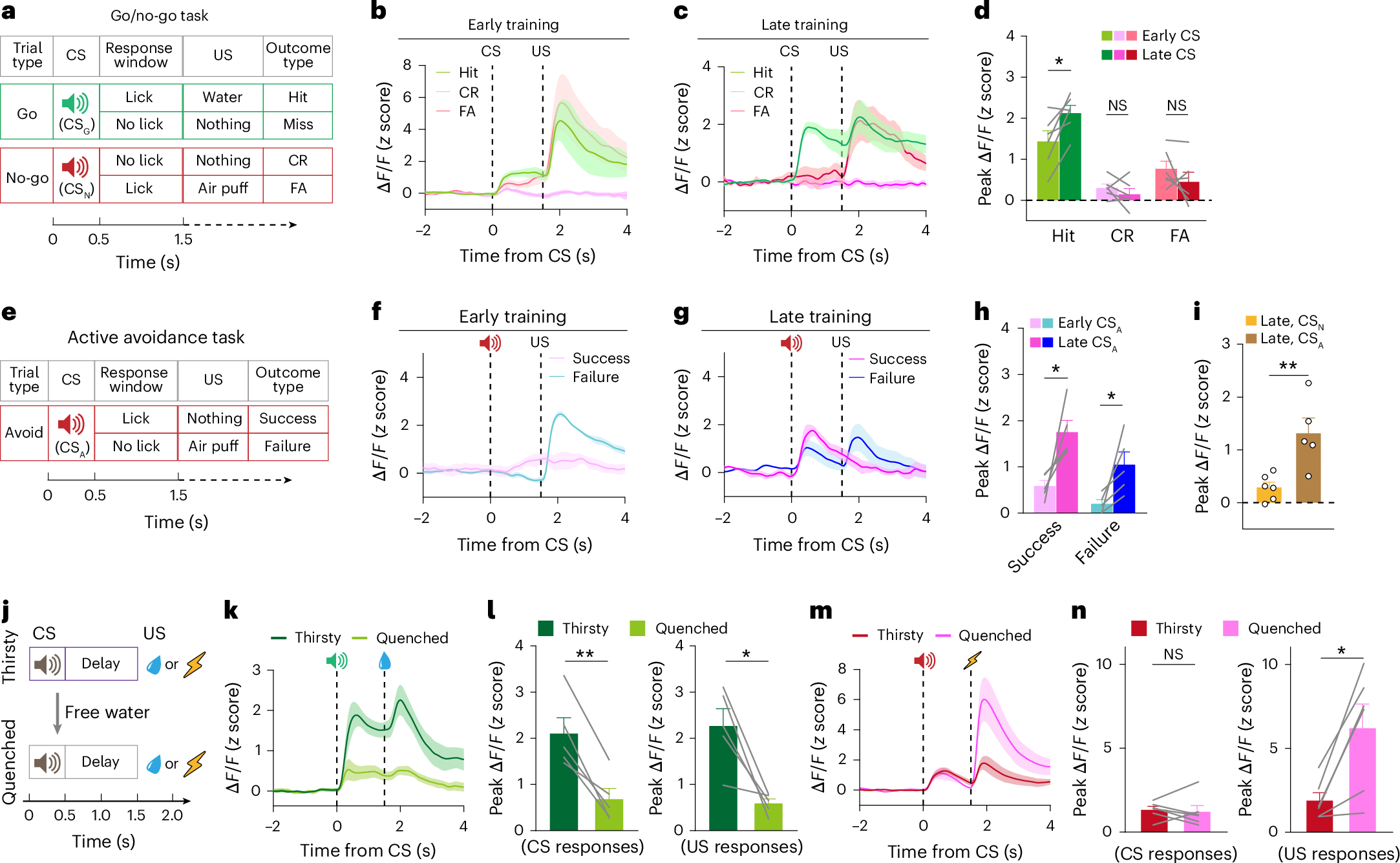
Basolateral amygdalar acetylcholine changed with task context and learning. Cue responses increased on rewarded hit trials in a go/no-go task and during active avoidance training. Punishment-associated cues elicited different responses across the tasks, relating the chemical signal to behavioral demands.
After thirst was quenched, responses to water-predicting cues and water delivery decreased. Punishment-cue responses did not significantly change, while responses during punishment increased. The signal therefore varies with context and state, rather than following a fixed scale of positive and negative events.
Source: Aixiao Chen et al. · Nature Neuroscience ·
Original figure and English caption ↗
Two inhibitory populations drive opposite effects
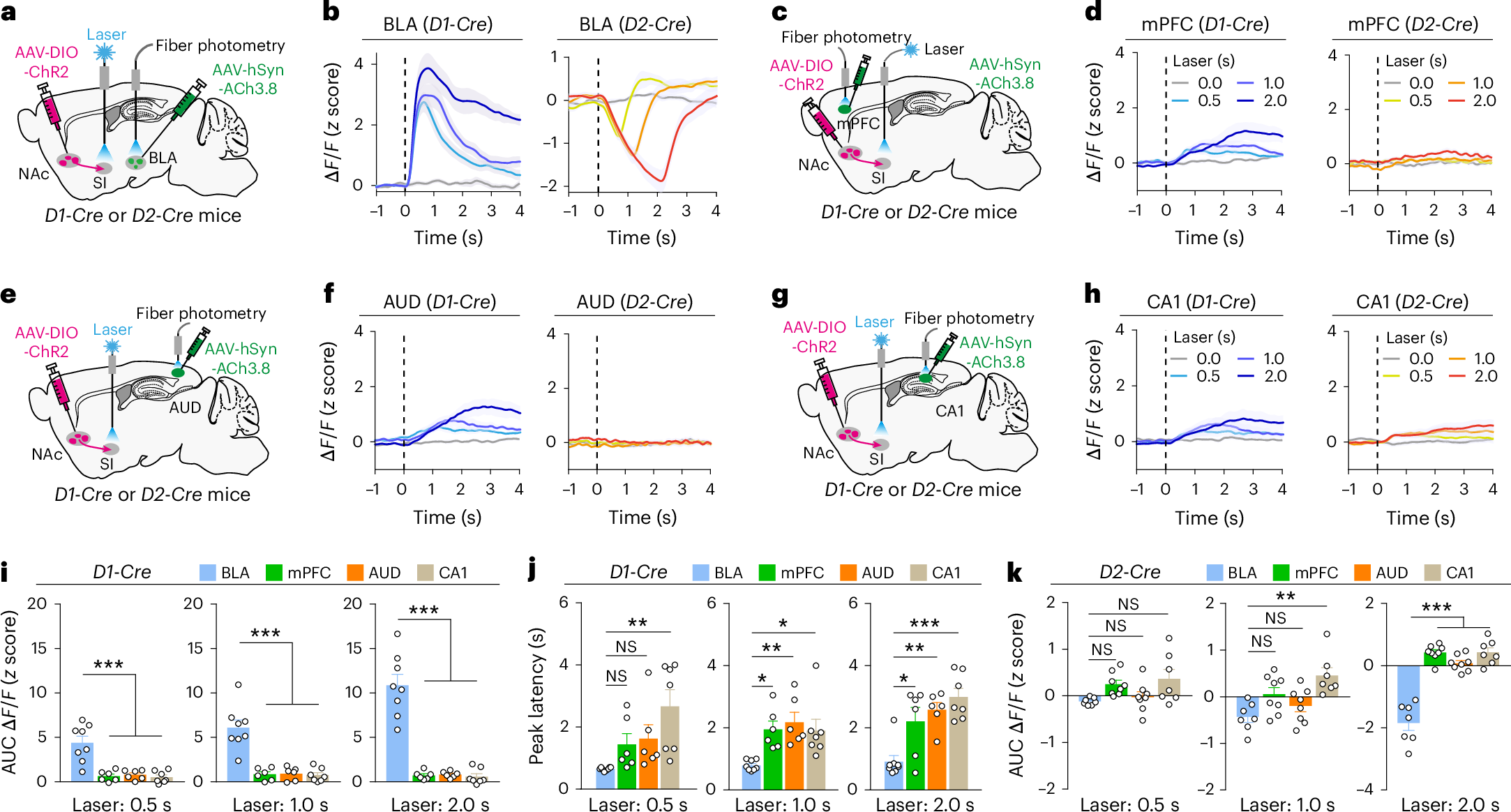
Activating accumbal axons in the substantia innominata produced opposing effects. The D1 pathway increased amygdalar acetylcholine, while the D2 pathway decreased it, revealing opposite regulation of the same downstream chemical signal.
The effect was regionally biased. Prefrontal, auditory-cortical and hippocampal CA1 responses were weaker than the amygdalar response, with timing differences for D1-evoked signals. These comparisons point to preferential amygdalar regulation rather than a uniform change throughout the brain.
Source: Aixiao Chen et al. · Nature Neuroscience ·
Original figure and English caption ↗
Inhibiting a brake can strengthen the output
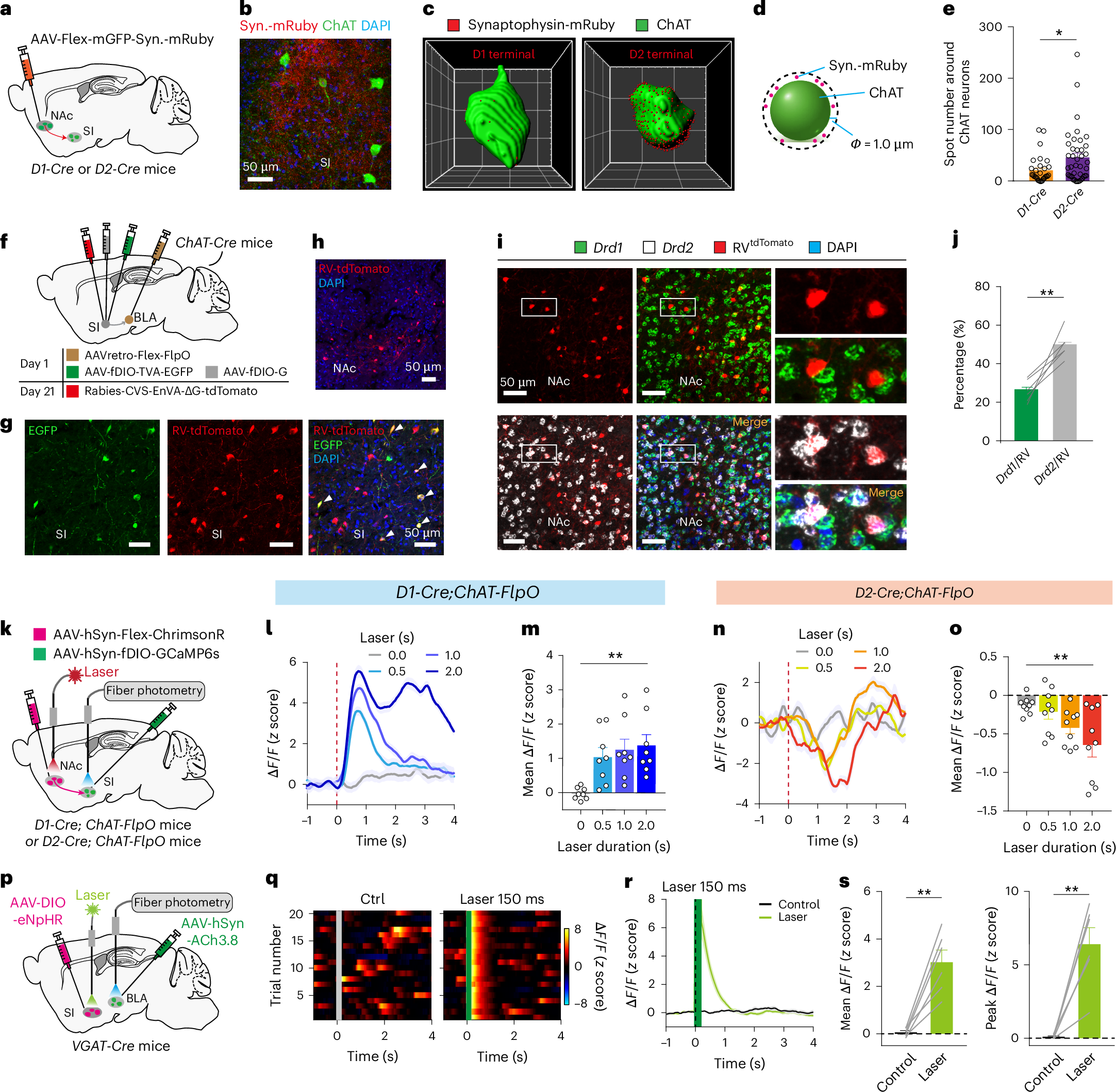
Cholinergic neurons in the substantia innominata contribute to amygdalar acetylcholine release. D1 and D2 inputs differ in their distribution around these neurons and their connectivity preferences. D2 inputs inhibit cholinergic activity, while D1 inputs promote it through local disinhibition.
Activating the two inputs increased or decreased cholinergic activity, respectively. Inhibiting local GABAergic neurons also increased amygdalar acetylcholine. These observations make the disinhibitory logic concrete: inhibition of a local brake can increase the final output. Connectivity preferences determine net effects without implying exclusive connections.
Source: Aixiao Chen et al. · Nature Neuroscience ·
Original figure and English caption ↗
Both pathways regulate reward- and shock-evoked signals
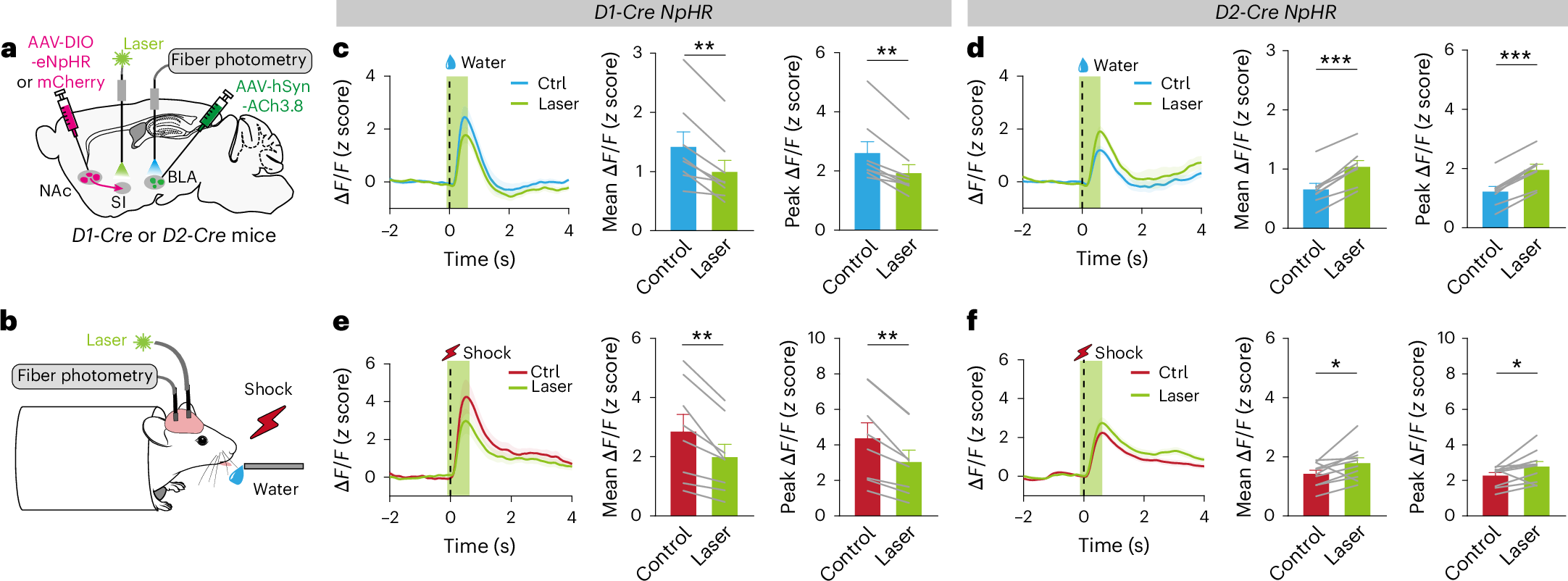
Inhibiting the D1 pathway during water delivery or shock attenuated amygdalar acetylcholine responses, whereas inhibiting D2 enhanced them. The opposing effects therefore occurred during both rewarding and aversive events.
Control illumination did not produce the same changes, and measured licking during water delivery did not significantly change. These controls distinguish signal modulation from the accompanying measured behavior. The pathways are not assigned exclusively to reward or punishment; both regulate event-evoked chemical responses.
Source: Aixiao Chen et al. · Nature Neuroscience ·
Original figure and English caption ↗
Learning changes the relationship with amygdalar signals
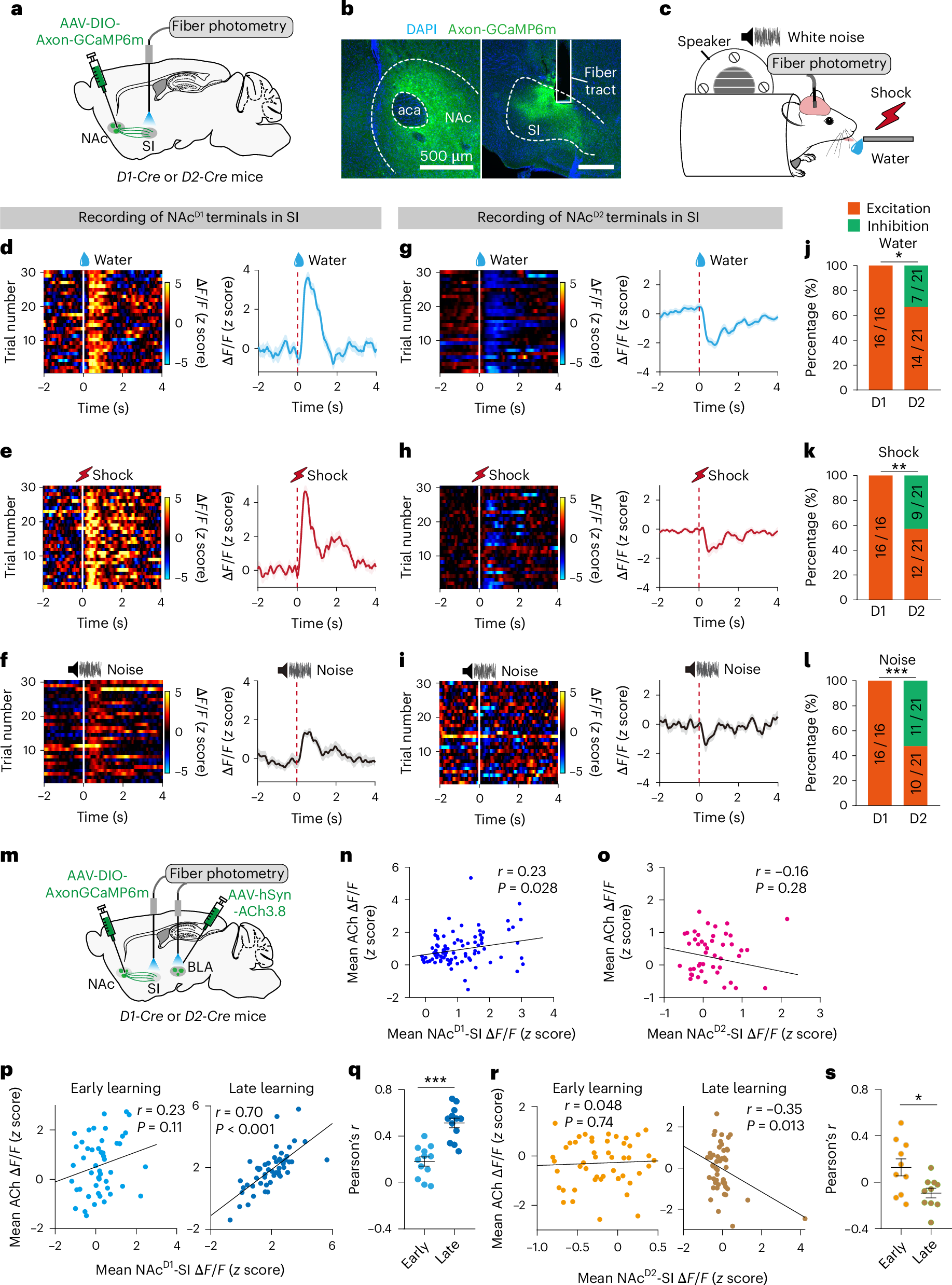
D1 axonal recordings predominantly increased during water, shock and white noise, whereas D2 recordings included increases and decreases. Their response distributions differed rather than forming perfect mirror images for each event.
Across stimulus recordings, D1 activity showed a weak positive correlation with acetylcholine, while the overall D2 correlation was not significant. During cue periods, learning strengthened the D1 relationship and reduced the D2 relationship. These associations describe experience-dependent coordination without assigning every release event to one input alone.
Source: Aixiao Chen et al. · Nature Neuroscience ·
Original figure and English caption ↗
Chemical-signal regulation accompanies altered learning
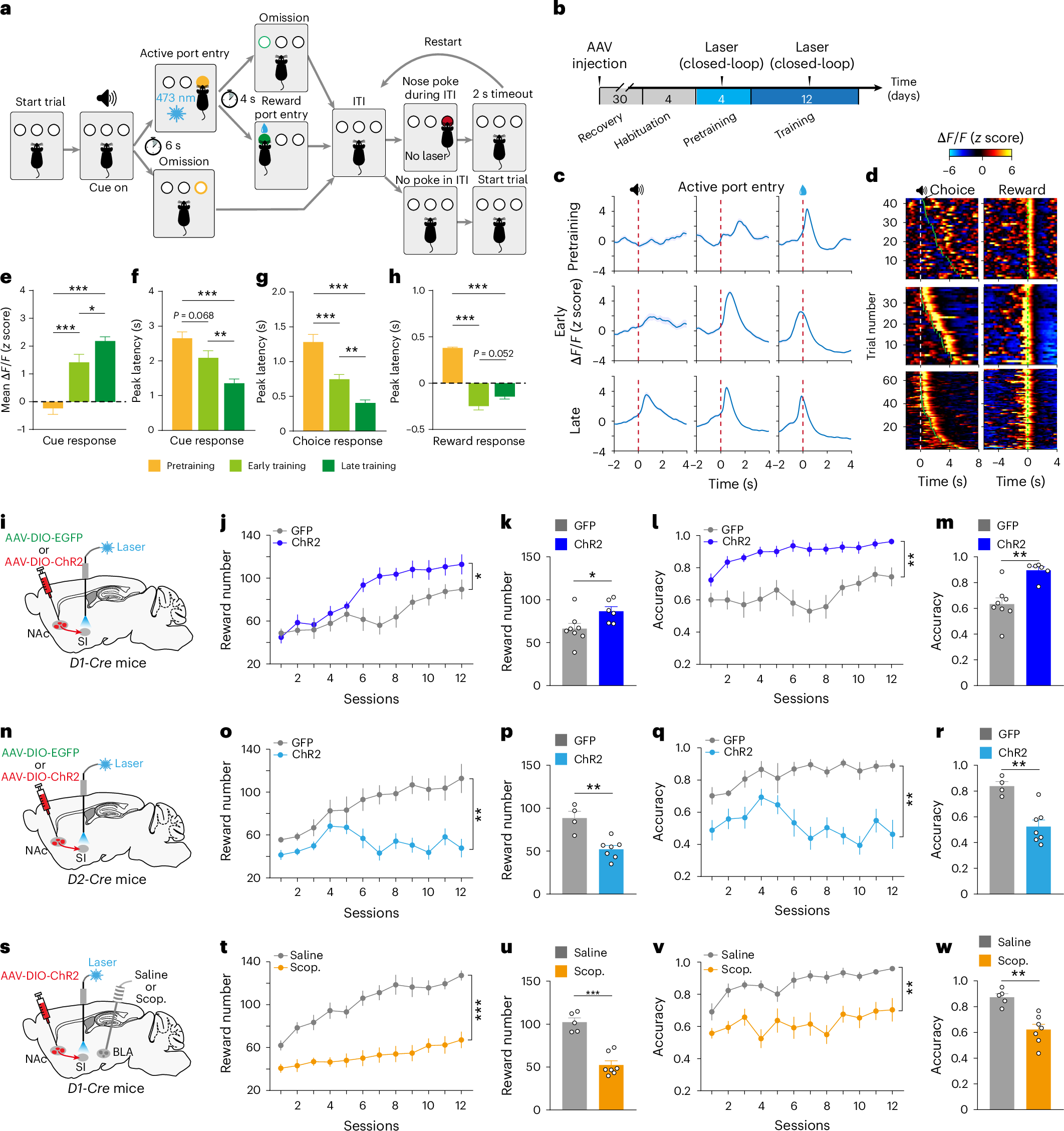
In a cue-guided reward task, closed-loop D1-pathway activation increased earned rewards and accuracy, whereas D2 activation reduced both. Opposing chemical effects were thus accompanied by different associative-learning performance.
With local muscarinic-receptor antagonism in the amygdala, performance during D1 activation was lower than with saline. In complementary inhibition experiments, D1 inhibition impaired performance, while D2 inhibition did not significantly change rewards or accuracy. This asymmetry shows that the pathways are not interchangeable controls under every manipulation. The findings expand the circuit-level view of striatal involvement in behavioral significance and learning.
Source: Aixiao Chen et al. · Nature Neuroscience ·
Original figure and English caption ↗