After a rancid odor: piriform cortex separates bodily action from place aversion
A male-mouse study finds that a shared olfactory cortical entry uses thalamic and accumbal outputs to influence retching-like actions and avoidance of an odor-paired place.
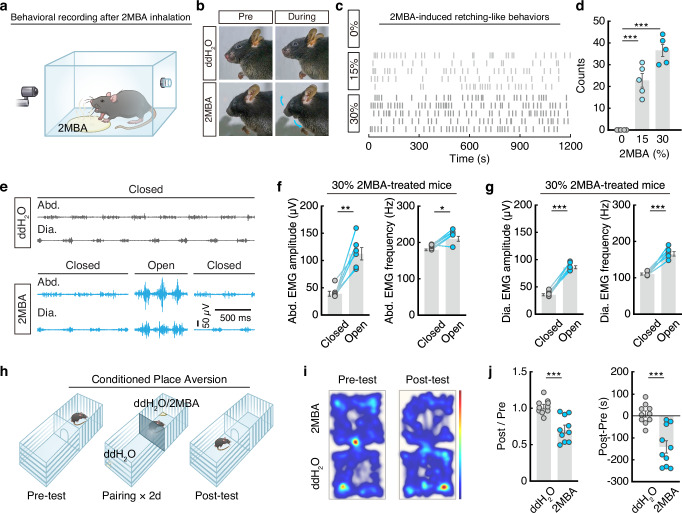
An unpleasant odor can trigger an immediate bodily response and teach an animal to avoid the place later. These outcomes often coincide but may use different pathways. A 2026 Nature Communications study follows the rancid-associated odorant 2-methylbutyric acid (2MBA) through anterior piriform cortex (aPir) in male mice. One output affects retching-like mouth and respiratory-muscle actions; another affects place aversion. A single odor experience diverges into different defensive responses.
aPir–MD output affects retching-like actions and muscle activity, while aPir–NAc affects place aversion. Bidirectional modulation reveals different functional routes after a shared olfactory entry.
Contents · 6 sections
Bodily action and place avoidance occur together
Among tested unpleasant odorants, 2MBA evoked clearer mouth opening, increasing with concentration. Diaphragm and external-oblique electrical activity also increased in amplitude and frequency, indicating respiratory-muscle participation. Other odorants and water lacked the same pattern, supporting the description of retching-like action.
Mice lack typical vomiting capacity, and this action did not involve gastric expulsion. They also spent less time in the odor-paired place, a separate defensive outcome. Impaired olfaction weakened both, identifying a shared sensory entry while leaving open how immediate bodily action and place choice diverged.
Source: Dong WY et al. · Nature communications · CC BY-NC-ND
Original figure and English caption ↗
Piriform cortex gathers the odor experience
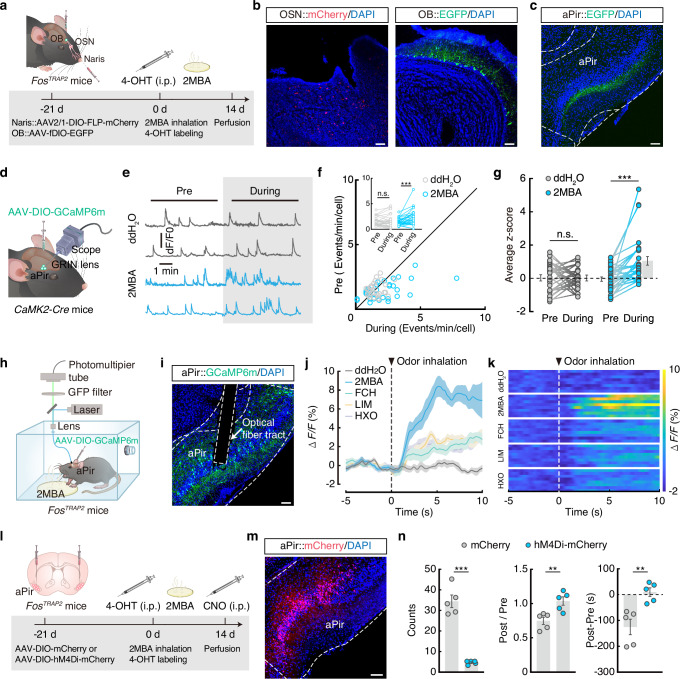
Tracing odor-recruited olfactory cells highlighted outputs to aPir, where recruited cortical cells were predominantly glutamate-associated. Some responded only to 2MBA, others to additional odors. The population response was stronger for 2MBA without forming an entirely rancid-specific ensemble.
Suppressing the 2MBA-labeled aPir ensemble reduced both mouth actions and place aversion, identifying a shared node. Attention then turned to its outputs: if odor experience reaches multiple regions, do bodily action and place choice diverge farther downstream?
Source: Dong WY et al. · Nature communications · CC BY-NC-ND
Original figure and English caption ↗
Toward thalamus or accumbens
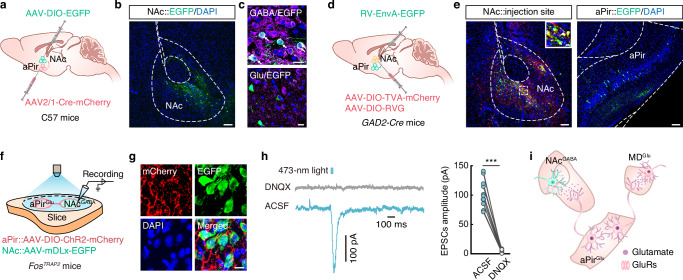
aPir projects broadly; the study focused on mediodorsal thalamus (MD) and nucleus accumbens (NAc). MD recipients were mainly glutamatergic and NAc recipients mainly GABAergic. Tracing and AMPA-sensitive terminal-evoked currents supported both connections, bringing cortical excitation into distinct networks.
MD- and NAc-projecting cells were largely separate with some overlap. The divergence thus emerged within a shared sensory system rather than isolated wires. Comparing responses and functions revealed how one odor experience could produce two separately modifiable outcomes.
Source: Dong WY et al. · Nature communications · CC BY-NC-ND
Original figure and English caption ↗
The thalamic route affects mouth and respiratory-muscle actions
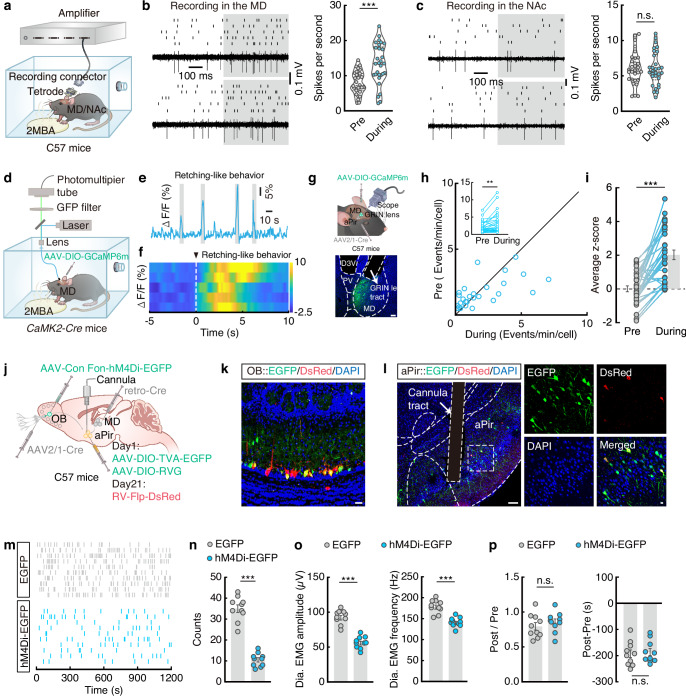
MD firing and calcium increased during retching-like bouts, while NAc lacked matching action-locked changes. Suppressing aPir–MD reduced actions while preserving place aversion. Suppression of the odor-entry-defined route also reduced actions and diaphragm activity, identifying a bodily-response contribution after the shared entry.
Enhancing these terminals evoked actions without real-time place aversion. Opposite manipulations converged on a dissociation: bodily response need not entail altered place choice. The result clarified the distinction between an unpleasant odor and the defensive response it produces.
Source: Dong WY et al. · Nature communications · CC BY-NC-ND
Original figure and English caption ↗
Accumbens relates more closely to place choice
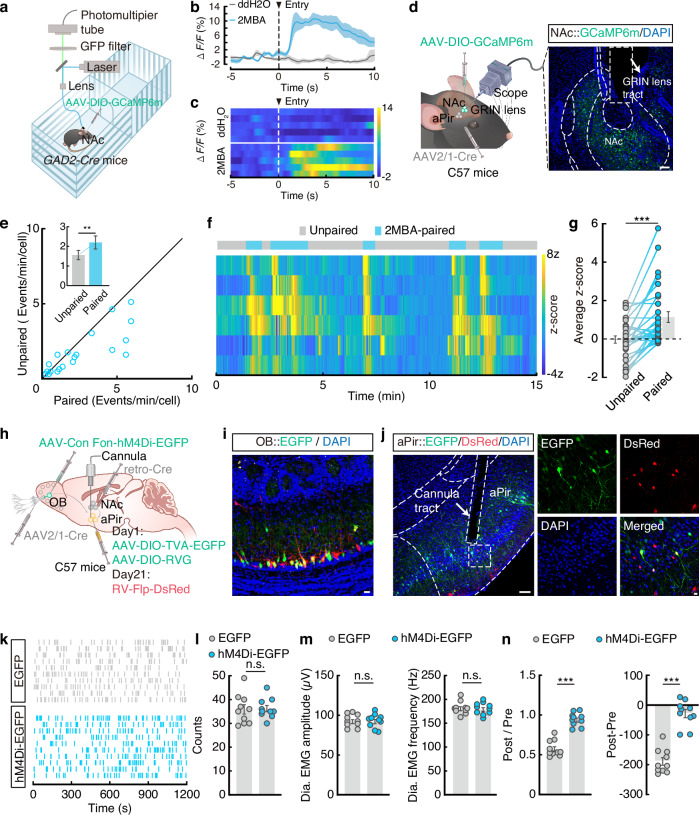
NAc GABA cells and aPir recipients increased activity on entry to the odor-paired place, without matching changes during retching. Suppressing aPir–NAc or the relevant olfactory route weakened aversion while largely preserving action and EMG. Enhancing terminals evoked real-time aversion without actions, complementing the MD results.
Other unpleasant odors also recruited these NAc responses, extending the aversion route beyond 2MBA. Immediate action and later place avoidance are both defensive, yet the brain distributes them across networks with different functional biases. Separating the outcomes exposes each output’s contribution.
Source: Dong WY et al. · Nature communications · CC BY-NC-ND
Original figure and English caption ↗
Bodily action extends toward brainstem networks
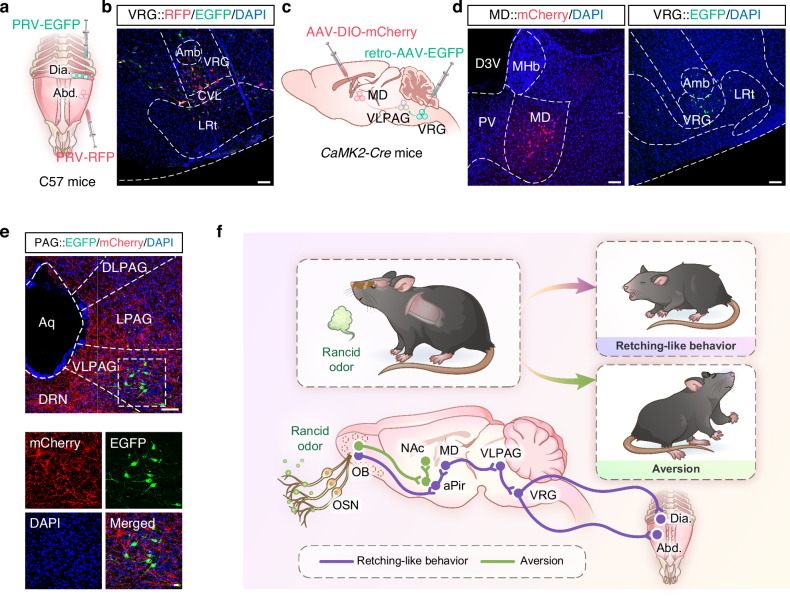
Multisynaptic tracing from diaphragm and external oblique converged in respiratory-related regions. MD terminals lay near VLPAG cells projecting toward ventral respiratory group (VRG); enhancing MD–VLPAG increased actions and both muscle signals. This added a functional segment linking thalamus with bodily responses.
This male-mouse study describes divergence between odor-evoked retching-like action and aversion; the complete chain to muscles remains to be established segment by segment. Its clearest result is that two defensive outcomes can be separately increased or reduced after a shared sensory entry, revealing different action exits from one odor experience.
Source: Dong WY et al. · Nature communications · CC BY-NC-ND
Original figure and English caption ↗