How do waiting actions help mice keep time?
Fewer waiting presses delay stopping, while extra presses advance it. Bidirectional experiments support action accumulation and reexamine dopamine’s relationship with timing.
Repeated movements during a wait may pass the time or help track it. A 2026 Science Advances study addresses this in mice trained to press a lever for food after a fixed interval. Removing waiting actions delayed stopping; adding actions advanced it. Repetition resembled countable pulses informing the decision to stop. This account also yielded a surprising result: increasing dopamine did not always shift stopping, particularly when actions remained unchanged.
In a trained fixed-interval task, press-count changes relate to stop-time shifts. Brainstem suppression and thalamic facilitation provide bidirectional support, while dopamine enhancement has different timing effects depending on action changes.
Contents · 6 sections
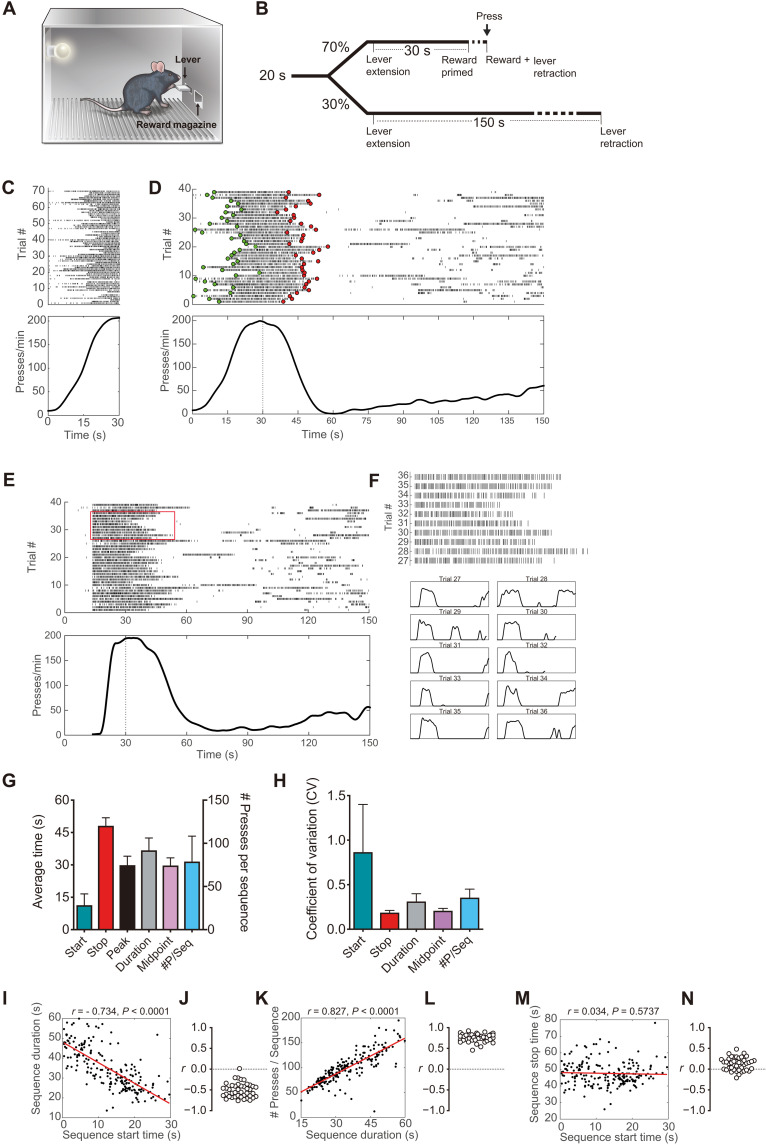
An average peak hides a plateau of actions
Food followed the first press after 30 seconds. During extended unrewarded probes, mice pressed for a while and then stopped. Averaging trials produced a peak near 30 seconds, but aligning each bout to its onset revealed a near-constant-rate plateau. Variation in starting and stopping largely generated the average peak.
Stopping was less variable than onset, duration and count. An earlier start tended to produce a longer bout without necessarily predicting earlier termination. Separating stopping from the average peak allowed a sharper question: did animals rely on elapsed seconds or on actions accumulated while waiting?
Source: Strassmann P et al. · Science Advances · CC BY-NC
Original figure and English caption ↗
After a pause, animals extend the wait
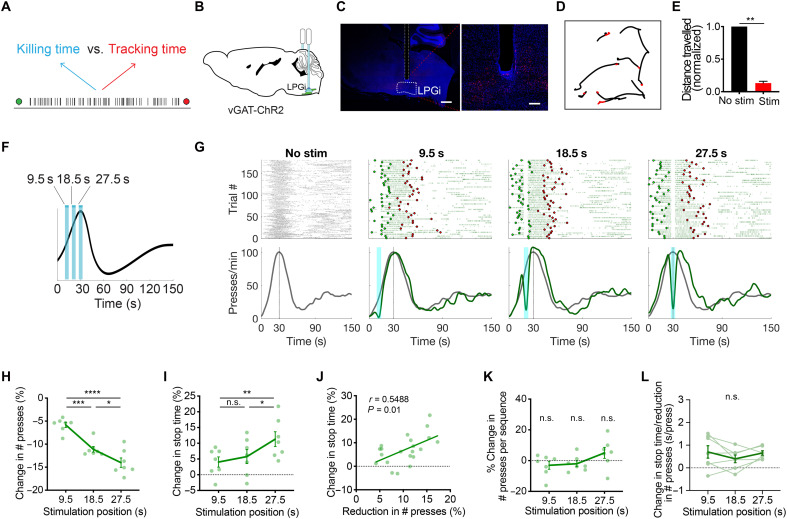
Enhancing GABA cells in the lateral paragigantocellular nucleus (LPGi) temporarily suppressed actions. Equal pauses at different waiting phases removed more presses later, when pressing was higher, and produced later stopping. Different delays after equal pauses related more closely to missing actions than pause duration.
Missing presses correlated with delay, while total bout count remained comparable. Animals appeared to make up the absent pulses after the pause. This supported action accumulation and motivated its reverse prediction: would extra actions during waiting advance stopping?
Source: Strassmann P et al. · Science Advances · CC BY-NC
Original figure and English caption ↗
Signals track pressing rather than a continuous ramp
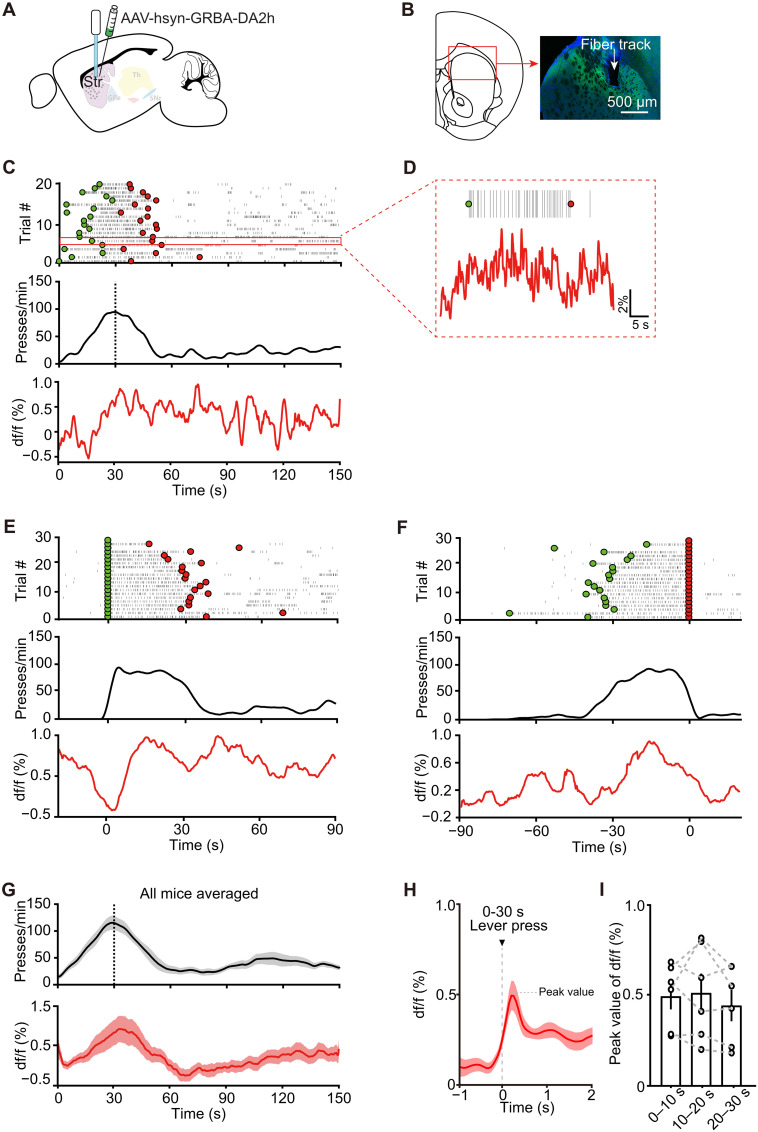
Dorsal striatal dopamine related to press rate without a clear elapsed-time ramp or uniform drop at 30 seconds. Press-aligned peaks were comparable across waiting phases, with similar patterns medially and laterally. These recordings linked signals closely to ongoing actions.
Dopamine is closely tied to movement, motivation and reward, and has been discussed as a direct influence on an internal clock. The findings suggested an alternative route through changes in action structure. Interventions then tested whether increased dopamine and altered actions always occurred together.
Source: Strassmann P et al. · Science Advances · CC BY-NC
Original figure and English caption ↗
More dopamine need not move stopping time
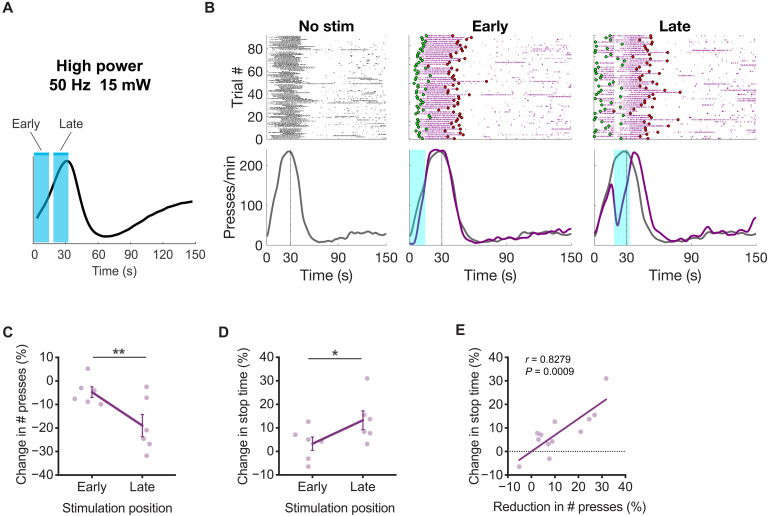
Stronger nigral stimulation increased dopamine, suppressed waiting presses and delayed stopping. Weaker stimulation still increased release and produced place preference without clear pressing or stop-time changes. Increased signals had clearer timing effects when actions also changed.
Long stimulation early in the wait left actions and stopping broadly unchanged; later stimulation altered both. Timing and pattern changed the context, so dopamine elevation alone did not predict the outcome. In this task, waiting actions were essential to understanding termination.
Source: Strassmann P et al. · Science Advances · CC BY-NC
Original figure and English caption ↗
Extra presses advance stopping
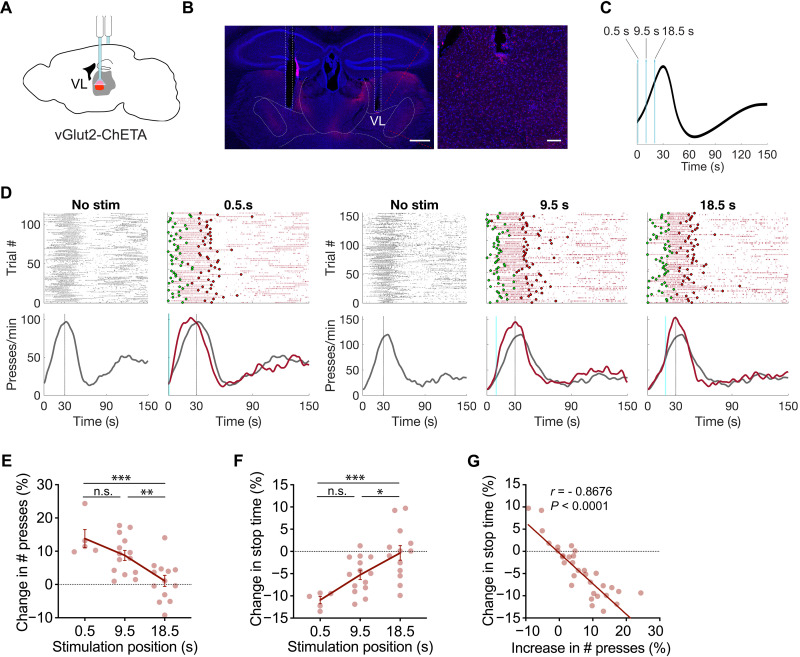
The behavioral-integration model treats each press as a pulse accumulated toward a reference threshold. It explains delays after action removal and predicts advances with added actions. Enhancing glutamatergic VL thalamic cells increased waiting presses and advanced stopping, with larger count increases relating to larger advances.
Opposite changes in motor-related regions converged: fewer actions delayed and more actions advanced stopping. The model’s accumulator has not been directly recorded, and feedback or energetic processes may contribute. The reverse test nevertheless gives action-based timing functional support beyond correlation.
Source: Strassmann P et al. · Science Advances · CC BY-NC
Original figure and English caption ↗
An animal’s own actions can supply temporal cues
The study returns timing to an actual wait: when action starts, how it proceeds and when it ends. Timing shifts after motor-region manipulation may involve the accumulation of the animal’s own actions. Details hidden by averaging become crucial, with each press potentially contributing a cue to stop.
Evidence comes from trained adult male and female mice in a fixed-interval lever task, rather than all temporal-perception settings. It suggests attending to what an animal does during an interval when asking how the brain tracks seconds. Waiting actions can participate in temporal computation rather than merely follow it.