Witnessing stress can change avoidance behavior in mice
Repeatedly witnessing social defeat reduces later exploration of exposed spaces in mice. The change involves context-related VTA activity and NAc input, without sustained social avoidance or reduced sucrose preference.

Stress need not arise from events directly experienced. Mice that observe a conspecific being attacked through a transparent divider later explore exposed areas less. A study published in Nature Communications on January 31, 2022 examines the circuitry of this change in male mice witnessing social defeat. It links the ventral tegmental area (VTA) with input from the nucleus accumbens (NAc), showing that the meaning of activity depends on behavioral context and on the population observed or manipulated. Regions familiar from reward research here contribute to exploration after aversive experience.
After witnessed stress, VTA dopamine-related populations show greater calcium activity during open-arm exploration, but not significant changes in basal firing or social-test responses. Broader VTA populations, NAc terminals and input-related VTA recipients provide distinct behavioral evidence.
Contents · 7 sections
Which behaviors change after witnessing stress?
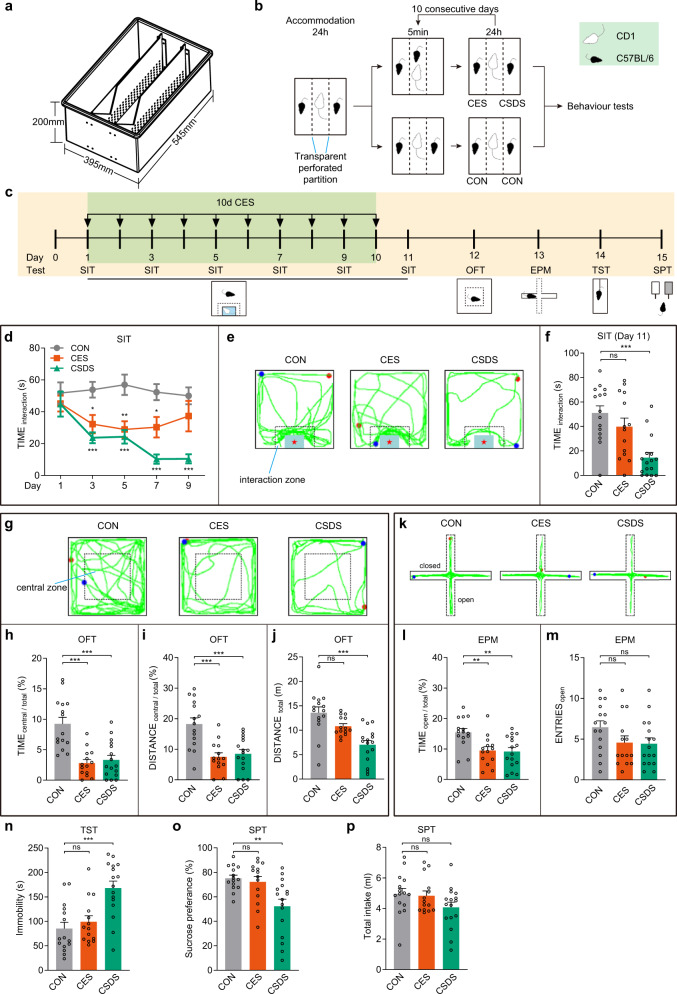
The study compares observers with mice directly subjected to social defeat. Repeated observation reduces time and distance in the open-field center and time in elevated-maze open arms. Open-arm entries and total open-field distance do not significantly change, separating increased avoidance from reduced overall movement.
Social time in observers initially falls but later returns near control levels. Tail-suspension immobility and sucrose preference also remain unchanged, unlike directly defeated mice. The witnessed experience therefore produces a selective behavioral pattern rather than uniformly worsening all measures.
Source: Qi G et al. · Nature communications · CC BY
Original figure and English caption ↗
A stronger response in a particular setting
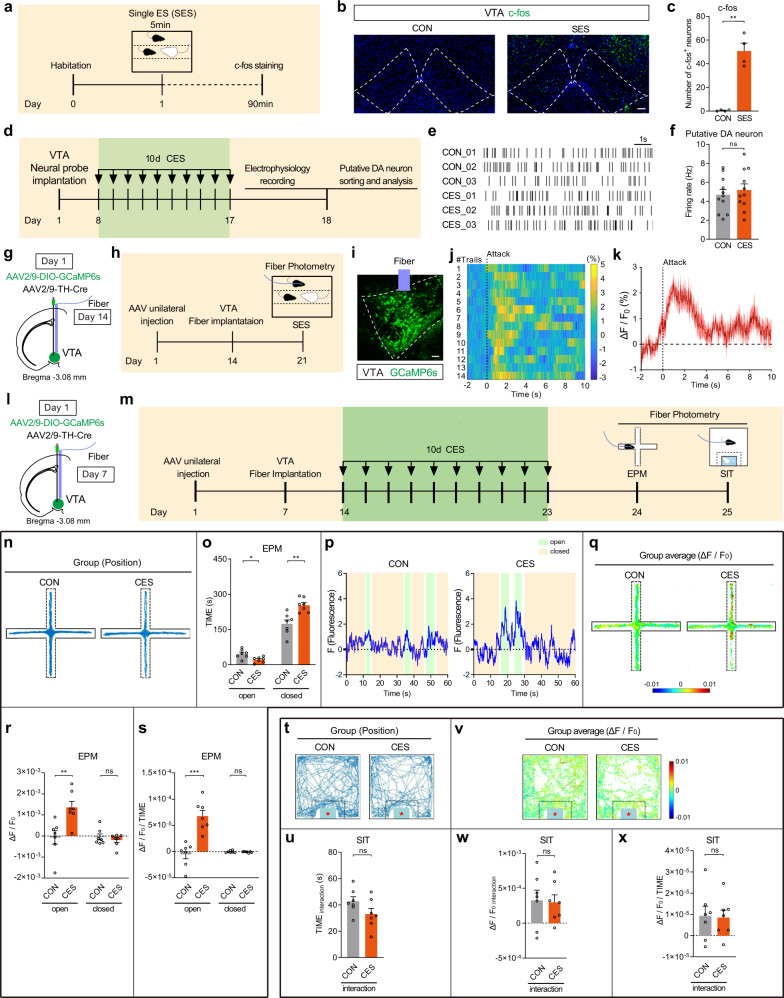
VTA dopamine-related cells show marked calcium responses during witnessed events. Yet basal firing after repeated observation is not persistently higher than in controls. This shifts the question from whether the cells are always more active to when their activity differs.
During open-arm exploration, observers show higher population calcium signals, whereas closed-arm activity does not show the same difference. Social-test time and calcium responses are also unchanged. The activity difference is linked to exposure rather than appearing uniformly across tests.
Source: Qi G et al. · Nature communications · CC BY
Original figure and English caption ↗
Activating a broader VTA population reduces center exploration
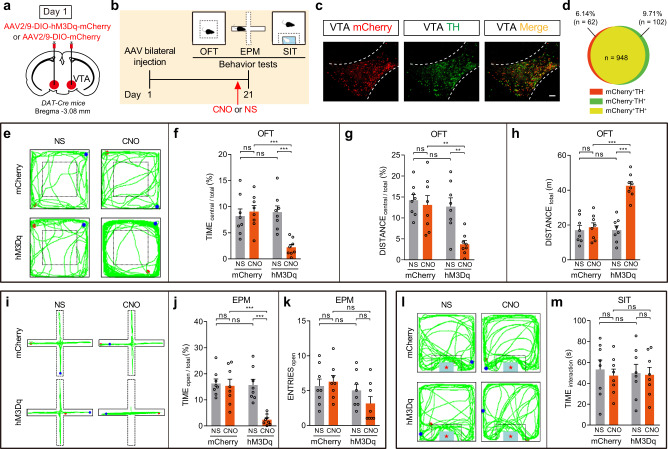
Activating a broader VTA dopamine-related population reduces time in the open-field center and open arms, without significantly changing social-zone time. Open-arm entry counts are also unchanged, preserving the specificity of the affected exploration measures.
The intervention also increases total open-field distance. Mice allocate less time to exposed areas while moving more overall, so increased avoidance here is distinct from reduced activity.
Source: Qi G et al. · Nature communications · CC BY
Original figure and English caption ↗
Inhibition influences avoidance at different times
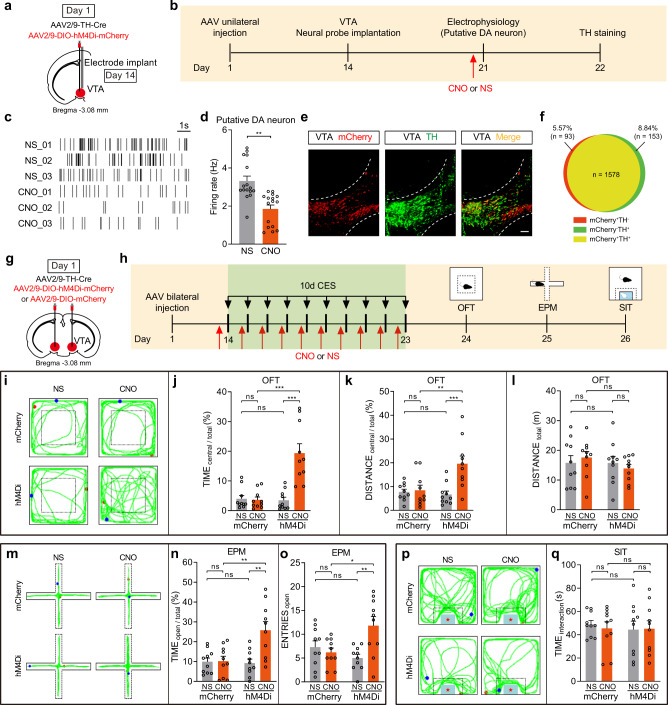
Suppressing this population during repeated witnessed stress increases later center and open-arm exploration without significantly changing total distance or social time. Intervention during the experience implicates the population in the resulting behavioral change.
Brief inhibition after stress, before behavioral testing, also increases center and open-arm time without changing social time; open-arm entries remain unchanged in this experiment. These results address both development of the phenotype and its later expression.
Source: Qi G et al. · Nature communications · CC BY
Original figure and English caption ↗
Accumbens input provides the next clue
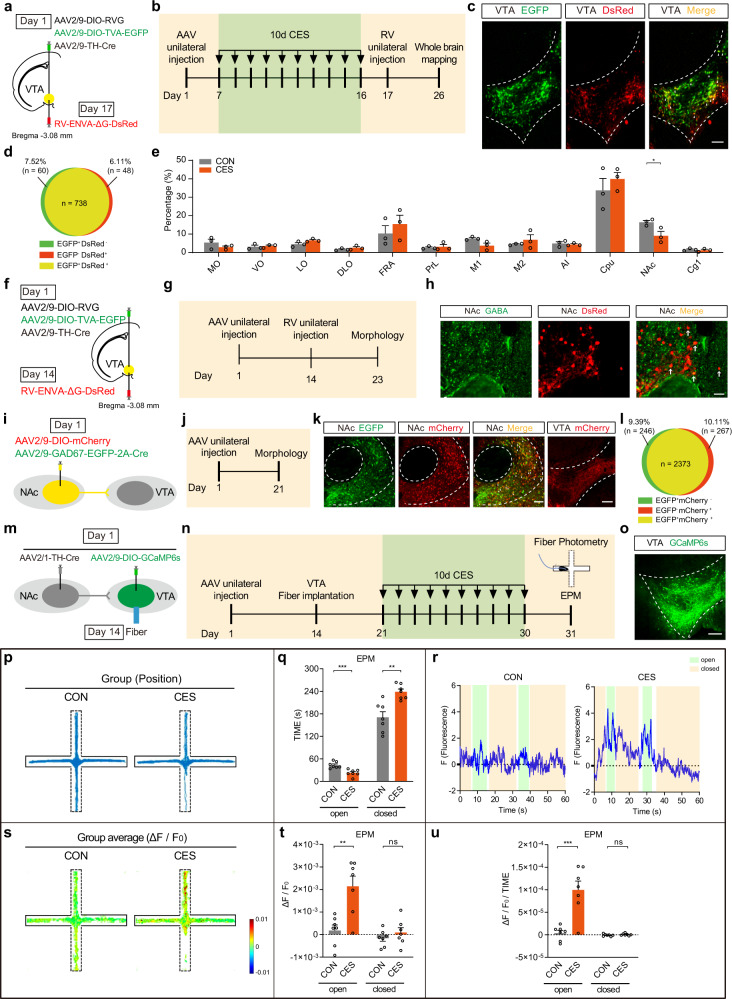
Tracing inputs to VTA dopamine-related neurons finds a lower relative proportion of labeled NAc input cells in observers. GABA-labeled NAc neurons also project to VTA. These anatomical findings motivate the circuit analysis, while stress-related changes in synaptic function remain to be tested.
NAc-input-associated VTA recipient cells show higher calcium activity during open-arm exploration in observers, without the same closed-arm difference. This links an input source with a context-dependent response while retaining the distinction between these recipients and the broader VTA population.
Source: Qi G et al. · Nature communications · CC BY
Original figure and English caption ↗
Projection terminals also influence exploration
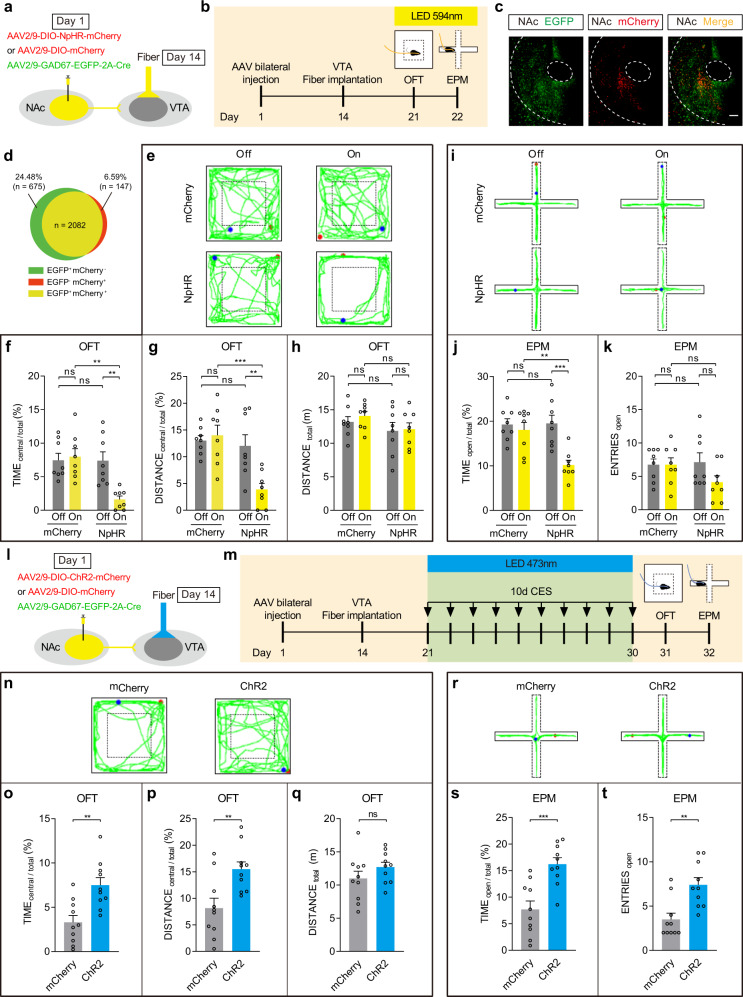
Suppressing terminals of NAc GABA-related neurons in VTA reduces center and open-arm time without significantly changing total distance or open-arm entries. Conversely, enhancing these terminals during witnessed stress increases later center and open-arm exploration while total distance remains unchanged.
This connects NAc-to-VTA input with behavior. Terminal stimulation can also influence source neurons and other branches through axonal propagation, motivating an additional examination at the VTA recipient side.
Source: Qi G et al. · Nature communications · CC BY
Original figure and English caption ↗
Recipient-side results emphasize population differences
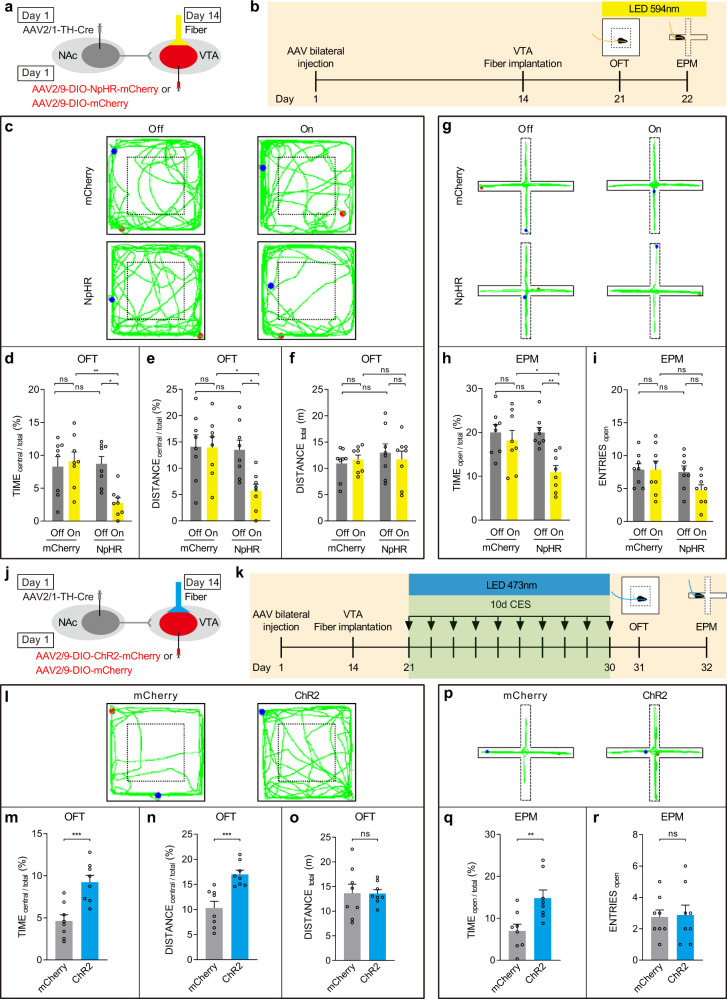
Suppressing NAc-input-associated VTA recipients reduces center and open-arm time, whereas activating them during witnessed stress increases later exploration. Total distance and open-arm entries remain unchanged. This differs from activating the broader dopamine-related VTA population and emphasizes distinctions between populations within one region.
In adult male mice, these findings connect witnessed experience, exposed-space avoidance and the NAc–VTA circuit. The cellular subgroups and local connections accounting for the different directions remain unresolved, rather than assigning one emotional meaning to all VTA activity.
Source: Qi G et al. · Nature communications · CC BY
Original figure and English caption ↗