Left prefrontal modulation after stress changes later fear extinction
In male rats, left IL activation after stress improves subsequent fear extinction without significantly improving anxiety-like behavior. Right-sided activation does not reproduce the extinction effect.
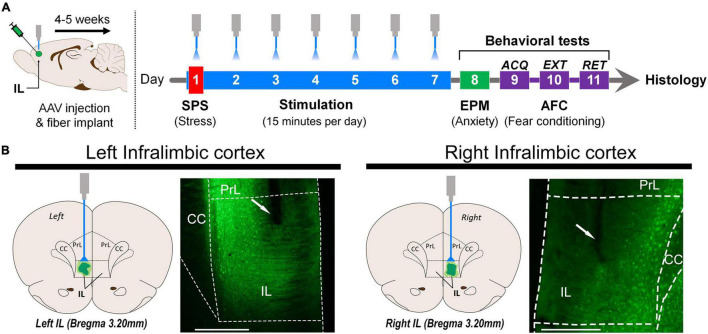
Can an animal reduce defensive responses when a cue no longer predicts danger? Prior stress can disrupt this extinction learning. A study published in Frontiers in Behavioral Neuroscience on December 20, 2021 activates infralimbic prefrontal populations in male rats after stress and before subsequent cue learning. Left-sided activation improves later freezing reduction, while right-sided activation does not reproduce the effect. Anxiety-like behavior remains, separating learning and exploration outcomes.
Left IL activation after stress and before fear learning reduces freezing late in extinction and at subsequent retention. Right-sided effects are not significant, and neither side significantly improves the tested anxiety-like measures.
Contents · 6 sections
Anxiety-like exploration and extinction ask different questions
Stressed rats spend less time in open maze arms and enter them less often. In cue learning they show another change: freezing remains high and declines less during extinction, when the sound is no longer accompanied by the aversive event.
One measure concerns allocation of exploration; the other concerns updating responses after an association has formed. Both relate to stress but occur in different contexts. Measuring both reveals which outcomes prefrontal modulation changes.
Extinction does not mean the cue–danger association was never learned. Responses can decline in a safe context, while maintaining that reduction later is a separate question. The study therefore distinguishes extinction learning and subsequent retention.
Modulation precedes the later learning test
Population activation occurs during the interval after stress. Cue association and extinction follow later. The comparison therefore asks how earlier prefrontal activity affects subsequent learning and response updating.
The target is a CaMKII-associated excitatory population in IL, examined in separate left- and right-sided conditions. The timing matters: stress has occurred, but the tested cue association has not yet been learned.
Left-sided activation improves late extinction
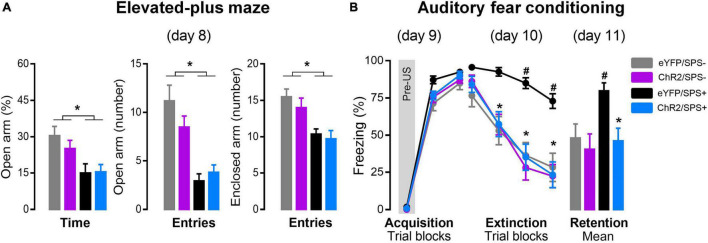
Left IL activation does not significantly alter cue-association acquisition. Late in extinction, stressed controls retain higher freezing, while stressed rats with prior left-sided activation show greater reduction. Unstressed rats show no significant additional extinction benefit.
The initial extinction block does not show the same improvement; the difference emerges later. The finding therefore concerns progress in updating responses in a safe context rather than failure to form the cue association. Defensive responses occur but subsequently decline more readily.
At subsequent retention, previously activated stressed rats also freeze less than stressed controls. The late-learning reduction therefore extends to later testing, rather than being only an immediate movement change during activation.
Anxiety-like exploration does not improve significantly. Stress-associated reductions in open-arm time remain, and closed-arm entries also vary with stress. Extinction changes therefore do not coincide with recovery of every exploration measure.
Source: Canto-de-Souza L et al. · Frontiers in behavioral neuroscience · CC BY
Original figure and English caption ↗
Right-sided activation does not reproduce the improvement
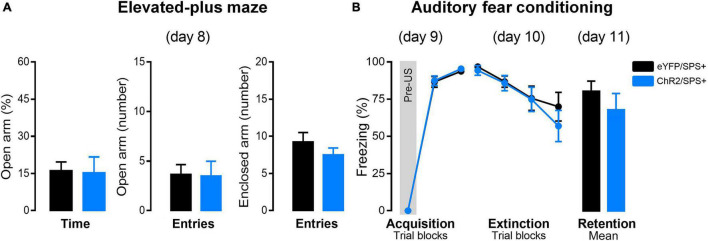
In the separate right IL condition, open-arm time, open-arm entries and closed-arm entries do not change significantly. Group differences in acquisition, extinction and retention are also nonsignificant.
The separate conditions show different outcome patterns, encouraging closer attention to hemisphere. The right-sided comparison includes stressed animals without a separate unstressed test, leaving lateralization dependent on population and task context and open to more direct comparison.
Source: Canto-de-Souza L et al. · Frontiers in behavioral neuroscience · CC BY
Original figure and English caption ↗
The cellular process behind the change remains open
Earlier work links post-stress prefrontal hypoactivity and altered IL glutamate with later behavior. The present study adds behavioral evidence: earlier left-sided activation is followed by better freezing reduction.
Changes in transmitter levels, dendritic structure or particular downstream connections are not directly established. Activation may affect network plasticity, but the intermediate steps connecting the earlier activity to later extinction remain unresolved.
One stress history can produce distinct behavioral trajectories
The male-rat study separates post-stress outcomes: anxiety-like exploration remains while later extinction improves. Prefrontal contributions to learning do not always move together with broader anxiety-like measures.
The specific question is which hemisphere and prior population activity alter later updating to a now-safe cue. The findings concern male rats under particular timing conditions; females, other stress contexts and longer retention remain to be examined.