Too much excitation brings silence: a counterintuitive thalamic switch
Prefrontal input can drive some rat thalamic neurons into depolarization block. Inhibitory input restores firing and shifts frequency-dependent effects on avoidance and food seeking.
Excitatory input as an accelerator and inhibitory input as a brake is not always an adequate metaphor for neural networks. A 2024 Neuron study shows that strong input from rat prelimbic cortex (PL) can prevent stable firing in some anterior paraventricular thalamic (aPVT) neurons. Inhibitory input from the anteroventral thalamic reticular nucleus (avTRN), however, can restore firing. This counterintuitive switch also relates to changes in cue-guided avoidance and food seeking.
Some aPVT cells enter depolarization block under strong cortical input, and inhibitory input can restore firing. Behavioral effects of cortical input depend on frequency and inhibitory modulation.
Contents · 7 sections
Cortex reaches thalamus directly and through inhibition
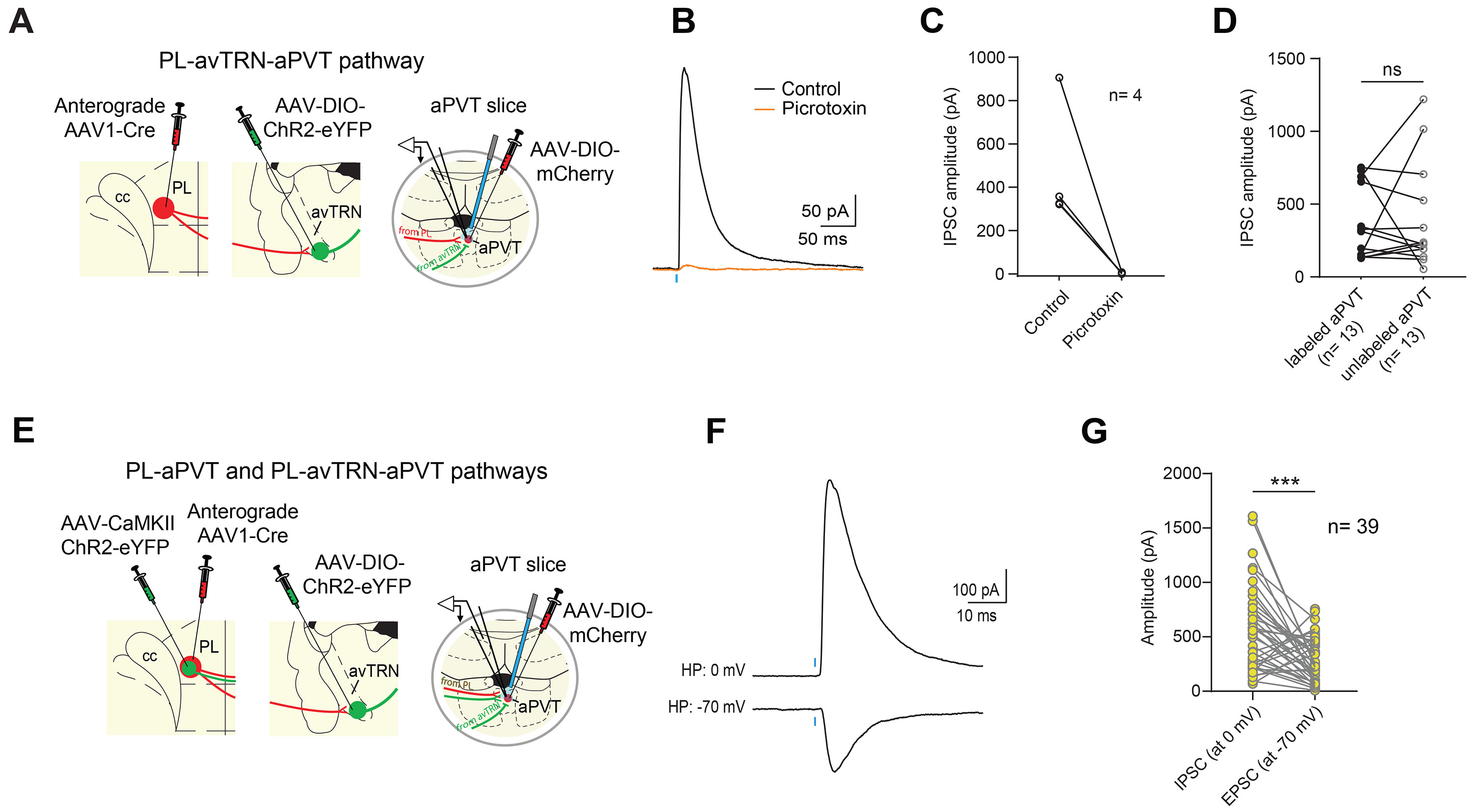
Tracing shows deep-layer PL cells reaching aPVT directly or projecting to avTRN, with some cells sending collaterals to both. avTRN and aPVT are also connected, allowing one cortical area to influence thalamus through direct and indirect routes.
Slice recordings place both routes onto individual cells: recorded aPVT neurons receive PL excitation and avTRN GABAergic inhibition, with inhibitory currents usually larger. Their firing depends on how these inputs interact with the cell’s own state.
Source: Guillermo Aquino-Miranda et al. · Neuron · TDM
Original figure and English caption ↗
One population falters while another keeps firing
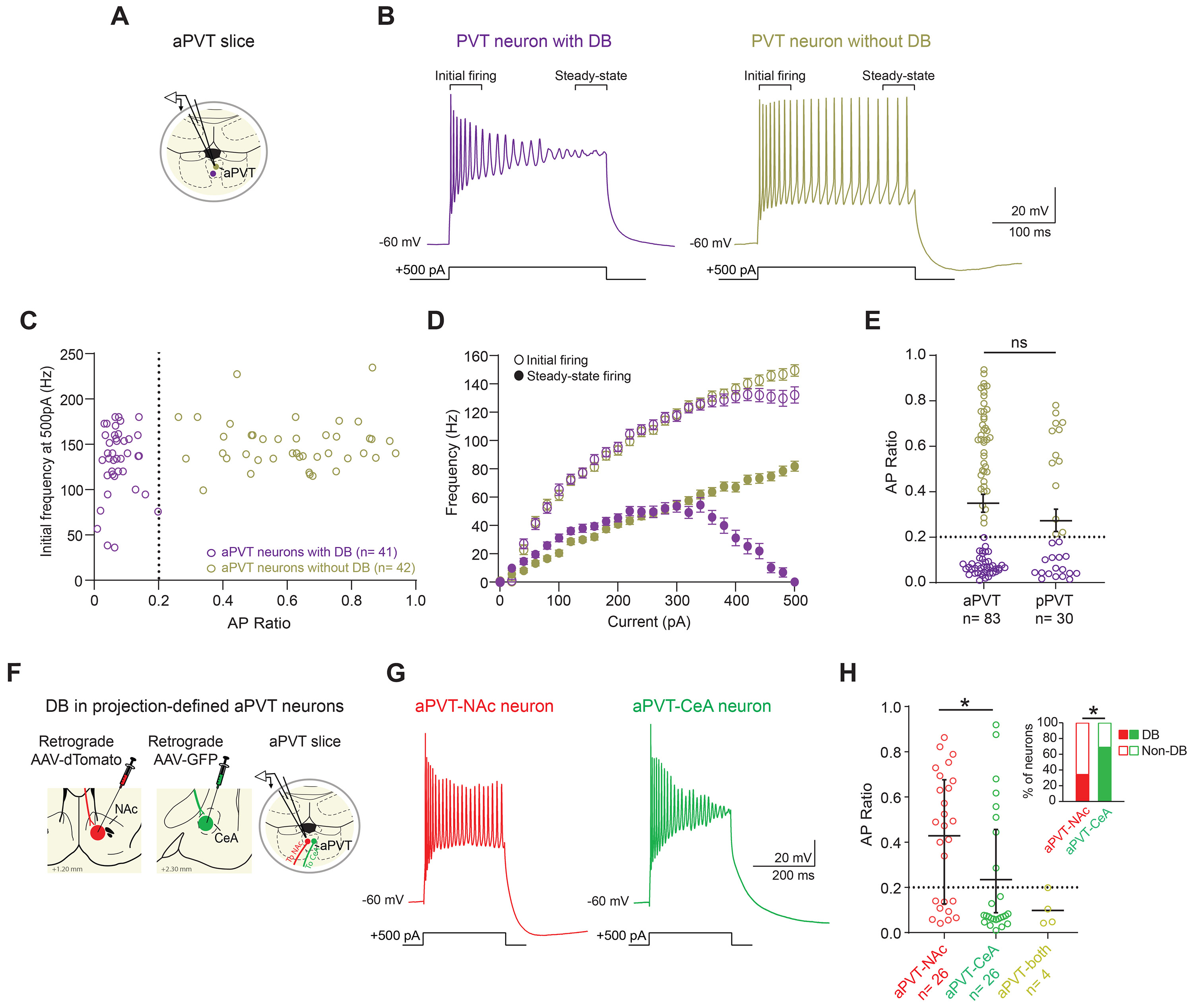
Strong depolarizing input makes some aPVT cells fire rapidly at first, then progressively smaller action potentials culminate in depolarization block. Another population maintains large action potentials. The two patterns occur in similar proportions among tested cells.
The distinction relates to output target: aPVT cells projecting to central amygdala more often show block, whereas more accumbens-projecting cells maintain larger spikes. Each group remains heterogeneous; target and firing properties associate without defining two absolute categories.
Source: Guillermo Aquino-Miranda et al. · Neuron · TDM
Original figure and English caption ↗
Timely inhibition helps firing continue
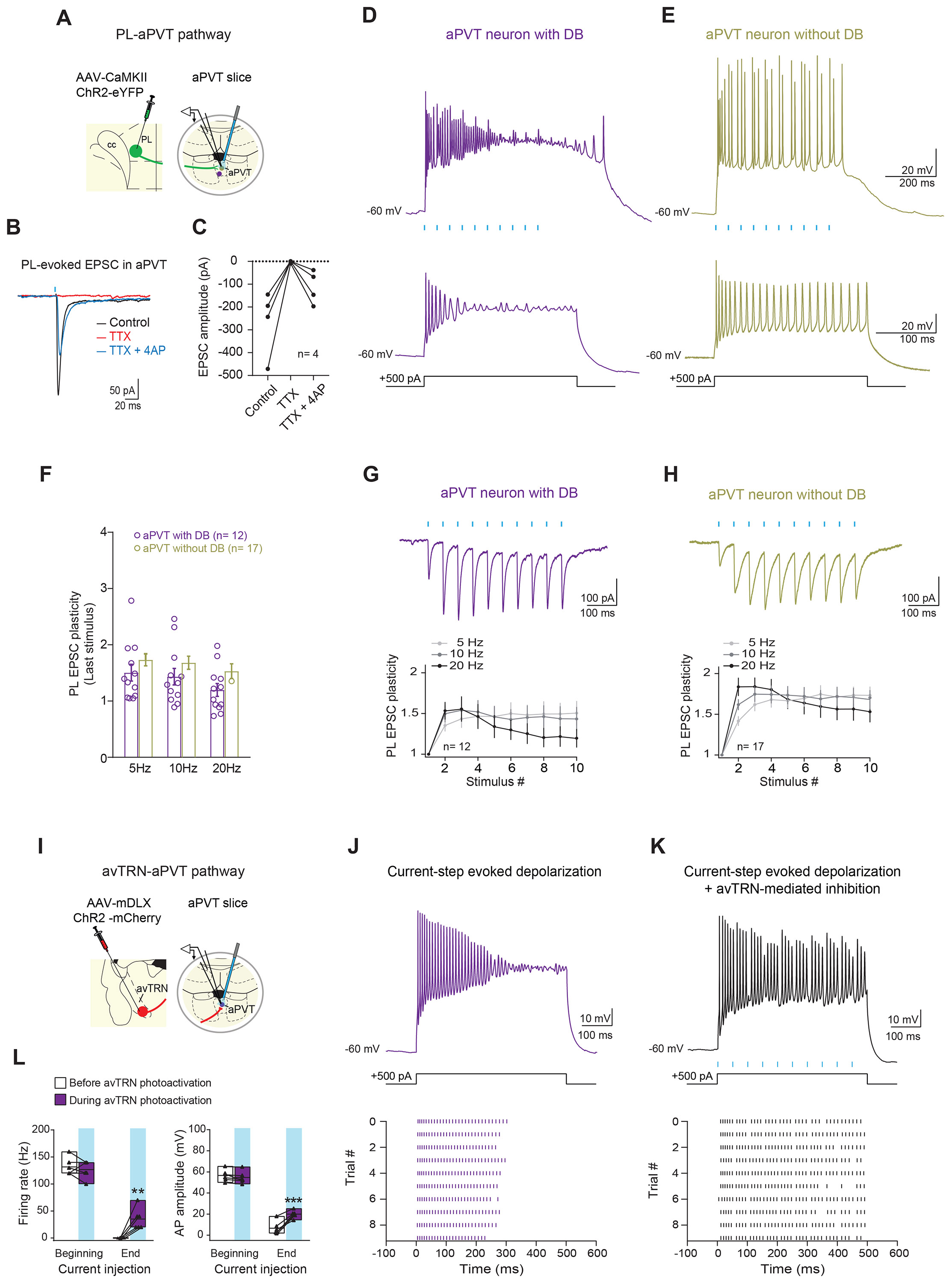
PL-evoked excitatory currents show similar short-term facilitation in the two populations. Comparable input dynamics produce different firing outcomes, emphasizing how downstream cells respond to sustained excitation rather than input quantity alone.
PL-terminal activation also evokes block in some aPVT cells, beyond direct current injection. NMDA-receptor blockade reduces initial firing in these cells but prevents block and allows firing to continue, implicating sustained excitation.
Adding avTRN inhibition to cells in block restores spike amplitude and firing rate. Under comparable conditions, non-blocking cells show no clear overall firing increase. The effect of inhibition depends on the cell’s state and can help it emerge from block.
Source: Guillermo Aquino-Miranda et al. · Neuron · TDM
Original figure and English caption ↗
Not every cell follows faster input
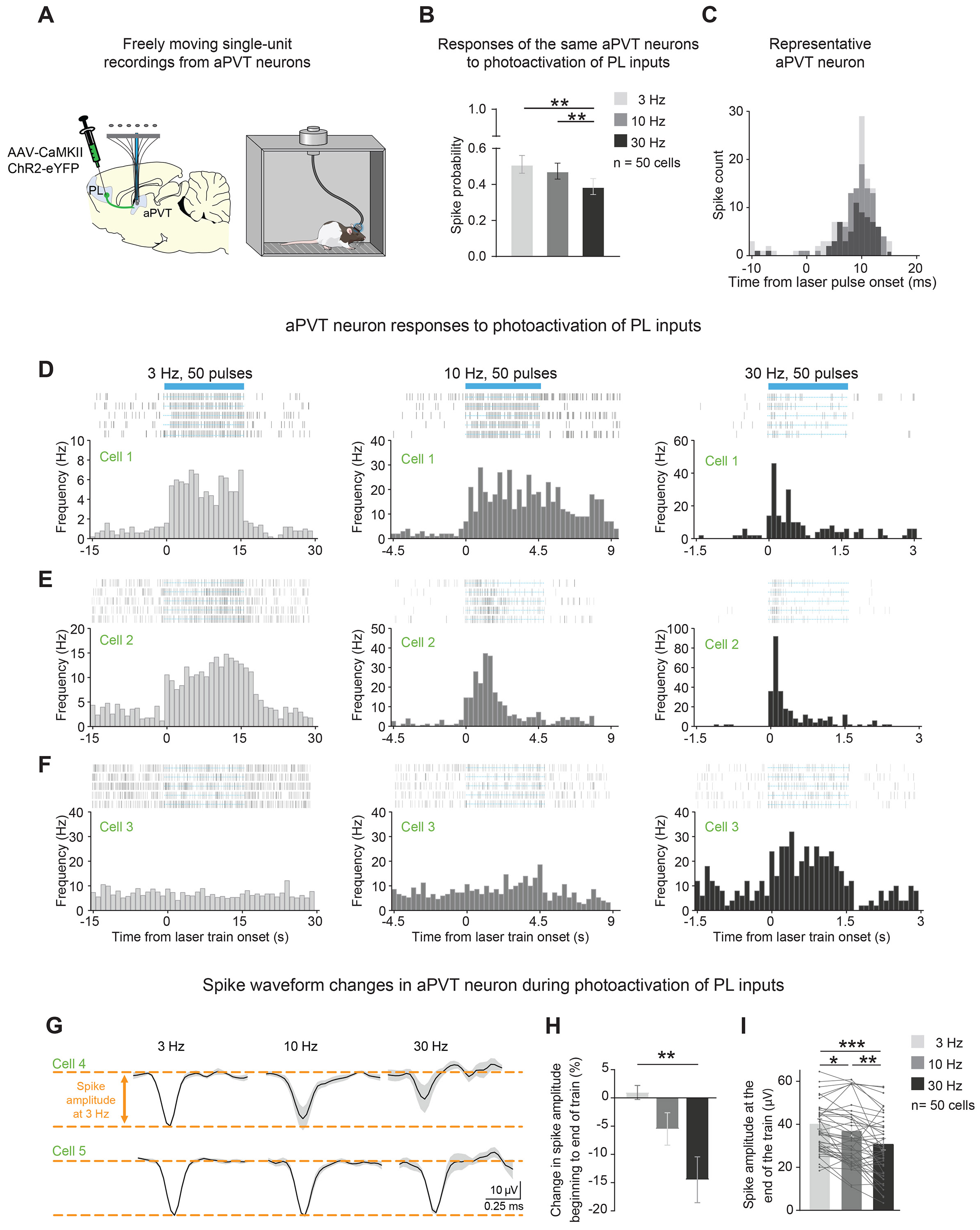
In freely moving rats, faster PL-terminal activation reduces average aPVT spike-response probability and attenuates spike amplitude in some cells. Others reliably respond at higher frequencies, echoing the divergence observed in slices.
Inhibiting avTRN increases spontaneous aPVT firing yet leaves attenuation under high-frequency cortical input intact. The attenuation therefore reflects intrinsic thalamic response properties rather than simply greater reticular inhibition, distinguishing excessive-excitation-related weakening from ordinary feedforward inhibition.
Source: Guillermo Aquino-Miranda et al. · Neuron · TDM
Original figure and English caption ↗
Brief high-frequency activity occurs during the task
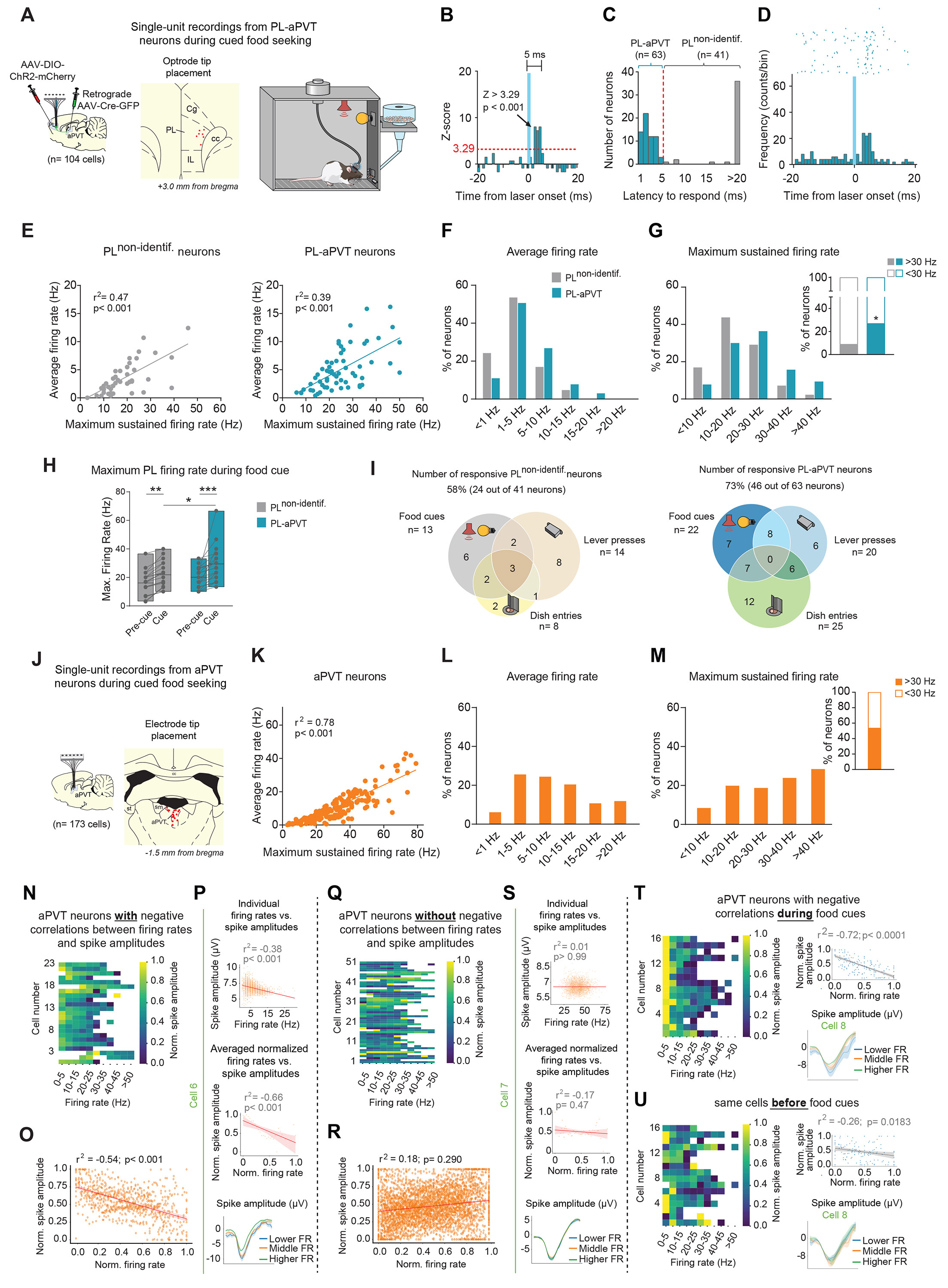
These cells do not continuously fire at high rates. During food seeking, most PL projection cells have low average rates, yet some sustain brief high-frequency periods and reach higher maximal rates at food cues. Average activity and brief peaks describe different aspects.
In aPVT recordings, some high-frequency cells show smaller spikes as firing rate rises, particularly after cue onset. Task-related activity thus exhibits a related attenuation pattern, linking stimulation findings with observations during behavior.
Source: Guillermo Aquino-Miranda et al. · Neuron · TDM
Original figure and English caption ↗
More activation does not mean stronger behavioral suppression
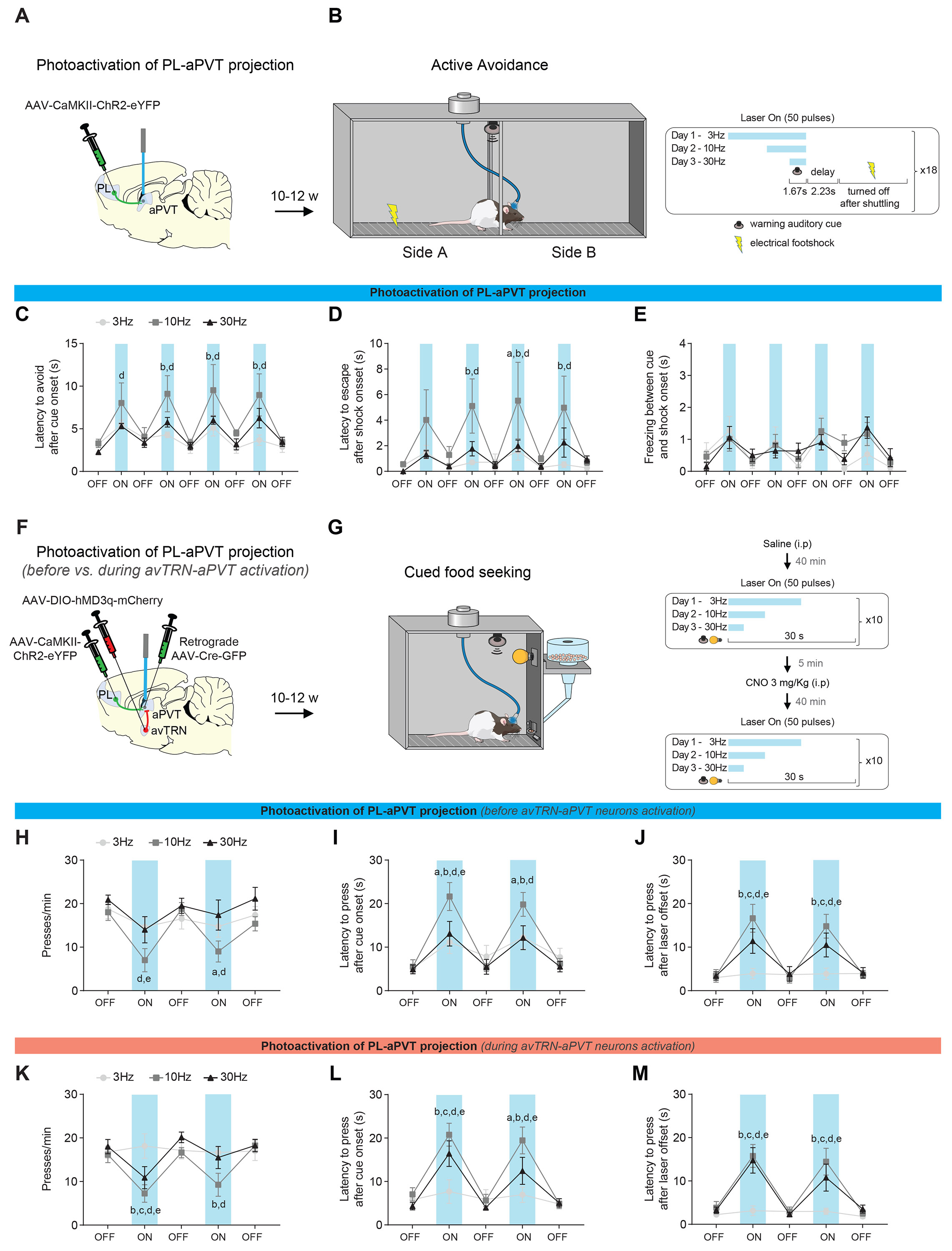
In avoidance tests, the intermediate frequency delays cue-guided shuttling and escape, while the higher frequency lacks comparable effects and freezing remains similar. In food seeking, the intermediate frequency reduces pressing and delays initiation; higher-frequency effects are weaker, with some latency changes remaining.
Activating aPVT-projecting avTRN cells makes high-frequency PL input clearly reduce pressing and delay initiation. Inhibitory modulation shifts the behavioral effect, consistent with restoring firing in blocked slice neurons. The behavior experiments establish network effects, while the contribution of specific cellular outputs remains to be connected further.
Source: Guillermo Aquino-Miranda et al. · Neuron · TDM
Original figure and English caption ↗
The effect depends on the cell’s current state
This rat study shows excitation and inhibition are not two invariably opposing buttons. Excessive excitation limits firing in some thalamic cells, while inhibition restores it. Prefrontal behavioral control therefore depends on input frequency, downstream cellular properties and cooperation with another input—not simply input quantity.