How odor meets emotion: olfactory input recruits a cortical brake
In acutely stressed mice, bergamot essential-oil exposure accompanies improved exploration. Olfactory input to ACC recruits local inhibition to reduce excitatory activity.
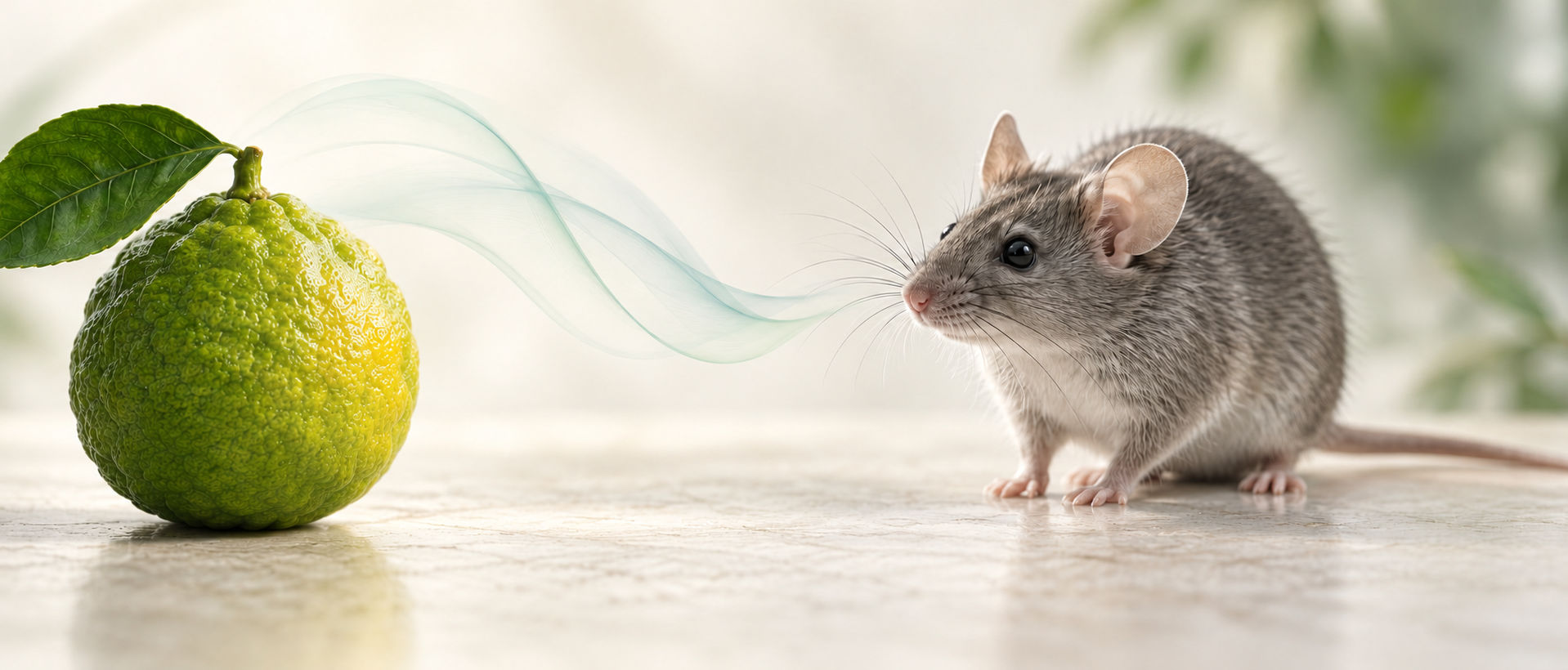
How can an odor change brain activity? A 2024 Advanced Science study connects behavioral effects of bergamot essential oil with a defined neural route. Exposure increases open-space exploration in acutely restrained mice. Excitatory input from the anterior olfactory nucleus (AON) can recruit inhibitory cells in anterior cingulate cortex (ACC), producing a seemingly paradoxical pattern: stronger activity in an olfactory region accompanies reduced activity in some downstream excitatory cells.
AON input to ACC and local GABAergic inhibition contribute to reduced anxiety-like behavior after essential-oil exposure; excitatory input can reduce another population’s activity through interneurons.
Contents · 7 sections
Exposed-space exploration increases
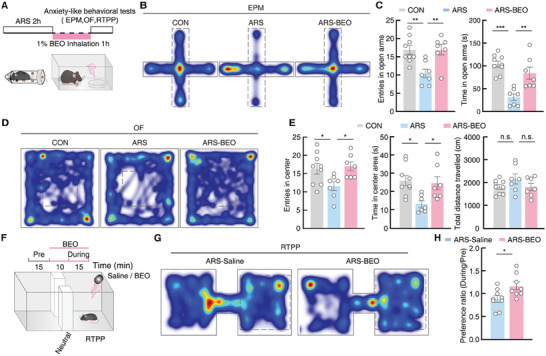
After acute restraint, mice spend less time in the open-field center and elevated-plus-maze open arms. Essential-oil-exposed mice spend more time there and enter more often, while total travel distance shows no clear change. The difference concerns where they explore rather than a general increase in movement.
The outcome depends on tested conditions: the lower concentration and an odorless control oil do not produce comparable behavioral improvement. Stressed mice prefer the oil side in real-time place choice, whereas unstressed mice show no clear preference. Odor-related choices depend on the animal’s state.
Source: Zhu MY et al. · Advanced science (Weinheim, Baden-Wurttemberg, Germany) · CC BY
Original figure and English caption ↗
Odor increases AON activity
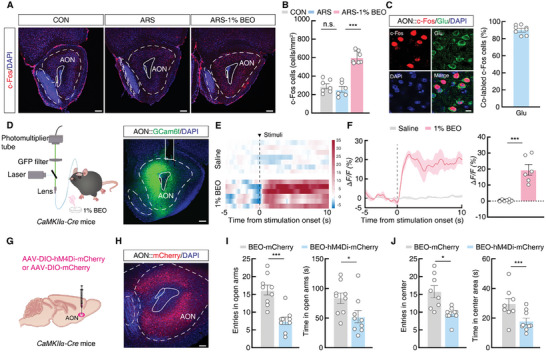
AON participates in olfactory processing. Essential-oil exposure increases its c-Fos activity markers, predominantly in glutamatergic cells. Calcium recordings also capture a rapid response in a mainly excitatory AON population, unlike saline controls.
The lower concentration also activates AON without clear exploration improvement. Recruiting local activity and producing the full behavioral effect are distinct. Inhibiting this AON population reduces exposed-space exploration after oil exposure, supporting its contribution under the tested stress conditions.
Source: Zhu MY et al. · Advanced science (Weinheim, Baden-Wurttemberg, Germany) · CC BY
Original figure and English caption ↗
One input reaches two cellular populations
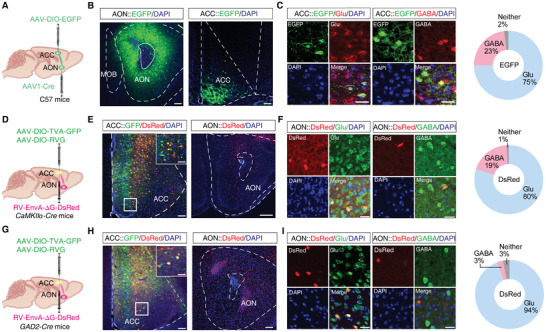
Olfactory information reaches the olfactory bulb, then AON and other areas before entering higher-order processing networks. The question is not simply whether odor is detected, but how signals reach stress-related cortex and alter relationships among its local cells.
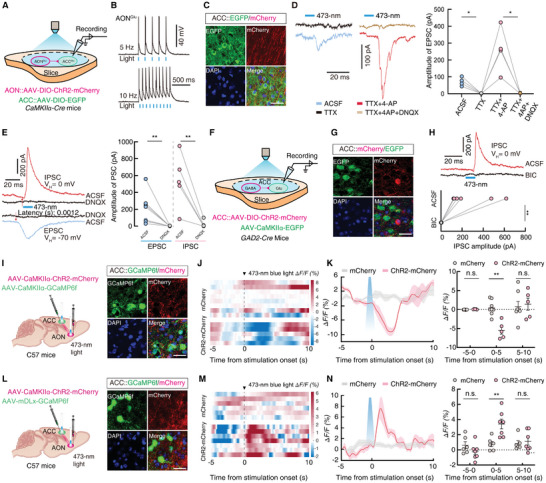
AON output reaches ACC and several other regions. Focusing on the stress-related ACC, tracing shows AON excitatory cells directly contacting both glutamatergic and GABAergic inhibitory populations.
Excitatory input describes the incoming signal but does not determine the region’s overall outcome. Recruiting local inhibitory cells can reduce another population’s activity. Synaptic recordings next follow this branch to examine transmission.
Source: Zhu MY et al. · Advanced science (Weinheim, Baden-Wurttemberg, Germany) · CC BY
Original figure and English caption ↗
Exciting interneurons reduces downstream activity
In slices, AON-terminal activation evokes excitatory synaptic responses in ACC cells, with excitatory cells also receiving a later inhibitory response. Activating ACC GABAergic cells directly likewise evokes inhibitory currents in local excitatory neurons, supporting a cortical inhibitory relay.
In vivo calcium recordings show a matching population pattern: AON activation increases ACC GABAergic activity and decreases activity in a mainly excitatory population. Olfactory input can thus reduce activity in the measured excitatory ACC population through interneurons.
Source: Zhu MY et al. · Advanced science (Weinheim, Baden-Wurttemberg, Germany) · CC BY
Original figure and English caption ↗
Two altered populations shift in opposite directions
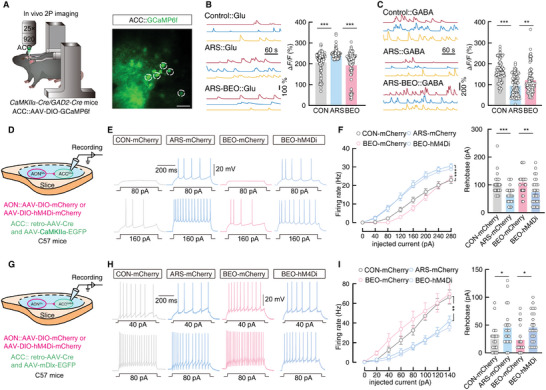
At the lower tested concentration, ACC c-Fos labeling shows no clear change, further indicating that an upstream AON response need not coincide with a change in downstream regional state.
In stressed mice, ACC excitatory-population calcium activity rises while GABAergic activity declines. Oil exposure decreases the former and increases the latter. Slice firing responses to current input shift correspondingly, linking behavioral improvement with opposing cellular adjustments.
Inhibiting ACC-projecting AON cells weakens these activity changes; inhibiting ACC GABAergic cells also reduces the oil-associated exploration benefit. The study progressively links upstream olfactory responses, local cortical activity and behavioral choice.
Source: Zhu MY et al. · Advanced science (Weinheim, Baden-Wurttemberg, Germany) · CC BY
Original figure and English caption ↗
Activating the input also changes exploration
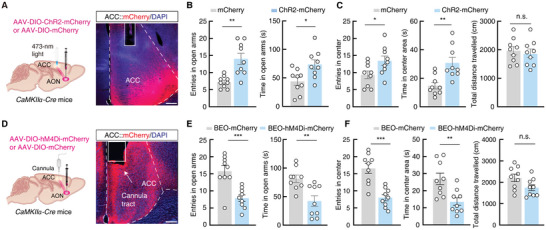
Activating AON terminals in ACC increases stressed-mouse center and open-arm time while total distance remains similar. The intervention reproduces the behavioral direction, supporting the connection’s capacity to regulate exploration after stress.
Conversely, inhibiting these terminals during oil exposure reduces exposed-space exploration. Activation and inhibition test the connection from both directions: it can drive behavioral changes and contributes to the oil-related benefit in this model, within a wider olfactory network containing other AON outputs.
Source: Zhu MY et al. · Advanced science (Weinheim, Baden-Wurttemberg, Germany) · CC BY
Original figure and English caption ↗
Odor effects depend on the network they enter
These findings come from an acute-stress model in adult male mice and describe how odor-related input and local inhibition contribute to exploration. They connect olfaction with emotion-related cortex through specific cellular relationships and show how excitatory input can produce different activity outcomes through local circuitry.