Stress can restore fear despite learned safety
Acute stress increases freezing to a learned safety cue. Paraventricular thalamic activity and prefrontal inhibitory networks contribute, affecting safety learning as well as the current expression of an established memory.

Why does a mouse become fearful again of a sound it has learned is safe? A study published in Neuropsychopharmacology on January 5, 2024 follows safety learning through the paraventricular thalamus (PVT) and prelimbic cortex (PL). Stress increases PVT responses to safety cues as previously suppressed fear reappears. This need not mean the memory has disappeared: after some interventions end, animals again use the safety information they learned.
PVT activation can impair safety learning and temporarily increase fear despite an established safety memory. Stress-associated PVT cells and PL somatostatin neurons contribute; inhibiting PVT alone does not significantly enhance ordinary safety-memory formation.
Contents · 7 sections
Two sounds acquire different meanings
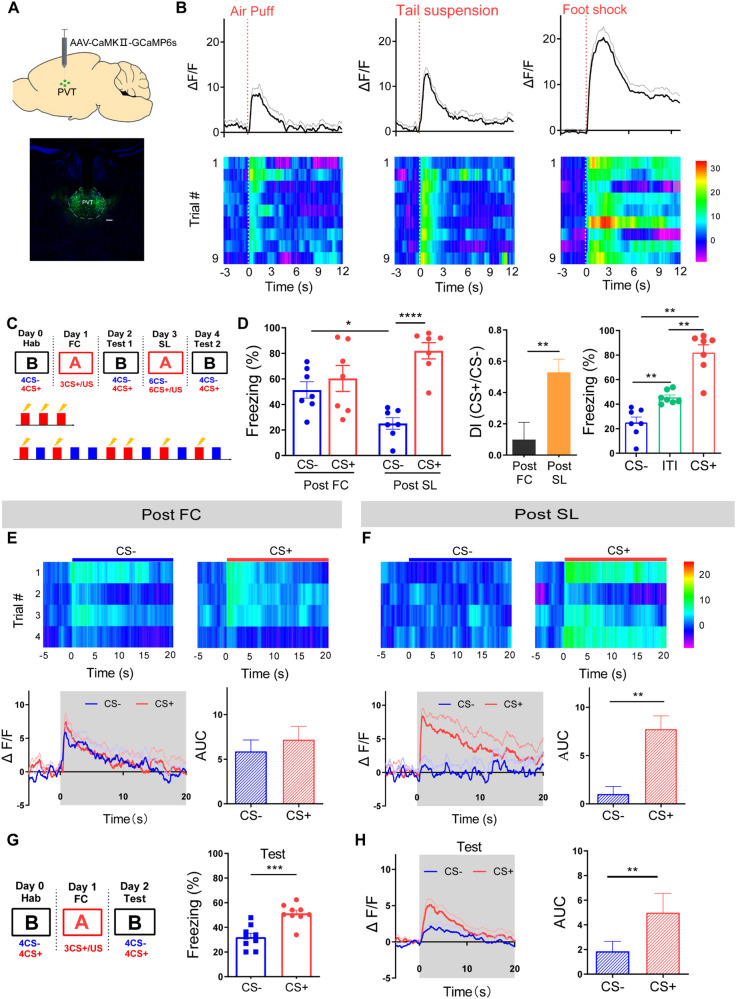
After initial conditioning, both sounds elicit substantial freezing. Subsequent learning keeps one sound predictive of an adverse outcome while the other is unreinforced. Mice learn to discriminate: freezing to the safety cue falls below even the intertrial interval, while the danger cue retains a stronger response.
Unlike making every threat cue harmless, this requires learning when to reduce defense while danger remains possible. Weaker initial conditioning already produces better discrimination, showing that prior experience changes the starting point for safety learning.
Source: Wang Z et al. · Neuropsychopharmacology : official publication of the American College of Neuropsychopharmacology · CC BY
Original figure and English caption ↗
Thalamic responses fall for the safety cue
PVT excitatory populations respond to several acute stressors. Early in the task, the sounds elicit similar population responses; after discrimination learning, the safety cue evokes a smaller response than the danger cue. Reduced defense accompanies differentiated neural activity. Different responses to the same cue across learning make PVT a node whose reactivity changes with experience rather than simply tracking external intensity.
This motivates two causal questions: does raising PVT activity alter the use of existing safety information, and does changing it during learning affect later discrimination? The study examines these phases separately.
Elevated activity affects learning and later expression
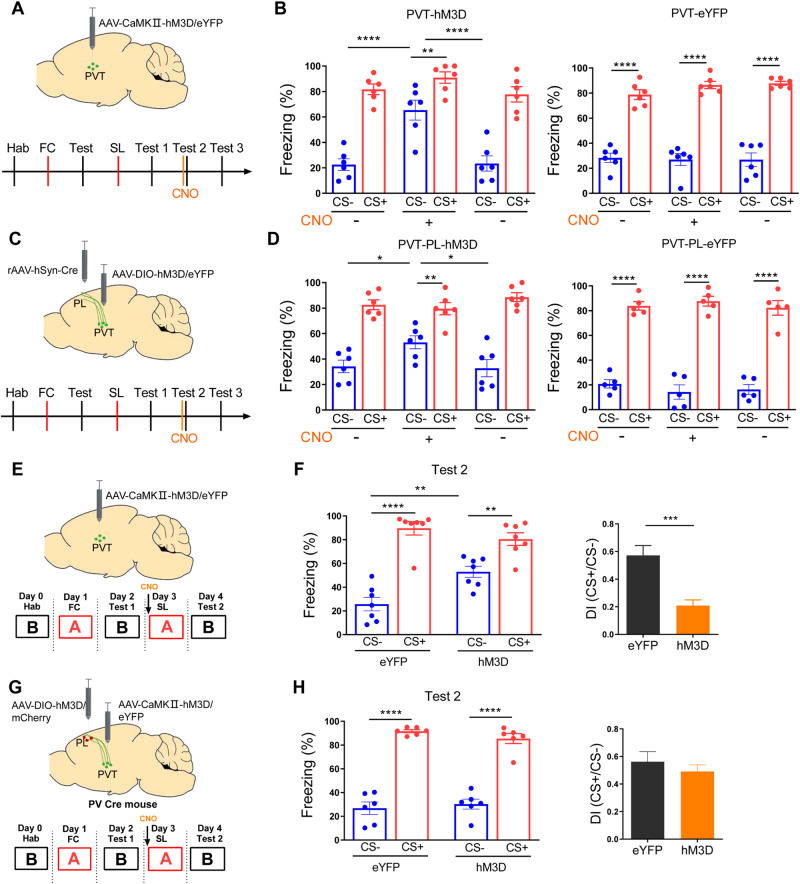
Activating PVT after learning increases freezing to the safety cue, with lower freezing again at the later test. Activating PL-projecting PVT cells produces a similar reversible change. These experiments target projection-defined source populations rather than only terminals within PL.
Activation during safety learning also reduces later discrimination. In contrast, inhibiting PVT alone does not significantly improve ordinary learning. Excessive activity can interfere with the process without lower activity automatically strengthening the memory.
Source: Wang Z et al. · Neuropsychopharmacology : official publication of the American College of Neuropsychopharmacology · CC BY
Original figure and English caption ↗
Acute stress increases PVT responses to the safety sound
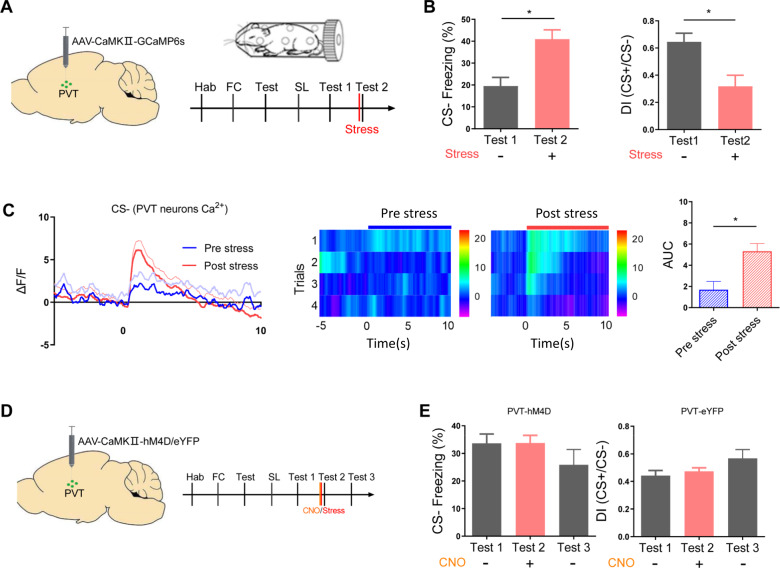
Acute restraint stress increases freezing to the safety cue, lowers discrimination and enhances the cue-related PVT calcium response. The experiment examines a change in how already learned safety information is expressed.
Under PVT inhibition, freezing and discrimination do not differ significantly across the pre- and post-stress tests. Alongside enhanced responses after stress, this intervention links PVT activity to safety-memory expression under stress.
Source: Wang Z et al. · Neuropsychopharmacology : official publication of the American College of Neuropsychopharmacology · CC BY
Original figure and English caption ↗
Focusing on cells active during stress
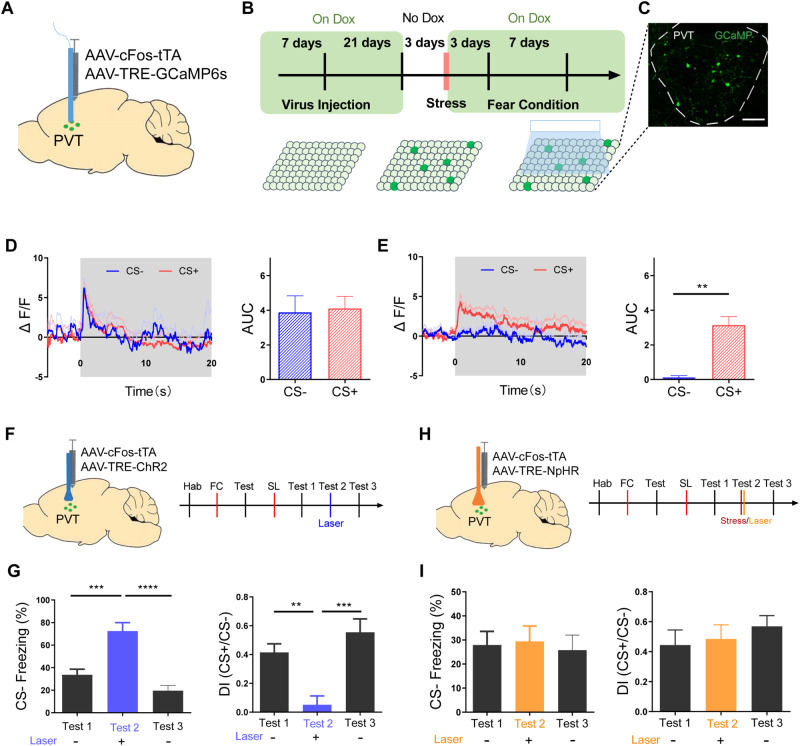
The team labels PVT cells active during stress. These cells initially respond similarly to the sounds, but respond less to the safety cue after learning. The stress-associated population therefore also changes its cue responses with learning.
Reactivating them after learning transiently increases freezing to the safety cue, which declines when activation ends. When these cells are inhibited during the post-stress test, freezing and discrimination do not significantly change across tests. Activity-dependent labeling links the modulation to a stress-associated population.
Source: Wang Z et al. · Neuropsychopharmacology : official publication of the American College of Neuropsychopharmacology · CC BY
Original figure and English caption ↗
Interacting inhibitory populations in prefrontal cortex
PL somatostatin (SOM) cells also show smaller safety-cue responses after learning. Activating them increases freezing to that cue. With concurrent PVT activation and PL SOM inhibition, the usual PVT-associated increase in freezing is not significant.
In another combination, concurrent PVT and PL parvalbumin (PV) activation preserves discrimination. Together with prior local-connectivity evidence, these results support a model in which SOM suppresses PV and weakens safety-related inhibition. Prefrontal inhibition itself contains interacting levels.
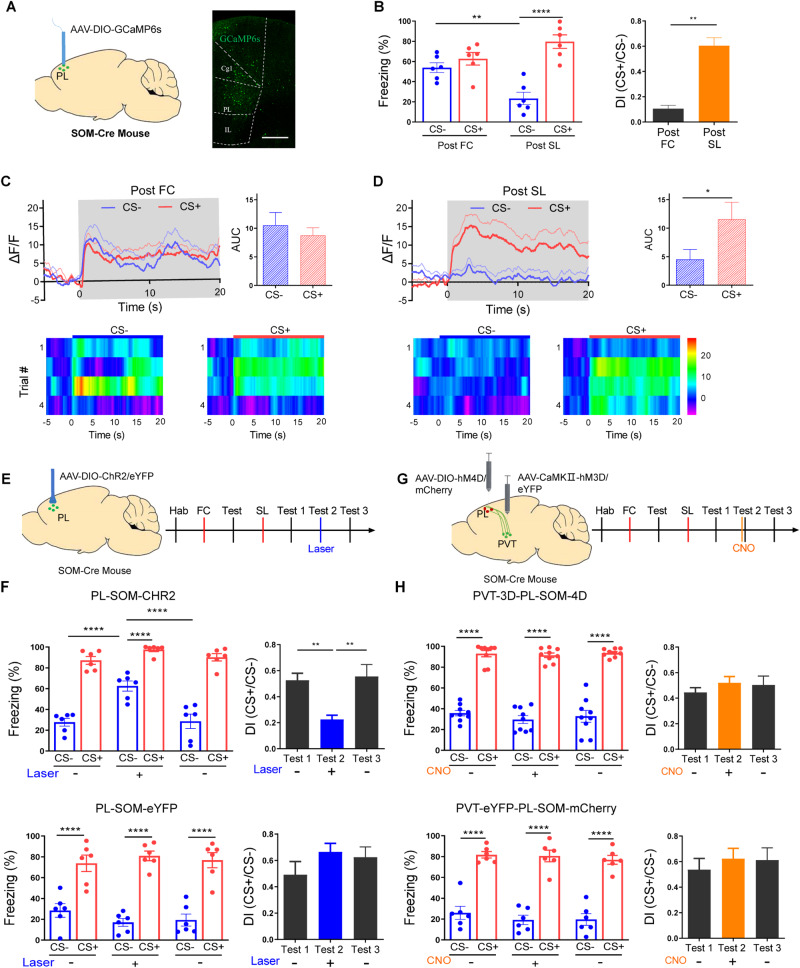
Source: Wang Z et al. · Neuropsychopharmacology : official publication of the American College of Neuropsychopharmacology · CC BY
Original figure and English caption ↗
Stress can change the use of safety information
The study uses adult mice, with most circuit analyses in males and selected PVT or SOM activation tests showing similar effects in females. Safety learning involves not only remembering an absent outcome but allowing that information to guide behavior in a changed state.
The reversible freezing changes are particularly informative: stress-related activity can temporarily override learned discrimination without requiring erasure of the safety experience. Forming a safety memory and using it under stress are connected but distinct processes.