Why does a prefrontal brake weaken under social stress?
In male mice, excitatory claustral input to inhibitory prefrontal cells supplies a local brake. Dynorphin and κ-opioid receptor signaling participate in changing this connection.
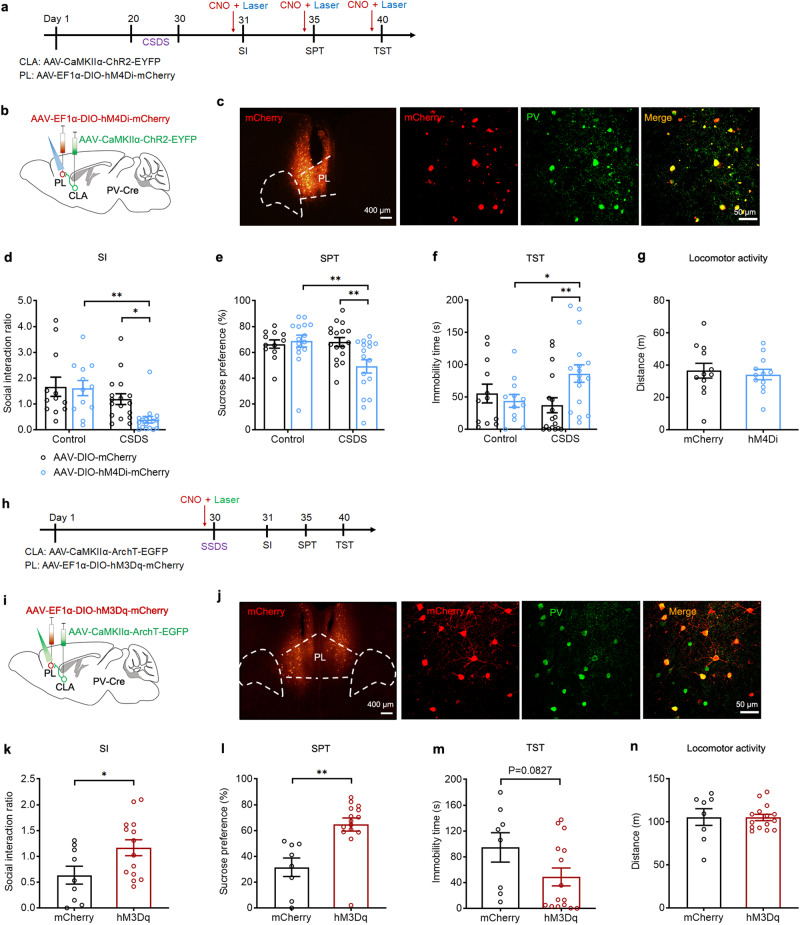
How can stress reduce interest in social contact? Neuroscience often turns to prefrontal cortex, where cells do not act in unison: excitatory cells convey output, inhibitory cells constrain the network, and incoming pathways can recruit both. A study published in Nature Communications on November 30, 2023 tracks claustrum (CLA) to prelimbic cortex (PL) connections in male mice exposed to social defeat. The excitatory input weakened, local PV inhibitory cells became less active, and pyramidal cells became more active. This apparent paradox points to a circuit in which an excitatory input helps supply inhibition.
Claustral excitation of PL PV cells contributes to feedforward inhibition and stress-related behavior. Dynorphin/KOR signaling weakens this input; manipulating the pathway, PV cells or KOR in projection-defined cells alters depression-like measures.
Contents · 6 sections
Weaker claustral activity increases behavioral vulnerability
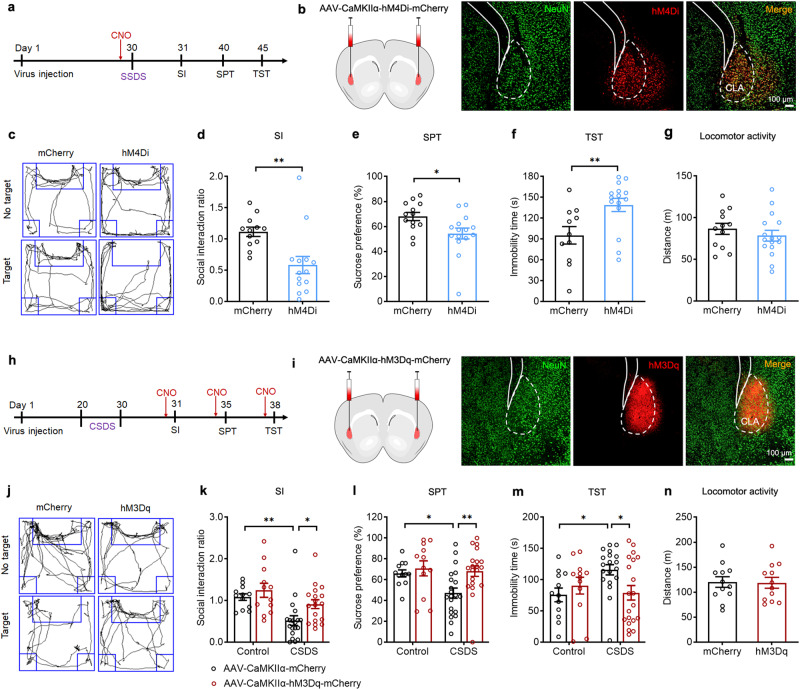
The claustrum is a thin, deeply situated structure with extensive connectivity. Suppressing a labeled population dominated by glutamatergic neurons under subthreshold social defeat reduced social interaction and sucrose preference and increased tail-suspension immobility.
Conversely, recruiting claustral cells after chronic social defeat improved these behavioral measures. Locomotor distance did not significantly change in either manipulation. The findings connect claustral activity to stress-related behavior and motivate examination of its downstream pathways.
Source: Wang YJ et al. · Nature communications · CC BY
Original figure and English caption ↗
Activity changes diverge within the same cortex
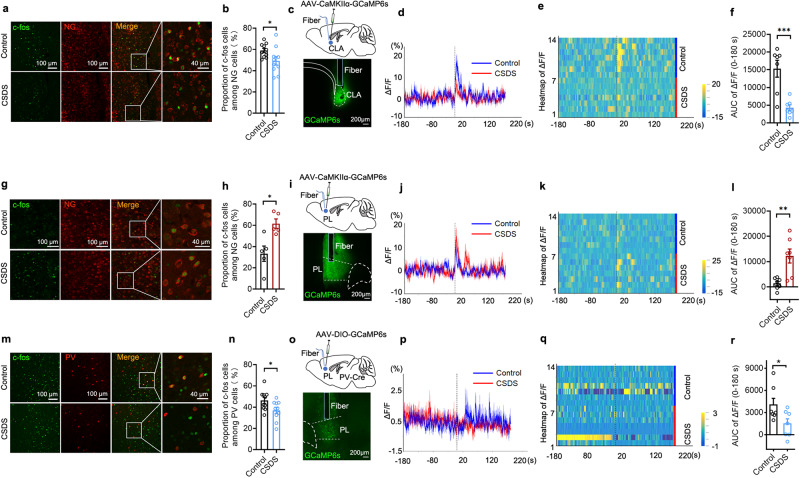
The claustrum supplies excitatory signals to PL. After chronic social defeat, activity-marker expression and population calcium signals decreased in claustral excitatory cells and PL PV inhibitory cells, but increased in PL excitatory cells.
These divergent changes illustrate why regional activity alone cannot capture cooperation among cell types. If an incoming excitatory pathway recruits inhibitory cells, weakening that input may release pyramidal cells from inhibition. The study next examined this local braking arrangement.
Source: Wang YJ et al. · Nature communications · CC BY
Original figure and English caption ↗
Recruiting the connection increases social approach
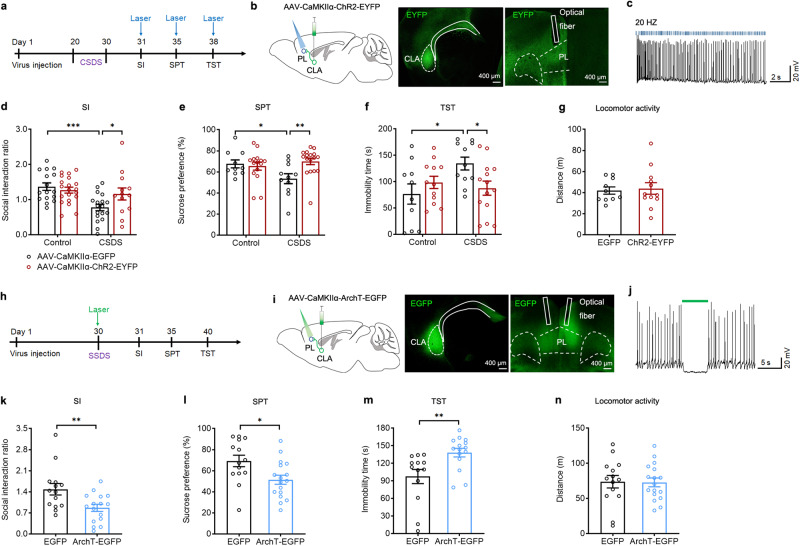
Recruiting claustral terminals in PL increased social interaction and sucrose preference and reduced tail-suspension immobility after chronic social defeat. Suppressing the connection under subthreshold stress produced the opposite behavioral pattern.
Locomotor distance did not significantly change, separating the observed behavioral effects from a corresponding change in overall movement. Stronger excitatory input need not simply make all of PL more excited; its interactions with local cells are central to the mechanism.
Source: Wang YJ et al. · Nature communications · CC BY
Original figure and English caption ↗
How does an excitatory input recruit inhibition?
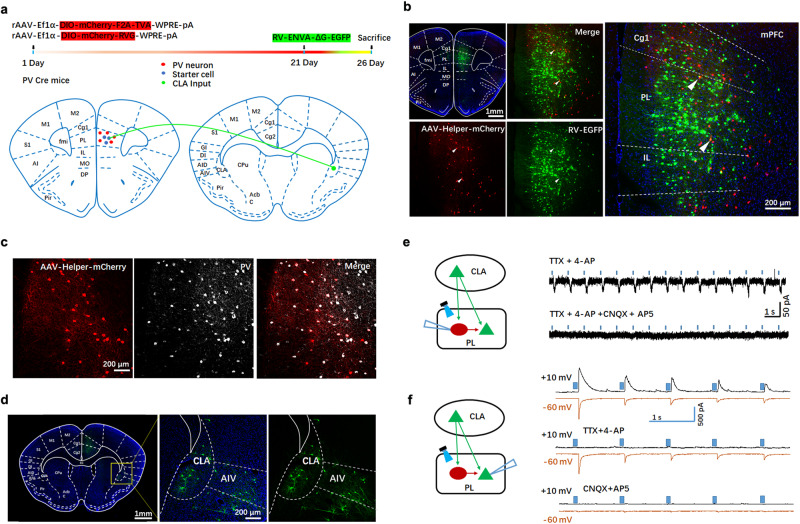
PL PV cells receive direct excitatory input from the claustrum. Incoming claustral signals can directly excite pyramidal cells and recruit local inhibitory cells, producing indirect inhibition of pyramidal cells. This arrangement is feedforward inhibition.
The input can thus convey information while also constraining output. Under stress, weaker claustral activity and lower PV activity accompany greater pyramidal activity. This provides a cellular network explanation linking the changes in the two regions.
Source: Wang YJ et al. · Nature communications · CC BY
Original figure and English caption ↗
Behavioral improvement depends on the inhibitory component
Suppressing PL PV cells while recruiting the claustral pathway weakened improvements in social interaction, sucrose preference and tail-suspension outcomes. Recruiting the input does not remove the importance of the local inhibitory component.
Conversely, recruiting PV cells while suppressing CLA-to-PL input improved social interaction and sucrose preference, while tail-suspension immobility did not significantly change. The different outcome profiles place PV cells at an important position between pathway activity and behavior.
Source: Wang YJ et al. · Nature communications · CC BY
Original figure and English caption ↗
Dynorphin and KOR reshape input strength
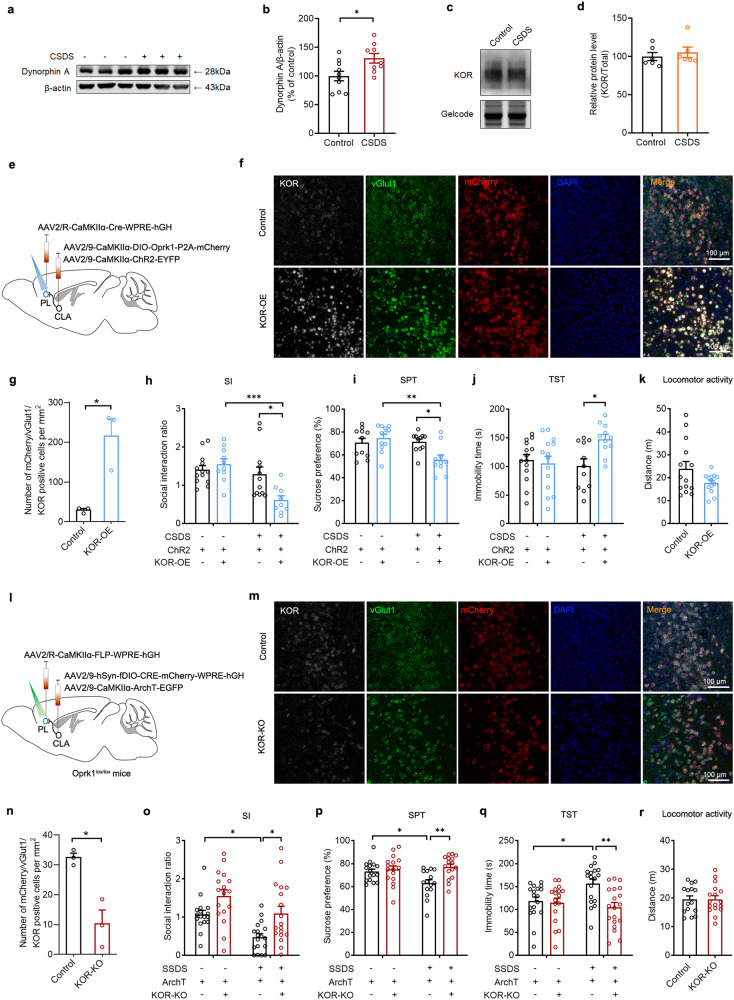
After chronic social defeat, PL dynorphin levels increased without a significant change in total KOR protein. KOR agonism reduced claustral-input-evoked excitatory currents and increased paired-pulse ratios, supporting presynaptic modulation, with stronger effects on PV cells.
Increasing KOR expression in PL-projecting claustral cells weakened behavioral benefits of pathway recruitment, while reducing KOR mitigated selected effects of pathway suppression. These receptor manipulations affect projection-defined cells, and local current measurements provide functional clues about their PL inputs.
This male-mouse study connects social stress, claustral input, local inhibition and dynorphin/KOR signaling. Prefrontal regulation depends not only on output strength but also on appropriate inputs to the cells constraining that output. Roles across sexes, stress contexts and human disease, and ways to achieve sustained, targeted effects remain to be explored.
Source: Wang YJ et al. · Nature communications · CC BY
Original figure and English caption ↗