Seeking reward or escaping discomfort? Two drivers of opioid reinforcement
Drug-associated behavior can be sustained by reward or escape from withdrawal. A mouse study links these drives to μ-opioid-receptor populations in VTA and central amygdala.
Why is an action chosen repeatedly? It may deliver a valued outcome or temporarily remove an unpleasant state. Addiction research calls these positive and negative reinforcement; negative reinforcement means reducing discomfort rather than punishment. A study published in Nature on May 22, 2024 distinguishes μ-opioid-receptor-associated populations in mouse ventral tegmental area and central amygdala, linking them to reward-related signaling and withdrawal-associated aversion, respectively.
μ-opioid-receptor-associated populations in VTA and central amygdala contribute to reward-related and aversion-relief drives, distinguishing cellular starting points for positive and negative reinforcement.
Contents · 6 sections
Withdrawal signs offer different clues
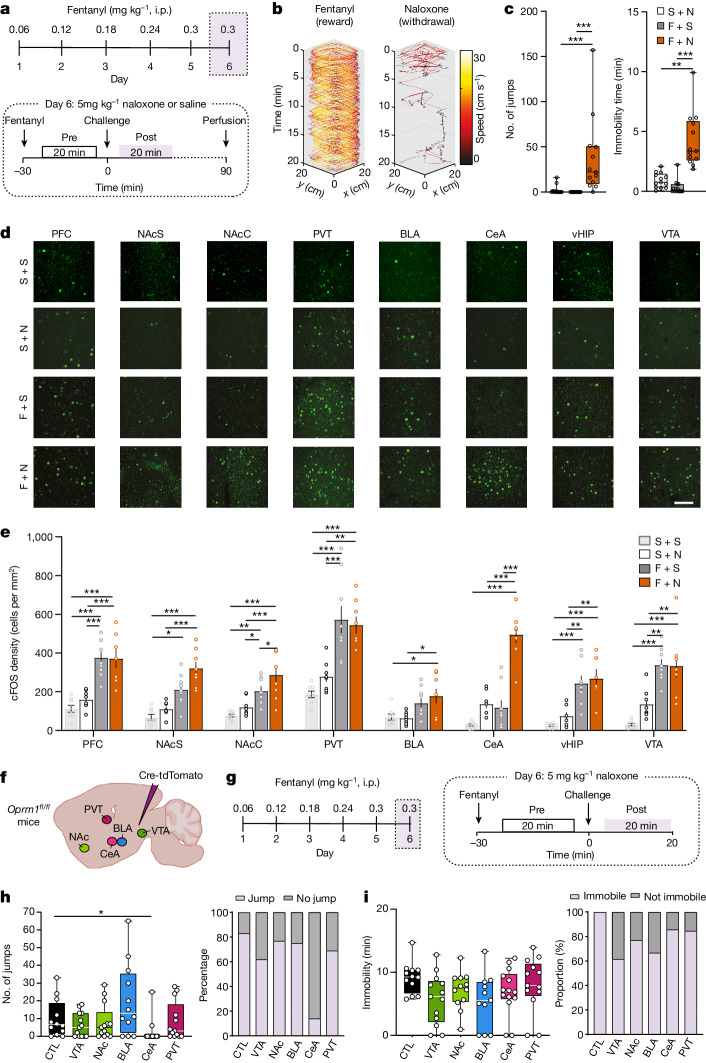
Following dependence, mice showed increased jumping and immobility, but the signs did not necessarily vary together. Screening activity-related c-Fos across several regions highlighted central amygdala during withdrawal, making it a focus for further investigation.
Reducing μ-opioid-receptor expression in central amygdala significantly reduced withdrawal-associated jumping without significantly changing immobility. Reducing receptors in VTA did not eliminate the withdrawal signs assessed here. These distinctions connected particular populations with particular behavioral components.
Source: Chaudun F et al. · Nature · CC BY
Original figure and English caption ↗
Identifying the relevant amygdala population
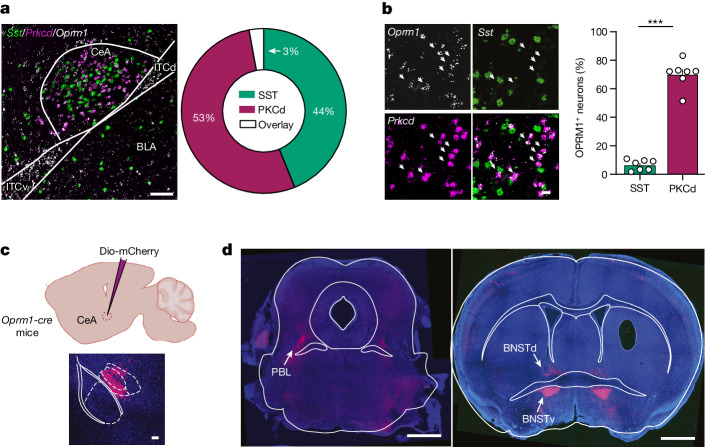
The μ-opioid receptor is encoded by Oprm1. Approximately 69% of Prkcd-labeled central amygdala cells coexpressed Oprm1, compared with around 11% of Sst-labeled cells. Each percentage refers to its respective marker-defined population.
Receptor-associated cells projected to the bed nucleus of the stria terminalis and lateral parabrachial nucleus, placing them within networks associated with aversion and bodily sensation. Which outputs support particular withdrawal or motivational functions remains to be established.
Source: Chaudun F et al. · Nature · CC BY
Original figure and English caption ↗
Inhibition releases another population from restraint
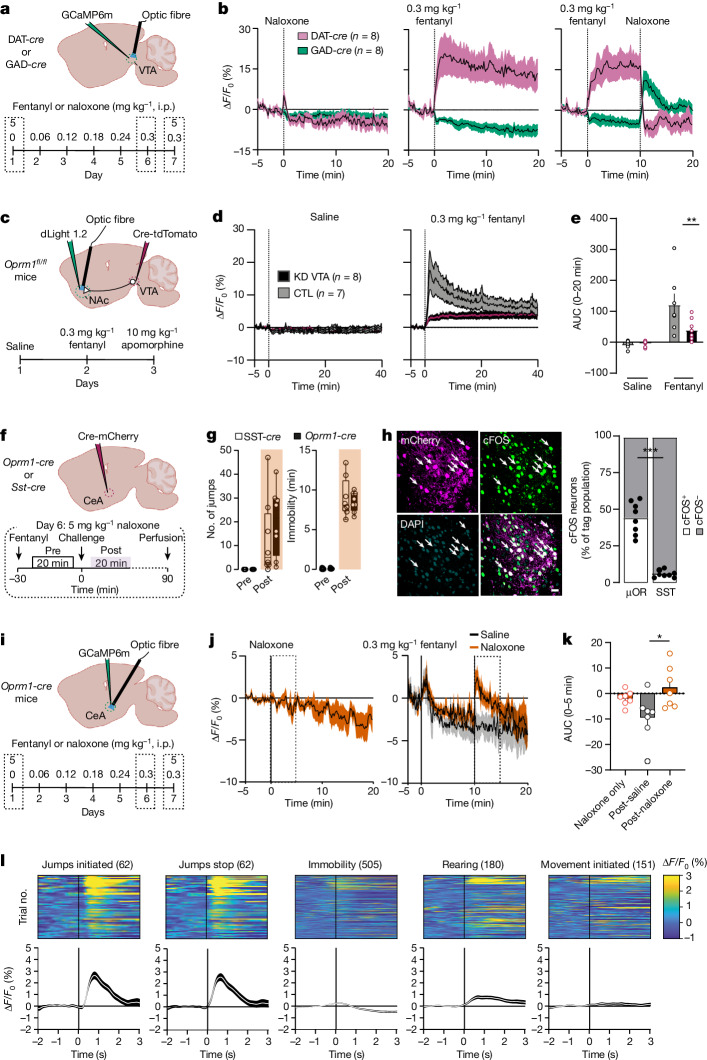
In VTA, fentanyl accompanied lower GABAergic population calcium signals and higher dopaminergic signals, consistent with disinhibition. A dopamine sensor in nucleus accumbens also recorded drug-associated increases.
Reducing VTA μ-opioid receptors attenuated fentanyl-evoked accumbal signals by approximately 66%, leaving a residual response. Population calcium activity and accumbal dopamine-sensor measurements address different levels of the pathway and provide complementary evidence.
Source: Chaudun F et al. · Nature · CC BY
Original figure and English caption ↗
Amygdala activity rises during withdrawal
During withdrawal in dependent mice, μ-opioid-receptor-expressing central amygdala cells showed increased c-Fos colabeling and transiently enhanced calcium signals. Naive mice did not show the same significant response, refining the regional clue to a defined population.
Aligning signals with behavior linked the calcium increase to the period around the end of jumps, while activity remained relatively stable during immobility. This temporal specificity complements the earlier difference between jumping and immobility outcomes.
Obtaining an outcome and making discomfort stop
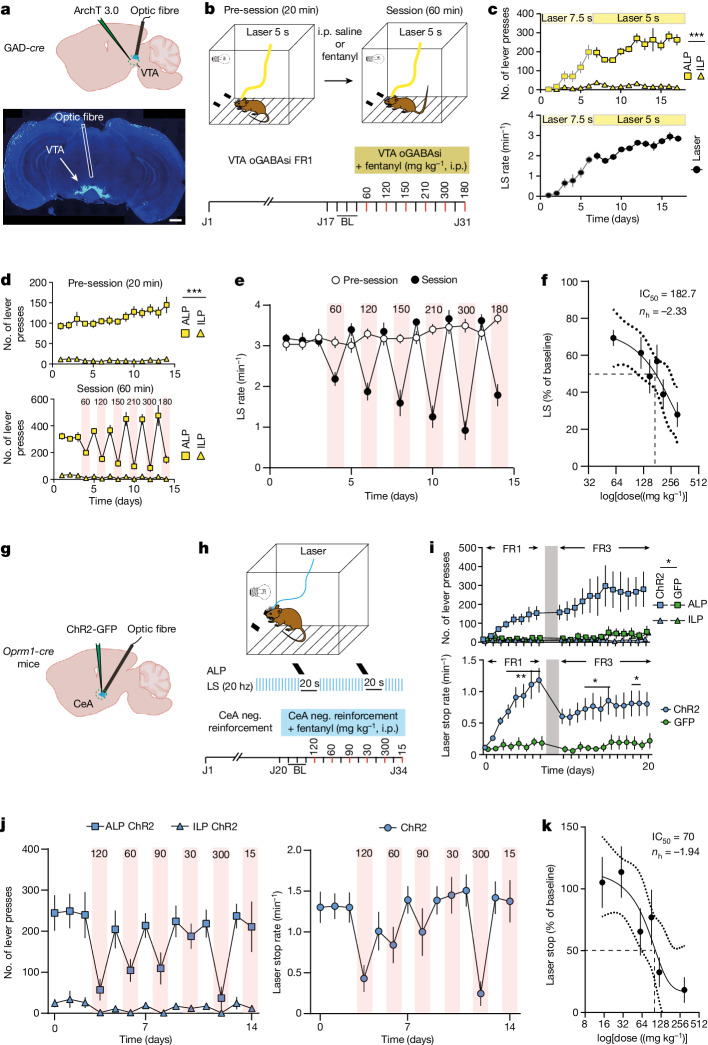
To examine behavioral influence, mice learned actions that inhibited VTA GABAergic cells, supporting a reinforcing role for disinhibition. Activating receptor-expressing central amygdala cells produced place avoidance, and mice learned actions that temporarily stopped that stimulation.
Both tasks sustained learned actions, but their outcomes differed: reward-related disinhibition versus relief from aversive stimulation. Fentanyl reduced the corresponding operant behavior in both tasks, suggesting functional convergence, although drug-associated locomotor changes may also influence performance.
Source: Chaudun F et al. · Nature · CC BY
Original figure and English caption ↗
The same receptor participates in different motivational networks
Together, the findings distinguish VTA disinhibition linked to reward-related signaling from receptor-associated amygdala populations linked to withdrawal aversion and relief. Both may sustain drug-associated behavior without being simple opposites within one population.
Where these signals converge and how they contribute to a transition toward compulsion remain unresolved. Distinguishing the drives provides a more detailed circuit framework for understanding addiction and separately testable questions for future intervention research.