Mice direct help toward a companion’s painful paw
Mice lick a companion’s affected hind paw as the recipient’s own licking declines. Anterior cingulate cortex regulates the behavior and carries distinct population patterns for licking, grooming and investigation.
A mouse approaching a distressed companion can do more than sniff: it can direct licking to the affected hind paw. A Nature study published on January 24, 2024 distinguishes this targeted licking from general social grooming and follows its relationship with anterior cingulate cortex (ACC) activity. The question extends beyond perceiving another’s state to organizing a response aimed at a particular site.
ACC inhibition reduces targeted licking and general grooming, while activation increases them without significantly altering investigation. Despite shared regulation, the behaviors mainly recruit different cells and distinguishable population activity.
Contents · 6 sections
After approaching, the response targets a particular site
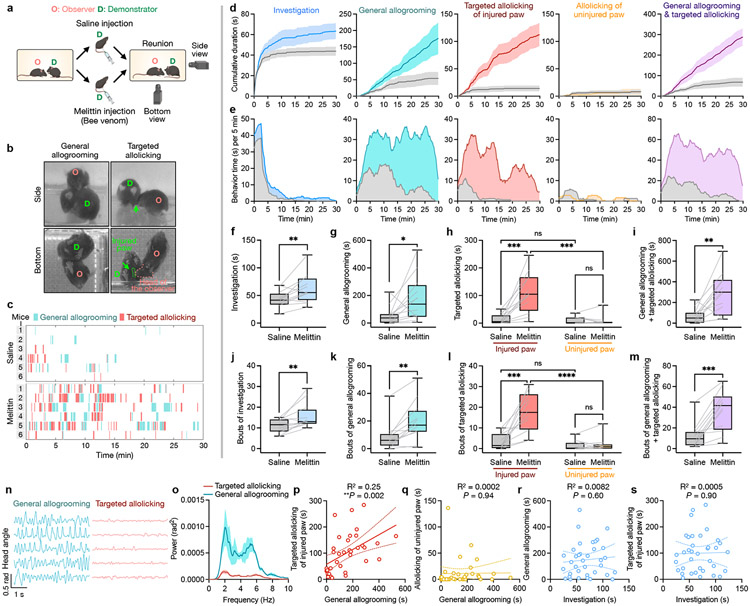
When one mouse shows localized hind-paw pain responses, its cage mate increases general grooming of the back, neck and head, as well as licking of the affected paw. Unaffected paws do not show the same increase. Targets and head-movement patterns distinguish the behaviors.
Targeted licking appears in both sexes, with a larger increase in males. Another sustained-pain model elicits similar responses. Acute restraint stress alone instead elicits more general grooming without targeted paw licking, showing that responses vary with the companion’s state.
Source: Mingmin Zhang et al. · Nature ·
Original figure and English caption ↗
A companion’s licking accompanies less self-licking
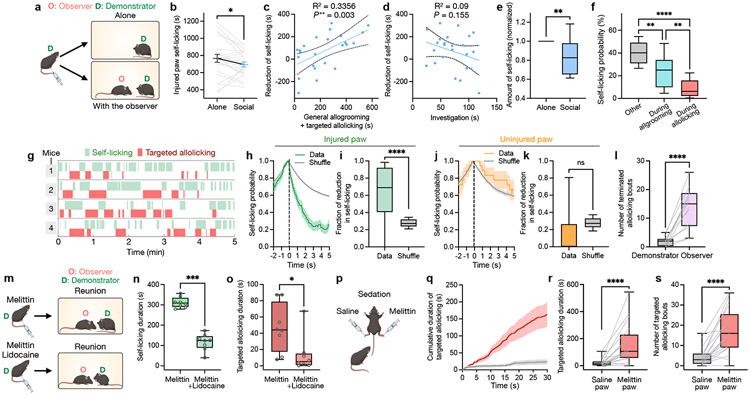
Compared with being alone, recipients interacting with a companion lick themselves less. The reduction correlates with received grooming and licking, but not with general investigation time. Recipients receiving little grooming or licking show no significant reduction.
When licking targets the affected paw, self-licking declines faster than its natural termination dynamics; licking other paws lacks that effect. Most bouts end because the helper stops rather than the recipient avoids contact. The authors propose that the behavior partly substitutes for self-licking as a coping response, with licking behavior providing the measured outcome.
Source: Mingmin Zhang et al. · Nature ·
Original figure and English caption ↗
Local cues can elicit a response even without movement
Reducing a recipient’s local pain responses decreases both its own paw licking and the companion’s targeted licking. Yet a sedated recipient that does not self-lick still receives licking of the affected paw, with selectivity for that paw emerging later.
The companion’s actions provide useful cues, while local chemical or tactile information may also contribute. The response can draw on multiple sources rather than requiring a single visible action.
ACC distinguishes another’s pain from general stress
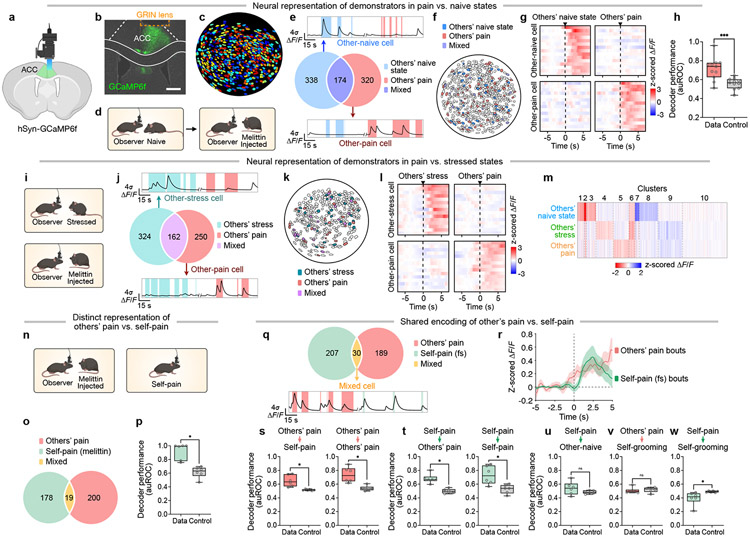
Calcium imaging during free interaction reveals different ACC recruitment for naïve, pain-experiencing and stressed companions. Pain- and stress-responsive populations are largely distinct but partly overlap, with cells spatially intermingled.
Among cells responding to both negative states, many also respond to naïve companions, while others mainly respond to pain and stress. Shared activity thus contains different components, including general social responses and signals more closely tied to another’s negative state. Population information captures this layered representation.
Self-pain and another’s pain predominantly recruit different cells, with some shared coding. Population models trained on one pain state can identify the other, but not self-grooming in the same way. ACC thus carries both distinctions and information shared across pain contexts.
Source: Mingmin Zhang et al. · Nature ·
Original figure and English caption ↗
Changing ACC activity changes the social response
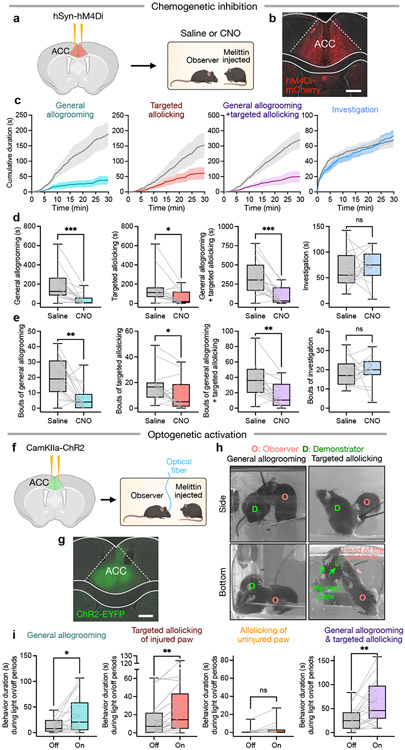
Inhibiting observer ACC reduces targeted licking and general grooming without significantly changing investigation or three-chamber social preference. Activating ACC pyramidal cells increases the two responses, with licking still directed to the affected paw rather than other paws and no significant increase in investigation.
Activating neighboring PrL does not produce the same increase, and ACC activation does not increase licking of the subject’s own painful paw. The comparisons connect ACC activity to organizing particular responses toward a companion rather than a general rise in contact or licking.
Source: Mingmin Zhang et al. · Nature ·
Original figure and English caption ↗
Shared regulation coexists with distinct population patterns
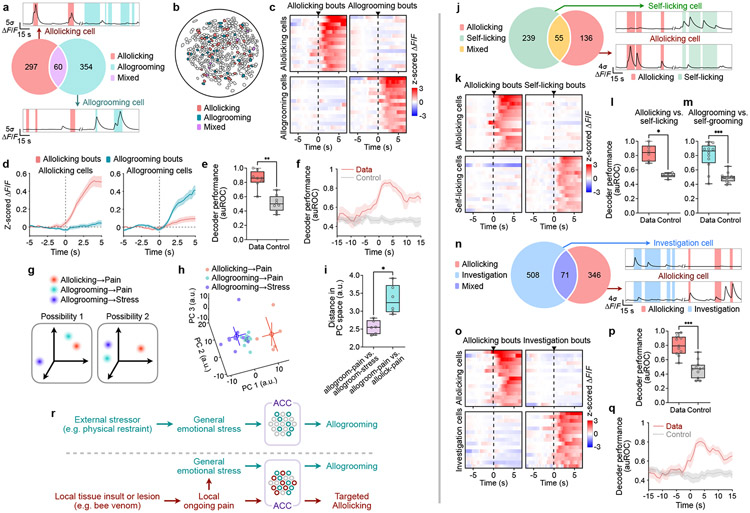
Targeted licking and general grooming mainly recruit different cells and can also be distinguished from population activity. Grooming of stressed versus pain-experiencing companions has more similar population patterns than grooming versus paw licking within the same pain context, highlighting the behavioral distinction.
Self- versus other-directed licking, and investigation versus active responses, likewise have distinguishable codes. Behavioral characterization includes both sexes, while imaging and functional manipulations use males. The study separates perception from action and shows how one cortical region can support distinct social responses.
Source: Mingmin Zhang et al. · Nature ·
Original figure and English caption ↗