Morphine and stress recruit different ensembles in the ventral tegmental area
A male-mouse study follows two experience-related ensembles with distinct distributions, connections and molecular profiles. Their calcium responses to sucrose and stress are selectively modulated by different drugs.

Does morphine recruit the same cells as a stressful experience within one brain region? The ventral tegmental area (VTA) participates in reward and aversion, yet does not simply brighten or dim as a whole. A study published in Theranostics on January 12, 2024 follows activity histories in male mice, comparing where the recruited cells connect, which inputs they receive and their molecular profiles. Experience-related populations differ, but can also respond in the same direction to a new event.
Both morphine- and foot-shock-related ensembles are mixed populations with distinct connections and molecular features. Activating the former produces place preference; activating the latter increases open-space avoidance. Both increase calcium with sucrose and decrease it during tail suspension, while drug effects differ by ensemble and context.
Contents · 8 sections
Different experiences leave different spatial patterns
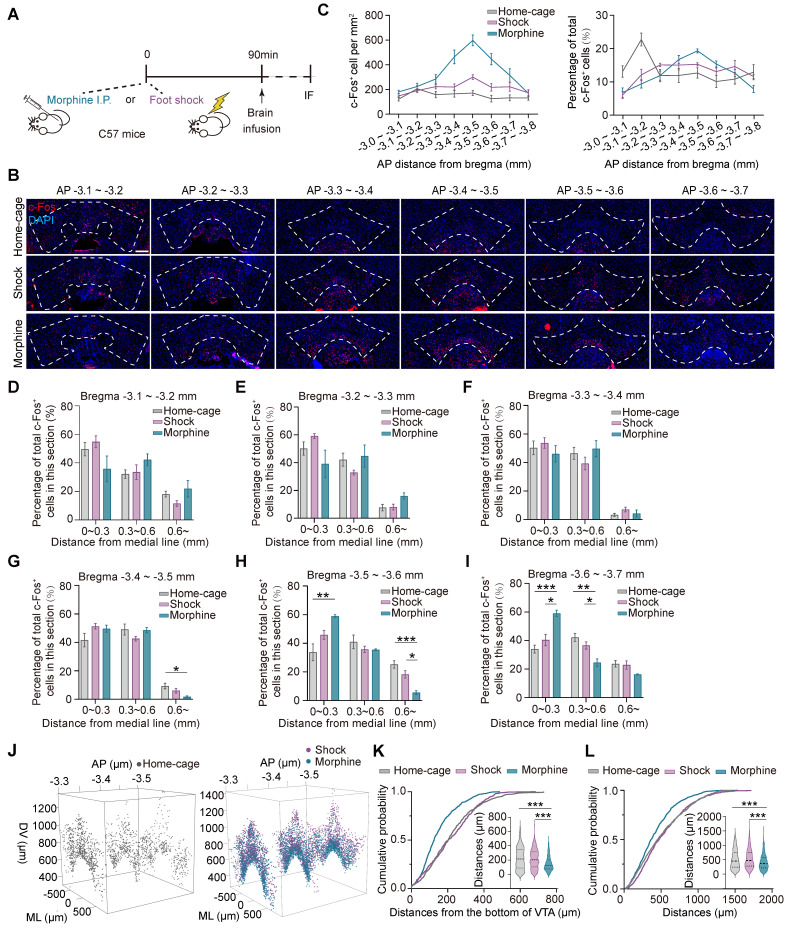
The team calls morphine-related cells Mor-Ens and foot-shock-related cells Shock-Ens. Activity labeling places morphine-recruited cells more ventrally, caudally and near the midline of VTA, while shock-related cells are more dispersed.
This approach identifies cells through participation in an experience before examining their properties. The label captures recruitment during a particular period, rather than defining a fixed cell type or dividing VTA into two independent regions.
Source: Wang F et al. · Theranostics · CC BY
Original figure and English caption ↗
Place preference and avoidance separate
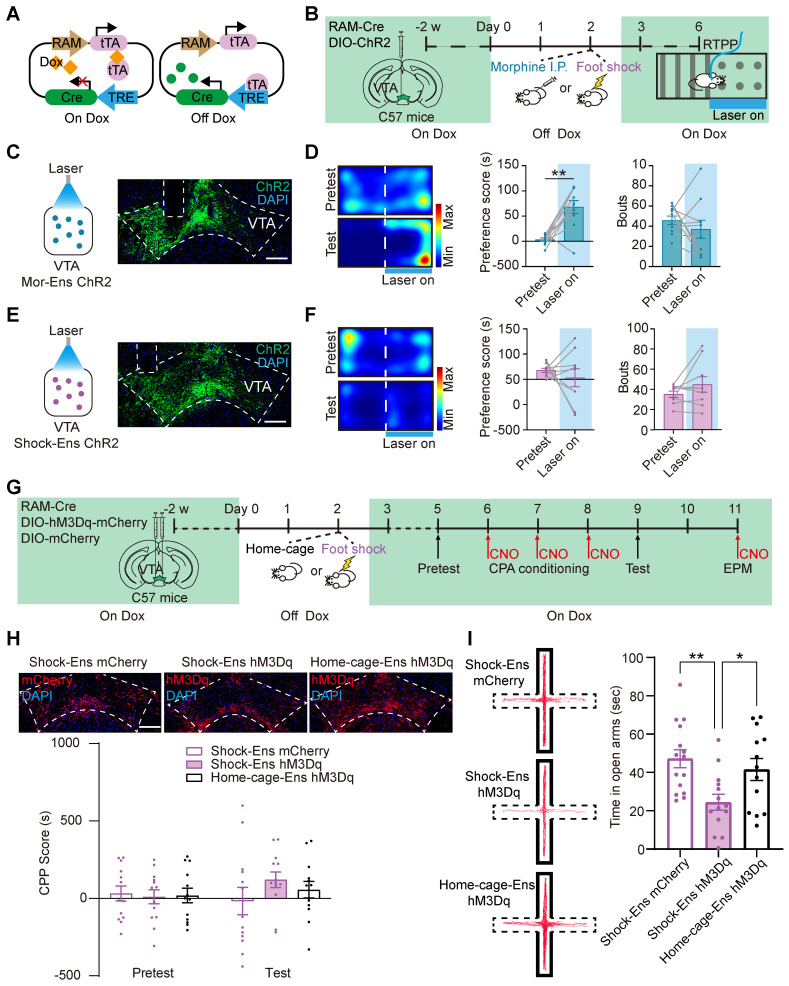
Reactivating Mor-Ens makes mice prefer the location paired with activation. Shock-Ens activation does not significantly produce real-time place avoidance. In a separate population-activation experiment, it reduces elevated-maze open-arm time without significant conditioned place preference or aversion.
The populations are therefore not simple reward-versus-aversion mirror images. Place choice and exposed-space exploration probe different behavioral dimensions, allowing distinct aspects of a population’s function to emerge.
Source: Wang F et al. · Theranostics · CC BY
Original figure and English caption ↗
Both dopamine-related and GABAergic cells are recruited
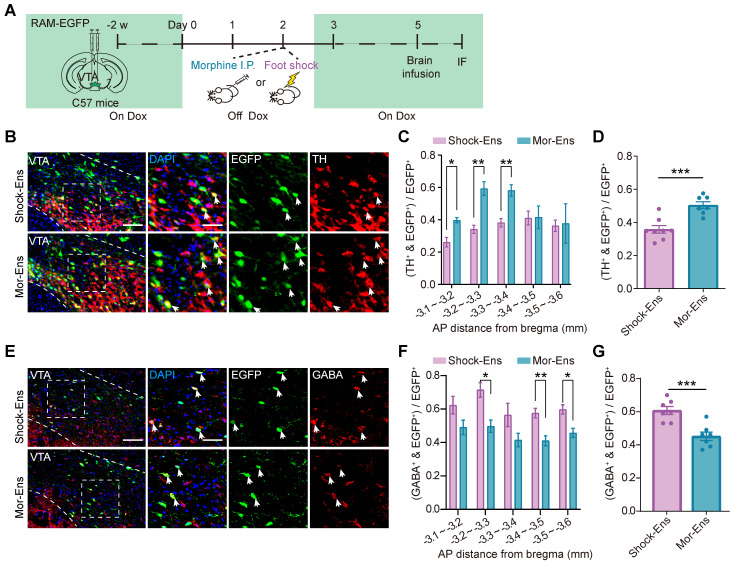
Although VTA is commonly associated with dopamine, neither ensemble is purely dopaminergic. Histology finds TH, a dopamine-related marker, in about half of Mor-Ens and GABA labeling in about 45%. Corresponding Shock-Ens proportions are approximately 36% and 61%.
Different cellular compositions provide context for later connectivity and response differences. An experience can recruit multiple members across conventional transmitter classes: activity history and molecular identity offer complementary views of the same network.
Source: Wang F et al. · Theranostics · CC BY
Original figure and English caption ↗
Similar input totals conceal different source proportions
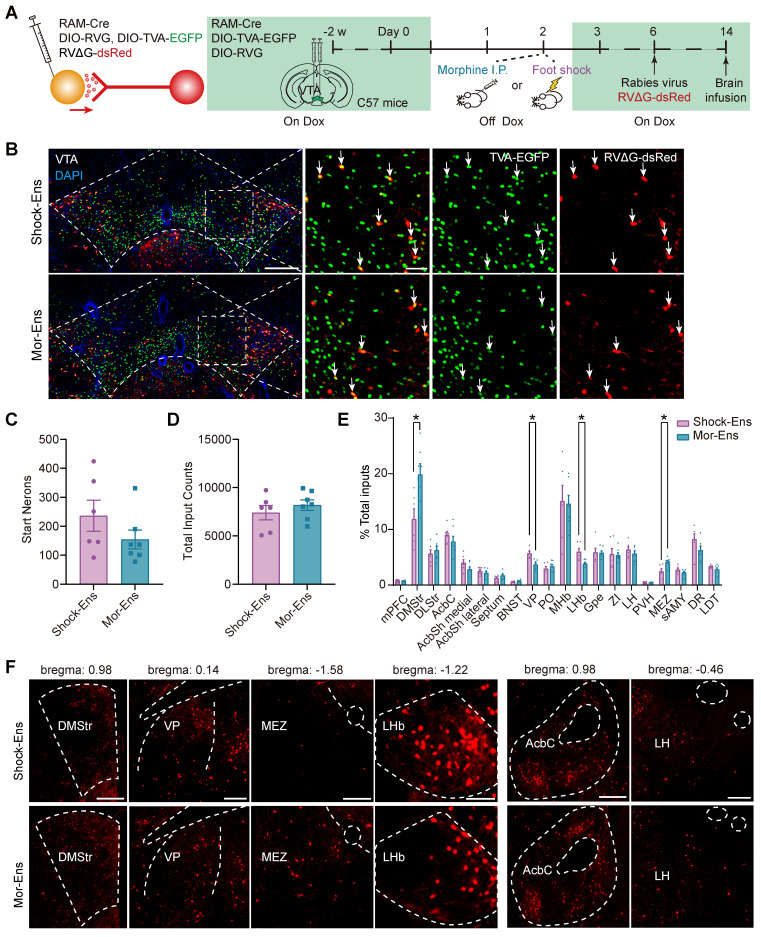
Tracing upstream connections reveals no significant differences in starter-cell or total input-cell counts, but different source proportions. Mor-Ens receives greater relative input from dorsomedial striatum and medial hypothalamic zone, and less from ventral pallidum and lateral habenula.
The distinction concerns where information arrives from, rather than simply having more connections. These proportions describe labeled input composition, specifying anatomical differences without directly measuring each input’s synaptic strength.
Source: Wang F et al. · Theranostics · CC BY
Original figure and English caption ↗
Zona incerta and ventral pallidum distinguish the output maps
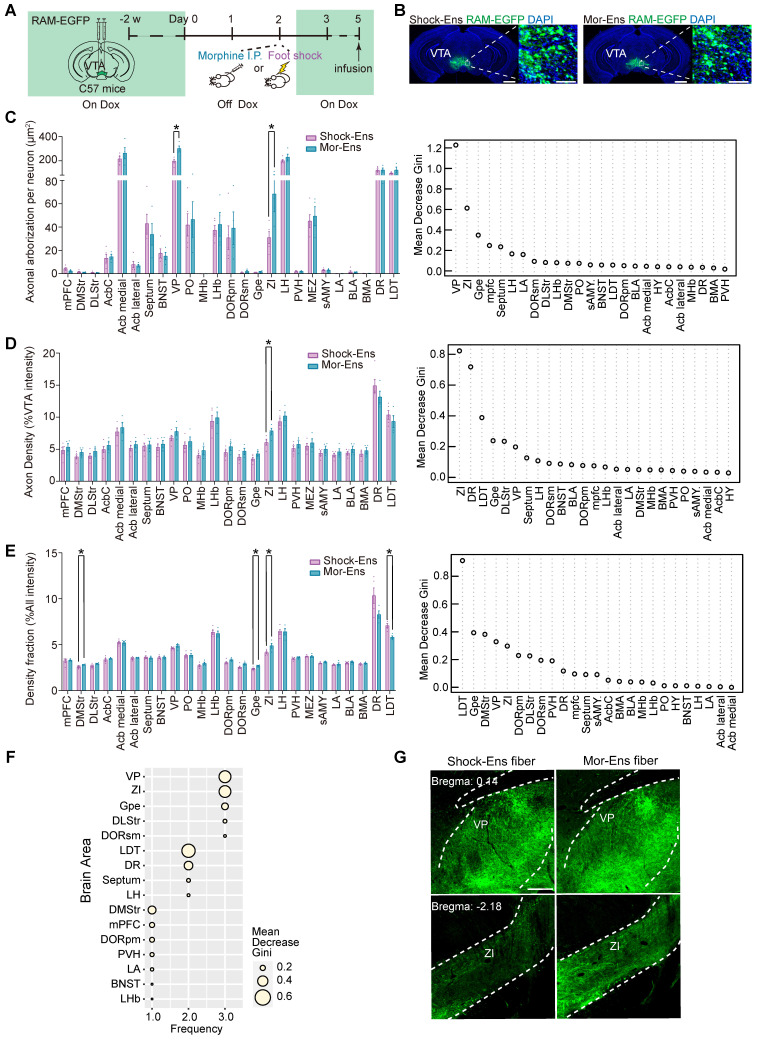
Outputs differ as well. Comparing axonal arborization, fluorescence density and relative fractions across target regions highlights zona incerta and ventral pallidum as distinguishing destinations. Mor-Ens has greater per-cell-normalized arborization in both and greater axonal density in zona incerta.
Arborization, local density and share of total labeling capture different features and need not change together. The maps describe how outputs are distributed, without individually testing the behavioral functions of those destinations.
Source: Wang F et al. · Theranostics · CC BY
Original figure and English caption ↗
Molecular profiles differ alongside connectivity
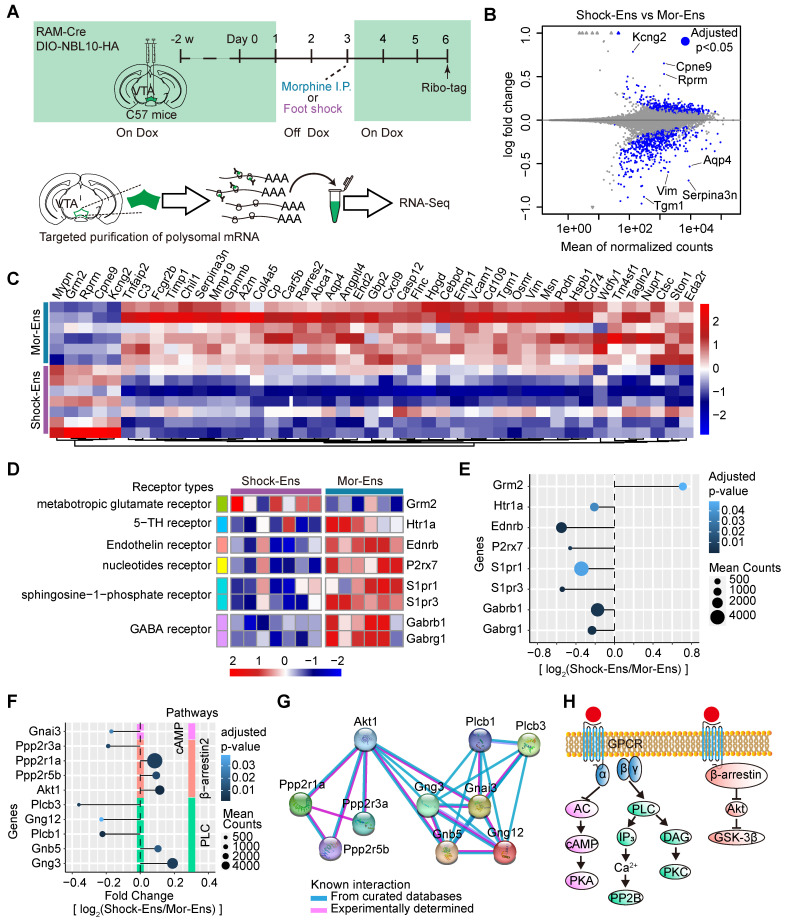
Comparing ribosome-associated transcripts identifies over a thousand differentially expressed genes, including neuroactive receptors and intracellular signaling components. Grm2 transcripts are more abundant in Shock-Ens, while Mor-Ens is enriched for receptors including Htr1a.
Tissue protein-related signals also show higher phosphorylated AKT1 in Shock-Ens and higher PLCβ3 in Mor-Ens. These signatures motivate tests with drugs favoring different signaling routes, without directly measuring the functional activity of an entire pathway.
Source: Wang F et al. · Theranostics · CC BY
Original figure and English caption ↗
Both respond to sucrose, but drug modulation is selective
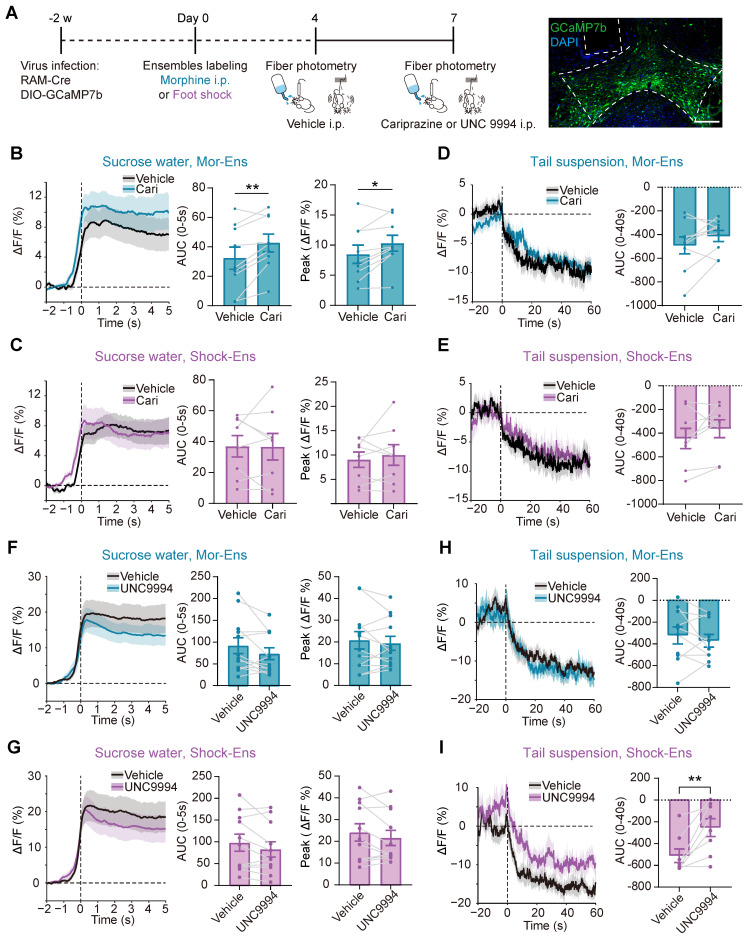
Both ensembles increase calcium with sucrose and decrease it during tail suspension. Cariprazine enhances the Mor-Ens sucrose response without significant effects on Shock-Ens or either tail-suspension response. UNC9994 attenuates the Shock-Ens calcium decrease during tail suspension without significantly changing either sucrose response.
Experience tags do not lock cells into one emotional direction. The populations still respond to new events, while systemic drug effects vary by ensemble and setting. Population calcium responses do not directly quantify dopamine release.
Source: Wang F et al. · Theranostics · CC BY
Original figure and English caption ↗
Behavioral effects also depend on context
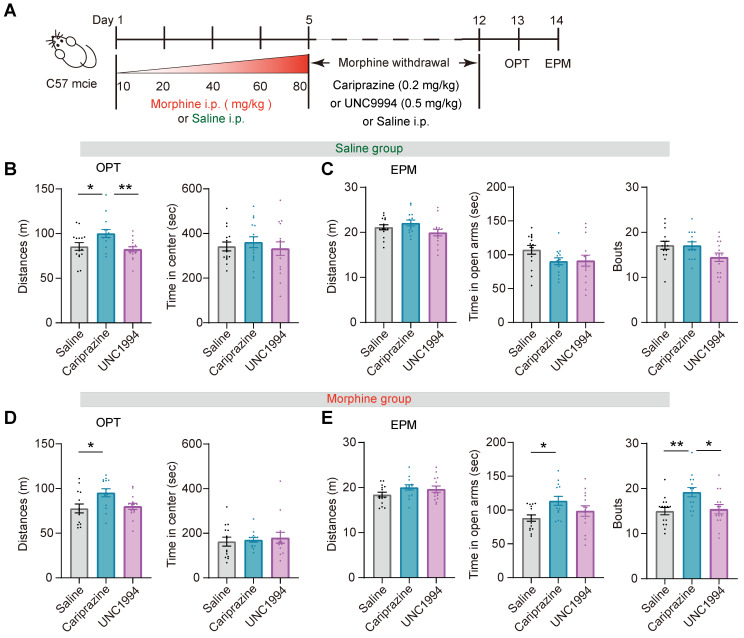
When given during withdrawal after morphine exposure, cariprazine increases open-arm time and entries without significantly changing maze distance. UNC9994 lacks the same improvement. Cariprazine also increases open-field locomotion in both saline-control and withdrawal groups.
These adult male-mouse findings bring experience, connectivity and molecular differences together. Systemic drug action does not establish that behavioral improvement originates solely in one ensemble. The study instead reveals experience-related VTA populations with distinct compositions that both share and differentiate responses in new settings.
Source: Wang F et al. · Theranostics · CC BY
Original figure and English caption ↗