How noise avoidance engages midbrain dopamine circuitry
A mouse study traces an inferior-colliculus–cuneiform–ventral-tegmental connection: loud noise recruits inhibitory cells as dopamine signals decline in lateral nucleus accumbens.
Sound begins as physical vibration but can become something an animal urgently avoids. What connects hearing noise with avoiding it? A 2025 Nature Communications study follows mouse auditory midbrain activity into another midbrain population and changes in accumbal dopamine signals. The connection links intensity with avoidance and helps explain why auditory input produces different outcomes at different levels.
Excitatory central inferior-colliculus cells recruit VTA GABA cells through the cuneiform nucleus, accompanying reduced lateral-accumbal dopamine. Weakening this connection reduces avoidance and anxiety-like behavior under the tested loud-noise conditions.
Contents · 7 sections
Avoiding noise and exploring exposed spaces less
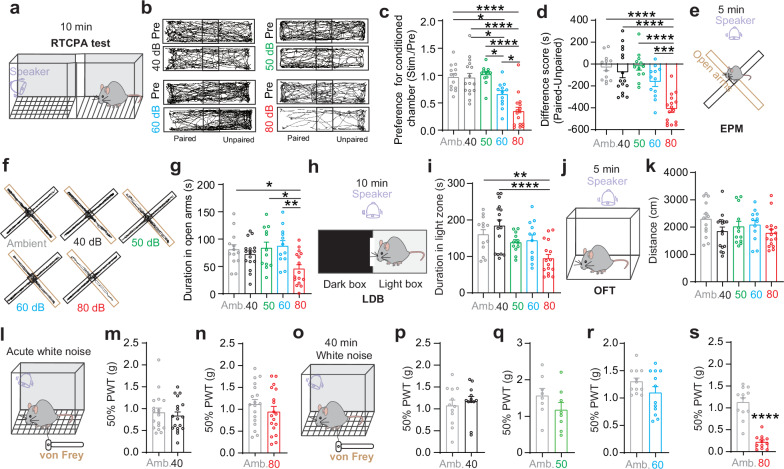
Mice can move between sound and quiet compartments. Louder noise produces avoidance of the sound side and less time in open arms and a light compartment; weaker noise has a different behavioral profile. Total distance traveled in the open field does not significantly change, whereas distance traveled on the sound side in the place-avoidance task decreases.
Nociceptive behavior also depends on exposure: brief loud noise does not clearly change hindpaw mechanical thresholds, whereas forty-minute exposure increases mechanical sensitivity. Avoidance, exploration and mechanical responses do not all change together from the outset.
Intensity does not map identically onto every behavior: 60-dB noise already produces some avoidance without the clear anxiety-like changes seen at 80 dB. Leaving a compartment and changing exposed-space exploration can have different response thresholds.
Source: Zhou S et al. · Nature communications · CC BY-NC-ND
Original figure and English caption ↗
These cells respond to more than sound
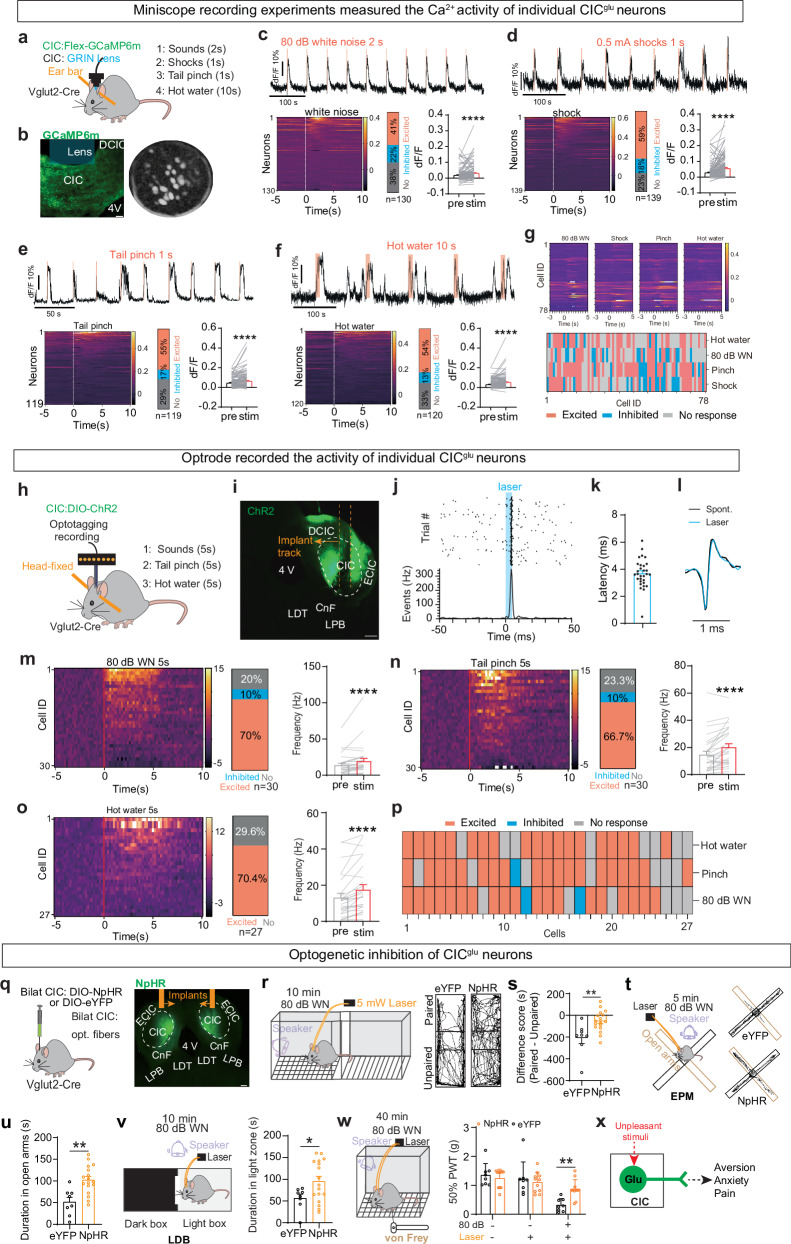
The central inferior colliculus (CIC) is an auditory-midbrain node. Its excitatory cells respond differently to noise intensity, and some also respond to shock, tail pinch or heat. Single-cell recordings show diversity: some cells activate, others are inhibited, and others show no clear response to the presented stimulus.
Sound and nociceptive stimuli converge in some cells, giving the population properties beyond a simple volume readout. Reducing excitatory CIC activity weakens loud-noise avoidance and anxiety-like behavior, while activating these cells induces place avoidance.
Source: Zhou S et al. · Nature communications · CC BY-NC-ND
Original figure and English caption ↗
An indirect route into VTA
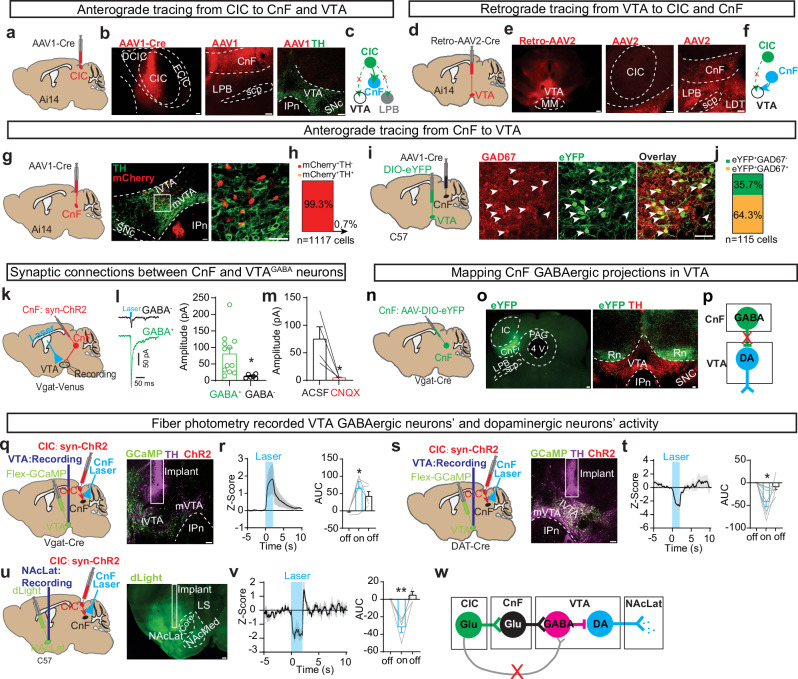
The study next asks how CIC influences the motivation-related ventral tegmental area (VTA). Tracing detects no direct projection between them but identifies the cuneiform nucleus (CnF) as a relay. CIC provides direct excitatory synaptic input to CnF, whose excitatory neurons project to VTA.
This branch differs behaviorally from output to auditory thalamus. Activating CIC terminals in CnF induces avoidance, whereas activating those in medial geniculate does not produce the same effect. Transmitting sound onward and making sound aversive can involve different output connections.
CnF relays auditory-midbrain input into a different cellular arrangement. The study also examines auditory cortex: under the tested noise conditions, inhibiting it does not clearly prevent the associated avoidance or accumbal dopamine changes. This midbrain connection offers an explanation for rapid sound-related behavioral changes.
Source: Zhou S et al. · Nature communications · CC BY-NC-ND
Original figure and English caption ↗
Recruiting an inhibitory population
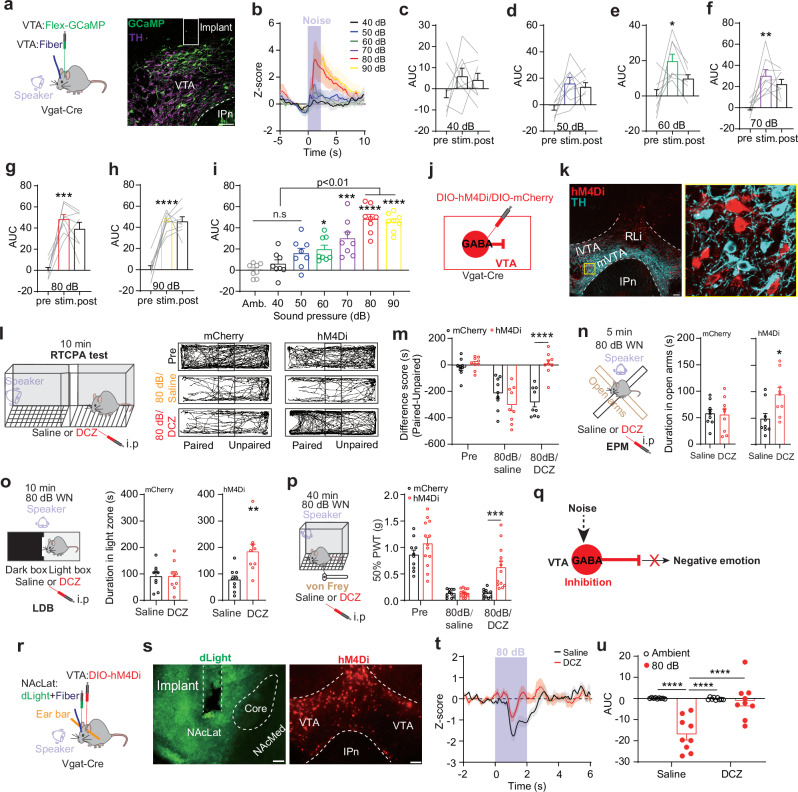
CnF input preferentially contacts GABAergic inhibitory VTA cells. Their calcium response generally grows with noise intensity; reducing their activity weakens loud-noise avoidance and anxiety-like behavior. Excitatory input into the midbrain can therefore change another population through inhibitory cells.
Activating CIC or its CnF-directed branch increases activity in the VTA GABA population while decreasing activity in the dopamine population. These opposing directions connect sound-intensity processing with downstream dopamine circuitry.
Dopamine here is an event-related neural signal rather than a universal score of an animal’s emotional state. Comparing place choice, exploration and sensory responses with cellular interventions reveals which specific outcomes this relay influences.
Source: Zhou S et al. · Nature communications · CC BY-NC-ND
Original figure and English caption ↗
Weakening the relay reduces avoidance
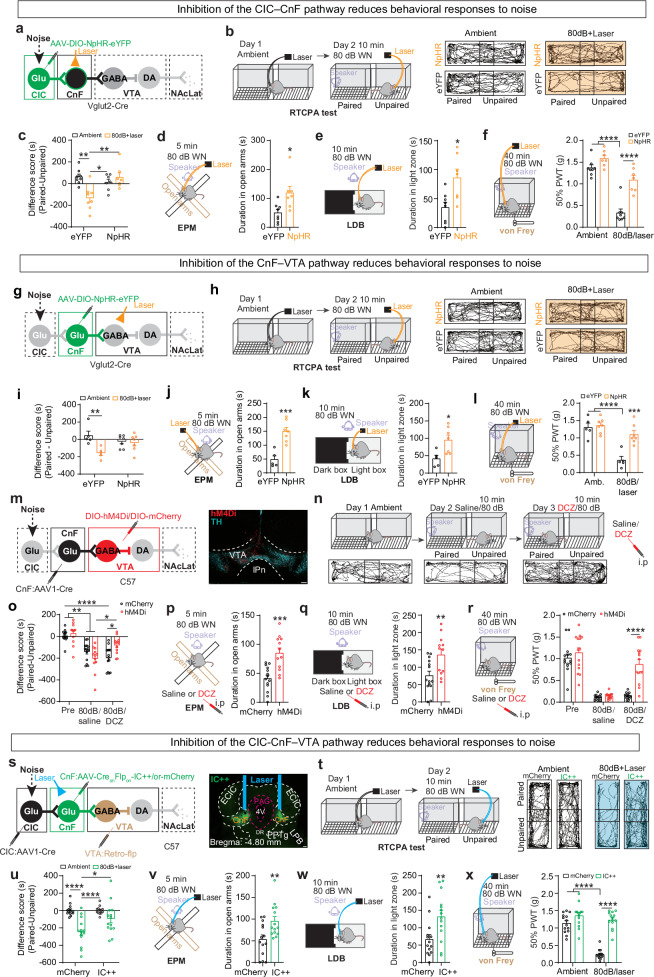
Inhibition targets CIC cells projecting to CnF, CnF cells projecting to VTA, and VTA cells receiving CnF input. Intervening at these stages reduces loud-noise avoidance and anxiety-like behavior and improves mechanical sensitivity after longer noise exposure.
A more selective strategy targets CnF cells that both receive CIC input and project to VTA. The relay thus involves a defined population that can influence behavioral outcomes, beyond overlapping anatomical connections.
Source: Zhou S et al. · Nature communications · CC BY-NC-ND
Original figure and English caption ↗
A distinctive response in lateral accumbens
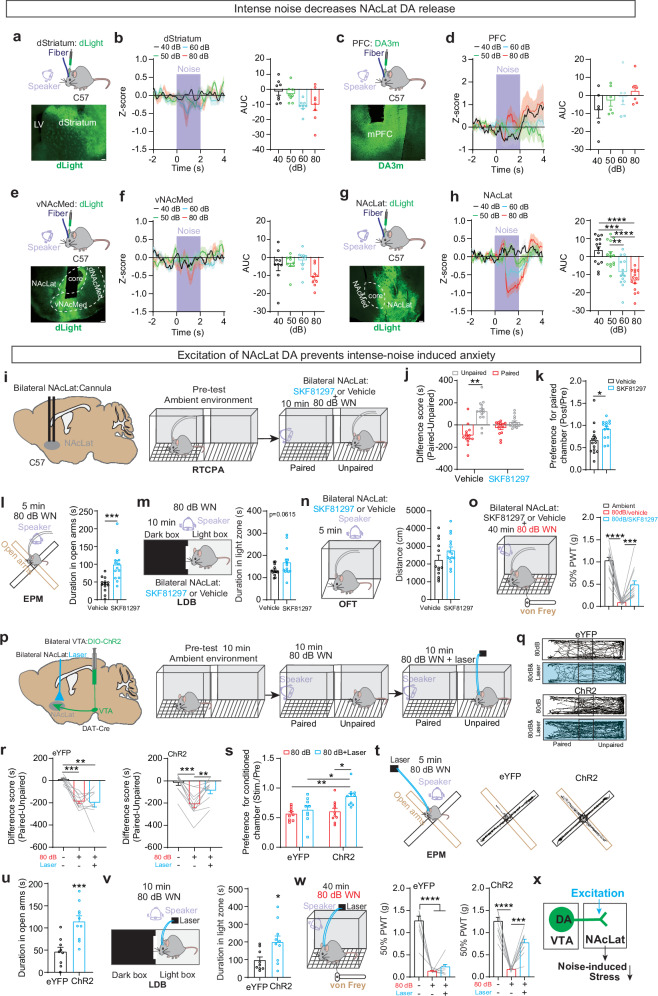
Noise does not produce the same dopamine changes in every tested area. Signals clearly decrease in lateral nucleus accumbens, without a comparable clear response in dorsal striatum, prefrontal cortex or ventral medial accumbens. The tested regions show different response profiles, giving the sound-related dopamine change a spatial pattern.
Increasing dopamine-terminal activity or local D1-receptor signaling in lateral accumbens reduces noise-related avoidance and anxiety-like behavior and improves mechanical sensitivity after longer exposure. Without noise challenge, terminal activation produces place preference but does not clearly alter the tested anxiety-like measures.
Source: Zhou S et al. · Nature communications · CC BY-NC-ND
Original figure and English caption ↗
Intensity reaches behavioral choice through a relay
This adult male-and-female mouse study connects loud noise, excitatory auditory-midbrain input, inhibitory VTA cells and accumbal dopamine changes. Auditory networks do more than pass sound onward: distinct output branches and local cellular relays also contribute to whether an animal stays where sound occurs.

Source: Zhou S et al. · Nature communications · CC BY-NC-ND
Original figure and English caption ↗