From reward to withdrawal discomfort, an inhibitory input grows stronger
VTA cells recruited by an initial morphine experience later receive stronger inhibitory input from amygdala. A mouse study connects reward-circuit changes with withdrawal-related aversion and anxiety-like behavior.
Where does the brain change when an initially rewarding experience is followed by discomfort after cessation? A mouse study published in Molecular Psychiatry on October 12, 2021 follows ventral tegmental area (VTA) cells active during an initial morphine experience. After chronic exposure, these cells receive stronger inhibitory input from central amygdala (CeA). The interaction between an experience-associated reward population and stress-related input offers a circuit-level account of withdrawal-related negative behavior.
After chronic morphine exposure, CRH-associated CeA input more strongly inhibits cells recruited by the initial experience. Altering the input or ensemble changes withdrawal-related behavior, while reducing ensemble CRHR1 improves selected outcomes without significantly changing place aversion.
Contents · 7 sections
Finding cells associated with the initial reward
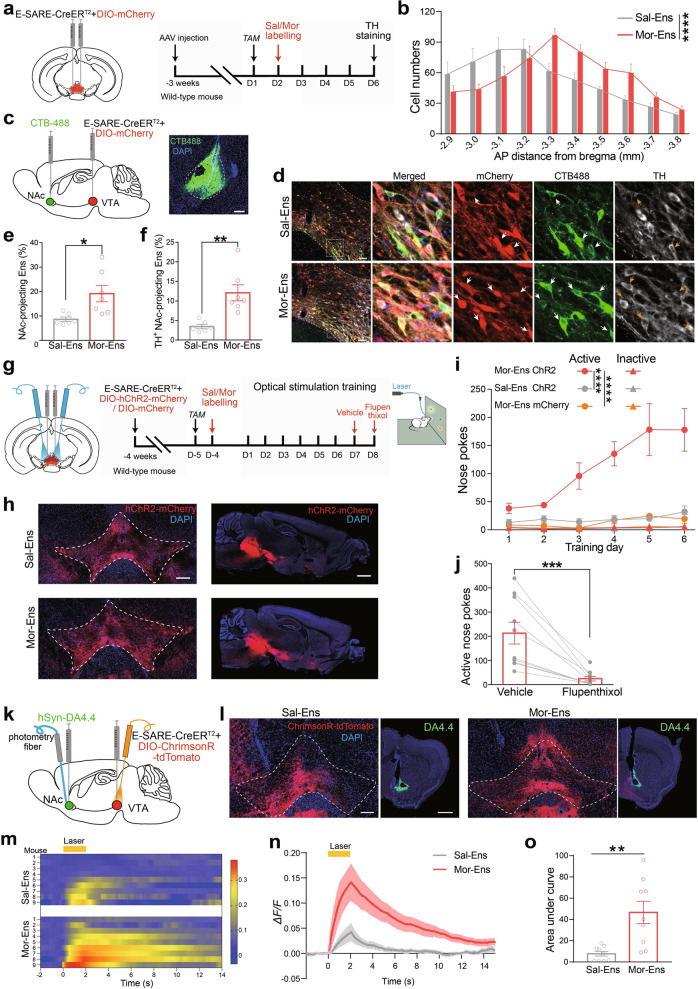
Rather than treating VTA as a uniform region, the study follows the population active during initial morphine exposure, termed Mor-Ens, against a saline-associated comparison. Mor-Ens has more abundant connections with nucleus accumbens, with a higher dopaminergic-marker proportion among the related cells, while remaining heterogeneous.
Increasing Mor-Ens activity makes mice more likely to repeat an action that produces it, alongside increased accumbal dopamine-sensor signals. Dopamine-receptor blockade weakens this responding. Together, ensemble activity, downstream signals and positive reinforcement connect the population with reward.
Source: Jiang C et al. · Molecular psychiatry · CC BY
Original figure and English caption ↗
Inhibitory input grows after repeated exposure
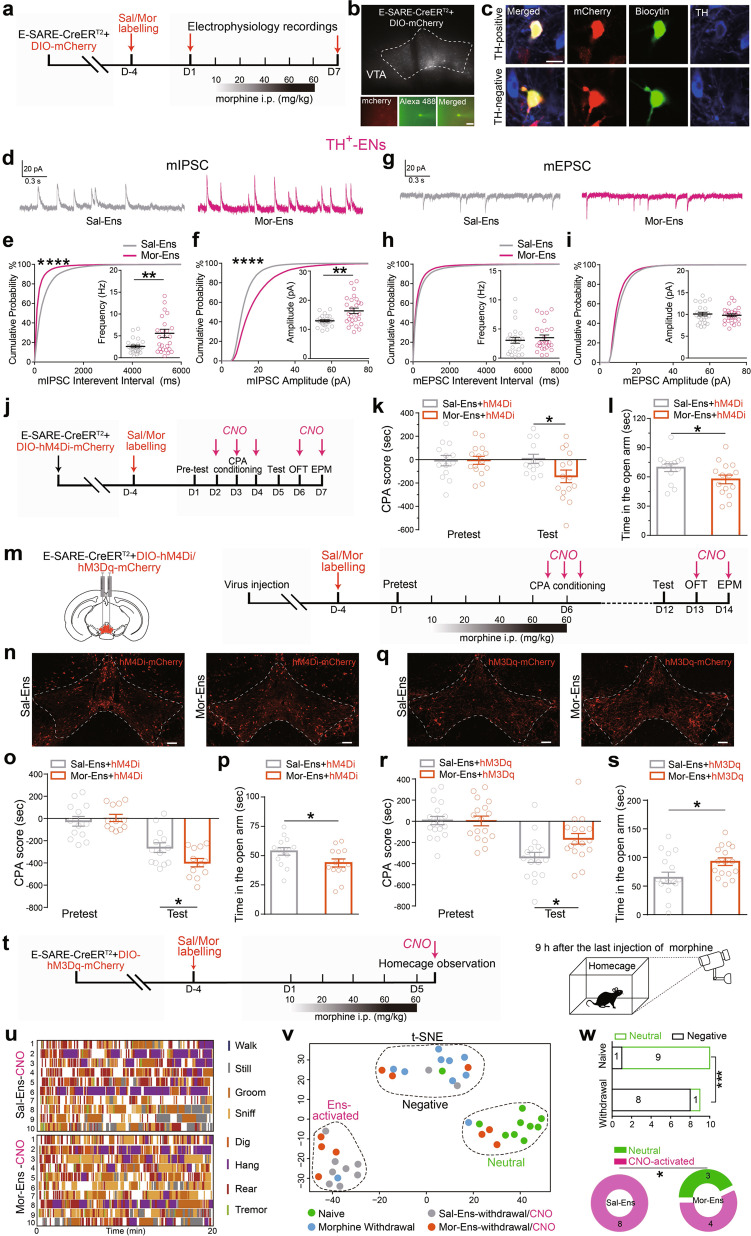
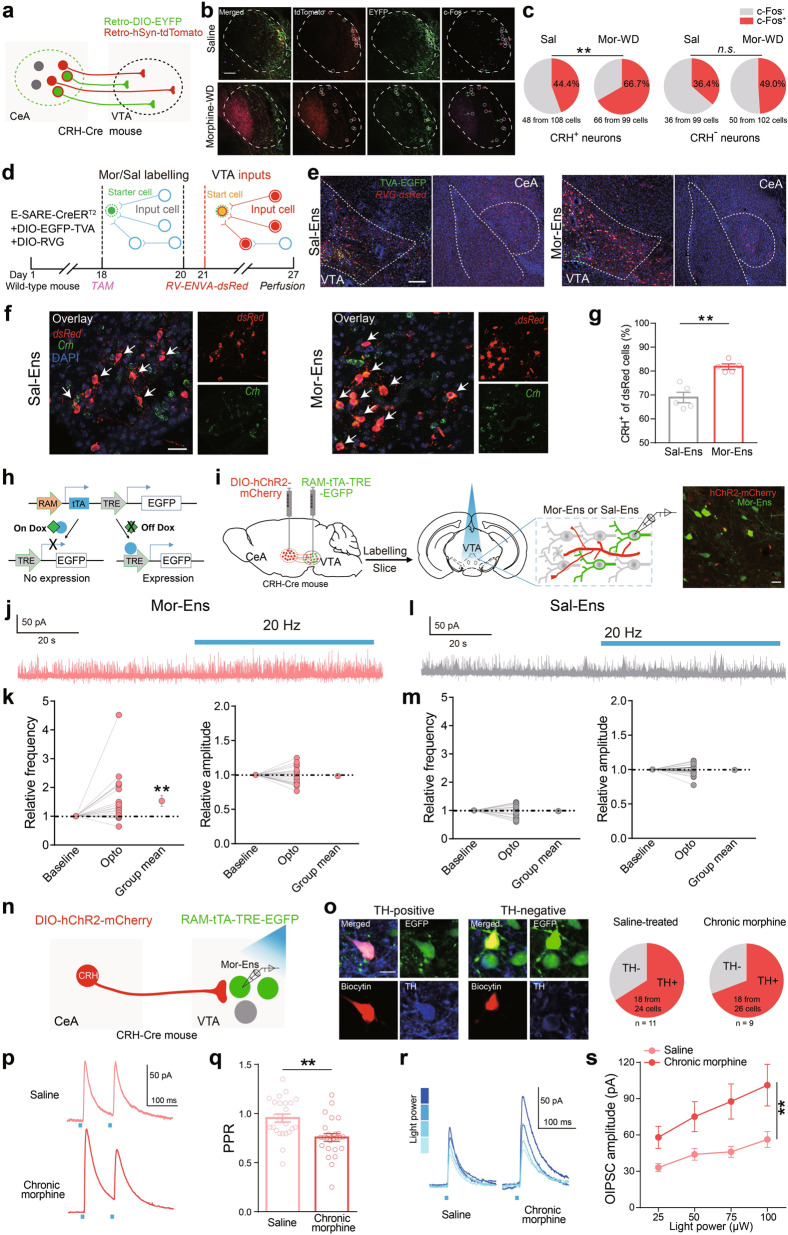
After chronic morphine exposure, dopamine-marker-positive Mor-Ens cells receive, relative to the saline-associated population, more frequent and larger miniature inhibitory synaptic currents, without significant differences in the corresponding excitatory-current frequency or amplitude. In this comparison, the change centers on stronger inhibition.
Cells within the experience-defined population differ. Those lacking the dopaminergic marker do not follow the same inhibitory-current pattern. VTA heterogeneity matters: recruitment by a shared experience does not make all cells change identically.
Source: Jiang C et al. · Molecular psychiatry · CC BY
Original figure and English caption ↗
Lower ensemble activity is linked with aversion and anxiety-like behavior
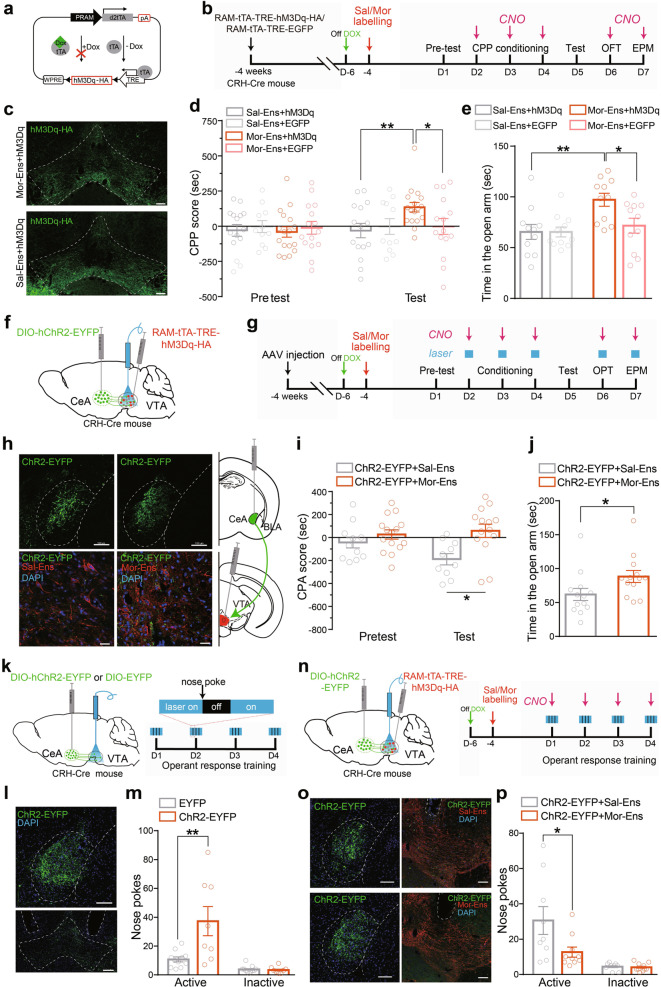
Reducing Mor-Ens activity increases place aversion and reduces time in exposed elevated areas, including in the withdrawal setting. Conversely, activating Mor-Ens weakens withdrawal-related place aversion and increases open-arm exploration.
These changes occur without significant alterations in overall locomotion or saccharin preference. A combined analysis of home-cage behavior also places some activated withdrawal mice closer to the neutral behavioral cluster. The measures capture different aspects of negative behavior rather than uniform elimination of withdrawal signs.
A stress-related input from amygdala
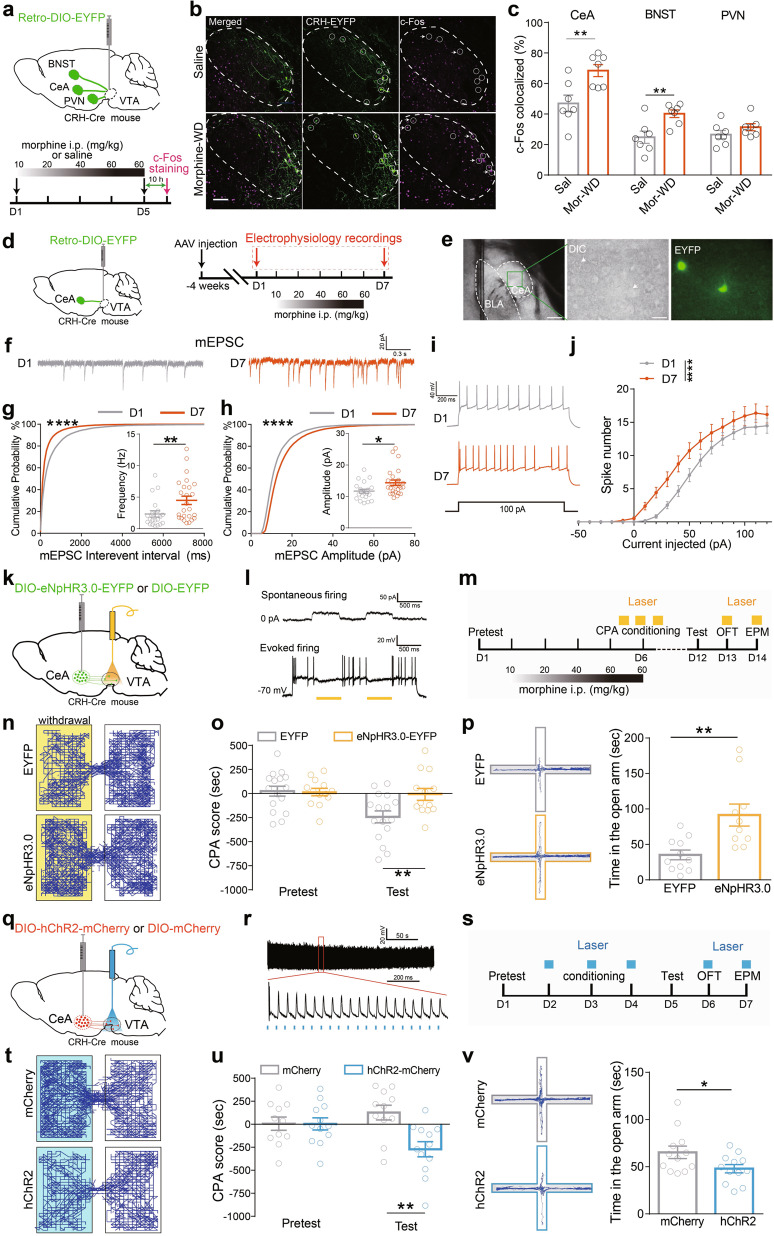
Where does the stronger inhibition originate? After chronic exposure, VTA-projecting CRH-associated CeA cells show more activity labeling, stronger excitatory input and greater firing excitability. Corresponding labeling also increases in BNST, another stress-related region, while the tested PVN comparison is not significant.
Reducing these CeA terminals’ activity in VTA weakens withdrawal-related place aversion and increases open-arm exploration. Activating the terminals can induce aversion and reduce open-arm time without significantly changing locomotion, functionally linking this input with negative behavior.
Source: Jiang C et al. · Molecular psychiatry · CC BY
Original figure and English caption ↗
The input preferentially reaches the experience-associated population
Among CeA cells connected with Mor-Ens, a larger fraction is CRH-associated. Functionally, increasing the input raises inhibitory-current frequency in Mor-Ens, without a significant corresponding change in the saline-associated population. Current amplitude does not significantly increase in this acute comparison.
Chronic exposure further strengthens the inhibitory current evoked by this input and changes paired-pulse responses. Reward and stress are therefore not simply parallel systems: cells associated with an earlier reward become recipients of stronger inhibition.
Source: Jiang C et al. · Molecular psychiatry · CC BY
Original figure and English caption ↗
Increasing ensemble activity changes avoidance-driven responding
When CeA input is activated, concurrent Mor-Ens activation is associated with less place aversion and more open-arm time in the relevant group comparisons. Activity in the reward-associated population can oppose some behavioral consequences of the stress-related input.
Mice also learn an action that terminates the aversive input, illustrating negative reinforcement: ending an unpleasant event promotes repetition of an action. Increasing Mor-Ens activity reduces this responding, connecting ensemble state with motivation to escape an aversive condition.
Source: Jiang C et al. · Molecular psychiatry · CC BY
Original figure and English caption ↗
CRHR1 contributes, with different behavioral outcomes
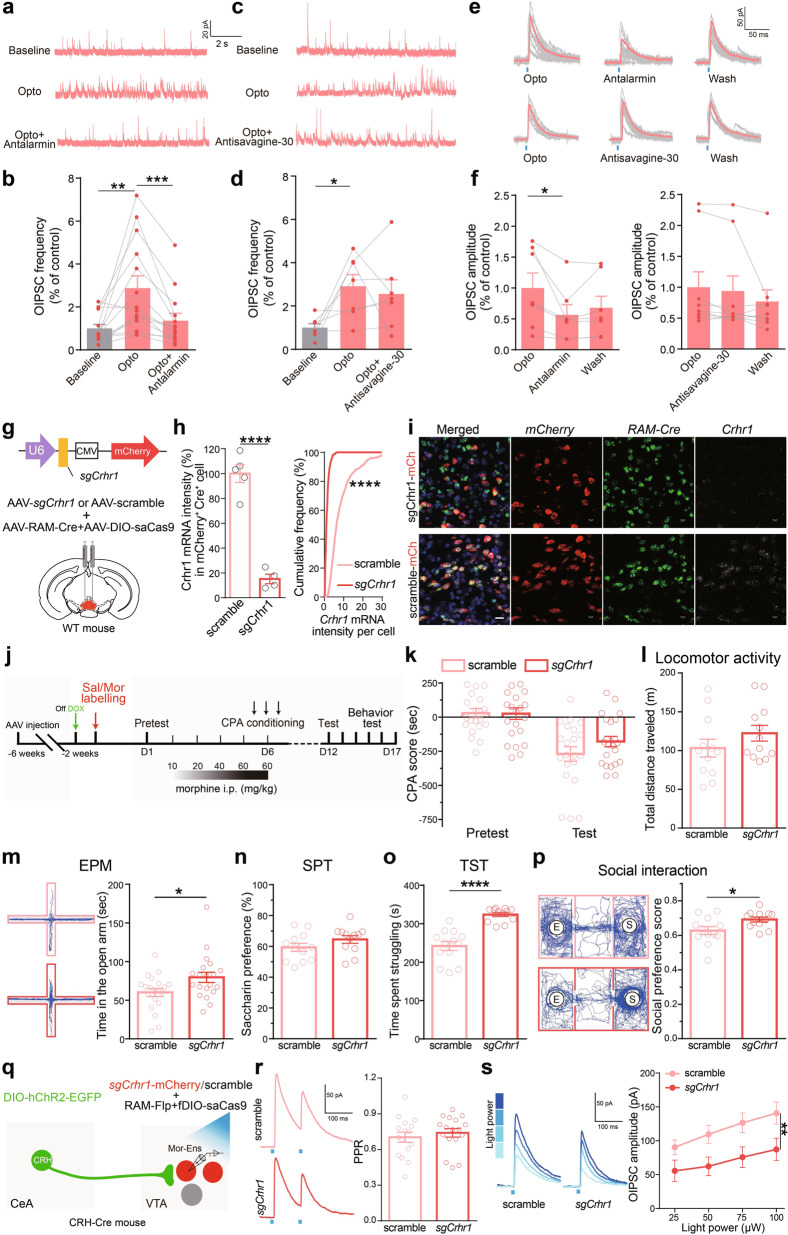
In recordings, blocking CRHR1-related signaling weakens input-evoked inhibitory responses, while the corresponding CRHR2 comparisons are not significant. Reducing Crhr1 expression within Mor-Ens also lowers input-evoked inhibitory-current amplitude without significantly changing the paired-pulse ratio.
Behavioral effects are selective: Crhr1 reduction increases open-arm time, struggling time and social preference, without significant changes in place aversion, locomotion or saccharin preference. Different withdrawal-related outcomes can thus be modulated separately. How peptide signaling cooperates with other transmission, and which ensemble cells matter most, remain unresolved. The study connects complex withdrawal-related behavior in mice with the circuit state of experience-associated cells.
Source: Jiang C et al. · Molecular psychiatry · CC BY
Original figure and English caption ↗