NG2 glia release GABA: another component of hippocampal inhibition
In mice, increasing NG2-associated glial activity enhances inhibition of nearby interneurons, accompanies greater pyramidal excitability and changes anxiety-like exploration. Necessity during stress remains unresolved.
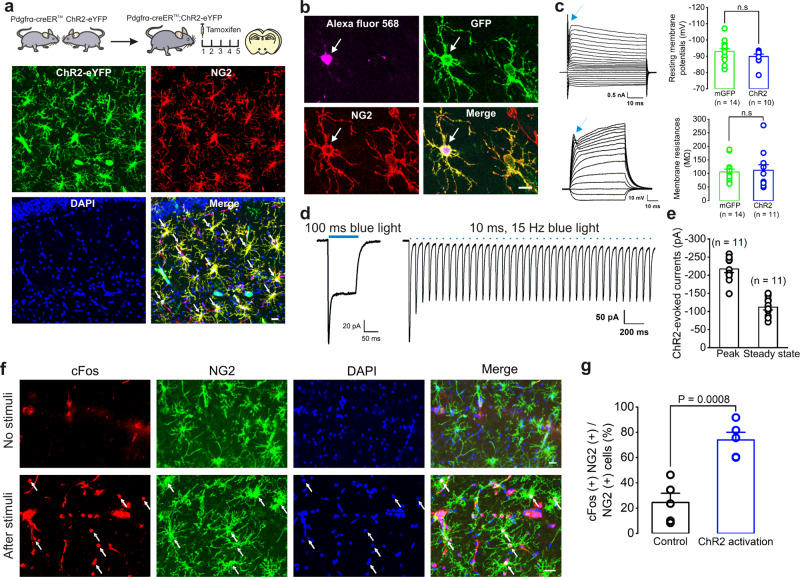
Can glial cells send inhibitory signals back to neurons, as well as receive them? A study published in Nature Communications on September 30, 2021 examines hippocampal NG2 glia, also called oligodendrocyte precursor cells. The study finds GABA-release capability with effects preferentially involving nearby inhibitory interneurons. Inhibiting an inhibitory cell need not quiet the network: pyramidal cells become easier to drive, alongside altered exploration behavior.
NG2-associated glia influence nearby interneurons through GABA. Population activation lowers interneuron excitability, increases pyramidal excitability and accompanies anxiety-like exploration, without establishing necessity for stress-related behavior.
Contents · 7 sections
Precursor glia also participate in local communication
NG2 glia are known for generating oligodendrocytes and contributing to myelin-related processes. They also receive direct neuronal synaptic input. The study asks whether communication is only one-way or whether glia influence nearby neurons.
The labeled population is predominantly NG2 glia within the oligodendrocyte lineage. Activation changes their membrane state, but they do not generate neuronal action potentials. Neighboring-cell responses and release measurements provide the evidence for output function.
Two hippocampal neuronal classes respond differently
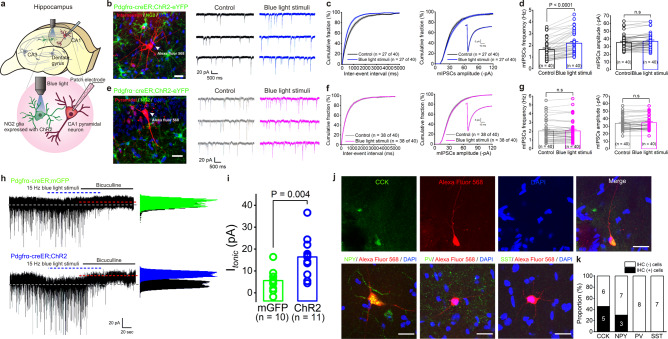
Following NG2-associated activation, about two-thirds of recorded interneurons show more frequent miniature inhibitory events, without a significant mean-amplitude change. Tonic GABA-associated inhibition also increases, identifying a local inhibitory effect.
Discrete synaptic events and tonic background current offer two perspectives: brief individual responses and sustained receptor activity. Increases in both extend the observation beyond one current measure and indicate altered temporal organization of local GABA action.
Corresponding miniature inhibitory currents in pyramidal cells do not show a significant overall change, and tested miniature excitatory currents do not show the same enhancement. The effect differs by recipient rather than increasing the same signal uniformly across the hippocampus.
Source: Zhang X et al. · Nature communications · CC BY
Original figure and English caption ↗
Nearby cells respond more often
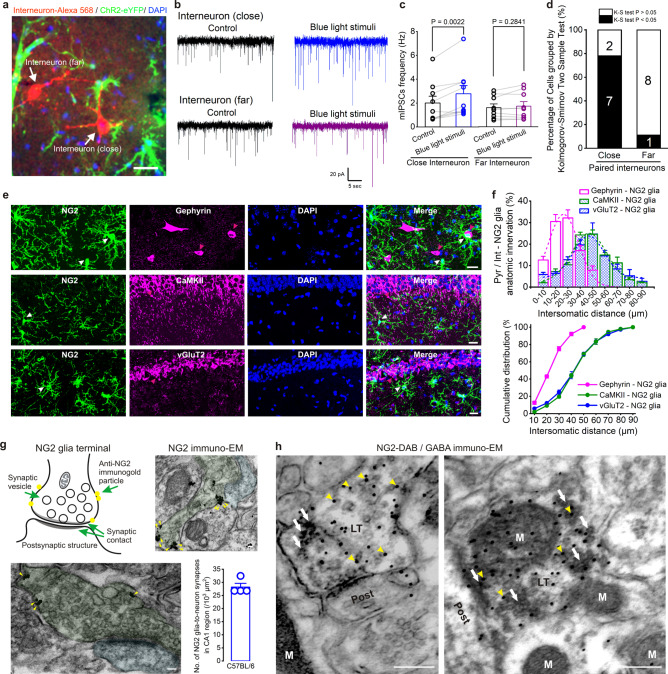
Nearby interneurons more often show increased inhibitory-event frequency, while distant cells show no significant overall effect. Tissue organization likewise places interneurons near NG2 somata, implicating local arrangement in communication.
Electron microscopy reveals vesicles in NG2-associated terminals and contacts with neurons, with GABA-associated labeling in some terminals. Structure and function converge, while the exact recipient identity at every contact remains unresolved.
Source: Zhang X et al. · Nature communications · CC BY
Original figure and English caption ↗
Synthesis and release evidence comes from several levels
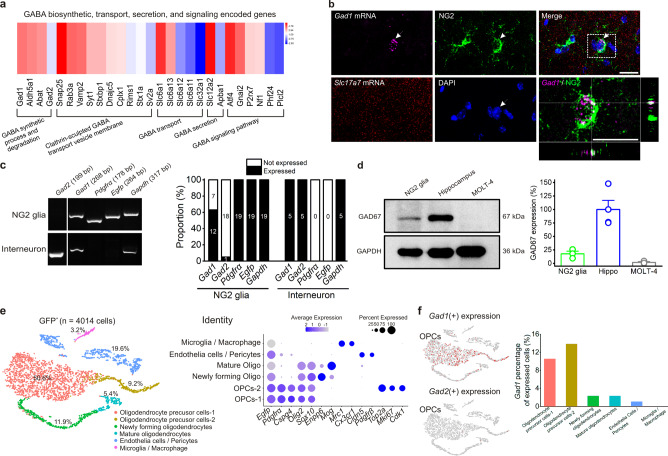
Transcript, in-situ and protein analyses detect the GABA-synthesis-associated Gad1/GAD67 in a subset of NG2 glia. Single-cell variation shows that the finding does not apply uniformly to every cell.
In isolated-cell observations, activation is followed by stronger GABA-related responses in nearby reporter cells and more vesicle fusion. Restricting exocytosis weakens the response. These findings support vesicular release without isolating GAD67 or one vesicle protein as uniquely necessary for the behavioral effect.
Source: Zhang X et al. · Nature communications · CC BY
Original figure and English caption ↗
Stress changes process signals and exploration
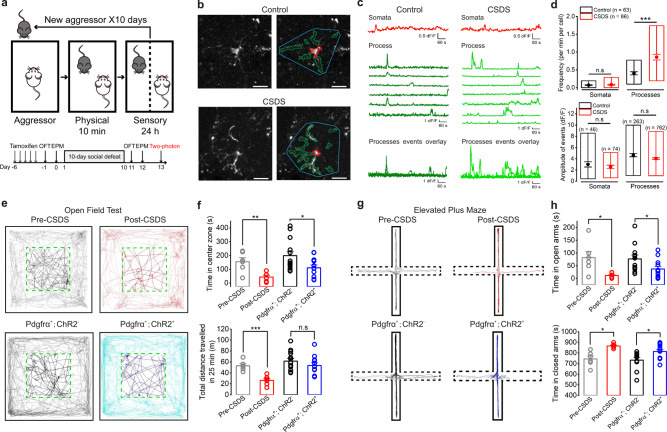
After chronic social stress, calcium-event frequency increases in NG2 processes, without significant somatic-frequency or corresponding amplitude effects. Mice spend less time in the open-field center and open maze arms, and total distance also decreases after stress.
In a separate activation comparison, NG2-associated enhancement also reduces center and open-arm time, without significant corresponding distance change or increased social avoidance. Stress-associated signals and activation effects therefore converge on some, but not every, behavioral feature.
Source: Zhang X et al. · Nature communications · CC BY
Original figure and English caption ↗
Inhibiting an inhibitory cell can leave pyramidal cells more excitable
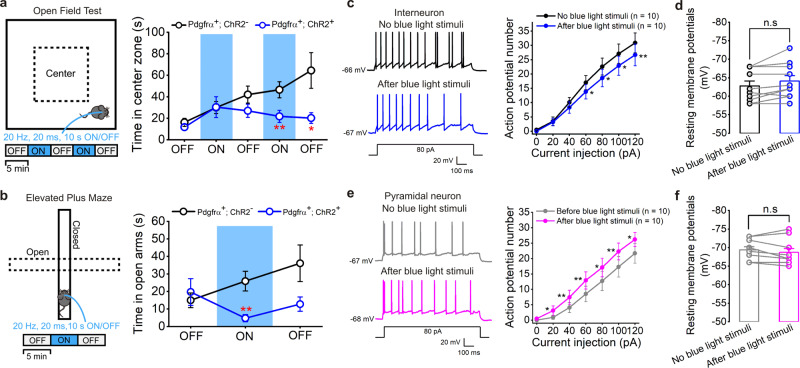
After NG2-associated activation, interneurons become harder to drive to fire and pyramidal cells become easier to drive. Resting potentials do not change significantly in either class, emphasizing altered input responsiveness rather than a uniform baseline shift.
This fits a disinhibition account: stronger restraint of inhibitory cells can reduce their influence on other cells. More GABA need not quiet the whole network; the recipient matters.
Source: Zhang X et al. · Nature communications · CC BY
Original figure and English caption ↗
From input recipient to a local network participant
The study positions NG2 glia as participants influencing neighboring cells as well as receiving synaptic input. Synthesis-related molecules, release capability, local responses and behavioral changes provide converging evidence.
The mouse findings leave open how release unfolds during natural stress, which recipients are decisive and whether the connection is necessary for stress-related behavior. Artificial activation reproducing some features does not establish the complete mechanism of stress.