Food, stimulation or drugs? Dopamine cue signals reflect different reward preferences
A mouse study links reward-predictive cue signals with individual choices and their changes as reward strength and risk shift.

Individuals can choose differently when offered the same rewards. Some favor food, while others pursue artificial stimulation or drugs. How is this variation reflected in the brain? A 2026 Nature Neuroscience study compares fat reward, optogenetic self-stimulation and cocaine while tracking accumbal dopamine. The findings shift attention from peaks at reward delivery to signals evoked by predictive cues. After learning, cue signals closely relate to individual preference and can change with costs and risks.
Differences in reward-cue dopamine during single-option sampling correlate with subsequent choice preferences. Increasing reward strength and introducing risk produce different updating trajectories.
Contents · 6 sections
From reward responses to learned value
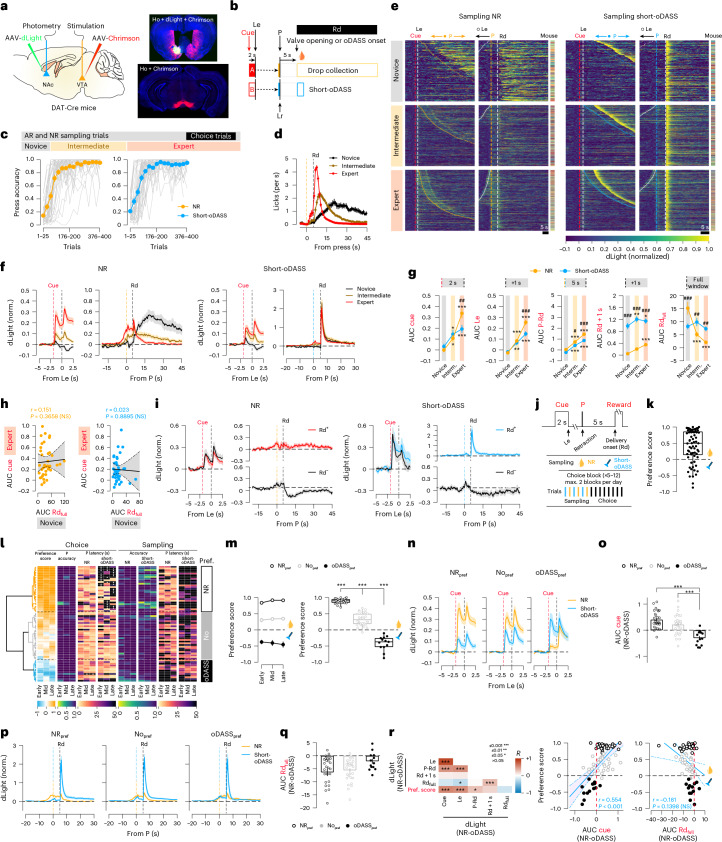
Comparing natural and artificial rewards offered a window onto individual differences. Fat solution served as the natural reward, while artificial options included dopamine-neuron optical self-stimulation or cocaine. Mice learned relationships between cues, lever presses and rewards before expressing preferences in two-option choices. Unrestricted food access and controlled trial numbers reduced hunger and satiation effects.
Dopamine recordings came from interleaved single-option sampling trials, while choice trials provided preference measures. This pairing tracked signals acquired by different rewards during learning and related them to later choices. Immediate reward responses and learned expectations thus became two levels that could be compared.
Preference aligns more closely with cue signals
Early in learning, natural-reward delivery evoked a prominent dopamine response. With expertise, delivery responses diminished and cue responses appeared. Optical reward also acquired cue signals but retained stimulation-evoked dopamine. Omitting expected rewards produced signal dips in both conditions, consistent with a prediction-error account.
Interestingly, early delivery-peak magnitude did not predict later cue signals. Differences between natural- and artificial-reward cues strongly correlated with subsequent preference, while delivery signals did not show the same relationship. Immediate reward strength and learned expected value thus presented different pictures, directing attention to what happens when a reward is predicted.
Source: Pascoli V et al. · Nature Neuroscience · CC BY
Original figure and English caption ↗
Stronger rewards and repeated experience have different effects
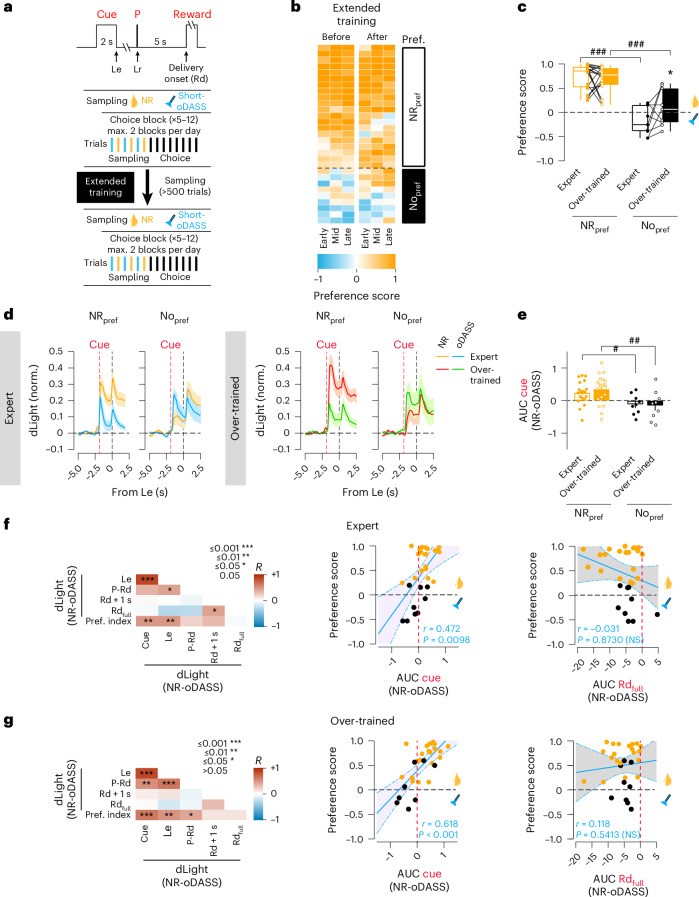
Longer optical rewards raised delivery responses and associated cue signals, shifting some mice from natural to optical reward. Others retained natural preference, showing that stronger artificial stimulation did not produce uniform choices. Cue signals changed alongside preference trajectories, outlining individual variation in updating.
Repeated experience with short optical rewards produced another outcome. After four weeks and more than five hundred rewards, delivery dopamine persisted, but cue signals did not significantly increase and preferences remained stable. Repetition differed from increasing reward strength: persistent delivery responses did not translate here into continuously accumulating cue value.
Source: Pascoli V et al. · Nature Neuroscience · CC BY
Original figure and English caption ↗
Individual choice differences persist with cocaine
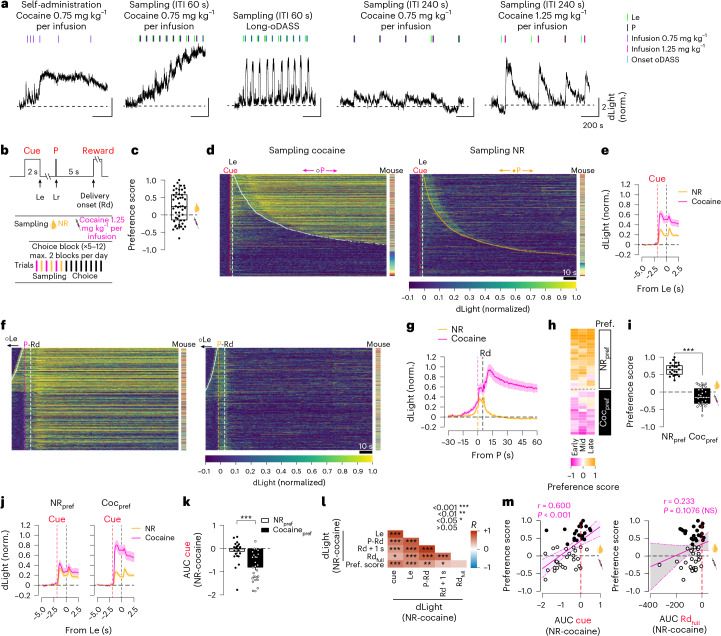
Cocaine delivery evoked dopamine lasting minutes, unlike the optical time course. Its cue signals also related to individual preference. Stronger drug reward generally accompanied higher population cue responses, yet many animals still preferred natural reward. Prominent delivery dopamine therefore did not produce the same choice in every mouse.
Rewards differed in delays and acquisition: drugs involved pharmacokinetic processes, optical stimulation was more direct, and natural reward required approach and collection. These conditions formed the context for value in the task. Across reward forms, recurring links between cues and preference made learned expectation a thread connecting the comparisons.
Source: Pascoli V et al. · Nature Neuroscience · CC BY
Original figure and English caption ↗
Most animals update while some persist
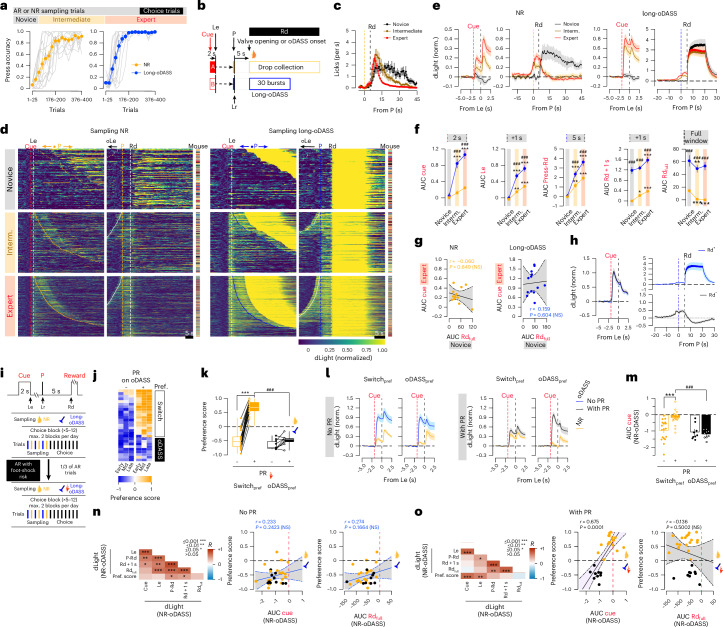
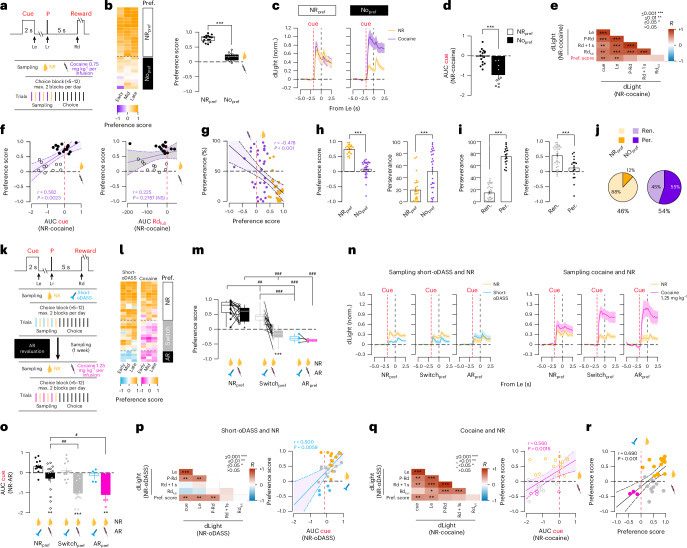
When stronger optical reward carried mild shock risk, most mice switched toward natural reward and relative artificial-cue dopamine weakened. Other animals retained optical preference and higher cue signals. Introducing cost produced divergent behavioral and signal trajectories, showing variation in value updating.
Delivery peaks did not distinguish the groups in the same way, whereas cues reflected differences after adding cost. Trial-level response latency related only weakly to cue signals, suggesting additional contextual and motivational influences on individual actions. Preference, learned expectation and immediate action form different layers of the choice process.
Source: Pascoli V et al. · Nature Neuroscience · CC BY
Original figure and English caption ↗
Preference has a nuanced relationship with continued seeking
Preference for weaker artificial rewards related to later punished self-stimulation or preference for stronger cocaine reward. Initial preference for strong unpunished optical reward did not significantly correlate with later perseverance, whereas punished choices had a stronger relationship. Some artificial-preferring mice did not persevere, and some perseverers chose a natural alternative when available.
Both sexes were included, without significant sex differences in fluorescence. The study brings delivery responses, learned value and updating under risk into one framework and motivates direct tests of cue-signal function. Why individuals persist and when they change choices can thus be approached more richly than through dopamine peak magnitude alone.
Source: Pascoli V et al. · Nature Neuroscience · CC BY
Original figure and English caption ↗