Fight back or flee? Different choices within oxytocin circuits
Two oxytocin outputs show opposite activity during social attack. Tracing their inputs reveals that the projection target alone does not determine the defensive response.

Oxytocin is often associated with approaching others. When another animal becomes an attacker, does it support fighting back or fleeing? A male-mouse study finds divergent PVN oxytocin populations: accumbens and amygdala outputs rise together during exploration but differ during attack, with input sources adding another layer.
Oxytocin defense effects depend on inputs and outputs: accumbens projections support counterattack, broad central-amygdala output promotes flight, and LHA-defined populations can enhance counterattack at either target.
Contents · 6 sections
A companion, an attacker and a later encounter differ
The experiments examined unfamiliar-animal exploration, direct attack and later exposure to a caged potential attacker. Immediate flight and counterattack differed in timing from subsequent avoidance and immobility, revealing contextual roles for oxytocin.
During defeat, PVN oxytocin activity and local peptide signals increased. Activating attack-tagged cells reduced counterattack and increased flight, with opposite effects after inhibition and changes in later avoidance. Ordinary exploration was not further reduced by activation.
Shared social responses diverge during attack
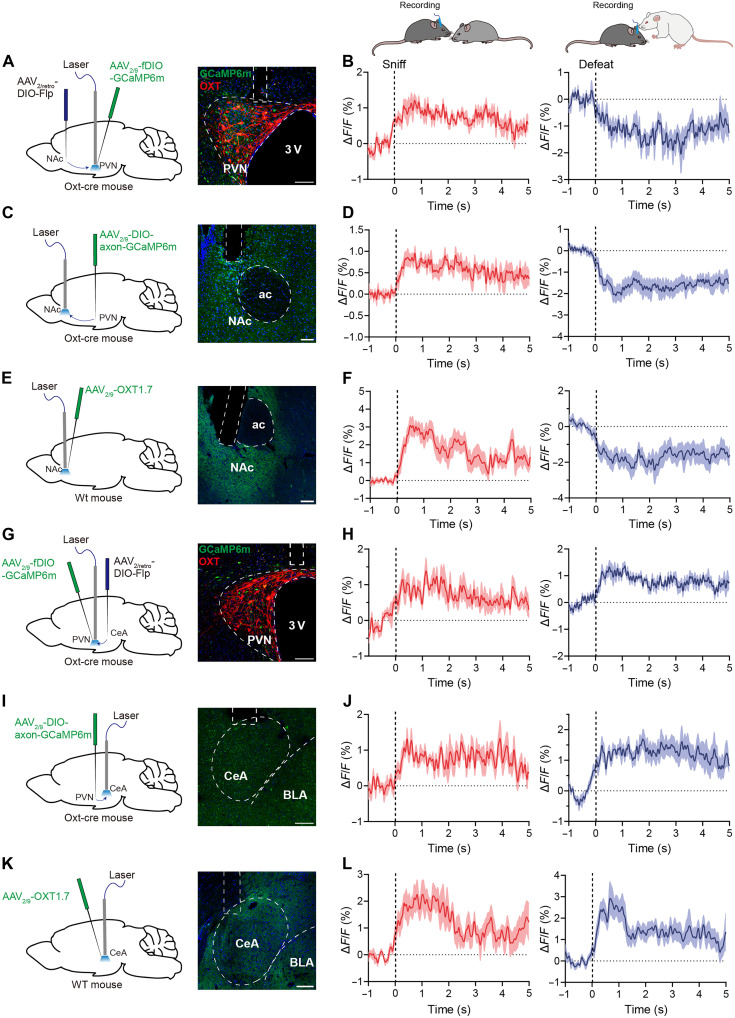
NAc- and CeA-projecting oxytocin cells both increased calcium signals during ordinary interaction, accompanied by peptide-sensor increases at both targets. Attack increased CeA-associated activity and peptide signals but decreased NAc-associated signals. Somatic, terminal and peptide readouts converged across distinct levels.
Stimulating either terminal population evoked peptide-sensor responses without producing real-time place preference or aversion. The team therefore returned to social contexts to test each output during approach, counterattack and flight.
Source: Liu C et al. · Science Advances · CC BY-NC
Original figure and English caption ↗
Two outputs shape different immediate defenses
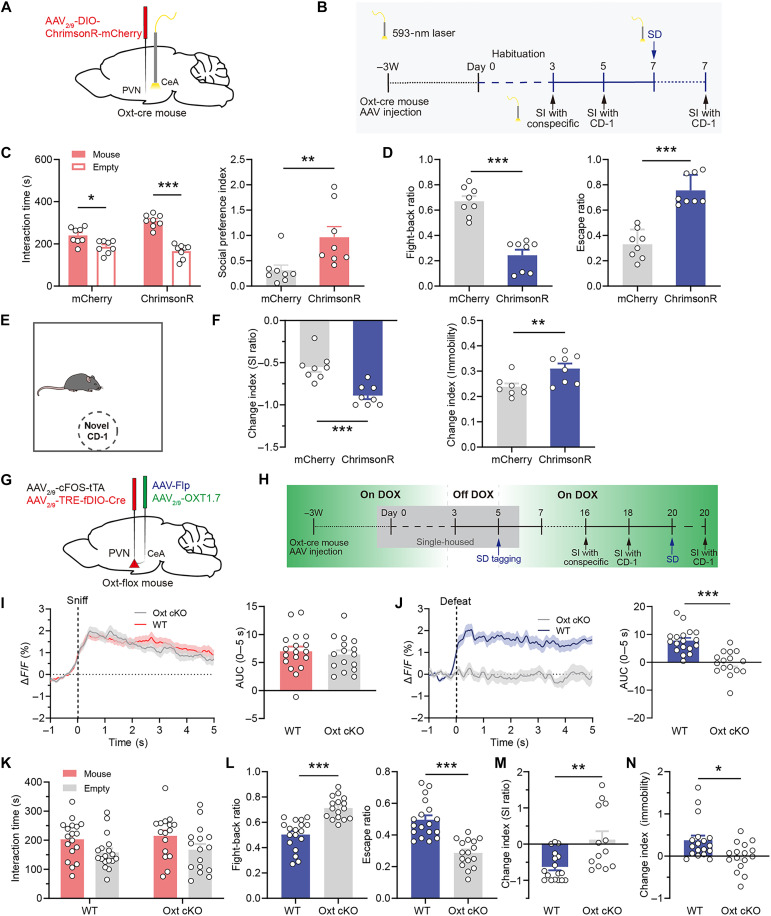
PVN–NAc activation increased exploration and counterattack. Removing oxytocin from the relevant excitatory PVN cells abolished or reversed these effects, indicating distinct peptide and co-transmitter actions. Later avoidance and immobility were unchanged after peptide removal.
Broad PVN–CeA activation also promoted ordinary exploration but increased escape and later avoidance or immobility. Peptide removal from defeat-tagged CeA-projecting cells reduced attack-associated release, escape and later avoidance without changing ordinary exploration, implicating different recruited components.
Source: Liu C et al. · Science Advances · CC BY-NC
Original figure and English caption ↗
At the same target, input origin changes the answer
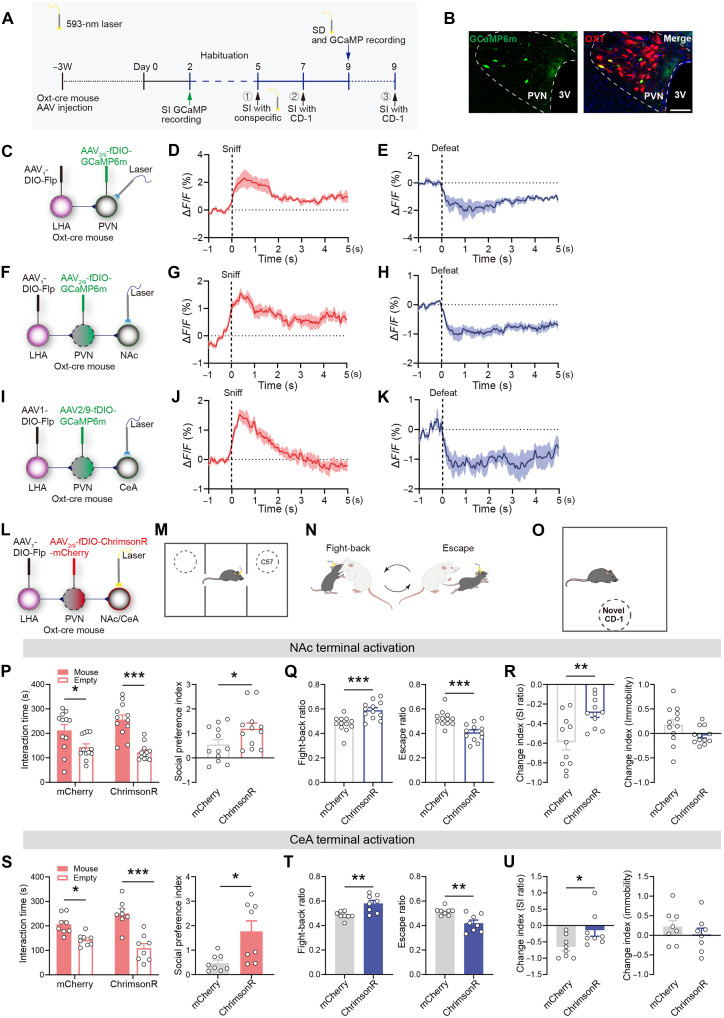
Tracing showed multiple inputs to both populations, with relatively greater LHA input to NAc-associated cells and LHb input to CeA-associated cells. LHA-defined cells increased activity during interaction and decreased it during attack; LHb-defined cells responded mainly to attack. These patterns motivated input-specific intervention.
Activating LHA-recruited terminals in either NAc or CeA increased counterattack and reduced later avoidance without changing immobility. LHb-recruited CeA terminals increased flight and avoidance but left exploration and immobility unchanged. Input origin differentiated functions at one target.
Source: Liu C et al. · Science Advances · CC BY-NC
Original figure and English caption ↗
Acute blockade and prolonged receptor reduction differ
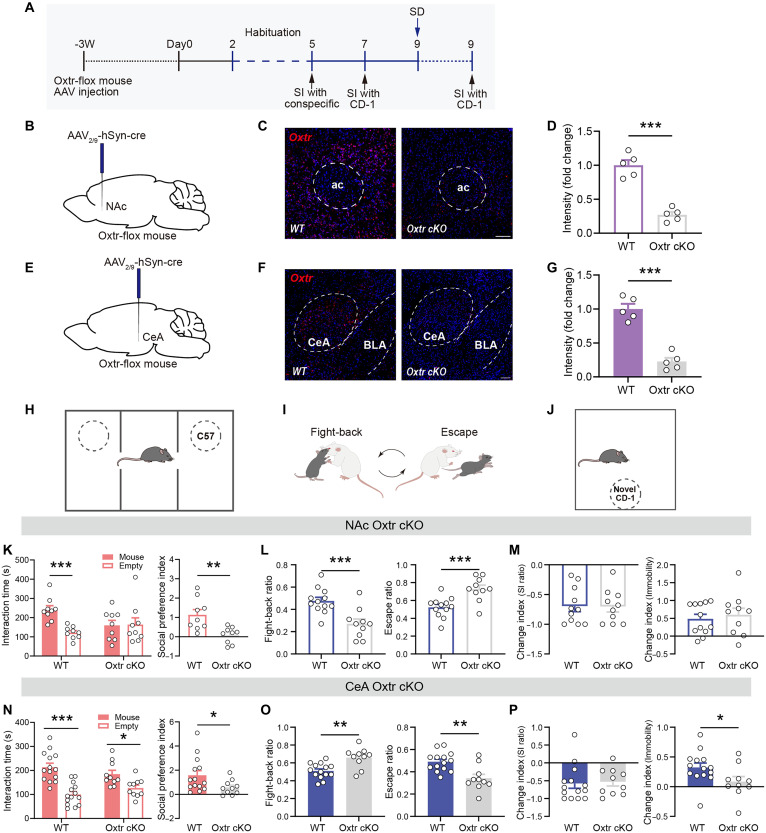
Reducing NAc oxytocin receptors decreased exploration and counterattack and increased flight, with comparable later avoidance and immobility; acute blockade showed broadly similar effects. CeA receptor reduction changed exploration, defense and some immobility measures but not later avoidance.
Acute CeA receptor antagonism had no significant effect, contrasting with prolonged genetic reduction. The authors proposed long-term plasticity or co-transmitter compensation, raising a question about intervention duration alongside receptor location.
Source: Liu C et al. · Science Advances · CC BY-NC
Original figure and English caption ↗
One peptide, multiple circuits and defensive strategies
Across exploration and attack, oxytocin effects vary with population, input, output and timing. Cells reaching the same CeA target can support different defenses depending on upstream origin, making a circuit map more informative than one behavioral label.
The study used male mice in social defeat. Subpopulations, co-transmitters and prolonged receptor regulation remain open, with cross-sex and contextual comparisons offering ways to understand how defensive choices change.