Drug-paired context preference links with PVN oxytocin output
In male-mouse conditioned place preference, OXT modulation and PVN-to-accumbens-core activation reduce methamphetamine-context preference; shell modulation does not produce the same effect.

A context previously paired with a drug can later attract investigation and occupancy. Can peptide signaling regulate this learned preference? A Nature Communications study uses male-mouse methamphetamine conditioned place preference, or METH-CPP, to investigate paraventricular/PVN OXT cells and nucleus accumbens/NAc connections. Effects depend on both peptide signaling and output destination, with distinct core and shell outcomes.
OXT treatment or PVN–NAc-core activation during testing reduces METH-context preference, with core receptor blockade weakening related effects. Shell-associated population or terminal modulation does not significantly change preference.
Contents · 6 sections
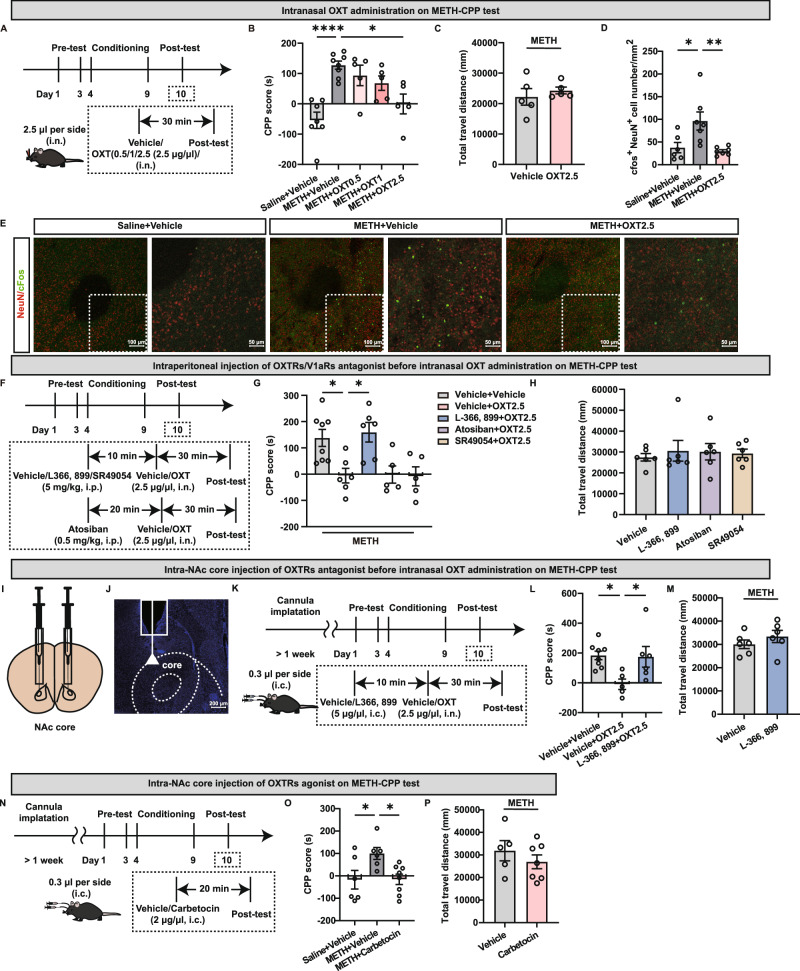
OXT at testing reduces context preference
One context is paired with METH and another with saline across six conditioning days. Later free-choice occupancy measures expression of the learned association, with clear preference in METH animals relative to saline controls.
After drug–context conditioning, mice explore during a test without additional METH. They prefer the paired side. Pretest intranasal OXT weakens this preference, with a clearer effect at higher tested concentrations.
Movement does not significantly change and vasopressin does not produce the same reduction. Core OXT-receptor blockade weakens intranasal effects, while receptor activation there also reduces preference.
Core c-Fos is higher in METH animals and falls after OXT. Behavioral and regional marker changes motivate examination of endogenous OXT sources.
Systemic pharmacological comparisons show that a brain-penetrant antagonist weakens OXT effects, whereas peripheral OXT-receptor and V1a antagonists do not. Site and receptor type guide the investigation toward a local circuit.
Source: Cheng YJ et al. · Nature communications · CC BY-NC-ND
Original figure and English caption ↗
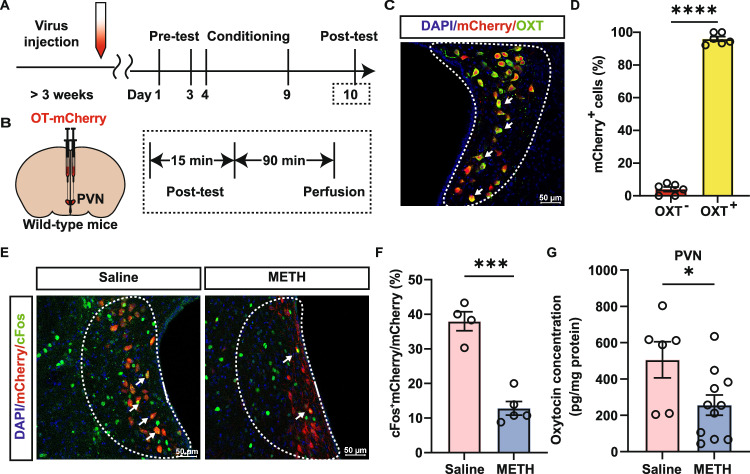
PVN markers and OXT protein decrease after repeated METH exposure
PVN OXT-associated cells have lower post-test c-Fos proportions in METH mice, with less tissue OXT protein, aligning cellular markers with peptide content.
Oxt transcripts show a nonsignificant downward trend; SON, pituitary and serum OXT and measured AVP proteins do not significantly change. The detected protein difference is regionally specific.
Lower upstream PVN markers coexist with higher core markers, which fall after OXT. These distinct regional directions motivate testing how recruitment of the upstream population affects context choice.
Source: Cheng YJ et al. · Nature communications · CC BY-NC-ND
Original figure and English caption ↗
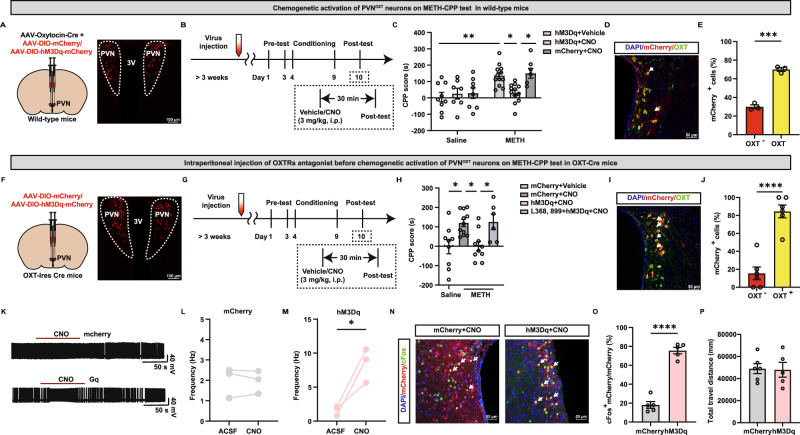
Activating PVN populations reduces learned place preference
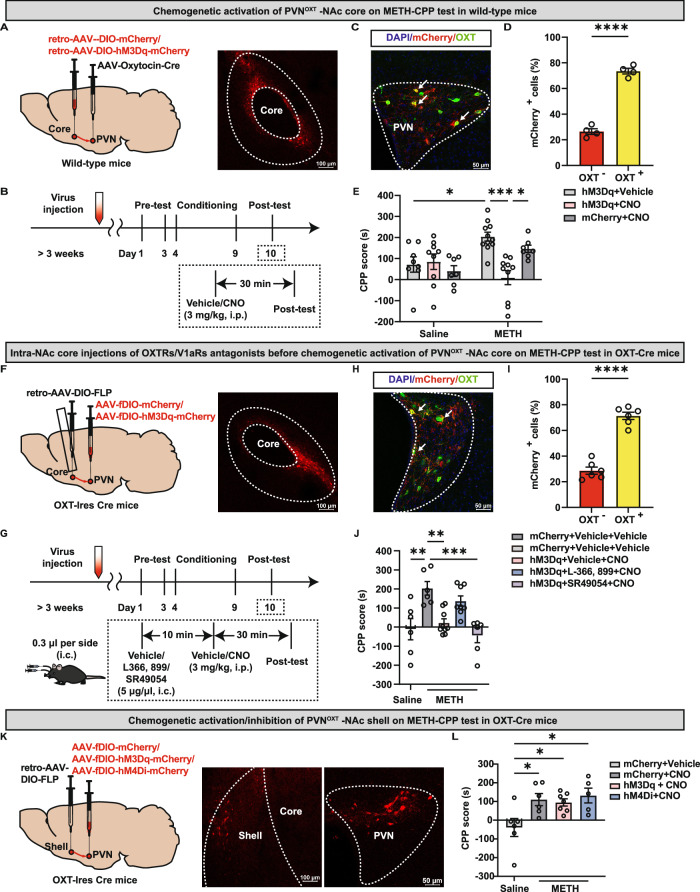
After conditioning, chemogenetic activation of PVN OXT-associated cells during testing reduces METH-CPP in both wild-type viral targeting and OXT-Cre validation, without significant movement changes.
A brain-penetrant OXT-receptor antagonist weakens the effect. Electrophysiology and markers confirm activation, linking endogenous population modulation with the behavioral effects of exogenous OXT.
Source: Cheng YJ et al. · Nature communications · CC BY-NC-ND
Original figure and English caption ↗
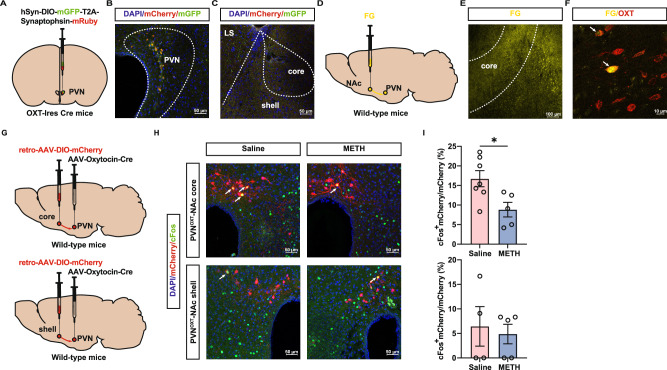
Core- and shell-projecting cells show different marker changes
Forward and retrograde tracing support PVN OXT projections to NAc. Core-projecting populations show lower c-Fos after METH, while shell-associated populations do not significantly change.
Adjacent subregions differ in their connections and functional contexts. Projection-defined analysis reveals population differences beyond regional averages and motivates separate interventions.
Source: Cheng YJ et al. · Nature communications · CC BY-NC-ND
Original figure and English caption ↗
Core-projecting activation reproduces preference reduction
Chemogenetic activation of core-projecting PVN OXT-associated populations reduces METH-CPP. Core OXT-receptor blockade weakens the effect; V1a blockade does not, aligning source, destination and receptor-associated outcomes.
Neither activation nor inhibition of the shell-associated population significantly changes METH-CPP, echoing its marker nulls and distinguishing output-associated effects under these conditions.
Source: Cheng YJ et al. · Nature communications · CC BY-NC-ND
Original figure and English caption ↗
Test-phase terminal effects remain target dependent
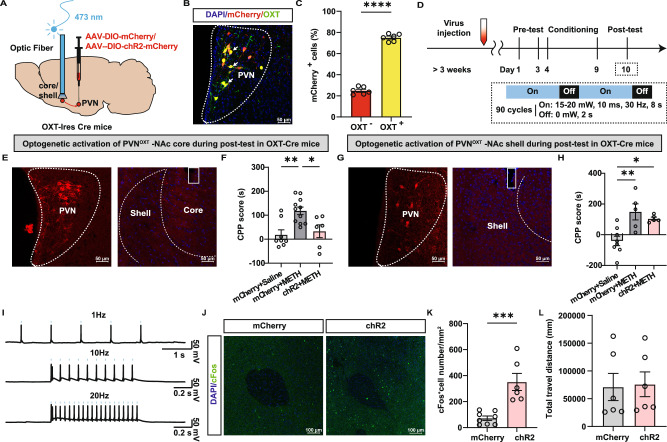
Optical stimulation of PVN-derived NAc terminals during testing reduces preference in core but not shell, without significant measured distance changes. Terminal outcomes parallel population modulation.
In this adult male-mouse CPP study, OXT signaling modulates expression of learned context preference. Distinct core and shell outcomes specify source, output site and test stage within reward-associated context choice.
Source: Cheng YJ et al. · Nature communications · CC BY-NC-ND
Original figure and English caption ↗