Different roles within D1 cells: a Tac2 population restrains cocaine-related behavior
In male mice, a Tac2-positive D1 population in the nucleus accumbens suppresses cocaine place preference and aspects of voluntary drug taking, revealing functional diversity within a major neuronal class.
D1 neurons are often associated with promotion of drug-related behavior. Does that picture hold when this broad class is divided into molecular subtypes? A male-mouse study published in Science Advances on August 12, 2022 focused on Tac2-expressing D1 medium spiny neurons in the nucleus accumbens. Increasing their activity weakened cocaine place preference and reduced voluntary drug taking under some conditions, bringing molecular identity and projection targets into the explanation.
Accumbens Tac2-positive D1 cells negatively regulate cocaine-related behavior, and activating their lateral hypothalamic output reduces cocaine place preference. Molecular identity and projection target both matter.
Contents · 6 sections
D1 is a class with distinct populations
The nucleus accumbens contributes to motivation and reward, but its neurons are heterogeneous. Beyond the conventional D1/D2 distinction, molecular maps identify multiple subtypes within each class. Broad population measures can obscure a smaller group with a different functional direction.
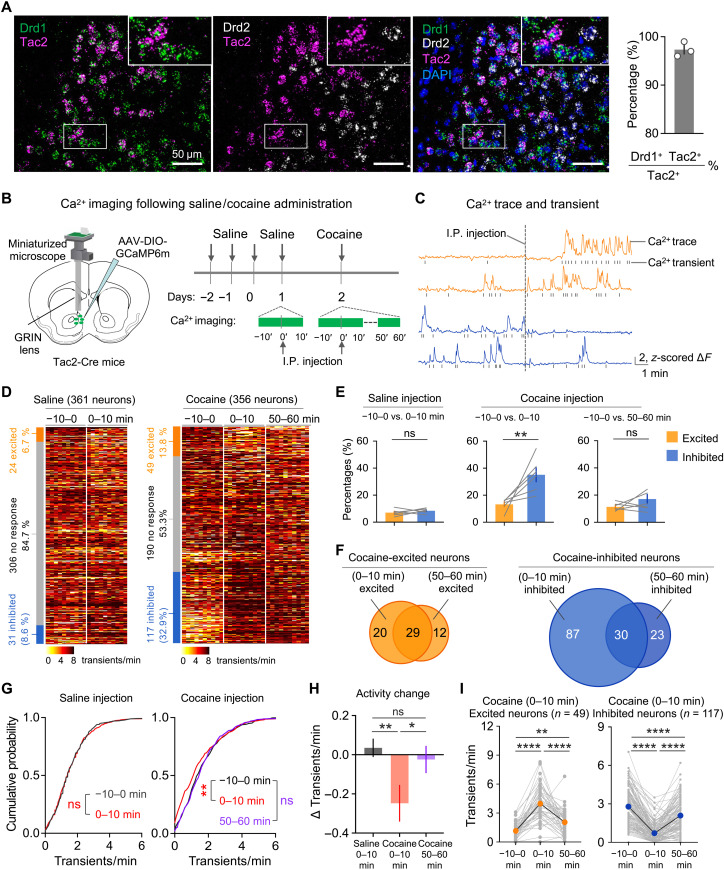
Tac2 provides one entry point. In an earlier mouse accumbens atlas, the subtype accounted for about 5% of D1 medium spiny neurons. Co-labeling in this study likewise showed that most Tac2-positive cells carried a D1-associated marker. D1 refers to receptor-related identity, not dopamine release by these cells.
Source: Zhao ZD et al. · Science advances · CC BY
Original figure and English caption ↗
Cocaine does not drive every cell in the same direction
Single-cell calcium measurements showed that about 32.9% of recorded cells decreased activity early after cocaine, while about 13.8% increased activity; the rest showed no corresponding response. The overall decrease therefore did not apply to every Tac2-positive cell, nor directly measure spike-rate changes.
Some responses changed at the later measurement. An increase or decrease at one time point is not a permanent cellular identity. This dynamic diversity led to a second question: could a drug-associated environment also alter the population’s responses?
Drug-associated contexts also carry a signal
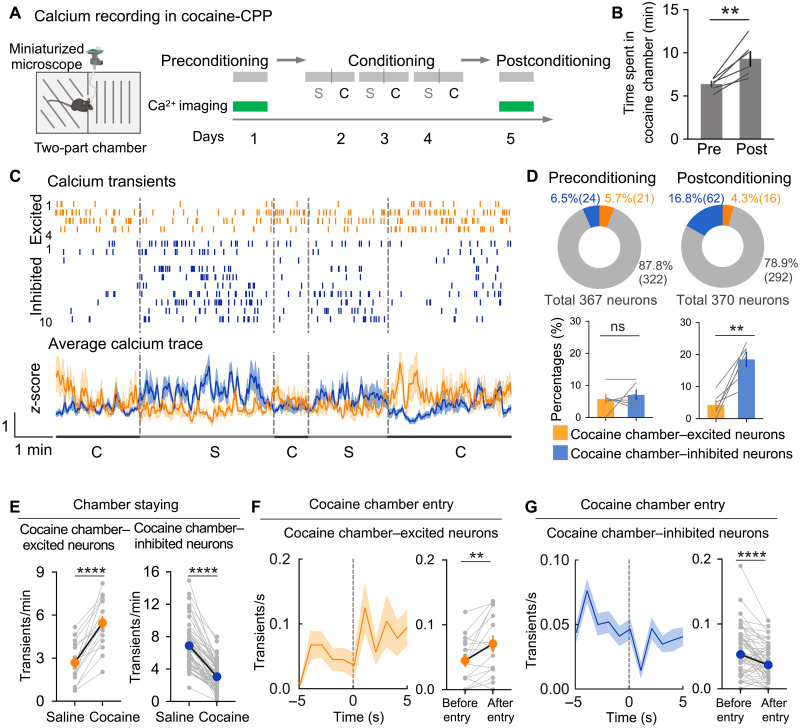
After cocaine place conditioning, mice spent more time in the drug-paired environment. The fraction of Tac2-positive cells with lower activity in that context increased, while a smaller group responded in the opposite direction. A molecular subtype can therefore still contain diverse context-related responses.
Calcium activity changed around entry into the cocaine-associated compartment. These observations link context and activity, but do not alone establish that the cells determine the choice. Testing causality requires asking whether altering their activity changes behavior.
Source: Zhao ZD et al. · Science advances · CC BY
Original figure and English caption ↗
Enhancing this D1 population weakens place preference
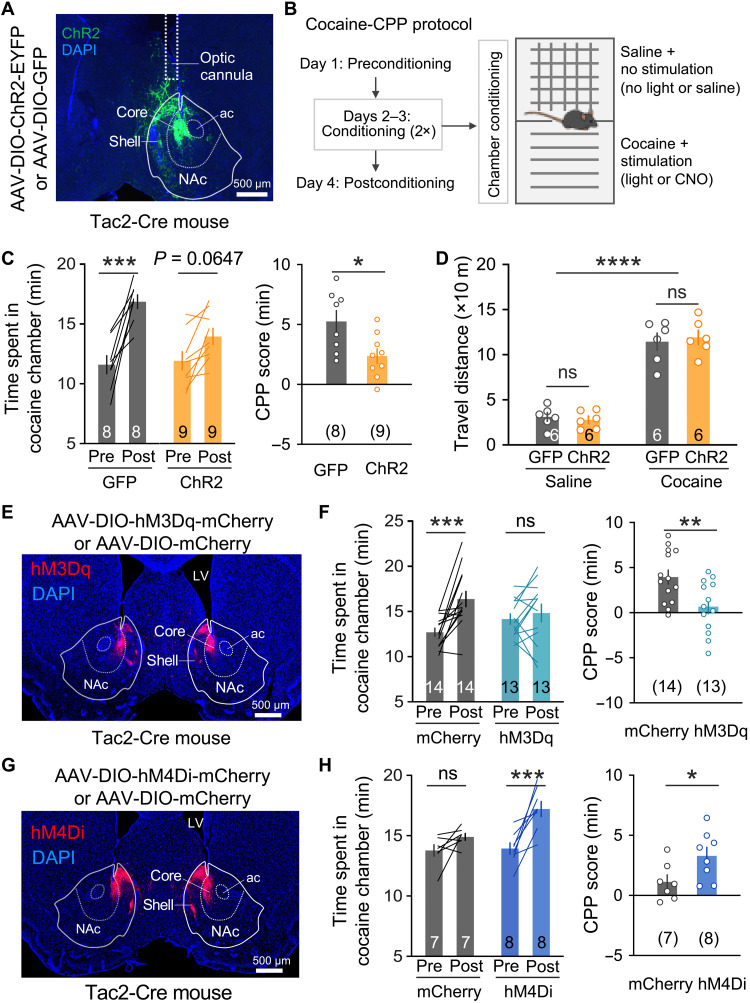
Increasing Tac2-positive activity weakened cocaine place preference, with a second activation approach giving a similar direction. Reducing activity enhanced preference under a weaker conditioning condition. These opposing interventions strengthen the link between population activity and reward-related behavior.
Activation did not significantly change cocaine-induced hyperlocomotion. Reduced place preference alongside preserved movement measures points toward a more specific reward-related effect, without showing permanent removal of drug-associated memory or loss of every cocaine response.
Source: Zhao ZD et al. · Science advances · CC BY
Original figure and English caption ↗
Effects extend to voluntary drug taking
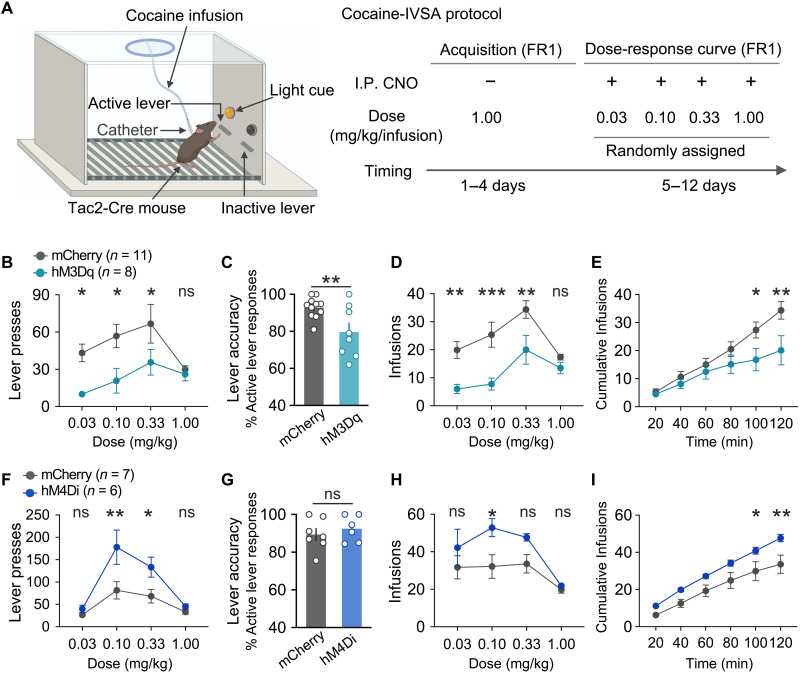
The study next examined voluntary cocaine self-administration. Activation reduced active responses and obtained infusions under some conditions; inhibition increased related measures under some conditions. Effects varied across conditions and were not significant in every comparison.
This extends the evidence from where mice prefer to stay to whether they actively obtain the drug. Activation also reduced response accuracy, indicating changes in behavioral structure. Fewer infusions alone do not establish elimination of addiction in the clinical sense.
Source: Zhao ZD et al. · Science advances · CC BY
Original figure and English caption ↗
A hypothalamic branch has a distinct effect
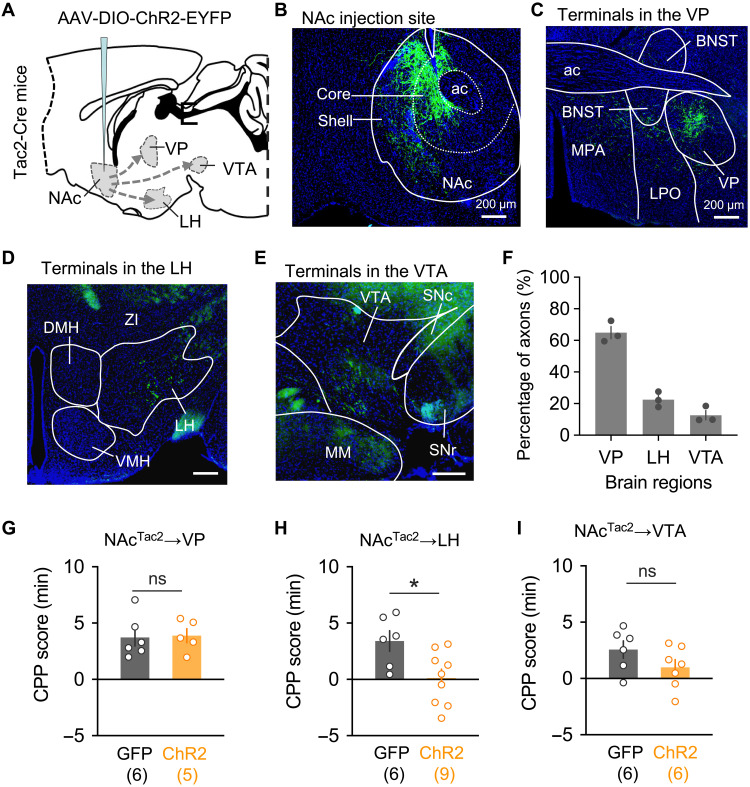
Tac2-positive cells project to multiple regions. Among outputs to ventral pallidum, lateral hypothalamus and ventral tegmental area, activating the lateral hypothalamic branch reduced cocaine place preference; corresponding comparisons for the other two branches were not significant. Anatomical prominence need not predict behavioral effect in this task.
The findings argue for considering broad cell class, molecular subtype and projection target together. Tac2 identifies the population without automatically establishing its encoded peptide as the mediator. These adult male-mouse findings do not demonstrate treatment efficacy in humans, even where related cellular identities exist in other species.
Source: Zhao ZD et al. · Science advances · CC BY
Original figure and English caption ↗