How do dorsal raphe cells track movement and immobility?
During a mouse stress-coping test, dorsal raphe cells show different firing changes. Serotonin-associated cells mostly decrease firing during immobility, whereas PV cells are more diverse; oscillatory and burst patterns also differ.
Do brain cells become uniformly quieter when a mouse stops moving? A study published in Frontiers in Behavioral Neuroscience on May 31, 2022 recorded dorsal raphe nucleus activity during tail suspension. This major serotonergic region also contains local regulatory cells. Many units reduced firing during immobility, while a smaller group increased it. Identifying serotonin-associated and PV-associated cells revealed further diversity, linking behavioral state with cell identity and firing pattern.
DRN state associations are heterogeneous: most SERT-associated units reduce firing during immobility, while PV-associated cells include both directions. Immobility also accompanies higher relative gamma power and fewer bursts.
Contents · 6 sections
One region contains different response directions
Behavior and DRN spiking were recorded together to compare mobile and immobile periods in tail suspension. The sample contained 248 units from 21 mice; unit counts and independent animal counts describe different aspects of the evidence. Within-cell state comparisons help distinguish state changes from differences already present across cells and provide a reference for response classification.
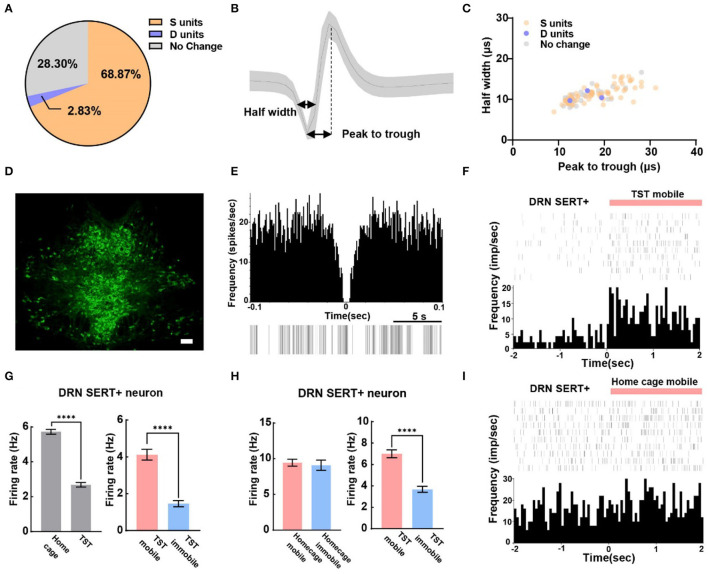
About 61% of units reduced firing and about 4% increased it across the transition to immobility, with the remainder lacking the same clear change. The authors’ S and D labels classify behavioral associations rather than established molecular types or direct measurements of internal survival or despair states.
Quieter units can coexist with a more prominent rhythm
The study also examined DRN local field potentials. The analyzed gamma band occupied a larger fraction of spectral power during immobility than movement, providing a population measure distinct from individual-cell firing rates.
Lower unit firing can coexist with greater relative rhythmic power, revealing network organization beyond a mean rate. The comparison establishes a state association without selectively manipulating gamma to show that it determines movement or stopping.
A majority reduces firing, alongside other responses
Among 106 identified SERT-associated units, about 69% were S units with lower firing during immobility and about 3% were D units with the opposite pattern. Others fell outside these classes. Serotonin-transporter-associated identification thus revealed diversity within the population.
Spike-waveform variation did not clearly separate these behavioral classes. Illustrated cells could also differ between home cage and tail suspension: home-cage movement transitions did not necessarily reproduce the test-associated difference. Context therefore matters alongside movement itself.
Source: Zhou L et al. · Frontiers in behavioral neuroscience · CC BY
Original figure and English caption ↗
PV-associated cells include both directions
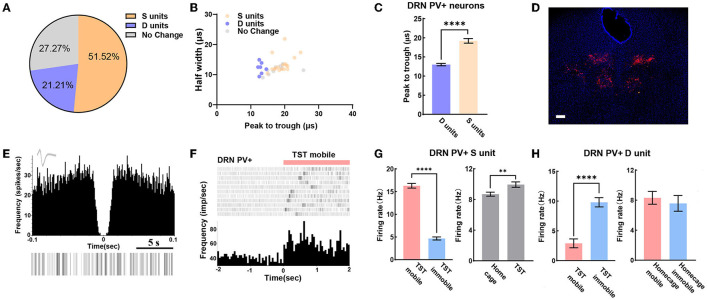
Parvalbumin, PV, identifies a subset commonly associated with inhibitory cells. Among 33 identified PV-associated units, about 52% were S units and about 21% were D units. A shared marker therefore encompassed distinct behavioral response directions.
Waveforms also differed, with shorter peak-to-trough times in D units. Illustrations distinguished the overall tail-suspension context from mobile–immobile phases within it: a cell could be more active during the test overall yet reduce firing during its immobile periods.
Source: Zhou L et al. · Frontiers in behavioral neuroscience · CC BY
Original figure and English caption ↗
Firing pattern changes alongside rate
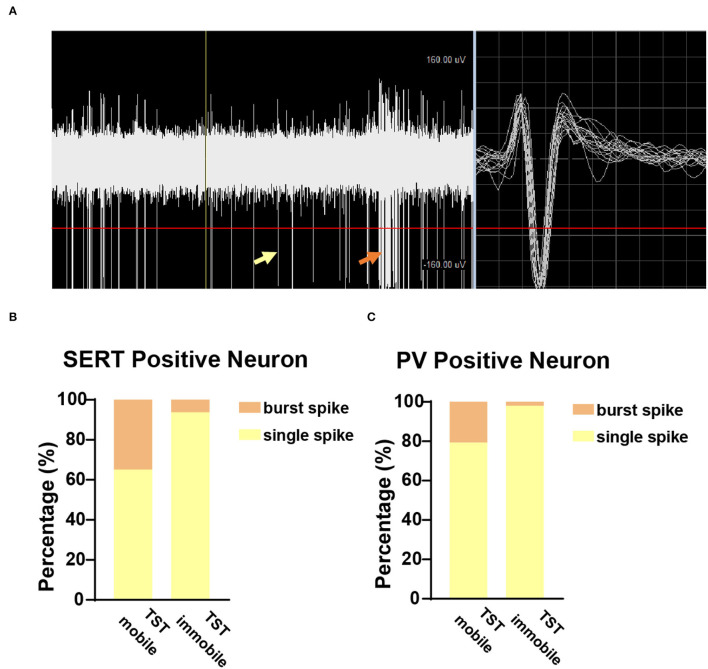
Units can emit isolated spikes or short bursts. Descriptive comparisons in the identified cell groups showed a smaller burst fraction and a larger single-spike fraction during immobility, adding another state-dependent feature of electrical activity.
Rate and burst fraction describe different properties. Spike clustering can matter even when overall rates are similar. The study did not simultaneously measure serotonin release or directly test how bursts alter behavior, leaving those mechanisms for subsequent work.
Source: Zhou L et al. · Frontiers in behavioral neuroscience · CC BY
Original figure and English caption ↗
Cell identity works alongside state and context
The study adds in vivo electrical detail to DRN heterogeneity. SERT majority patterns, bidirectional PV responses, gamma and bursts describe regional engagement during stress coping without establishing a single local connection controlling every serotonergic cell.
Immobility is a task behavior shaped by movement, context and coping strategy. Causal subtype roles, the behavioral effects of selective rhythmic or burst manipulation and relevance to humans require further investigation.