After prior stress, which companion does a mouse explore first?
With three differently treated companions present, early choices vary with the observer’s experience, and anterior cingulate activity contributes to the exploration priority.

Three companions appear together: untreated, recently restrained, or given sucrose after water deprivation. Which does the observer explore first? Untreated mice initially prefer the restrained companion, while previously stressed observers lose that preference. ACC calcium responses and optical interventions reveal a cortical contribution.
Prior stress alters initial two-minute preference and ACC responses. ACC inhibition weakens normal preference, while activation restores it in stressed observers without further enhancement in other groups.
Contents · 6 sections
Three targets place choices within one scene
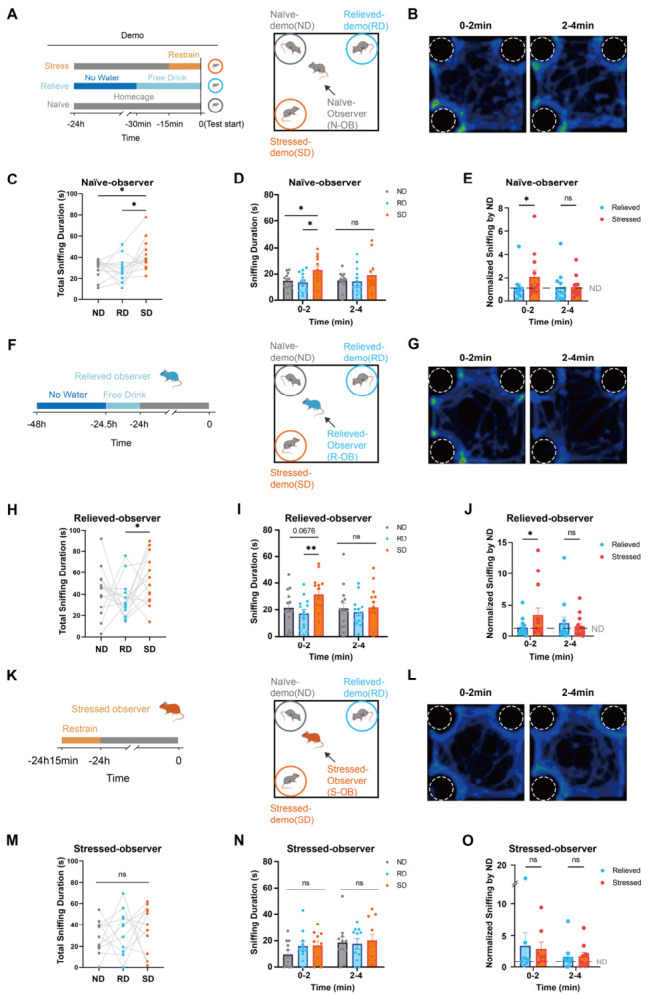
Unlike companion-versus-empty tests, this task presents three companions. Restraint and sucrose after deprivation operationalize the authors’ stress and relief conditions. Free approach and sniffing over four minutes reveal how exploration is distributed among competing targets.
Untreated observers preferred the restrained companion mainly in the first two minutes, with weaker differences later. Previously relieved observers showed a similar initial pattern. Time-resolved analysis captured early choice and subsequent habituation.
Source: Cao H et al. · Brain sciences · CC BY
Original figure and English caption ↗
Preference changes while total exploration remains comparable
Observer treatments occurred the day before testing, unlike the targets’ recent treatments. Stressed observers explored targets more evenly despite comparable total sniffing to untreated mice; relieved observers sniffed more overall without stronger target preference.
Movement, tested anxiety-related measures, general sociability and serum corticosterone showed no significant group differences. Changes centered on initial allocation among targets rather than a general loss of social exploration, motivating examination of the corresponding neural response.
ACC responses vary with target and observer history
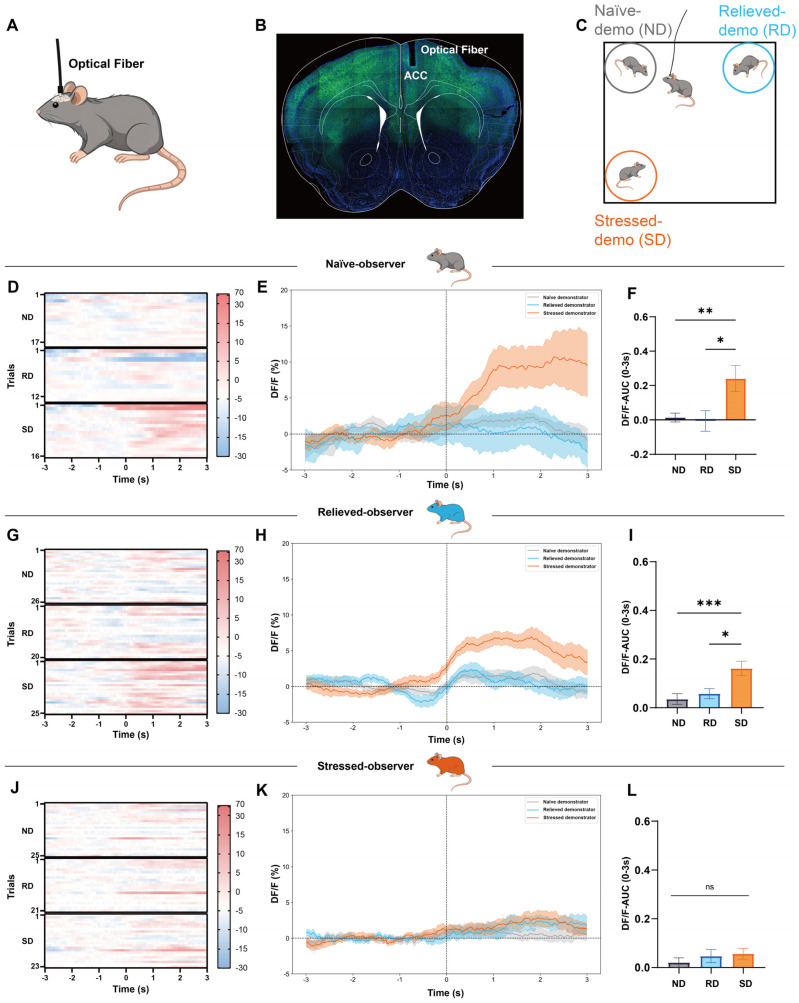
Population ACC calcium signals were aligned to sniffing. During the first two minutes, naïve and relief-experienced observers responded more strongly to stressed partners than other targets; previously stressed observers lacked the same significant increase. This temporal correspondence motivated causal tests.
Later, untreated and relieved observers showed more similar responses across targets, paralleling weaker preference; stressed observers remained less responsive. The time course suggested that prior experience affects both choices and cortical responses, leading to direct ACC interventions.
Source: Cao H et al. · Brain sciences · CC BY
Original figure and English caption ↗
Reducing ACC activity changes early choice
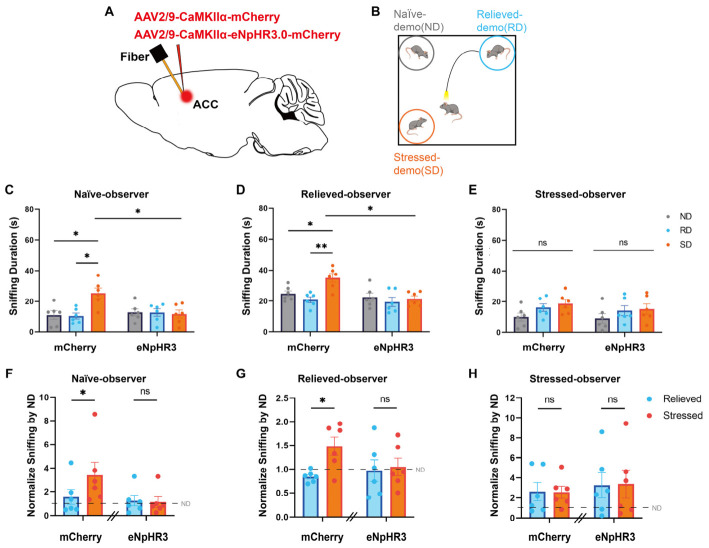
Inhibiting ACC excitatory cells during the first two minutes removed clear stressed-partner preference in naïve and relief-experienced observers. Stressed observers showed no significant additional change. This supports a necessary contribution to normal early selection beyond a neural correlate.
Stressed observers lacked clear initial preference and showed no further significant change after inhibition. The same manipulation depended on initial state, whereas reduced ACC activity removed the evident target priority in untreated and relieved groups.
Source: Cao H et al. · Brain sciences · CC BY
Original figure and English caption ↗
Increasing ACC activity restores stressed-observer preference
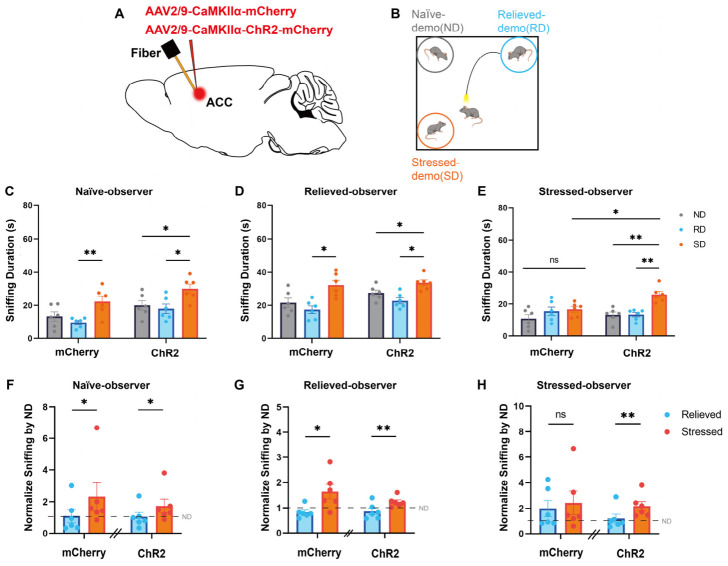
Activating ACC excitatory cells restored greater exploration of restrained companions in previously stressed observers, without significant further enhancement in untreated or relief-experienced groups. The authors proposed that existing responses may already be near saturation. The contrast points to a state-dependent influence: an established preference was not amplified, while preference lost after prior stress could be restored.
All targets still provided odors, movements and other cues while light altered exploration allocation. Linked behavioral and cortical changes identify an actionable node in short-term social priority, with cue integration remaining an open question.
Source: Cao H et al. · Brain sciences · CC BY
Original figure and English caption ↗
How does personal experience shape an immediate social choice?
Facing the same targets, mice with different histories allocated early exploration differently, accompanied by altered ACC responses. Recording and bidirectional intervention connect observer state, target information and choice, highlighting timing and target beyond total exploration.
The task captures adult mice’s choices during brief approach and sniffing. Which cells and outputs contribute, which partner cues matter most and how long preferences persist in other contexts remain questions to follow. Extending these moments into richer social encounters may explain how personal experience changes the timing of information seeking, partner approach and departure.