After witnessing a companion’s defeat, how do NG2 cells shape reunion grooming?
In medial amygdala, reduced NG2 activity and Gad1 accompany weaker inhibition of GABAergic neurons, modulating companion grooming in a specific social context.
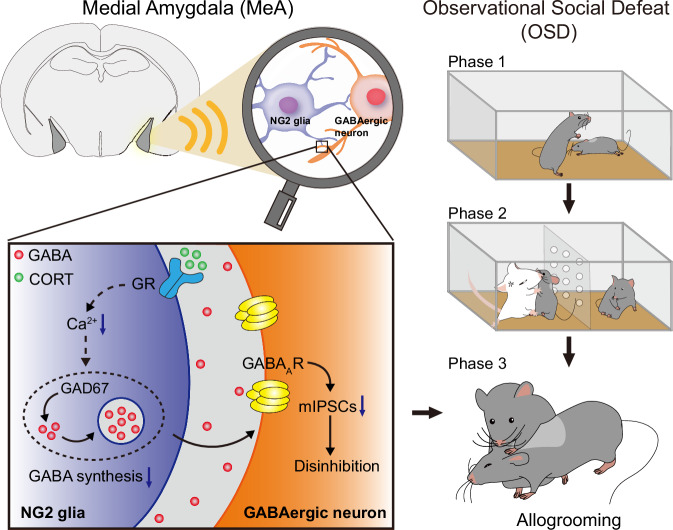
After witnessing a familiar companion’s attack through a transparent divider, mice groom that companion more on reunion. Researchers followed the change to medial-amygdala NG2 cells, whose reduced activity and altered GABA regulation leave inhibitory neurons less restrained, revealing a behavioral role for cells often viewed as myelin precursors.
After observed defeat, MeA NG2 calcium activity and Gad1 decrease. Inhibition or reduced GABA synthesis enhances reunion grooming, activation weakens it, and the same enhancement is absent without observation.
Contents · 7 sections
A familiar companion is attacked, and reunion grooming increases
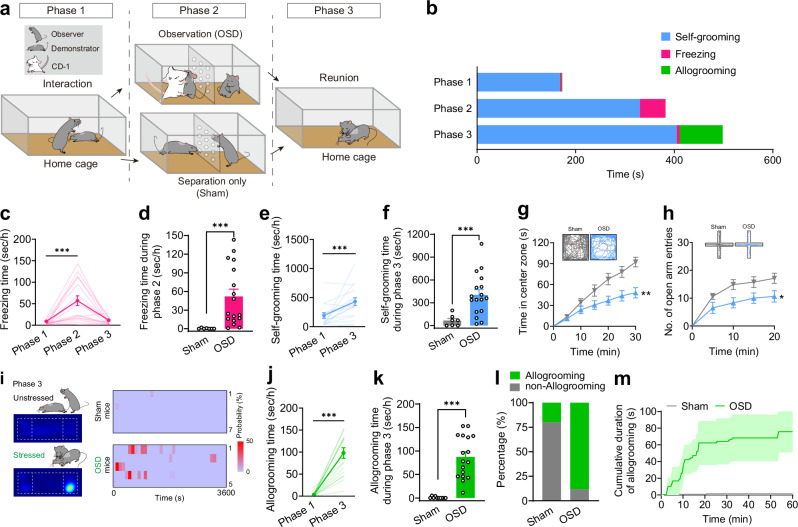
After co-housing, an observer witnesses its partner's defeat through a transparent sensory-permeable partition before reunion. Freezing and self-grooming rise during observation; huddling and allogrooming rise after reunion. Strangers evoke some stress-associated behavior without the same allogrooming enhancement, implicating familiarity and experience.
Ordinary interaction or attack without defeat did not produce the same increase, and visual obstruction reduced later grooming. Female supplementary tests showed similar behavior, while main mechanisms used males. Familiarity, observation and reunion jointly defined the response.
Source: Jian Y et al. · Nature communications · CC BY-NC-ND
Original figure and English caption ↗
GABAergic cells become more active while receiving less inhibition
Screening highlighted MeA and medial preoptic area without significant ACC/BLA labeling increases. During reunion, MeA GABAergic activity related more to companion grooming, while glutamatergic activity related more to self-grooming, revealing cell-type associations with distinct behaviors.
GABAergic cells retained comparable intrinsic firing and membrane properties but received fewer miniature inhibitory events, without corresponding excitatory changes. Glutamatergic cells also lacked the same alterations. The pattern suggests reduced restraint rather than globally increased intrinsic excitability, motivating investigation of the local inhibitory environment.
NG2 cells near inhibitory structures show reduced activity
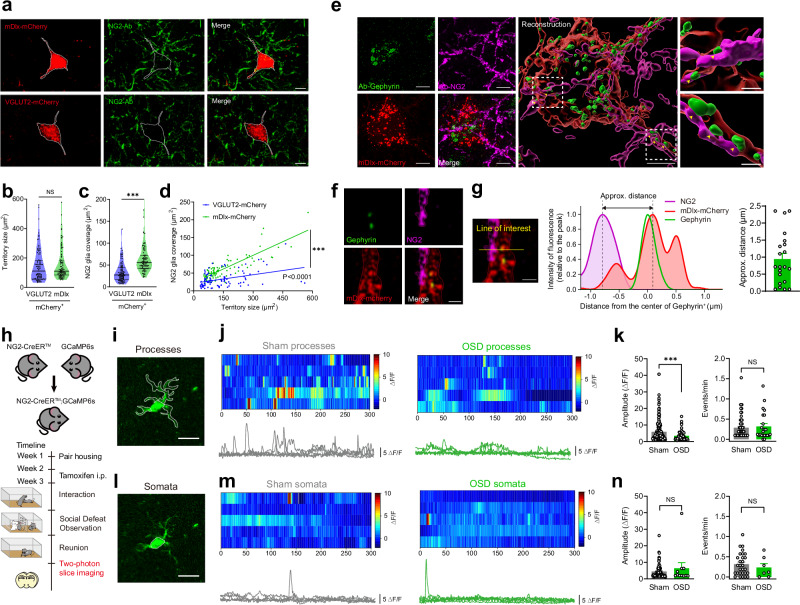
NG2 cells are often viewed as oligodendrocyte precursors; this study examined adult signaling roles. Reconstruction placed their processes near GABAergic regions and inhibitory markers. Calcium fluctuations declined after observed defeat, particularly in fine processes, identifying a candidate regulator.
Local processes and experience-dependent calcium changes motivated direct NG2 manipulation. Spatial observations suggested where to look, while functional tests asked whether cell state altered grooming. The authors proposed immunoelectron microscopy to resolve contacts more finely.
Source: Jian Y et al. · Nature communications · CC BY-NC-ND
Original figure and English caption ↗
Glial state adjusts grooming intensity and onset
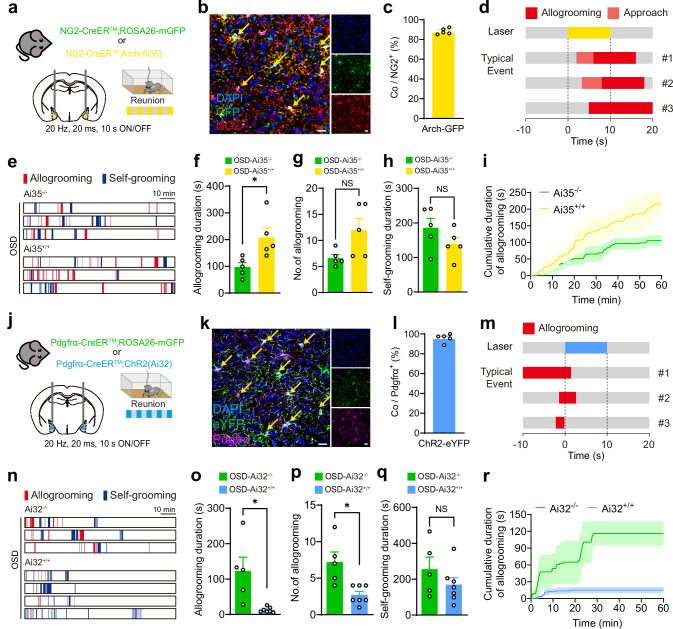
During reunion after observed defeat, NG2 inhibition increased and advanced companion grooming with comparable self-grooming; activation reduced and delayed it. Local cell removal also enhanced the response without changing baseline grooming in unexposed animals.
NG2 inhibition reduced inhibitory events in GABAergic cells while most excitatory and intrinsic measures remained comparable. Removing NG2 elsewhere or local astrocytes did not reproduce the behavior, localizing a disinhibitory process.
Source: Jian Y et al. · Nature communications · CC BY-NC-ND
Original figure and English caption ↗
Gad1 links glial state with GABA regulation
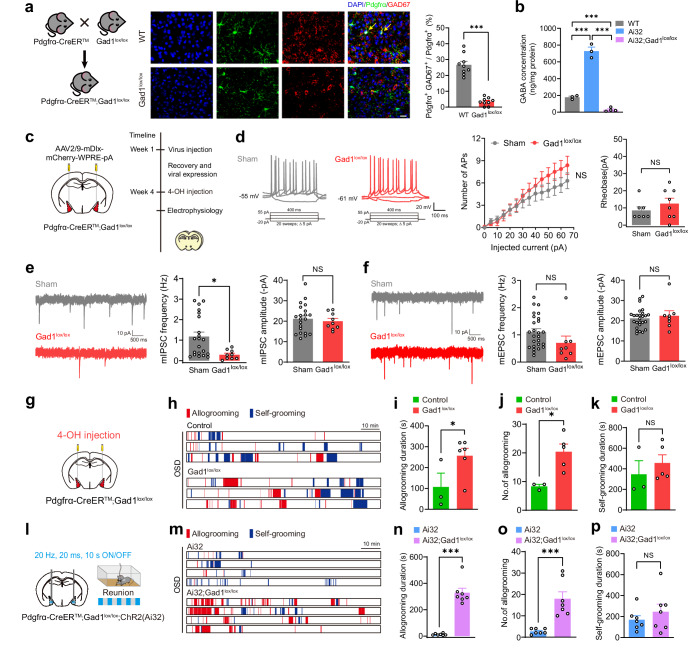
Transcriptional analysis identified a Gad1-positive NG2 subset linked to GABA synthesis. Gad1 decreased after defeat while selected release or transporter genes did not. Targeted deletion reduced GAD67 and inhibitory-event frequency onto GABAergic cells with comparable intrinsic and excitatory measures, supporting altered local inhibition.
Gad1 removal increased grooming after observation but not without it, and weakened the grooming-reducing effect of NG2 activation. Bidirectional cell-state and synthesis manipulations implicated glial GABA in local neuronal and behavioral regulation.
Source: Jian Y et al. · Nature communications · CC BY-NC-ND
Original figure and English caption ↗
Corticosterone provides an upstream stress-related clue
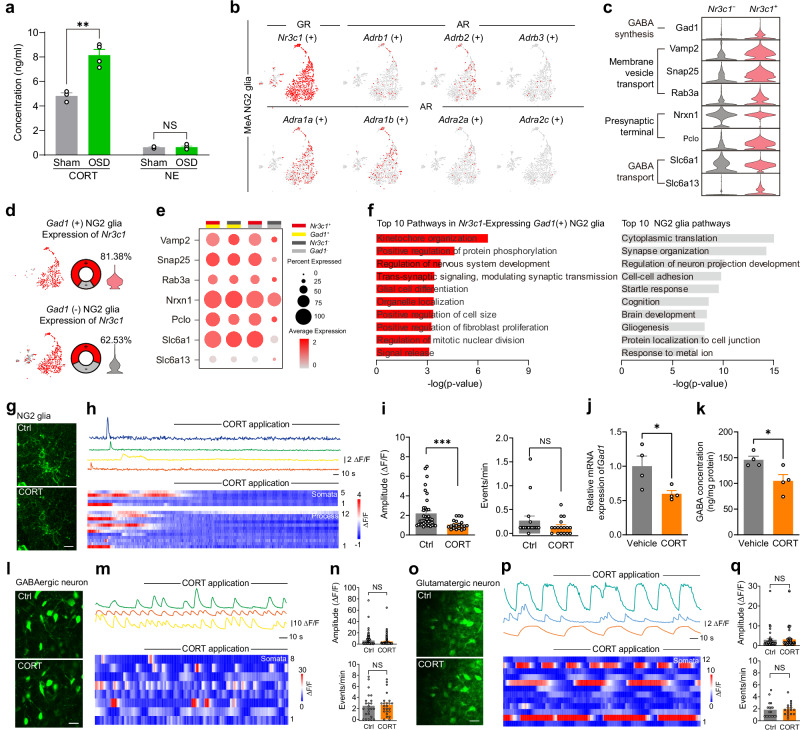
MeA corticosterone increased after defeat without a significant norepinephrine increase, and relevant NG2 cells expressed glucocorticoid-receptor transcripts. Ex vivo corticosterone rapidly reduced glial calcium, while longer culture exposure reduced Gad1 and GABA. Neighboring neurons lacked comparable rapid calcium changes.
Hormone effects across tissue, slices and culture indicated NG2 sensitivity to corticosterone. Rapid calcium and slower Gad1 responses suggested a route from experience to glial state, with cell-specific receptor signaling in vivo remaining a next step.
Source: Jian Y et al. · Nature communications · CC BY-NC-ND
Original figure and English caption ↗
Glia contribute to local regulation in a social context
From witnessing attack to reunion grooming, the study places NG2 signaling within adult behavior. Experience provides context while glial GABA regulation adjusts response intensity, linking a precursor-cell identity to broader local functions.
Main mechanisms were studied in males. Ultrastructural contacts, in vivo hormone-receptor pathways and other social contexts remain open. Tracking how familiarity, visual cues and cellular connections converge can clarify how environmental information and glial state jointly shape reunion responses.
Source: Jian Y et al. · Nature communications · CC BY-NC-ND
Original figure and English caption ↗