A prefrontal population quiets when mice meet a new companion
Il1rapl2-marked prefrontal cells reduce activity when mice encounter a new mouse. Raising their activity weakens social novelty preference without clearly changing sociability.
Approaching a companion and preferring to explore a new companion are distinct behaviors. A 2025 Science Advances study identifies an Il1rapl2-marked population in mouse medial prefrontal cortex. Its population calcium signal falls when interaction with a new individual begins; experimentally increasing activity changes novelty preference. A broad category of social behavior thus gains a more specific cellular connection.
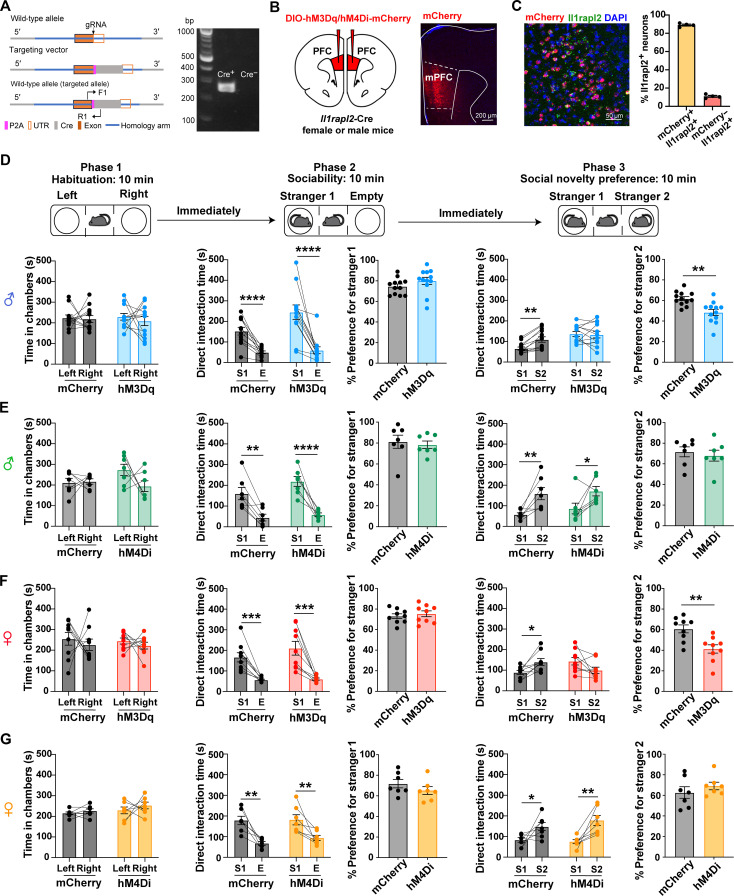
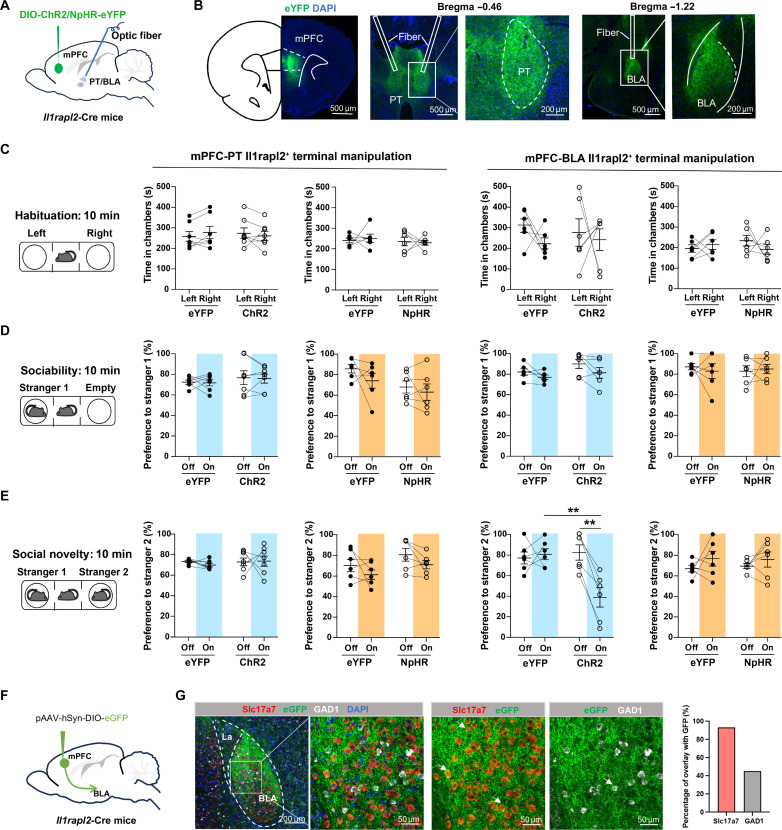
Activating mPFC Il1rapl2-positive cells or their BLA terminals reduces social novelty preference. Tested sociability remains similar, and inhibition does not clearly alter these behaviors.
Contents · 7 sections
Approaching company differs from preferring novelty
Given a mouse and an empty cage, animals usually spend more time near the conspecific, reflecting sociability. After exposure to that individual, adding a new mouse tests whether exploration shifts toward the newcomer. The choices are related but answer different questions.
Distinguishing familiar and novel information also involves perception, attention and previous experience. The study seeks a relevant population within heterogeneous prefrontal cortex rather than treating regional average activity as an explanation of every social behavior.
Different populations within prefrontal cortex
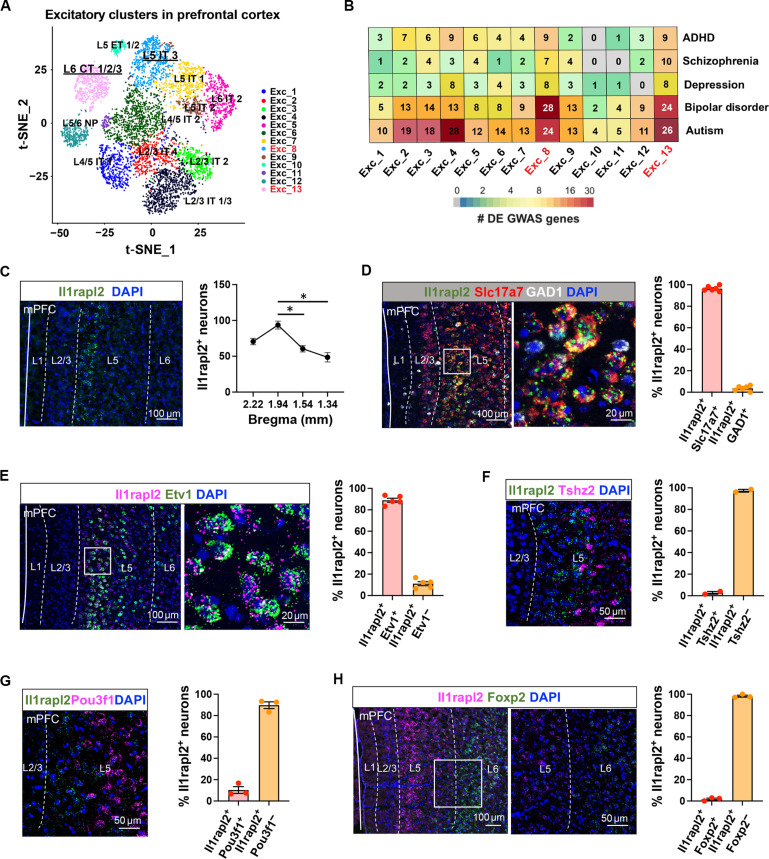
Single-cell transcriptomics divides medial prefrontal cortex (mPFC) excitatory neurons into subtypes. Developmental expression differences and disease-associated candidate-gene data help select populations for further study, including a predominantly layer-five Il1rapl2-expressing subtype.
Tissue localization shows that most carry a glutamatergic marker and overlap little with several other layer or subtype markers. Il1rapl2 provides an address for repeatedly targeting a defined population in recordings and interventions.
Layer-six Foxp2-marked cells are also tested; their activation or inhibition does not clearly change the social measures. Similar selection clues need not imply identical behavioral functions, directing attention toward the Il1rapl2 population.
Source: Liu Y et al. · Science advances · CC BY
Original figure and English caption ↗
Novelty preference falls while sociability persists
Increasing Il1rapl2-positive activity weakens the clear preference for a new individual. Yet mice still favor a conspecific over an empty cage. The change concerns exploration between companions rather than a simple loss of sociability.
Reducing this population does not clearly alter sociability or novelty preference. Cell-population interventions show similar directions in male and female mice, with no clear locomotor change. Increasing and decreasing activity have asymmetric outcomes.
Source: Liu Y et al. · Science advances · CC BY
Original figure and English caption ↗
Population signals fall when a new interaction begins
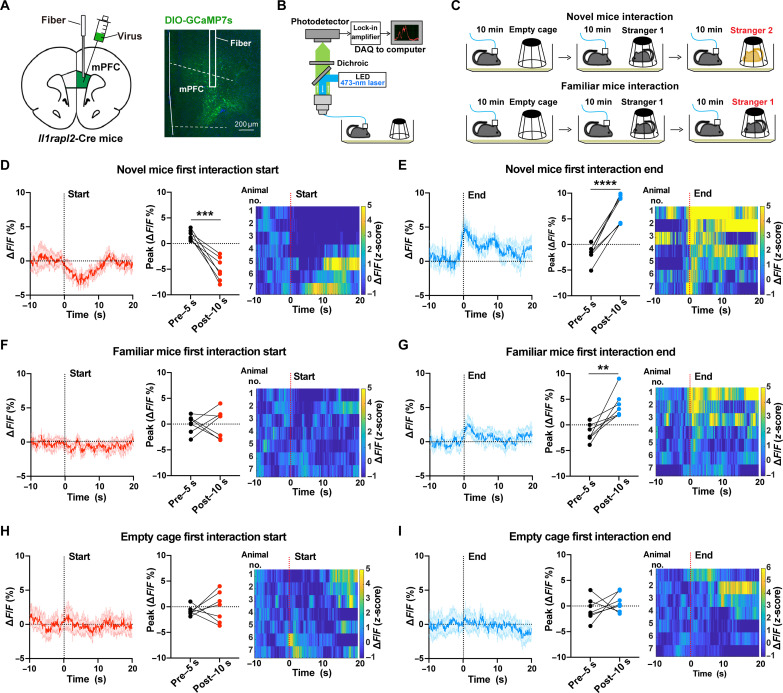
During natural interaction, Il1rapl2 population calcium rapidly decreases at the first onset of contact with a new mouse. Contact with a familiar individual or empty cage does not show the same clear decrease, linking the response with the current target.
At interaction end, signals rise for both new and familiar mice, without a clear change for an empty cage. Onset and offset are distinct responses; aligning recordings with specific events reveals activity across different interaction stages.
Source: Liu Y et al. · Science advances · CC BY
Original figure and English caption ↗
A connectivity map behind the cellular address
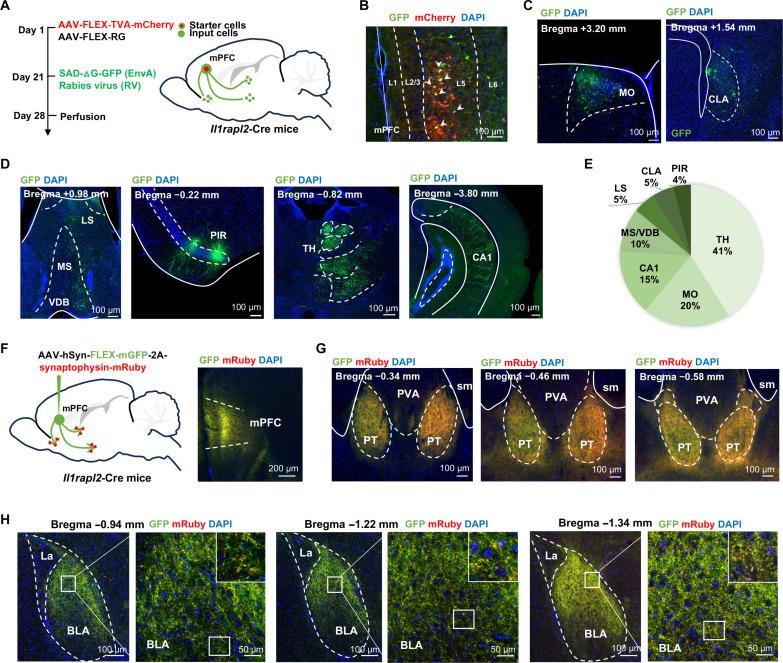
These prefrontal cells receive inputs from regions including motor cortex, claustrum and hippocampus, with thalamus accounting for a larger labeled fraction. Output tracing highlights paratenial thalamus (PT) and basolateral amygdala (BLA), both containing prominent terminals and presynaptic markers.
One population can send information to multiple targets, while behavioral effects may depend more strongly on a particular branch. Anatomical projection alone does not identify which output changes novelty preference, motivating separate tests of the terminals.
Source: Liu Y et al. · Science advances · CC BY
Original figure and English caption ↗
Amygdala-directed terminals can change novelty choice
In male mice, activating the population’s BLA terminals weakens novelty preference, whereas PT-terminal activation does not produce the same effect. Sociability and movement remain similar. BLA-branch activation reproduces the main direction of the cell-population intervention.
Inhibiting BLA terminals still does not clearly alter the tested preference, and an additional anxiety-like test shows no clear activation effect. Tissue imaging places more terminals around glutamatergic BLA cells, suggesting a downstream cellular relationship for further examination.
Source: Liu Y et al. · Science advances · CC BY
Original figure and English caption ↗
Different kinds of novelty need not share one population
The same cell activation does not clearly change novel-object recognition or cued fear memory. The novelty-preference effect does not extend to these memory measures; distinct tasks could distinguish effects on social-information formation, retrieval and exploration choice.
The study connects social functions with cellular identity and output branches: an excitatory population briefly reduces activity during novel interaction, while increasing its activity weakens novelty preference. Understanding prefrontal involvement requires identifying the cells and moments of interaction as well as the connected regions.