A prefrontal inhibitory population quiets during aggression
During intermale aggression, prelimbic GABAergic population activity declines. Activating these cells or their lateral hypothalamic projections reduces aggression, with orexin-related cells and receptor signaling also implicated.
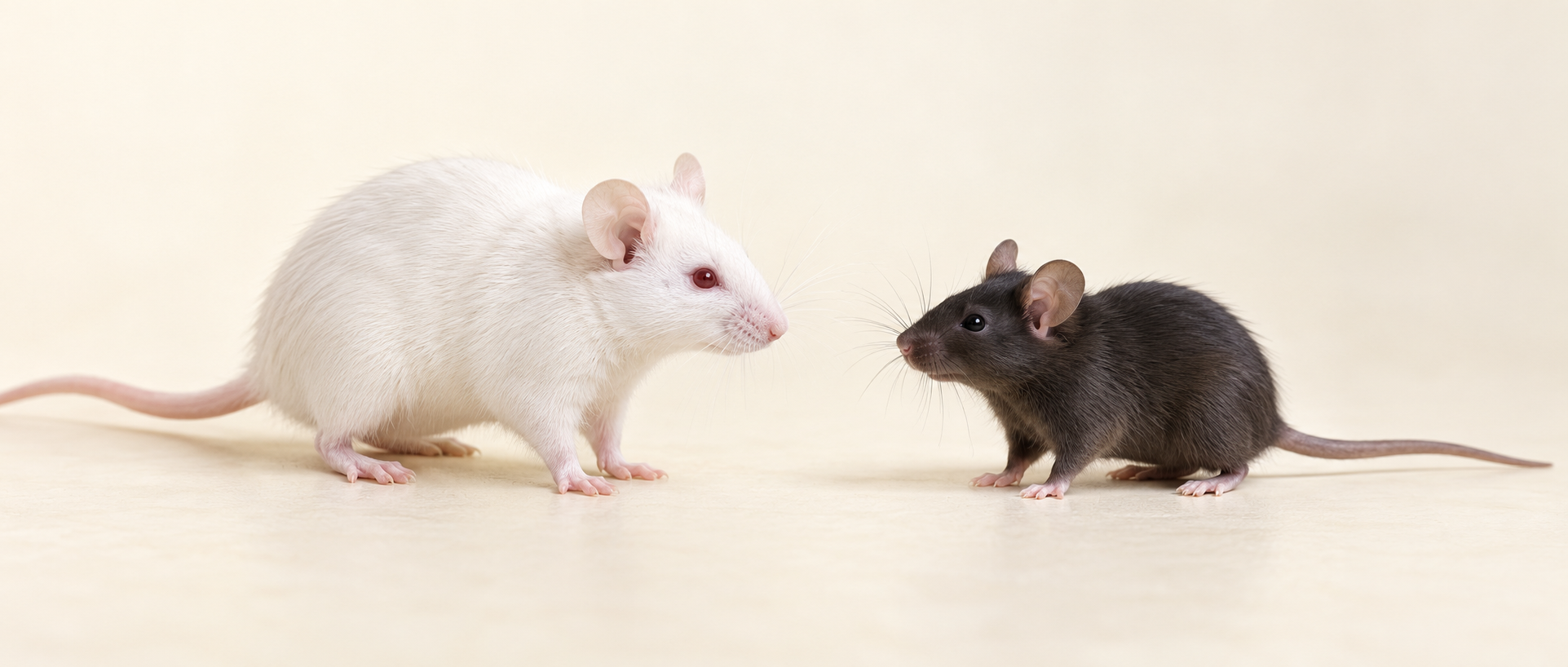
When an unfamiliar male enters a territory, some mice pursue and attack while others do not initiate aggression. How does the prefrontal cortex contribute? A study published in iScience on August 25, 2023 finds that overall activity labeling in the prelimbic area (PL) rises during aggression while a GABAergic population changes in the opposite direction. Following its output to the lateral hypothalamus (LH) identifies a cortical connection that can constrain aggressive behavior.
Activating PL GABAergic cells or their LH terminals delays attacks and reduces attacking and pursuit; inhibition shifts behavior in the opposite direction. Activity labeling and firing in LH orexin cells, together with orexin-receptor pharmacology, support a contribution of this downstream system.
Contents · 6 sections
Overall labeling rises while an inhibitory population declines
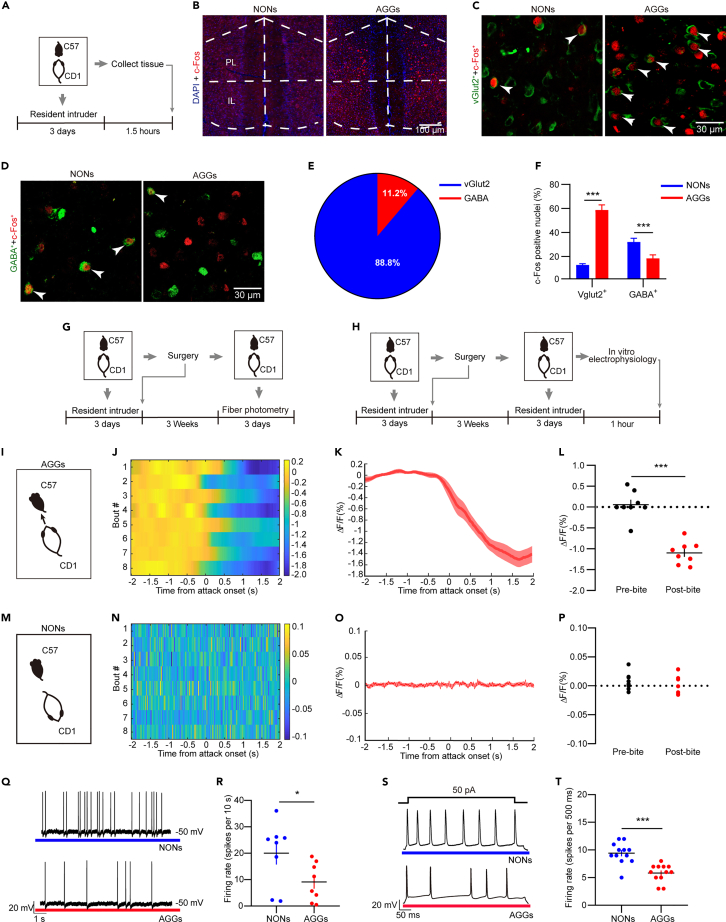
Resident males are classified as attackers or non-attackers. After aggression, attackers have more c-Fos-labeled cells in PL and more co-labeling in excitatory cells. Yet c-Fos co-labeling in GABAergic cells is lower, indicating different activity patterns within the same region. The groups also make different choices about a context paired with encounters: attackers prefer it, whereas non-attackers avoid it.
During bite onset, PL GABAergic population calcium signals fall in attackers; corresponding recordings in non-attackers show no significant change. Slice recordings also show lower spontaneous and current-evoked firing in this population. Across these measures, aggression accompanies a selective change rather than uniform prefrontal silence.
Source: Bai F et al. · iScience · CC BY-NC-ND
Original figure and English caption ↗
Attacks begin later and pursuit decreases
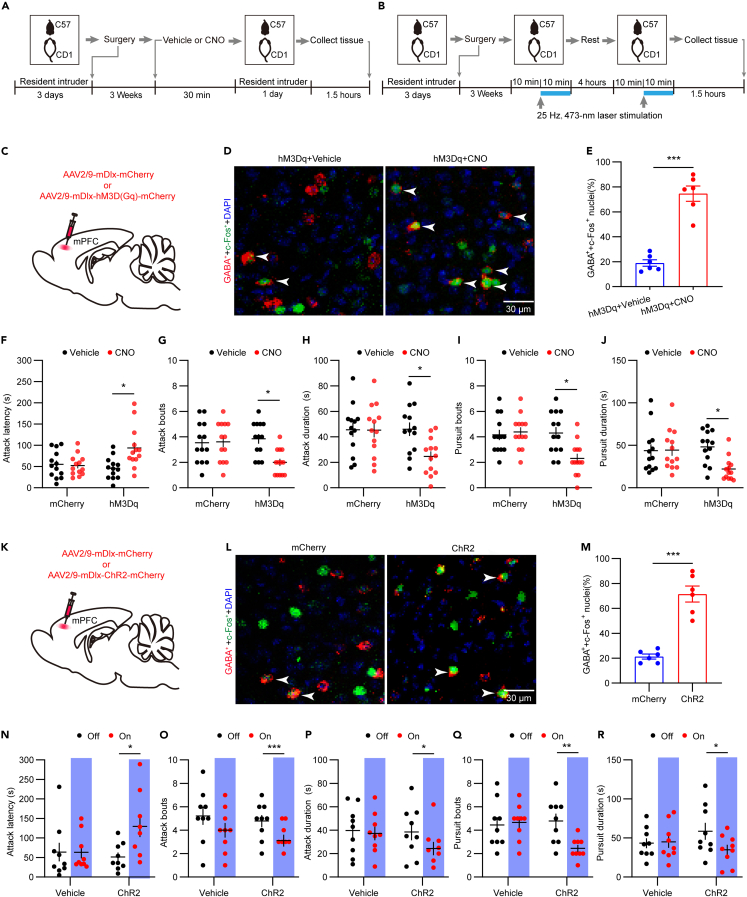
Activating PL GABAergic cells in previously aggressive males delays the first attack and reduces the number and duration of attacks and pursuits. Chemogenetic and optogenetic approaches yield similar directions of change, moving the evidence beyond an activity correlation.
The effects extend to a context paired with encounters. After activation, attackers show reduced preference and aversion toward that context, whereas non-attackers do not develop a further significant aversion with activation. The initial behavioral state influences what the intervention changes.
Source: Bai F et al. · iScience · CC BY-NC-ND
Original figure and English caption ↗
Inhibition increases aggression
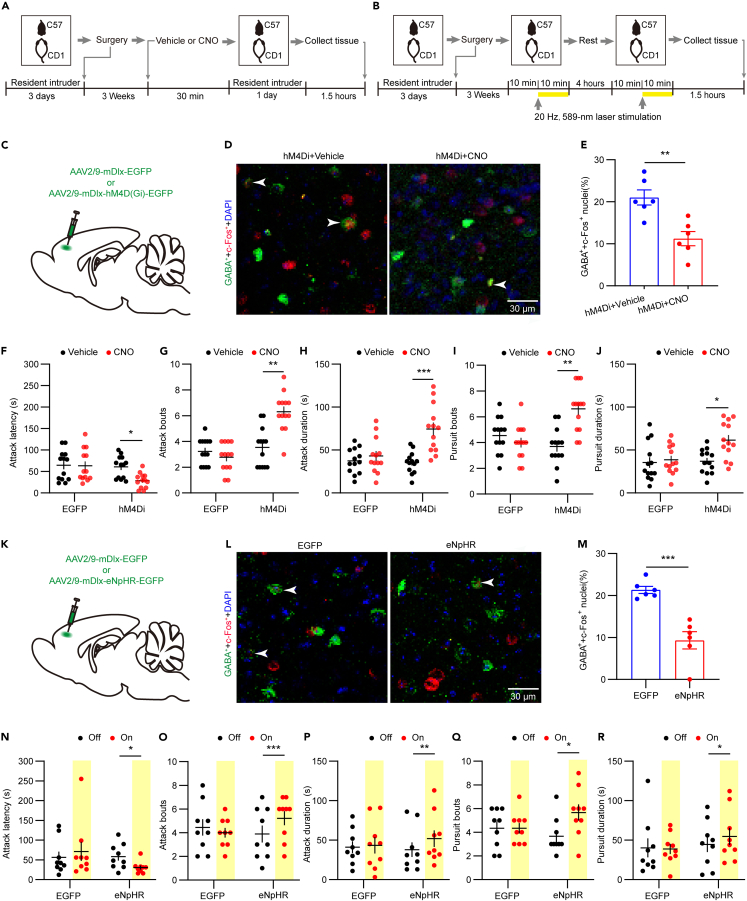
Conversely, inhibiting PL GABAergic cells in attackers brings forward the first attack and increases attack and pursuit counts and durations. Complementing the activation findings, this supports a role in constraining aggression in the tested setting.
Context preference does not simply track attack intensity. In attackers, inhibition increases time in the paired context without a further significant increase in the normalized preference score; in non-attackers, that score can increase. Aggression and later contextual choice are related but have distinct outcomes.
Source: Bai F et al. · iScience · CC BY-NC-ND
Original figure and English caption ↗
LH terminals can change behavior
Cortical inhibitory cells are often considered within local networks, where they regulate nearby excitatory cells. This study asks about another spatial scale: what happens when inhibitory cells send signals to more distant regions? By manipulating PL cells and examining terminals at separate downstream sites, the researchers narrow a regional effect to a particular output.
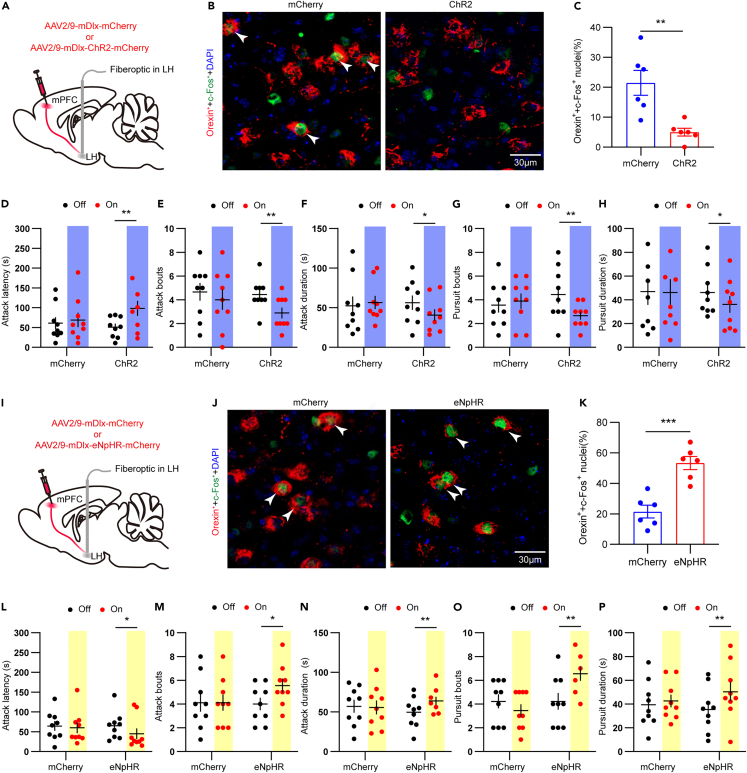
Fibers from this cortical population reach several regions, including the internal capsule, horizontal diagonal band and LH. Manipulating terminals in the first two locations produces no evident aggression effect under the tested conditions, whereas LH terminal manipulation produces clear changes in both directions.
Activating LH terminals reduces attacks and pursuit alongside lower c-Fos co-labeling in LH orexin cells. Inhibiting the terminals shifts behavior and labeling in the opposite direction. This inhibitory cortical output to the hypothalamus provides a specific downstream link to the behavioral findings.
Source: Bai F et al. · iScience · CC BY-NC-ND
Original figure and English caption ↗
GABA signaling is linked to orexin-cell firing
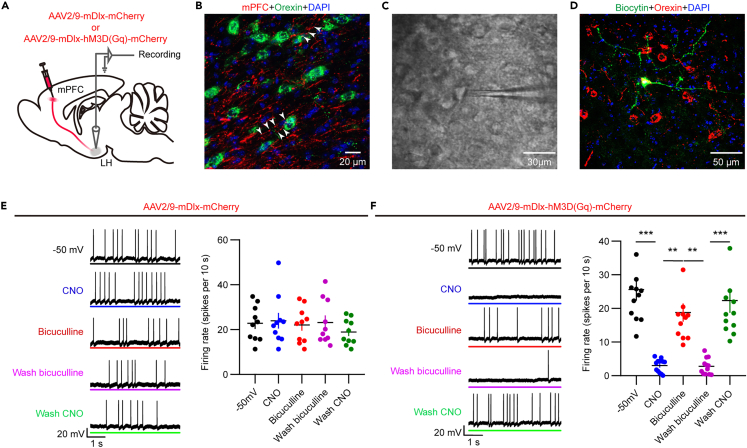
Fluorescence images place PL fibers near LH orexin cells. Slice recordings further show reduced firing in identified orexin cells when PL inputs bearing the chemogenetic receptor are activated. GABA_A-receptor blockade reverses the reduction, while control recordings do not show the same changes.
The findings support GABA-mediated inhibition as a link between cortical output and LH cell activity. Because the orexin system also participates in arousal and motivation, the firing and behavioral findings place aggression within a broader context of state regulation.
Source: Bai F et al. · iScience · CC BY-NC-ND
Original figure and English caption ↗
Receptor pharmacology changes aggression and contextual choice
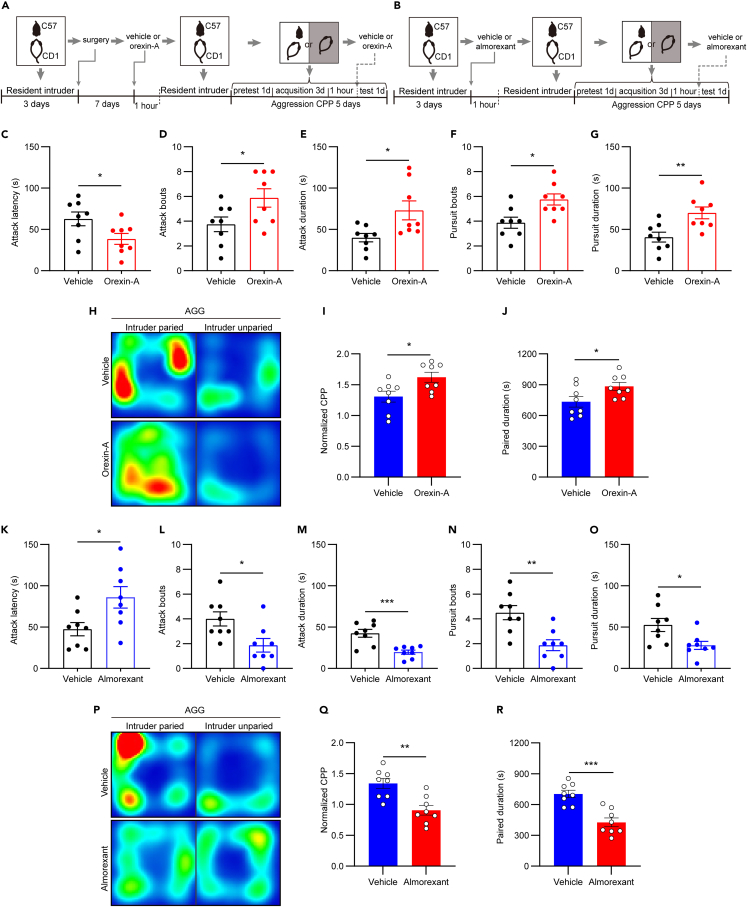
Local orexin-A treatment in LH brings forward attacks, increases attacking and pursuit, and strengthens preference for the encounter-paired context. In a separate experiment, systemic blockade of both orexin-receptor types reduces aggression and shifts contextual preference toward aversion. These pharmacological findings support a role for orexin signaling in behavioral regulation.
The study reveals that a smaller inhibitory prefrontal population can influence intermale aggression through long-range output. The evidence comes from adult males tested during the light phase; the crucial cellular subtypes and the contribution of arousal remain specific questions for understanding this regulation.
Source: Bai F et al. · iScience · CC BY-NC-ND
Original figure and English caption ↗