Different neural rhythms accompany pup retrieval in dams and sires
Dams and sires show distinct anterior cingulate and locus coeruleus activity during pup retrieval. Inhibiting cingulate excitatory cells or cingulate-projecting locus coeruleus cells disrupts early maternal behavior.
When a pup outside the nest calls, when does a parent approach and when does it carry the pup back? A study published in Cell Reports on July 7, 2023 links these small actions to population activity in the anterior cingulate cortex (ACC) and locus coeruleus (LC). Dams and sires differ in both behavior and neural timing. Inhibiting some of the participating cells delays early maternal retrieval.
During retrieval, ACC excitatory responses are stronger in dams, while the overall sex difference in inhibitory-population responses is nonsignificant. ACC-projecting LC activity and local noradrenaline signals accompany retrieval. Inhibiting these LC cells delays maternal retrieval without abolishing it.
Contents · 7 sections
Differences emerge before and between retrievals
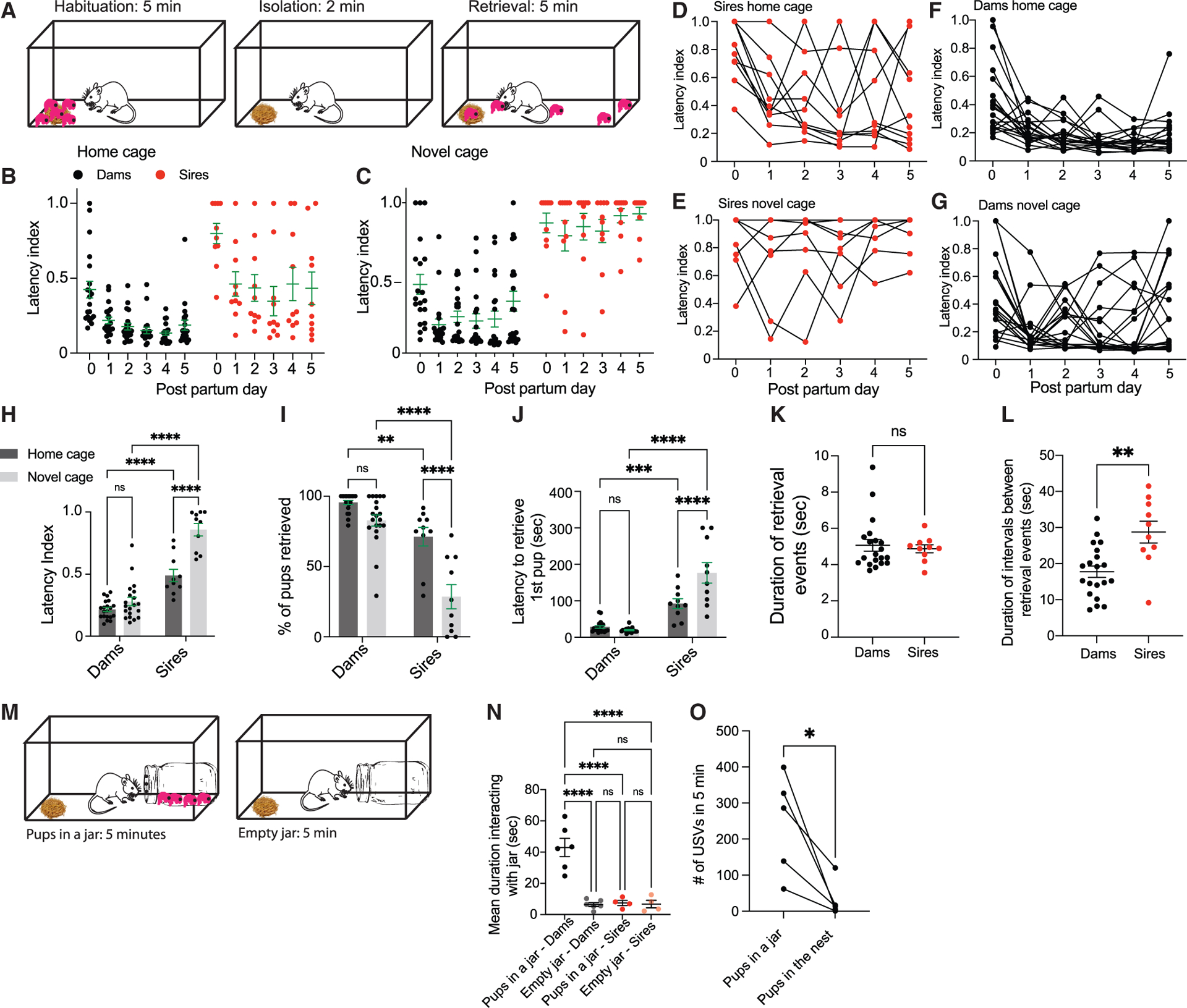
In the initial behavioral cohort, dams retrieve more reliably and improve faster across days. Sires are less consistent and particularly affected by a novel cage. Sires take longer to approach the first pup and pause longer between retrievals, but the time from contact to nest deposition does not differ significantly between sexes in this cohort.
When pups can be heard and smelled but not immediately contacted, dams interact more with the pup-containing container than with an empty one. Pups also emit more ultrasonic calls there than in the nest. This setting distinguishes exploration of an object from responses to pup-associated cues.
Source: Corona A et al. · Cell reports · CC BY-NC-ND
Original figure and English caption ↗
Excitatory responses are stronger in dams
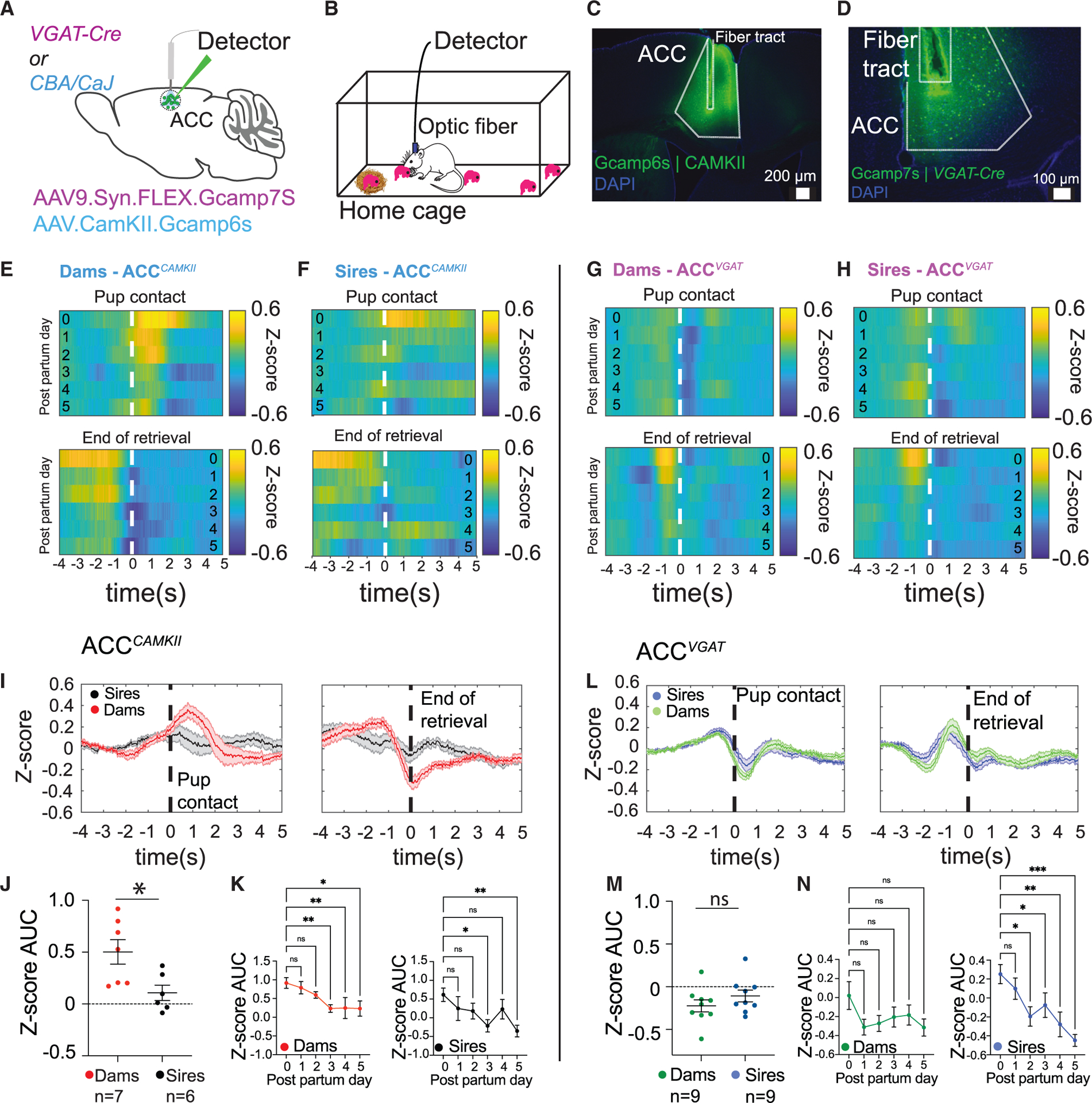
A brain-wide activity-labeling screen draws attention to ACC: c-Fos labeling increases markedly during maternal retrieval and differs between dams and sires. Dynamic calcium recordings then show stronger retrieval-associated ACC excitatory-population responses in dams.
Responses are not constant across days. Excitatory response magnitude declines with postpartum day in both sexes, and strong early responses reappear with a second litter in dams. Inhibitory signals decline at pup contact and briefly rise near retrieval completion, without a significant overall sex difference in response magnitude.
Source: Corona A et al. · Cell reports · CC BY-NC-ND
Original figure and English caption ↗
Two populations follow distinct event-related rhythms
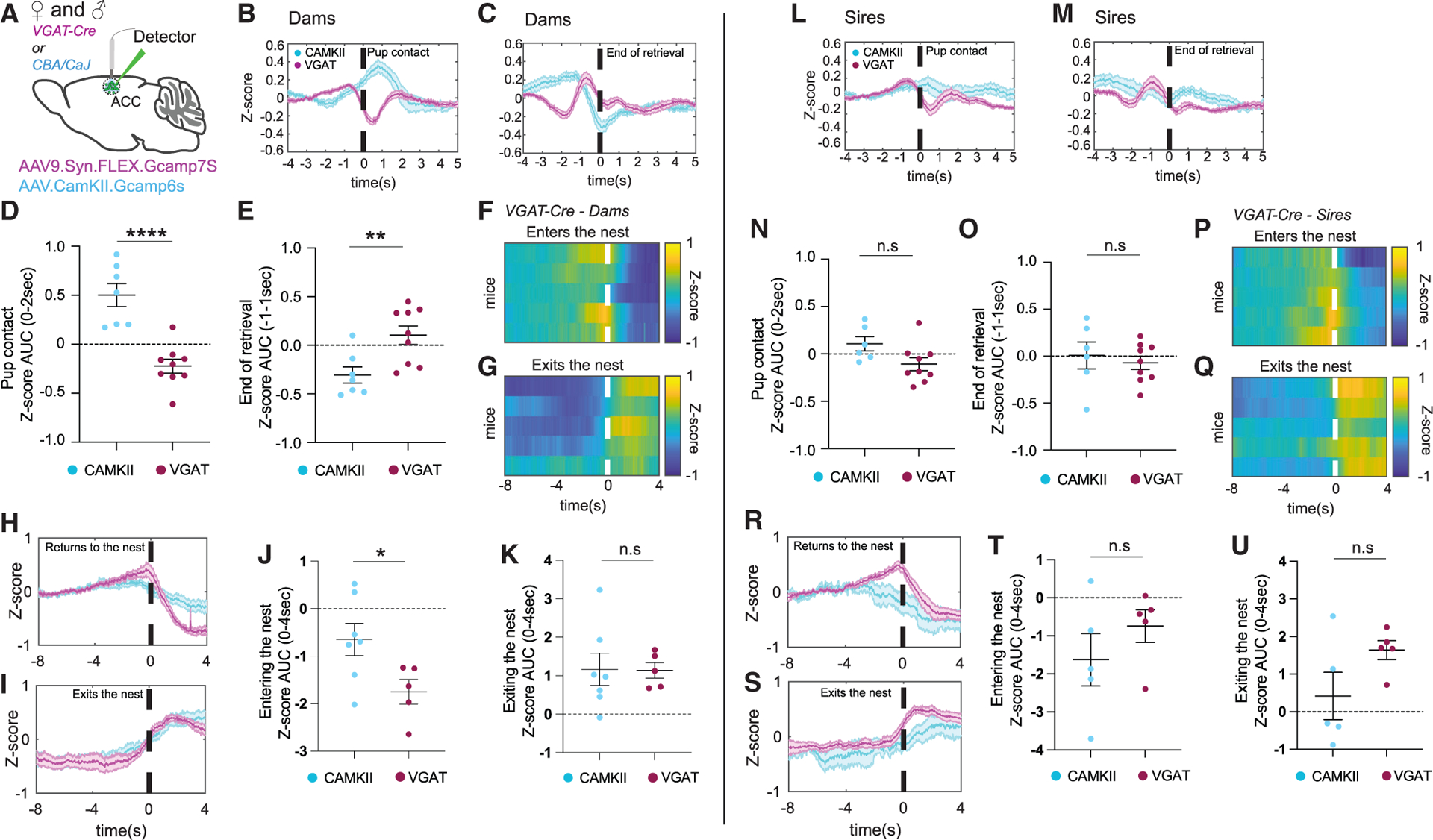
In dams, excitatory responses increase and inhibitory responses decrease after pup contact; around nest deposition, their directions reverse. Once the pups are gathered, maternal nest entry also accompanies a decline in inhibitory signals, followed by a rise during exit.
In sires, differences between the two populations in the corresponding periods do not reach significance. The recordings reveal population-specific temporal structure rather than a uniform regional increase or decrease. Contact, deposition and nest entry are distinct behavioral events.
Source: Corona A et al. · Cell reports · CC BY-NC-ND
Original figure and English caption ↗
Excitatory-cell inhibition delays early maternal retrieval
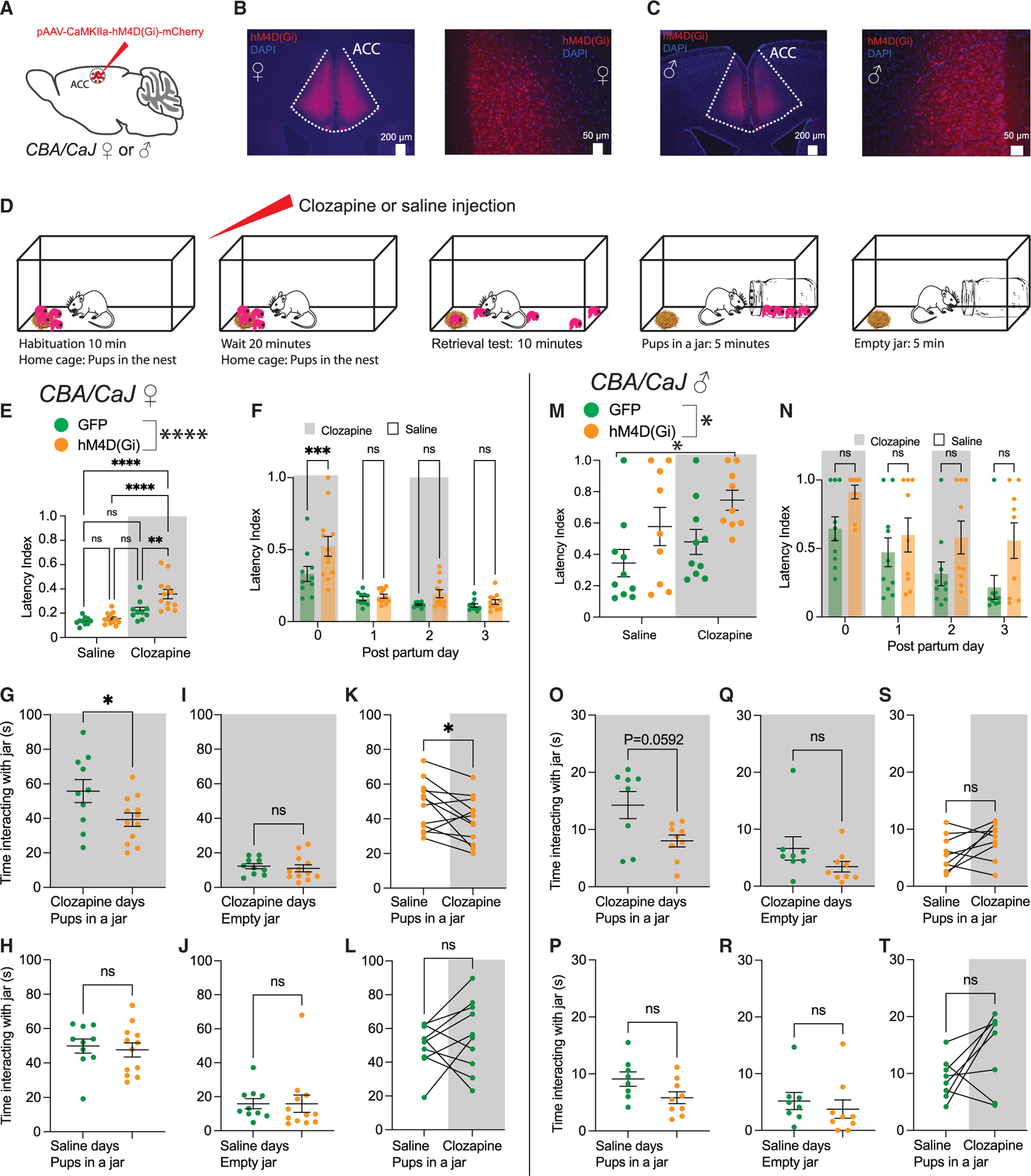
Inhibiting ACC excitatory cells increases maternal retrieval latency, particularly at the earliest postpartum stage and most clearly on day 0. Dams also interact less with the pup-containing container, while empty-container interactions remain without significant changes. Elevated-plus-maze open-arm time and entries likewise do not change significantly.
Sires do not show the same clear acute retrieval effect, with day-by-day between-group comparisons nonsignificant. Although interaction with the pup-containing container is numerically lower, neither that between-group comparison nor the within-animal drug comparison is significant. The effects are therefore not simply symmetrical between parents.
Source: Corona A et al. · Cell reports · CC BY-NC-ND
Original figure and English caption ↗
LC responses are larger and longer in sires
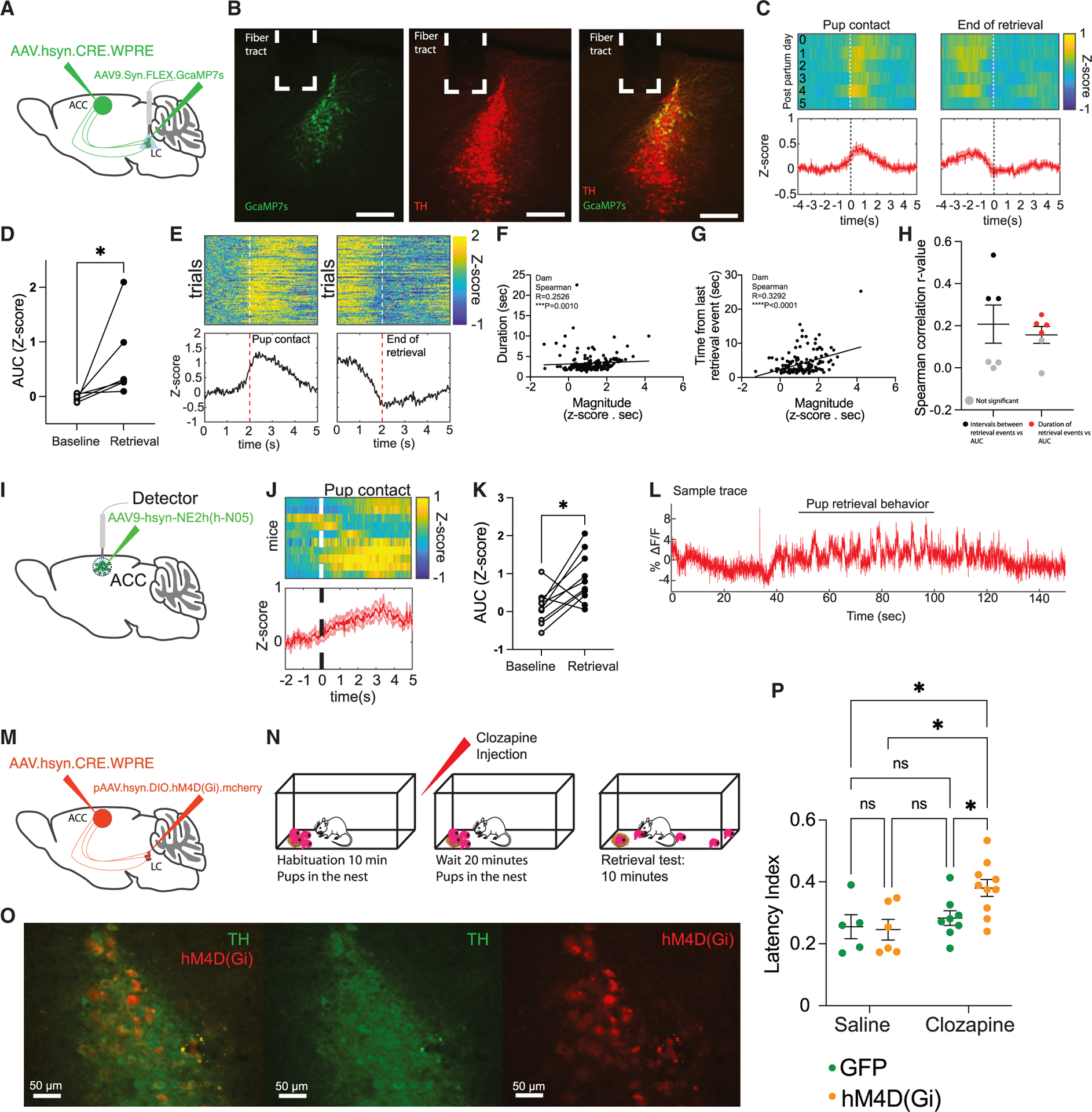
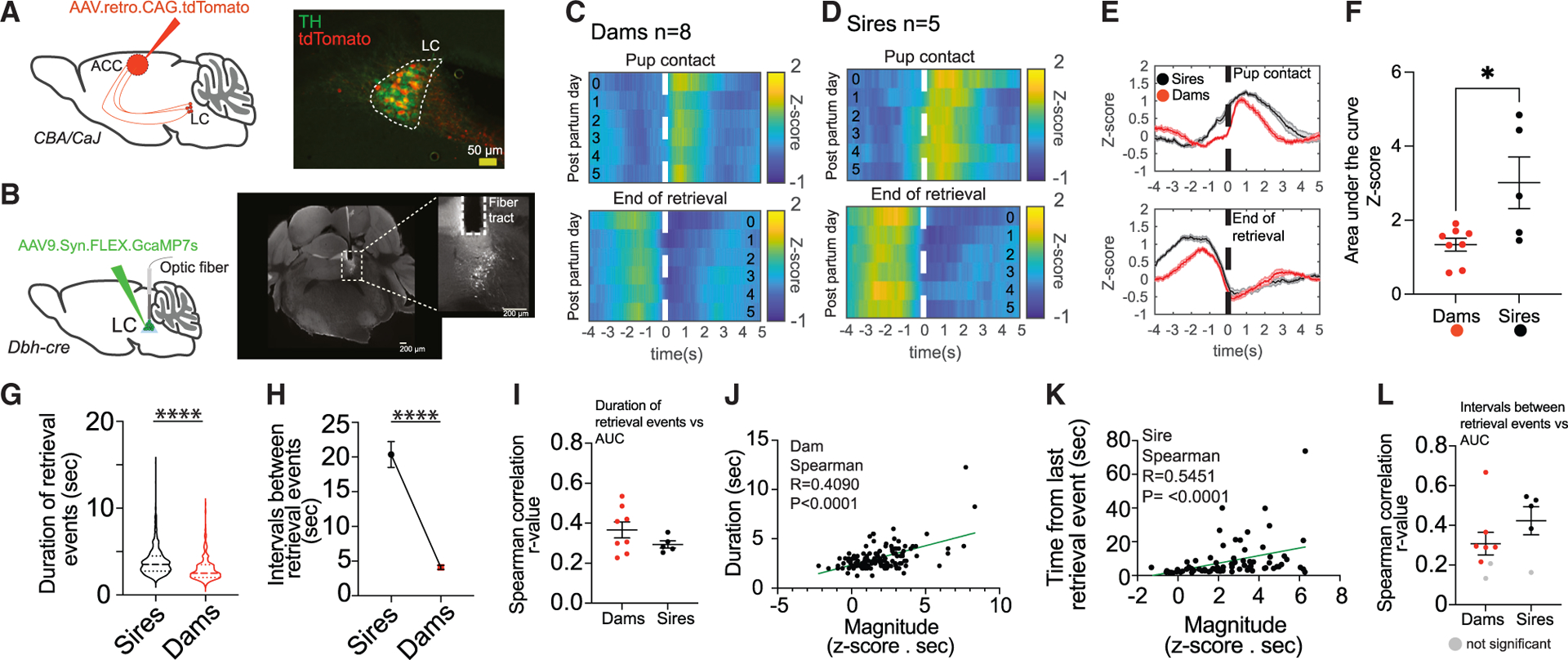
One upstream ACC connection arises from LC, a region associated with noradrenaline, arousal and attention. LC population activity increases during pup contact and transport and declines after deposition. Unlike ACC excitatory responses, LC response area is larger in sires.
In the LC-recording cohort, sires have longer retrieval events and intervals. Response magnitude correlates with event duration and the preceding interval. A larger signal therefore does not simply mean faster behavior; its magnitude is linked to the temporal organization of the action.
Source: Corona A et al. · Cell reports · CC BY-NC-ND
Original figure and English caption ↗
ACC noradrenaline signals rise during retrieval
Recording ACC-projecting LC cells likewise reveals retrieval-associated transients. A noradrenaline sensor in ACC shows an increase after pup contact, linking upstream cellular activity with local cortical transmitter changes.
Inhibiting ACC-projecting LC cells increases early maternal retrieval latency without abolishing retrieval. The manipulation targets projection-defined cells and may affect their other branches. This LC population contributes to timely care, while retrieval remains possible.
Source: Corona A et al. · Cell reports · CC BY-NC-ND
Original figure and English caption ↗
Timing matters between pup cues and action
By separating approach, contact, transport and deposition, the study reveals distinct rhythms across populations and parents. It also shows that disrupting ACC or the associated LC population can change how quickly dams act early after birth.
The findings concern adult mouse parents in defined caregiving settings. The study has not shown that increasing ACC activity improves paternal retrieval, and the cellular and receptor mechanisms translating local transmitter signals into action remain unresolved. The central insight is that care involves not only how active a region is, but when its signals occur relative to the next action.