What drives a mouse to eat after capturing prey?
A hypothalamic CaMKIIα-associated population links exploration, capture and consumption. Different inputs and outputs reveal that pursuing prey and eating it are separable.
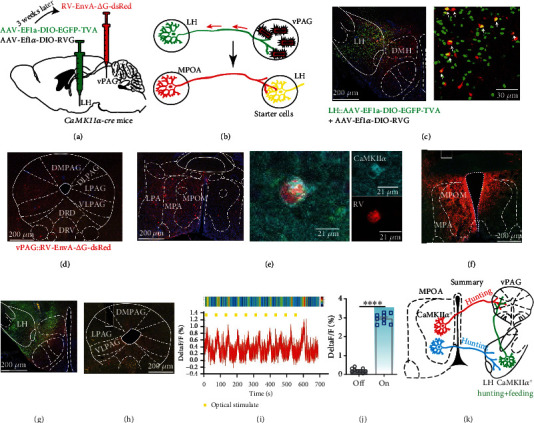
A mouse can catch a cricket and then leave it, yet continue eating in another activity state. What separates capture from consumption? A study published in Research on August 5, 2022 follows novelty exploration into CaMKIIα-associated cells in the lateral hypothalamus, or LH. These cells participate in object approach and retrieval as well as hunting and eating. Their upstream and downstream connections reveal divisions within this behavioral sequence. Searching, pursuit, capture and ingestion each demand different actions. The study asks when these phases move together and when they separate.
LH CaMKIIα-associated cells contribute to exploration, hunting and consumption. Enhancing MPOA input to LH promotes pursuit and capture without increasing intake, whereas enhancing the LH–vPAG branch promotes prey consumption.
Contents · 7 sections
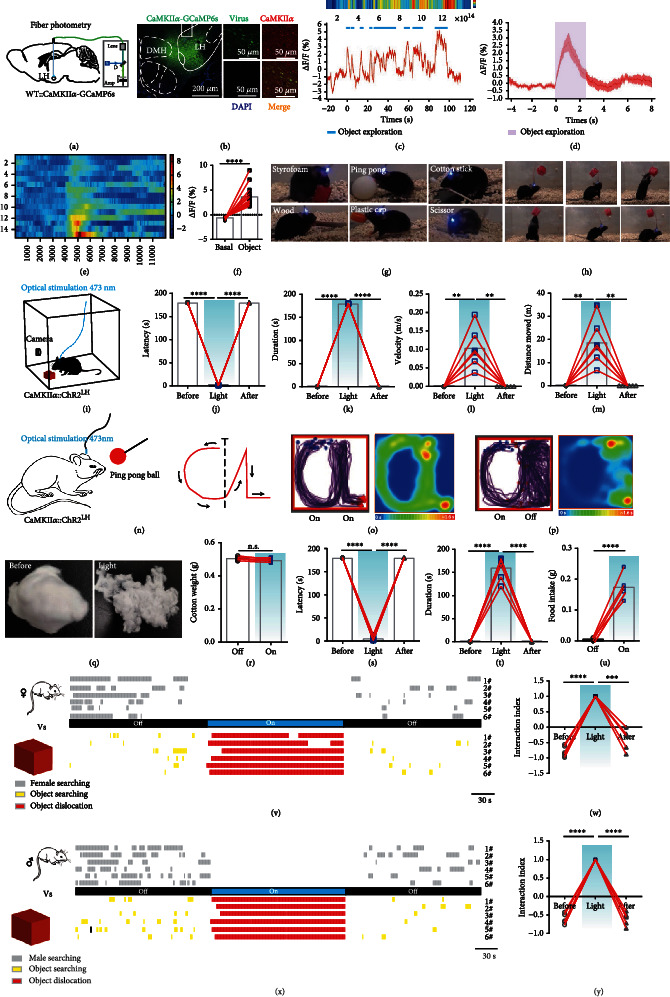
Novel objects recruit vigorous exploration
Calcium signals rise when mice contact a novel object, remain elevated during retrieval and fall after release. Activating the population speeds approach, prolongs object displacement and encourages pursuit of moving objects.
The engagement extends to inedible objects: cotton is torn apart without a significant loss of weight. In competitions between an object and another mouse, behavior shifts toward the object, with no conspecific attack observed. Biting, pursuit and retrieval remain distinct from consumption.
Source: Tan N et al. · Research (Washington, D.C.) · CC BY
Original figure and English caption ↗
Hunting and consumption have different natural signals
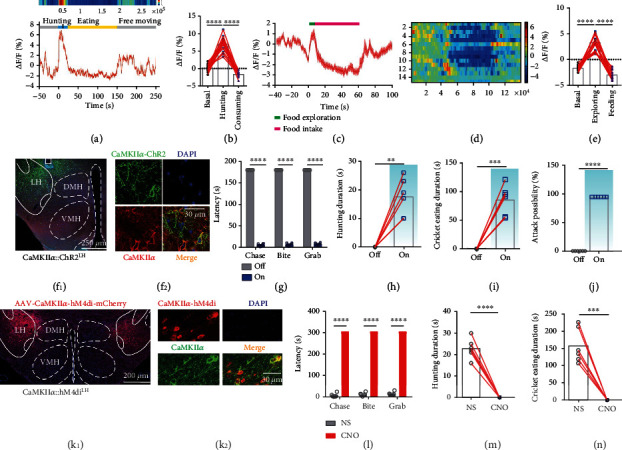
During hungry mice’s cricket hunts, population calcium increases and then falls during consumption. Ordinary food produces a similar sequence: a rise at interaction and a decline during eating. Free locomotion does not produce an obvious comparable increase.
The sequence therefore does not resemble one program remaining uniformly active. Acquiring a target and consuming it have different dynamics, while the population average can combine different cellular responses.
Exploring toys and contacting food can both accompany increased activity. The rise therefore accompanies a set of target-acquisition behaviors rather than appearing only for food. Object exploration provides an entry point for comparing actions shared across different targets.
Activating LH recruits hunting even in fed mice
Activating the LH CaMKIIα-associated population recruits hunting in fed, cricket-naive mice, followed by consumption. Hunting begins sooner and hunting and eating last longer. The study also observes prey being dropped after activation ends.
Suppressing the population delays pursuit, biting and capture and shortens hunting and consumption. These bidirectional effects link it to progression through the sequence. Its natural activity decline during eating also highlights a difference between population activation and physiological timing.
Population activation also increases ordinary-food intake in fed mice and weakens their natural preference for edible over inedible objects. This broad engagement contrasts with more focused downstream effects and motivates following its outputs.
Source: Tan N et al. · Research (Washington, D.C.) · CC BY
Original figure and English caption ↗
The vPAG branch favors biting and consumption
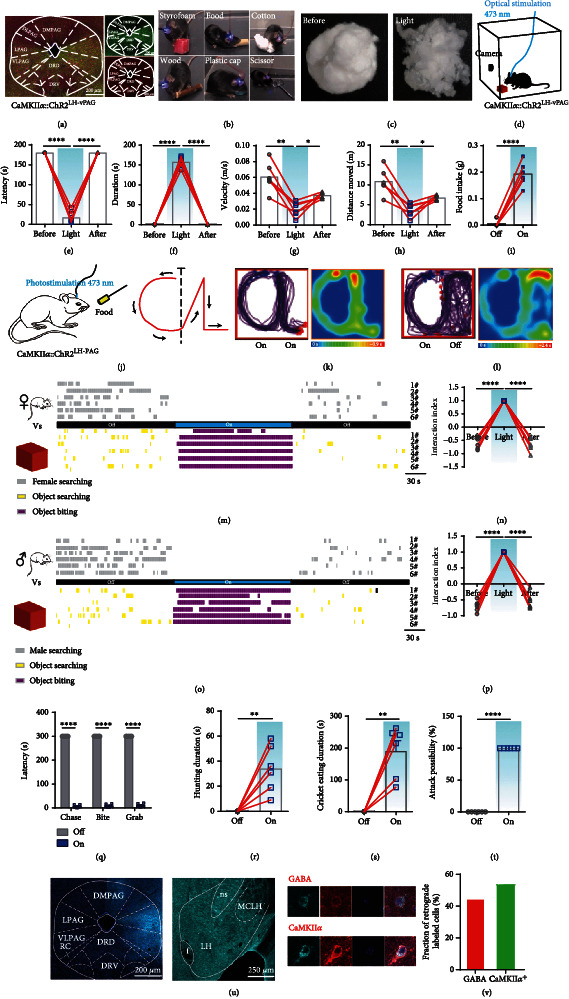
Following LH outputs leads to ventral periaqueductal gray, or vPAG. Enhancing LH-associated terminals there favors stationary biting, while object-displacement speed and distance decline. With ordinary food, actual intake increases.
Mice rarely follow a moving inedible ball but pursue moving food and consume captured crickets. Compared with the broad exploration and retrieval accompanying LH population activation, this branch produces a combination favoring biting and consumption.
Source: Tan N et al. · Research (Washington, D.C.) · CC BY
Original figure and English caption ↗
MPOA input does not reproduce the consumption effect
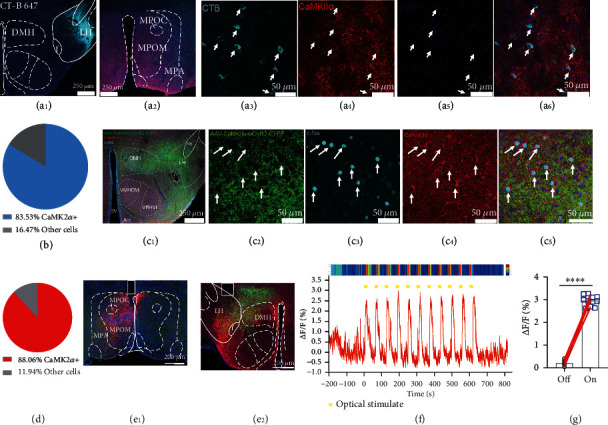
Upstream evidence points to medial preoptic area, or MPOA. Anatomical tracing links it to LH, and activating the MPOA-associated population increases calcium in LH CaMKIIα cells, providing a functional connection between the regions.
Source: Tan N et al. · Research (Washington, D.C.) · CC BY
Original figure and English caption ↗
Successful capture can stop before consumption
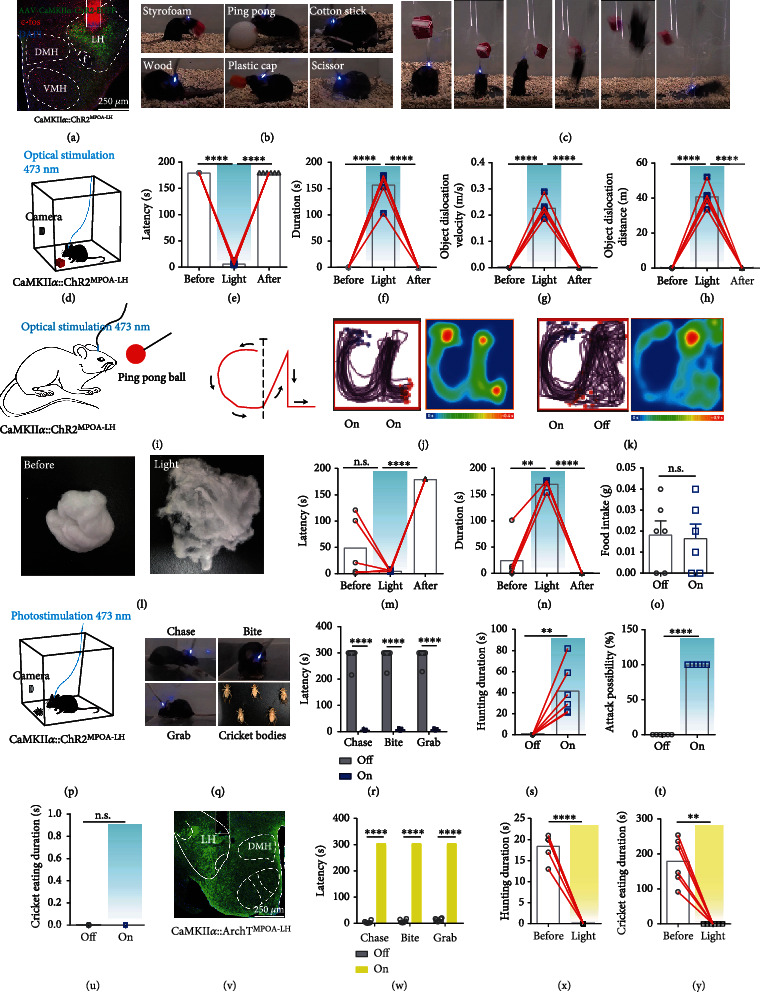
Enhancing MPOA input to LH promotes exploration, pursuit, biting and capture without significantly increasing ordinary-food intake or cricket consumption. Obtaining the target and consuming it separate clearly here.
Suppressing the input delays hunting and reduces hunting duration. Upstream input can promote approach and capture, while subsequent consumption depends on the wider network state. Completing one phase does not ensure the next follows.
Source: Tan N et al. · Research (Washington, D.C.) · CC BY
Original figure and English caption ↗
A candidate relay contains distinct cells and branches
Further tracing links MPOA, LH and vPAG. Activating MPOA increases calcium in LH axons projecting to vPAG, supporting LH involvement in this relay. LH CaMKIIα cells are heterogeneous: only about six in ten overlap with the vGluT2 marker.
These observations in male mice separate exploration, capture and consumption. LH provides an important connection, while transmission between particular cells and contributions from other branches remain unresolved. Between catching prey and obtaining energy, the brain coordinates another distinct phase.
Source: Tan N et al. · Research (Washington, D.C.) · CC BY
Original figure and English caption ↗