Two preoptic populations respond differently as temperature changes feeding
Two glutamatergic preoptic populations in mice connect to feeding-promoting and feeding-suppressing routes. Distinct calcium responses and interventions in downstream recipients reveal how ambient temperature relates to intake.

Why do cold environments promote eating while heat reduces appetite? A study published in Nature Communications on July 22, 2022 identifies neighboring populations in the anteroventral and periventricular medial preoptic area, apMPOA, in mice. Both are glutamatergic but project to different targets: arcuate nucleus, ARC, and paraventricular hypothalamic nucleus, PVH. Environmental exposure, cellular calcium responses and feeding outcomes link ambient temperature with energy intake.
Activating apMPOA terminals in ARC promotes intake, while activation in PVH suppresses it. Inhibiting or reducing apMPOA-recipient PVH cells increases intake and diminishes measured temperature-dependent feeding differences.
Contents · 7 sections
Ambient temperature joins hunger as an influence
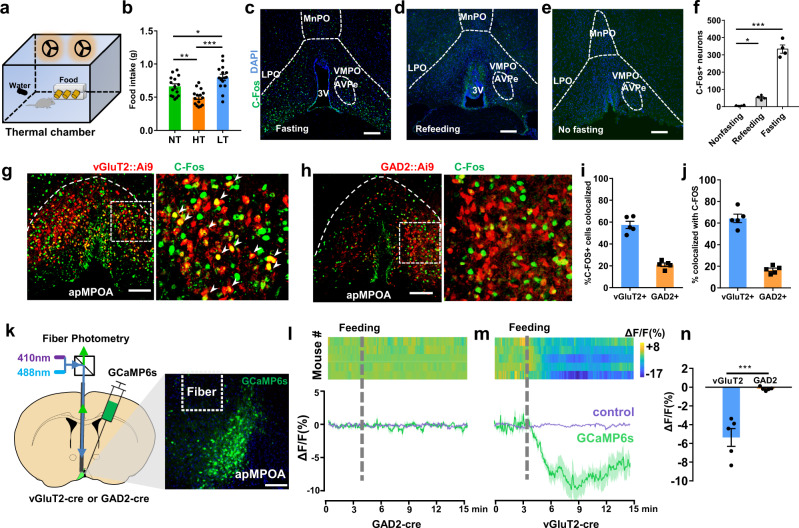
In the tested environments, heat reduces intake and cold increases it without corresponding rectal-temperature changes. Feeding adjustments may contribute to thermal balance rather than simply follow an already disrupted body temperature.
Fasting increases activity labeling in apMPOA, which declines after refeeding and overlaps substantially with glutamatergic cells. Population calcium likewise falls after feeding begins, without a corresponding GAD2-population change. The region links dietary state with thermoregulation.
Source: Qian S et al. · Nature communications · CC BY
Original figure and English caption ↗
Broad activation changes feeding alongside heat regulation
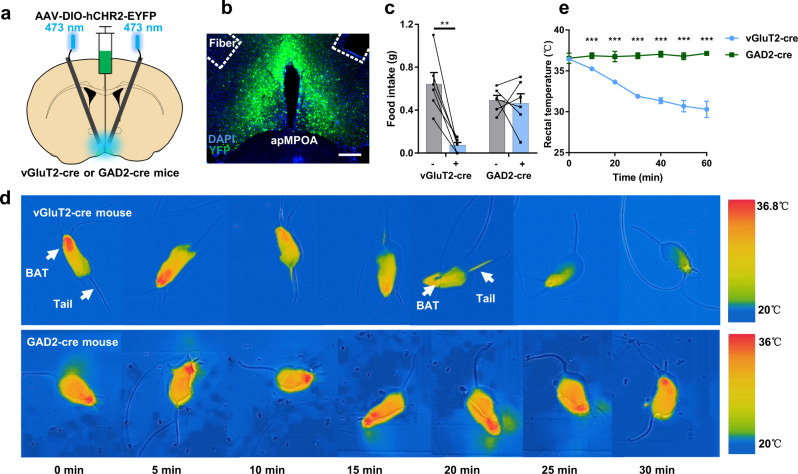
Broad glutamatergic apMPOA activation markedly reduces intake, increases tail heat dissipation, reduces brown-fat thermogenesis and lowers temperature. Mice also build nests. Tested GAD2 activation does not produce corresponding intake or temperature changes.
The scene involves more than appetite: heat balance and behavioral allocation also change. To distinguish outputs more closely associated with feeding, the team follows downstream projections and separates the broader regional effect into routes.
Source: Qian S et al. · Nature communications · CC BY
Original figure and English caption ↗
Excitatory outputs influence feeding in opposite directions
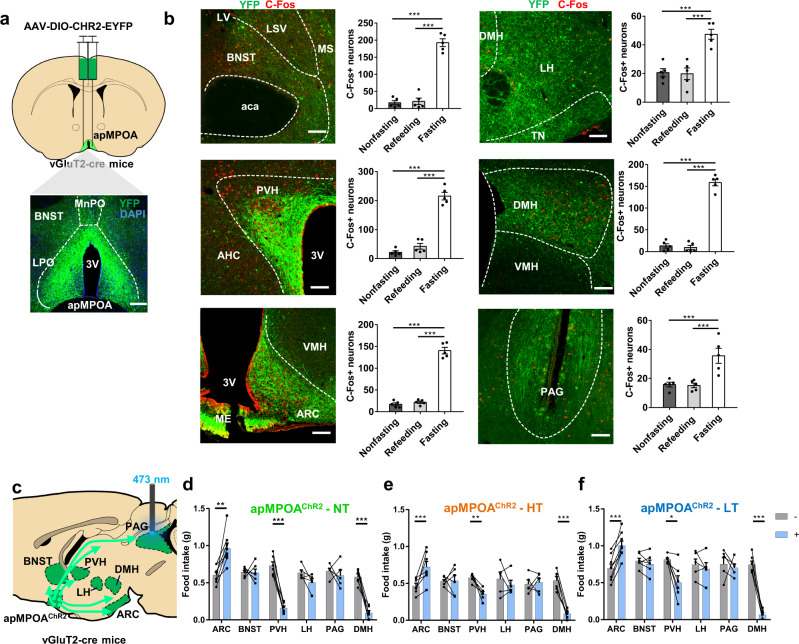
Activating apMPOA terminals in ARC increases intake; activating terminals in PVH decreases it. Both effects occur in tested cold, hot and neutral environments without corresponding rectal-temperature changes or prominent nesting.
ARC and PVH both regulate feeding but contain diverse cells. Destination helps explain behavioral direction beyond glutamatergic identity alone. A DMH output also accompanies reduced eating but prominently evokes nesting, making a direct feeding interpretation less clear.
Source: Qian S et al. · Nature communications · CC BY
Original figure and English caption ↗
PVH recipients influence temperature-related differences
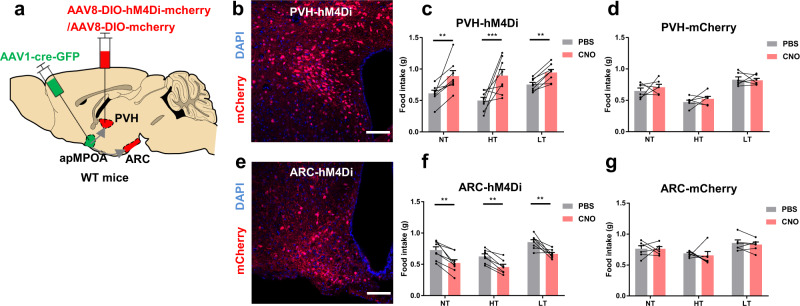
The study next labels downstream apMPOA recipients. Reducing or inhibiting ARC recipients lowers intake, while corresponding PVH-recipient interventions increase it. Recipient-side results complement terminal activation while targeting the cells themselves.
After PVH-recipient intervention, intake differences among cold, neutral and hot environments become nonsignificant. ARC-recipient intervention lowers intake while temperature differences persist. Both routes affect intake, but PVH recipients more prominently connect intake with environmental variation.
Source: Qian S et al. · Nature communications · CC BY
Original figure and English caption ↗
Cold and warmth recruit different output populations
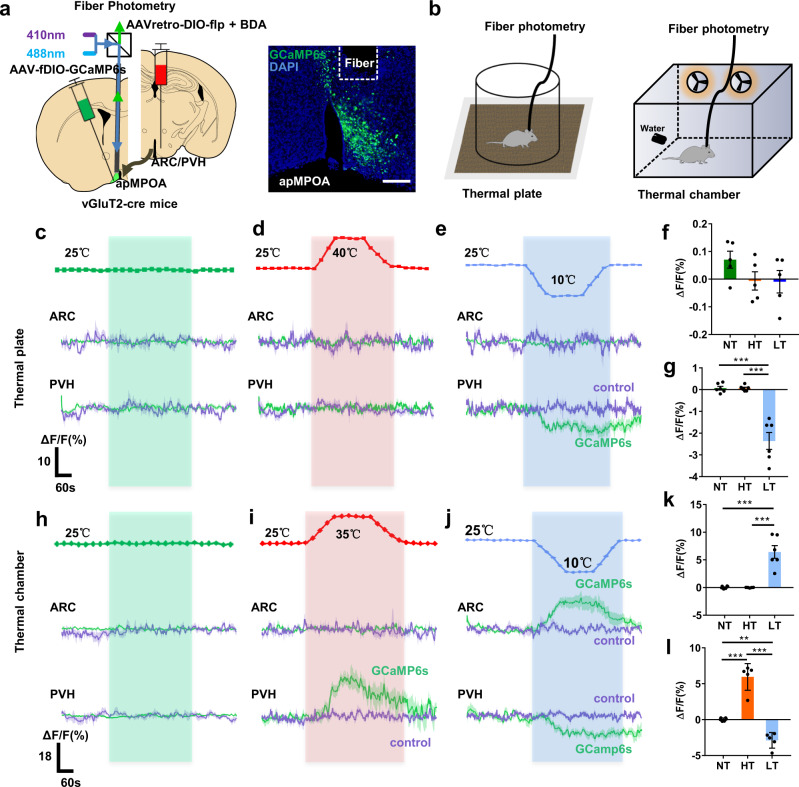
In ARC-projecting apMPOA cells, cold environments increase calcium without a corresponding heat response. PVH-projecting cells increase calcium in heat and decrease it in cold. Their different dynamics align with feeding-promoting and feeding-suppressing effects.
Local thermal-plate exposure differs: ARC-projecting cells show no significant response, while PVH-projecting cells mainly decline during local cooling. Whole-environment thermal challenges and local contact recruit the populations differently.
Source: Qian S et al. · Nature communications · CC BY
Original figure and English caption ↗
Neighboring cells receive different upstream inputs
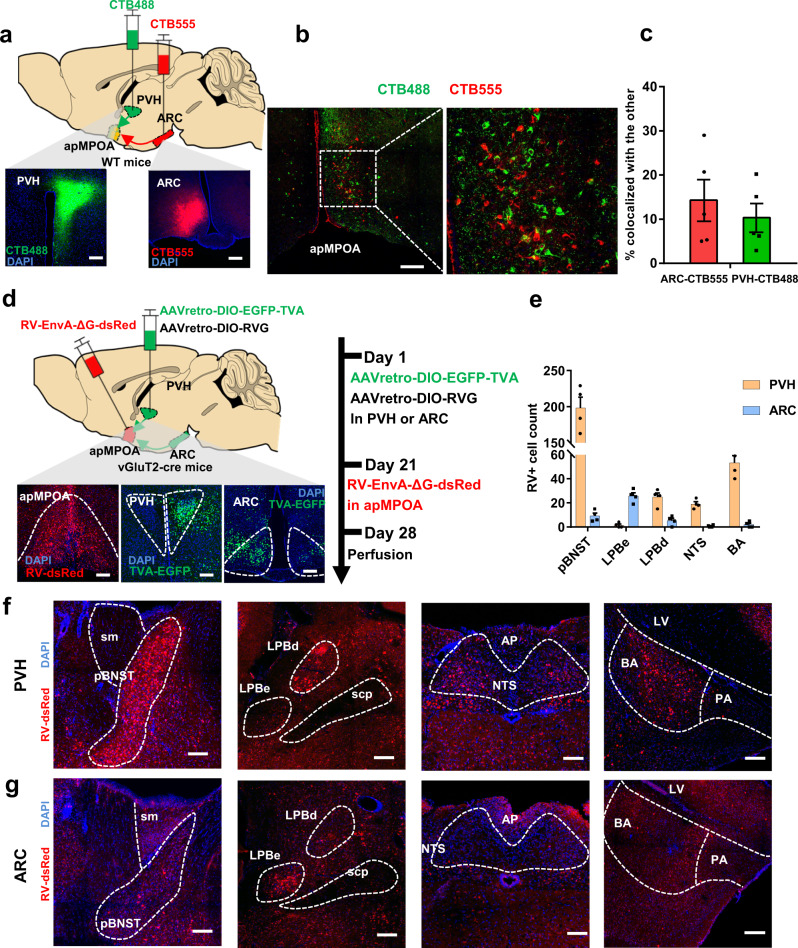
Dual tracing identifies neighboring populations with limited overlap. Upstream anatomical tracing links PVH-projecting cells more strongly with dorsal lateral-parabrachial input and ARC-projecting cells with the external subregion, alongside other source differences.
Parabrachial regions are already implicated in thermal signaling; these findings refine the connectivity map. The new evidence describes input distributions, while their functional contribution to feeding awaits direct intervention.
PVH-projecting cells also receive more labeling from posterior bed nucleus, solitary tract nucleus and amygdala-related sources. The populations belong to a broader information network that could bring bodily state and environmental cues together in feeding regulation.
Source: Qian S et al. · Nature communications · CC BY
Original figure and English caption ↗
Molecular profiles help distinguish the populations
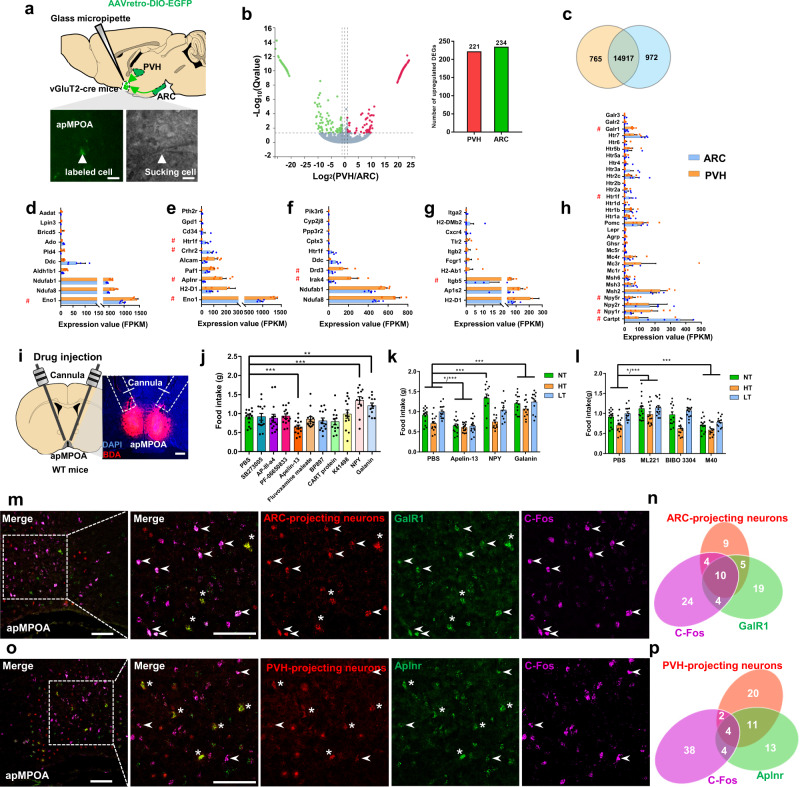
Transcript comparisons and in-situ labeling show more GalR1 expression in ARC-projecting cells and more apelin receptor Aplnr in PVH-projecting cells. Neither exclusively labels every member. Local pharmacology alters intake, identifying candidates for further study.
Using adult female and male mice, the study links environment and dietary state with two output routes. It describes distinct neighboring responses and coordination rather than one uniform appetite switch. Specific recipient identities, upstream thermal inputs and receptor functions remain to be connected.
Drug effects also depend on context. NPY promotes intake at neutral temperature but has no significant effect in hot or cold conditions; tested NPY1-receptor blockade also changes intake nonsignificantly. Molecular effects remain dependent on the particular setting.
Source: Qian S et al. · Nature communications · CC BY
Original figure and English caption ↗