Preoptic astrocytes contribute to cooling after acute challenge
Selected acute noxious challenges lower temperature in male mice. The study links preoptic astrocytes, extracellular adenosine and receptor actions, while persistent cooling after metabolic intervention indicates additional contributions.
Following an acute noxious challenge, mouse body temperature falls and activity changes appear in a thermoregulatory region. A study published on May 7, 2024 in CNS Neuroscience & Therapeutics follows this phenomenon to hypothalamic preoptic area, POA. Alongside several thermoregulatory neuronal populations, POA contains astrocytes surrounding neurons. Astrocytic calcium rises after challenge, and interventions in these cells and local adenosine receptors alter temperature. The curves reveal regulation involving supporting cells and chemical signals.
Predominantly astrocyte-targeted POA activation lowers temperature and increases adenosine-sensor signals. A1- or A2A-related blockade weakens activation-induced cooling. Local metabolic intervention raises absolute temperature, yet a noxious challenge still produces a fall.
Contents · 6 sections
Different challenges produce different temperature profiles
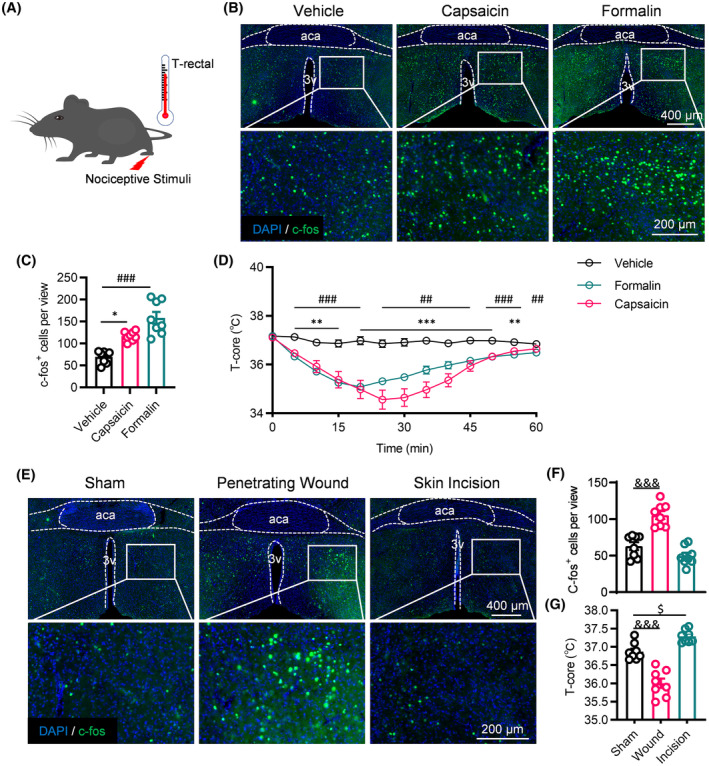
After intraplantar capsaicin or formalin challenge, male-mouse core temperature falls and subsequently recovers over time. Both models show increased POA c-Fos labeling, linking peripheral noxious challenge with changes in a central thermoregulatory region.
A deep-wound model also produces cooling and increased POA activity. Superficial incision shows no corresponding activity increase, and temperature at the tested time is higher than sham. Tissue origin and bodily changes may influence the response; subsequent mechanistic experiments focus mainly on capsaicin.
Source: Jia J et al. · CNS neuroscience & therapeutics · CC BY
Original figure and English caption ↗
Astrocytic calcium rises after the challenge
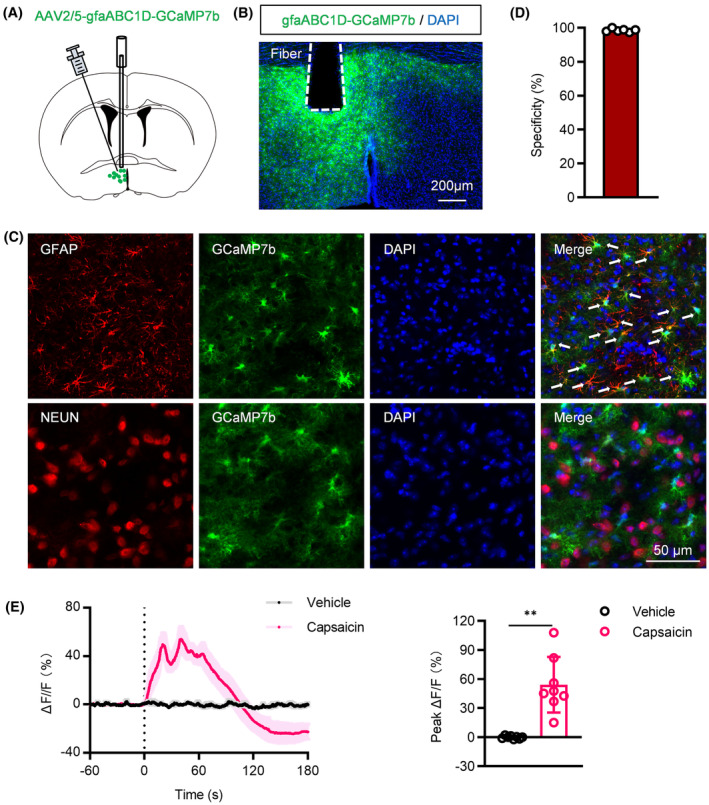
A calcium indicator is expressed predominantly in POA astrocytes, with strong GFAP overlap in histology. Population calcium rises rapidly after capsaicin, unlike the vehicle control. Supporting cells respond to the bodily event alongside the temperature decline.
Calcium recording describes collective changes within a region rather than individually resolving every cell. The study next manipulates the target population to test whether changing its activity affects temperature, progressing from an associated response to functional involvement.
Source: Jia J et al. · CNS neuroscience & therapeutics · CC BY
Original figure and English caption ↗
Activation cools, while metabolic intervention leaves a subsequent fall
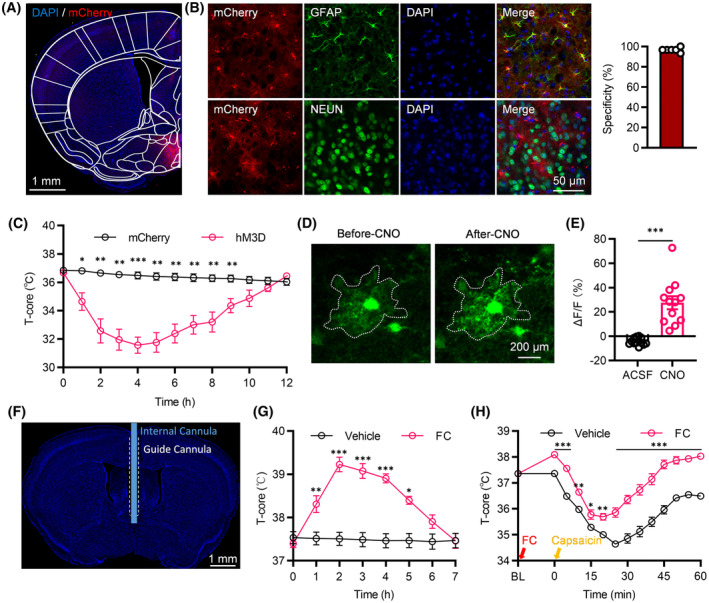
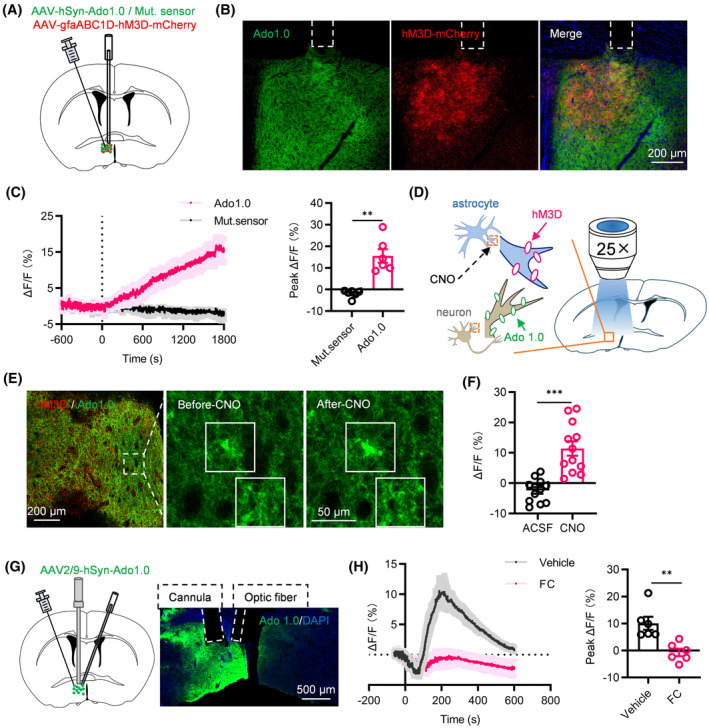
Predominantly astrocyte-targeted chemogenetic activation strengthens calcium responses and produces a sustained period of lower temperature. The fluorophore control lacks comparable cooling, demonstrating an ability of target-population modulation to change temperature. Its time course differs from that of a brief peripheral challenge.
Local metabolic inhibitor FC instead raises temperature. After FC pretreatment, capsaicin still produces a marked fall, although absolute temperature remains higher. The intervention changes the preceding state: cooling occurs again from a higher starting point rather than the entire response being eliminated.
Cooling after cell activation extends over hours, whereas temperature after peripheral challenge recovers over a shorter observation period. The changes have similar directions but different durations: the population can regulate temperature, while sustained activation produces a distinct process from the response to brief challenge.
Source: Jia J et al. · CNS neuroscience & therapeutics · CC BY
Original figure and English caption ↗
Adenosine rises, and receptor activation can also cool
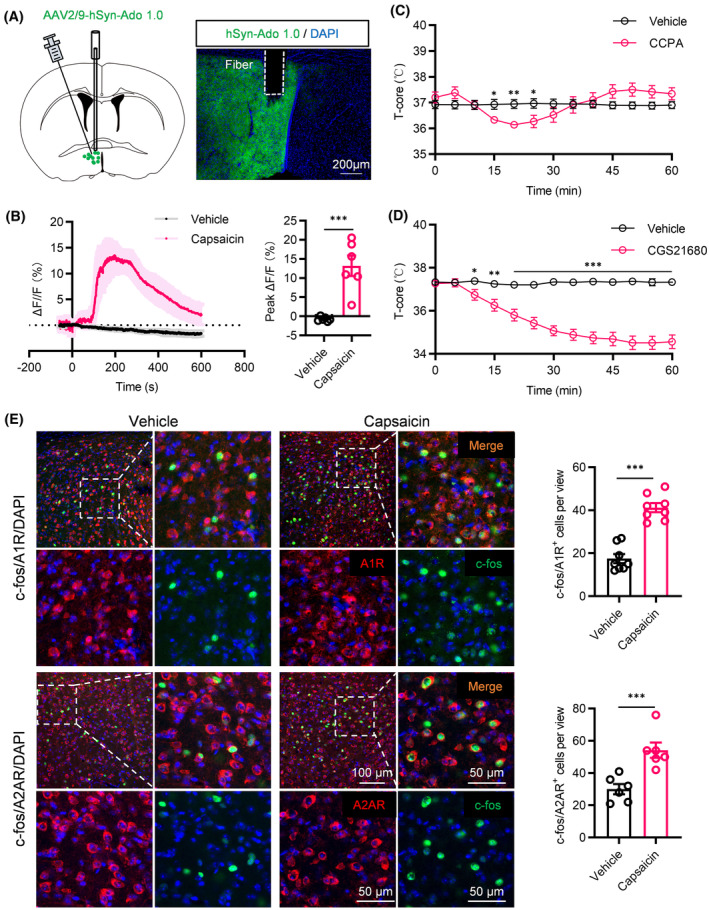
Extracellular adenosine is the next focus. POA adenosine-sensor signals rise after capsaicin alongside calcium responses and temperature changes. The sensor reports local adenosine-related changes without directly identifying the cell of origin for every component.
Local A1- or A2A-related receptor activation can each lower temperature. Following challenge, more active cells carry these receptor markers. Adenosine signals and receptor effects supply related clues that combined experiments then connect with astrocyte activation.
Source: Jia J et al. · CNS neuroscience & therapeutics · CC BY
Original figure and English caption ↗
Astrocyte manipulation changes local adenosine responses
Activating the target astrocytic population increases POA adenosine-sensor signals, unlike a nonresponsive control sensor. Slice imaging also detects increased local adenosine-related signals, linking activation of these cells with a changed chemical environment.
FC pretreatment weakens the capsaicin-evoked adenosine increase. Together the experiments support astrocyte-related processes in local adenosine regulation, while neurons and extracellular ATP breakdown may also contribute. Sensor signals are not resolved into quantitative contributions from each source.
Source: Jia J et al. · CNS neuroscience & therapeutics · CC BY
Original figure and English caption ↗
Receptor blockade weakens cooling after activation
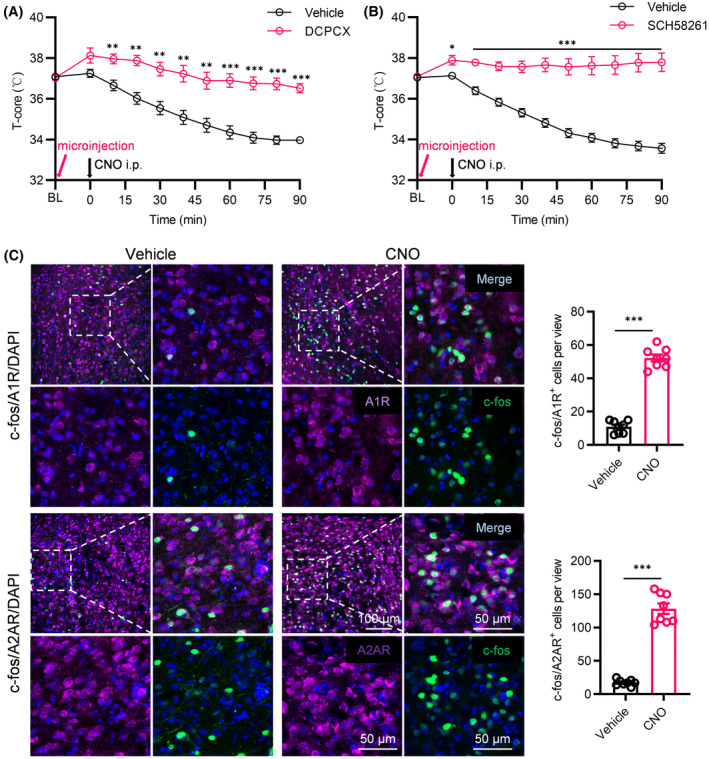
Blocking POA A1- or A2A-related action before target-cell activation weakens subsequent cooling. Activation also increases activity colabeling among receptor-marked cells. Receptor interventions strengthen the connection between cellular activity and temperature effects, supporting adenosine-related contributions.
These tests concern cooling induced by cell activation, with evidence chiefly from eight-to-fourteen-week-old male mice. The study shows how acute bodily challenges accompany supporting-cell and local chemical changes, within multicomponent temperature regulation. It does not directly measure whether cooling changes nociception in return.
Source: Jia J et al. · CNS neuroscience & therapeutics · CC BY
Original figure and English caption ↗