A small accumbal population links feeding with energy balance
Serpinb2-marked cells in mouse accumbal shell are active during eating and bidirectionally regulate food seeking and intake. They connect to hypothalamic leptin-receptor cells; reducing them also changes weight gain and metabolic measures.
Eating depends on both the body’s energy needs and motivation to approach food and act. The nucleus accumbens is associated with goals and reward, but its cells do not all contribute to feeding identically. A 2024 Nature Metabolism study identifies a small Serpinb2-marked population in accumbal shell, NAcSh, predominantly expressing dopamine D1 receptors. Its eating responses differ from those of a broader D1 population, while connections to lateral hypothalamus, LH, link food seeking and leptin-related regulation in one network.
Activating Serpinb2-marked cells promotes food seeking and intake, whereas suppressing them reduces both. Corresponding broader D1 and Tac2 interventions do not significantly change these measures. Long-term population reduction lowers intake and weight gain and raises bodyweight-normalized energy-expenditure measures.
Contents · 6 sections
One population is more readily recruited during refeeding
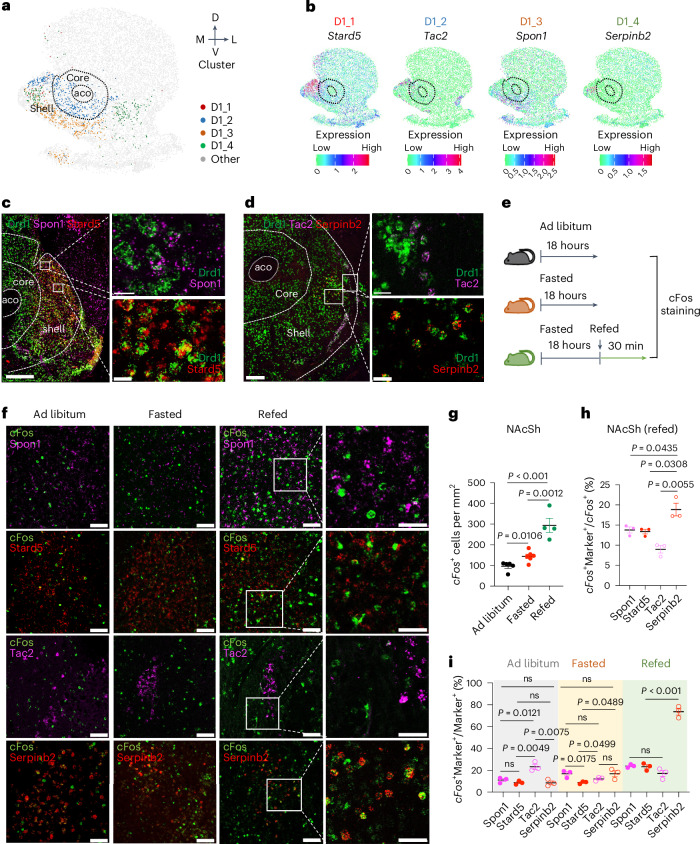
Combining single-cell and spatial-expression data identifies four D1-associated populations within the examined NAcSh region, marked by genes including Stard5, Tac2, Spon1 and Serpinb2. They share a region but have distinct molecular profiles. Serpinb2 identifies a population here; the study does not directly test the protein’s own feeding function.
Across freely fed, fasted and refed conditions, the Serpinb2 population stands out in activity-labeling proportions during refeeding. Roughly seventy percent carry the activity marker, indicating focused recruitment of a smaller population that broader D1 categorization may obscure.
Source: Liu Y et al. · Nature metabolism · CC BY
Original figure and English caption ↗
The subset differs from the broader D1 population
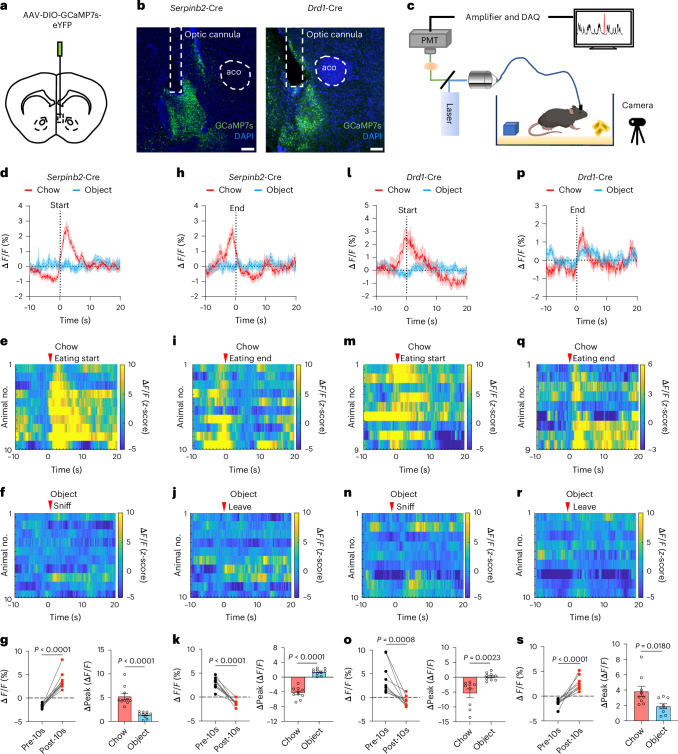
Serpinb2-population calcium rises when freely behaving mice begin eating and declines after eating ends. Sniffing a non-food object produces no comparable change. Recordings link population dynamics with feeding onset and offset.
A separate recording of broader D1 cells shows higher signals during food approach, a decline during eating and another rise at the end. Tac2 cells show no obvious corresponding response. Shared D1 expression does not imply activity in the same behavioral phase, making subpopulation comparisons informative.
Source: Liu Y et al. · Nature metabolism · CC BY
Original figure and English caption ↗
Higher activity promotes approach and consumption
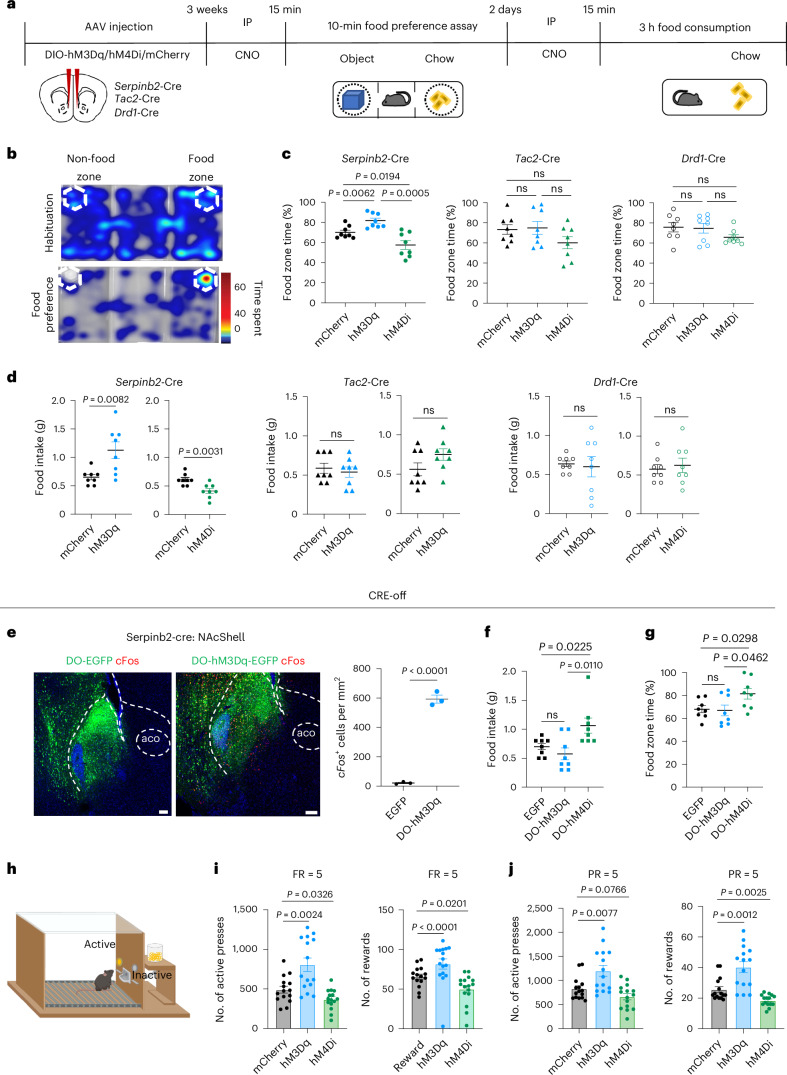
Increasing Serpinb2-cell activity prolongs food-zone occupancy and increases consumption; suppression reduces both. Corresponding Tac2 and broader D1 interventions have no significant effects. Suppressing local Serpinb2-negative cells instead increases food-zone occupancy and consumption, showing the opposite direction.
In food-reinforced tasks, activation increases active lever pressing and earned pellets, while suppression has opposite effects under a fixed requirement. Tested movement, sucrose preference, social interaction and anxiety-related measures change nonsignificantly. The findings concern food seeking and intake rather than directly equating more lever presses with greater subjective pleasure.
Food-seeking assays examine both approach and action to obtain food. Population interventions alter free choice and goal-directed responses, linking consumption with changes in food-zone occupancy and continued action.
Source: Liu Y et al. · Nature metabolism · CC BY
Original figure and English caption ↗
Lateral hypothalamus receives the input
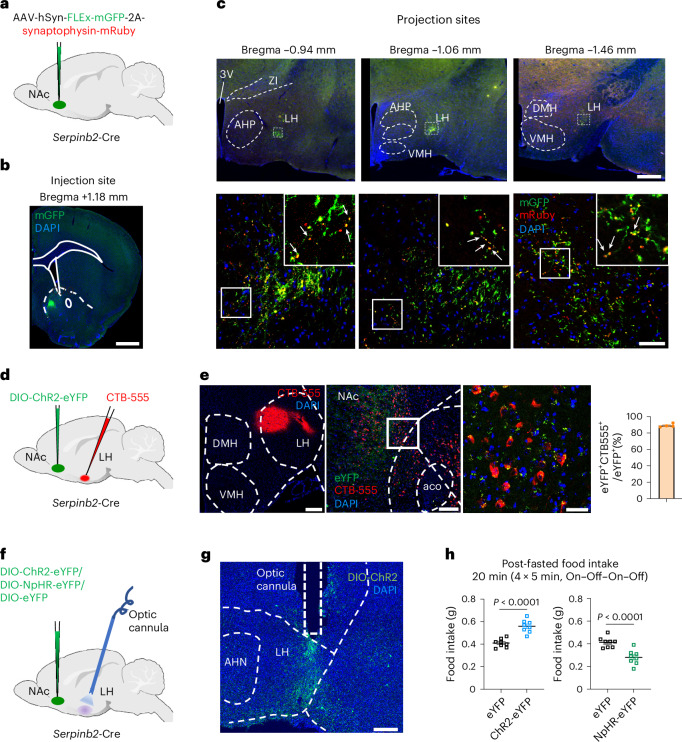
Anterograde axonal and synaptic labeling appears in LH, and retrograde tracing from LH reaches NAcSh Serpinb2 cells. The examined ventral pallidum, ventral tegmental area and basolateral amygdala lack comparable terminal colabeling, focusing the study on LH as a major output target.
Stimulating Serpinb2-cell terminals in LH increases post-fast intake, while suppression decreases it. The input both reaches LH and bidirectionally affects consumption under the tested conditions, prompting identification of recipient cells.
Source: Liu Y et al. · Nature metabolism · CC BY
Original figure and English caption ↗
The input connects to leptin-receptor cells
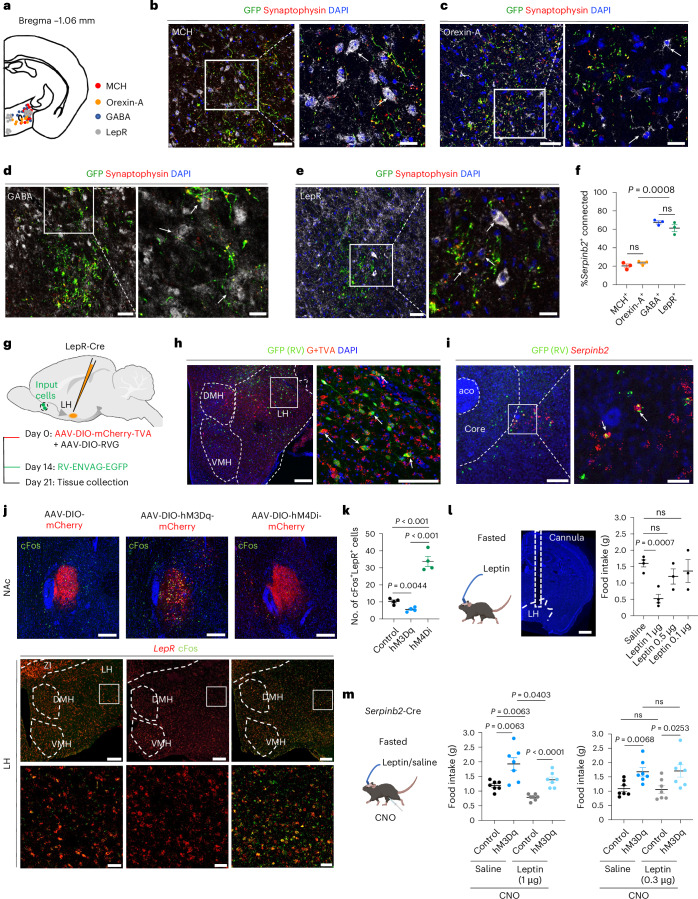
GABA and leptin-receptor, LepR, labeling is common among LH cells associated with terminals, while MCH and orexin associations are less frequent. Monosynaptic retrograde tracing from LepR cells reaches the Serpinb2 population. Suppressing that population increases LH activity labeling with LepR colabeling, consistent with a model of inhibitory regulation from GABAergic cells.
Leptin signals energy reserves, and local delivery can reduce consumption. Under a leptin condition that suppresses intake, activating Serpinb2 cells still increases consumption, partly countering that suppression. Neural input and hormonal action influence the same behavioral outcome at the hypothalamic recipient region.
Accumbal input supplies hypothalamic regulation alongside signals of bodily reserves. Tracing establishes population connectivity, while combined experiments show that consumption varies with neural activity and local hormonal conditions, linking behavioral goals with bodily needs.
Source: Liu Y et al. · Nature metabolism · CC BY
Original figure and English caption ↗
Slower weight gain accompanies more than reduced intake
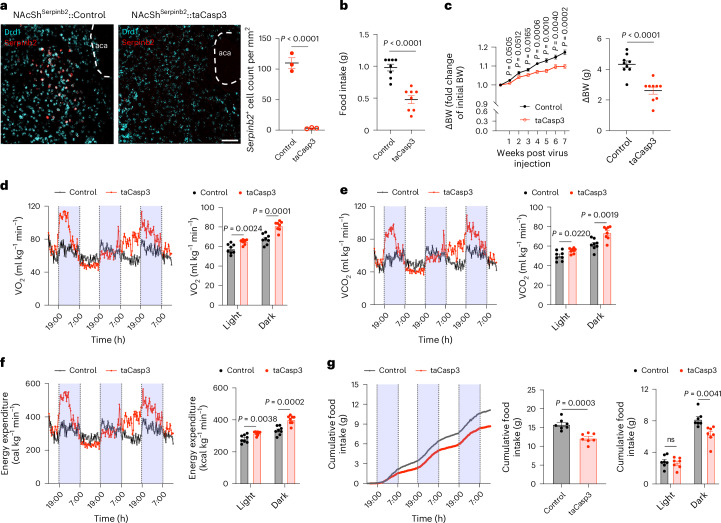
Long-term reduction of NAcSh Serpinb2 cells lowers intake and reduces weight gain over seven weeks. Both groups gain weight, with less gain after intervention: the result concerns a changed growth trajectory. Metabolic recordings also show higher bodyweight-normalized oxygen consumption, carbon dioxide production and energy expenditure.
Respiratory exchange ratio and measured movement change nonsignificantly, while intake differences are more prominent in the dark phase. These findings, mainly in adult male mice, link a molecularly marked subset with food seeking, hypothalamic input and longer-term energy balance. D1-cell regulation of feeding depends on the population and behavioral phase involved.
Source: Liu Y et al. · Nature metabolism · CC BY
Original figure and English caption ↗