Why do anxiety-like behavior and sleep loss travel together after stress? A shared BNST ensemble with distinct outputs
A mouse study identifies stress-recruited BNST cells affecting behavior and sleep, with recipient cells in dorsal raphe and preoptic area showing distinct affect-related and sleep effects.
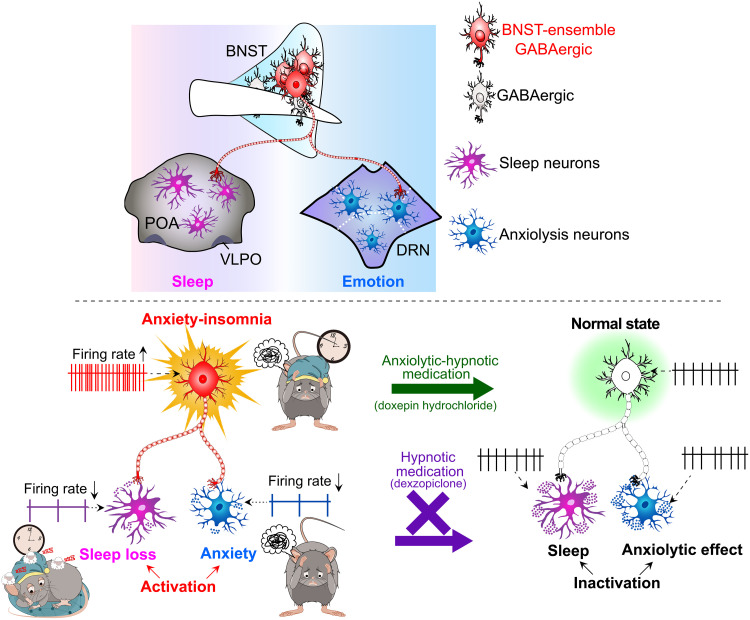
Tension and poor sleep often occur together, but how much neural machinery do they share? A Science Advances study identifies cells in mouse bed nucleus of the stria terminalis (BNST) recruited by both chronic stress and sleep loss. They are more active during wakefulness and anxiety-related situations, and increasing activity worsens both outcomes. Following their outputs reveals a split: recipient cells in dorsal raphe mainly affect anxiety-like behavior, while preoptic recipients mainly affect sleep. One shared starting point can link distinct outcomes.
The stress-related BNST ensemble has dual functions, while downstream recipient cells show selectivity: DRN affects anxiety-like behavior and POA affects NREM and wakefulness.
Contents · 7 sections
Stress and sleep loss recruit overlapping cells
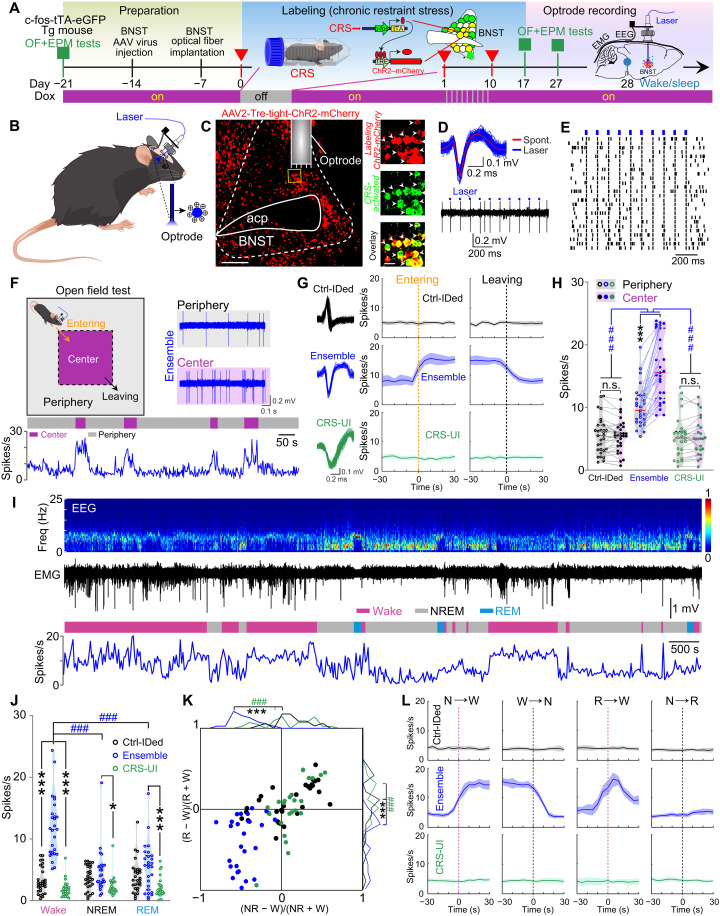
After chronic restraint stress, mice explore exposed areas less, spend less time in NREM and REM and remain awake longer. Sleep loss itself also produces anxiety-like behavior without significant changes in general locomotion in the relevant tasks. Other stress conditions and another strain show related co-occurring sleep and behavioral changes.
Many stress-recruited BNST cells are also recruited by sleep loss. Labeling sleep-loss-related cells and then observing stress responses reveals substantial overlap in the reverse direction. The experiences meet in a shared population more prominently than in home-cage-recruited cells, identifying a common neural starting point.
Activity rises on entering exposed areas
In stressed mice, ensemble firing rises on entering the open-field center or open maze arms and falls on leaving. Unidentified cells and home-cage control populations do not show the same clear changes. Activity relates to context rather than remaining identical after stress ends.
Sleep recordings show higher ensemble activity in wakefulness than NREM or REM. Firing rises rapidly on waking and declines gradually on entering NREM. The same population responds to exposed contexts and sleep–wake transitions, motivating tests of its behavioral contribution.
Source: Sun H et al. · Science advances · CC BY-NC
Original figure and English caption ↗
One ensemble can influence two outcomes
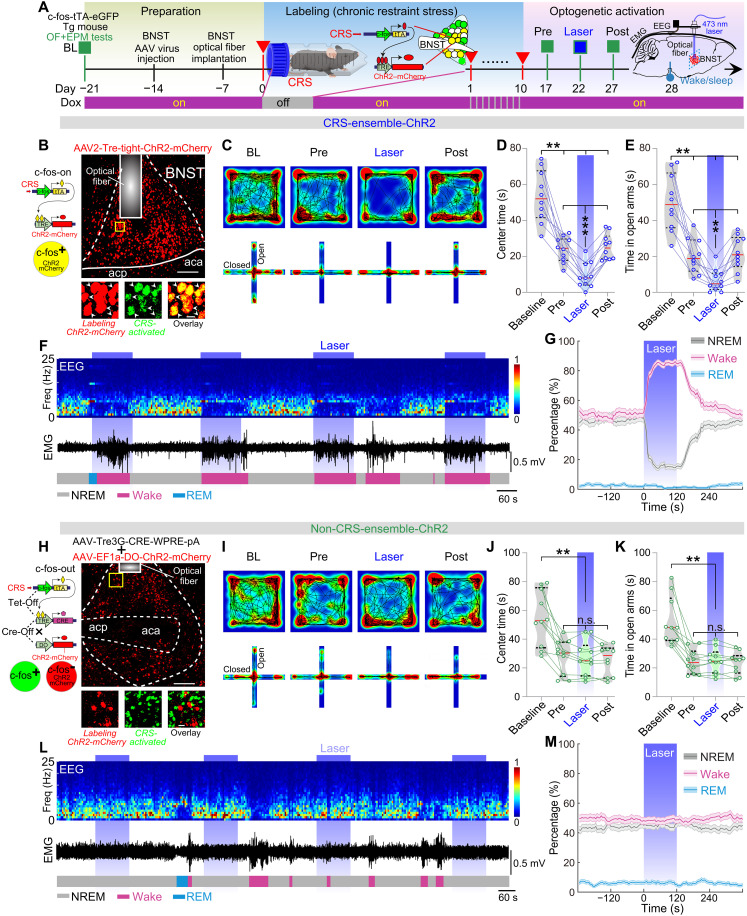
Increasing stress-ensemble activity reduces center and open-arm time without an equivalent locomotor change, decreases NREM and REM and increases wakefulness, facilitating awakening. Behavioral and sleep measures show that the activity can influence both outcomes rather than merely accompany them.
Activating neighboring nonensemble cells does not significantly change tested anxiety-like behavior or sleep states, and home-cage-labeled populations do not reproduce the effects. Population selection matters within one region. Sleep-loss-recruited ensembles can produce both outcomes on activation even without chronic restraint, reinforcing the shared-population finding.
Source: Sun H et al. · Science advances · CC BY-NC
Original figure and English caption ↗
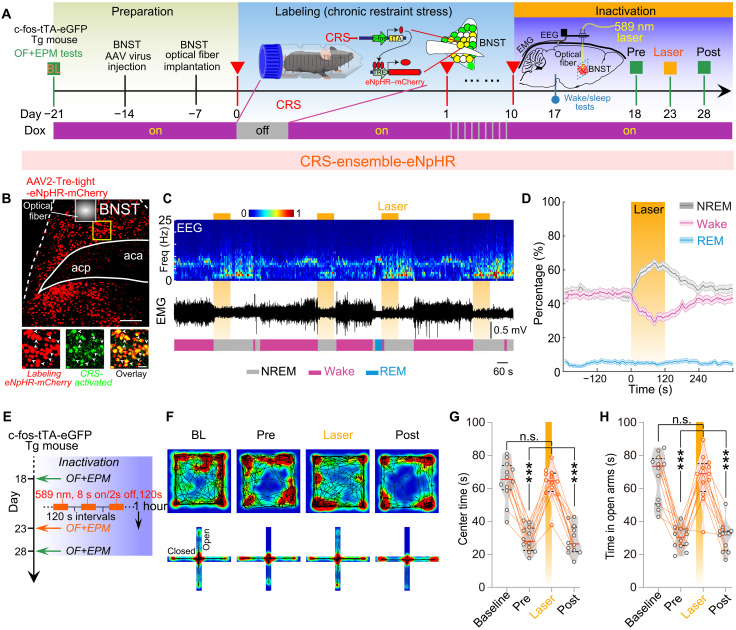
Reducing ensemble activity increases NREM
Reducing stress-ensemble activity increases NREM and lowers wakefulness without a clear REM change. Sleep promotion also accompanies reduced locomotion, so exploration is examined in another observation window, showing increased center and open-arm time. Opposite activity changes yield corresponding sleep and anxiety-related outcomes.
Improved sleep has a specific meaning here: the clearest increase concerns NREM, without all sleep stages recovering together. A shared ensemble can influence several states without every measure moving uniformly. Its output targets offer a way to understand the two functions and differences among sleep stages.
Source: Sun H et al. · Science advances · CC BY-NC
Original figure and English caption ↗
Outputs diverge, with some cells reaching both targets
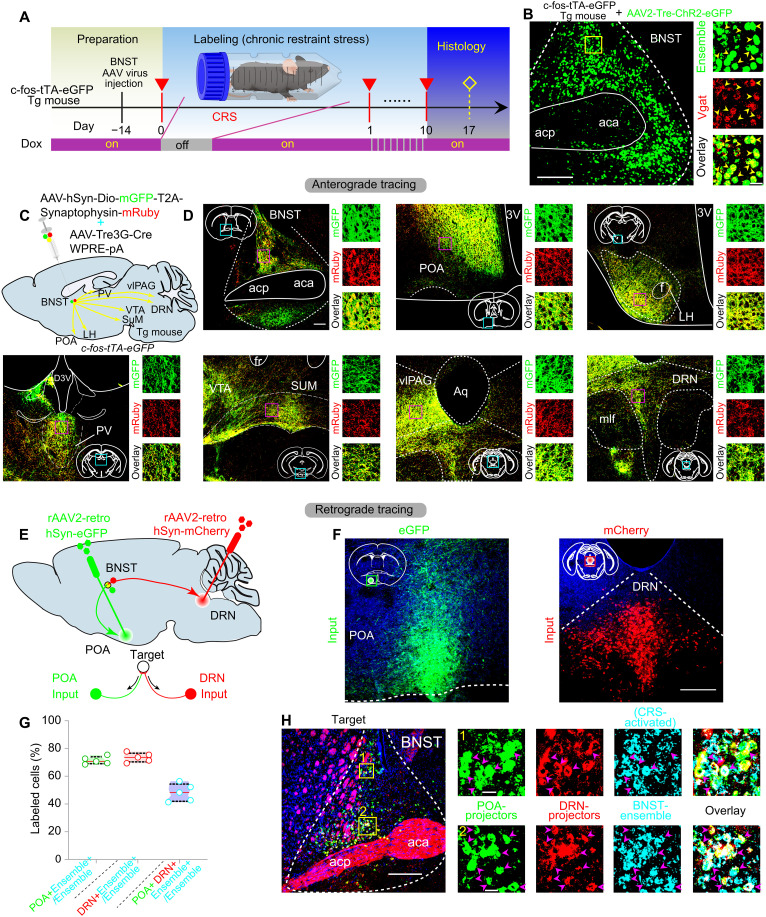
Vgat labeling supports a GABAergic identity for the BNST ensemble. Its axons reach several regions, with preoptic area (POA) and dorsal raphe nucleus (DRN) examined closely. These regions are associated with sleep and affect-related regulation, placing the two functions at distinct downstream locations.
Retrograde tracing shows that about half the ensemble reaches both POA and DRN, alongside other projection combinations. Experience-recruited cells can distribute outputs to different destinations. The anatomy provides a basis for functional division, tested next through the recipient populations.
Source: Sun H et al. · Science advances · CC BY-NC
Original figure and English caption ↗
Two targets change affect-related behavior and sleep separately
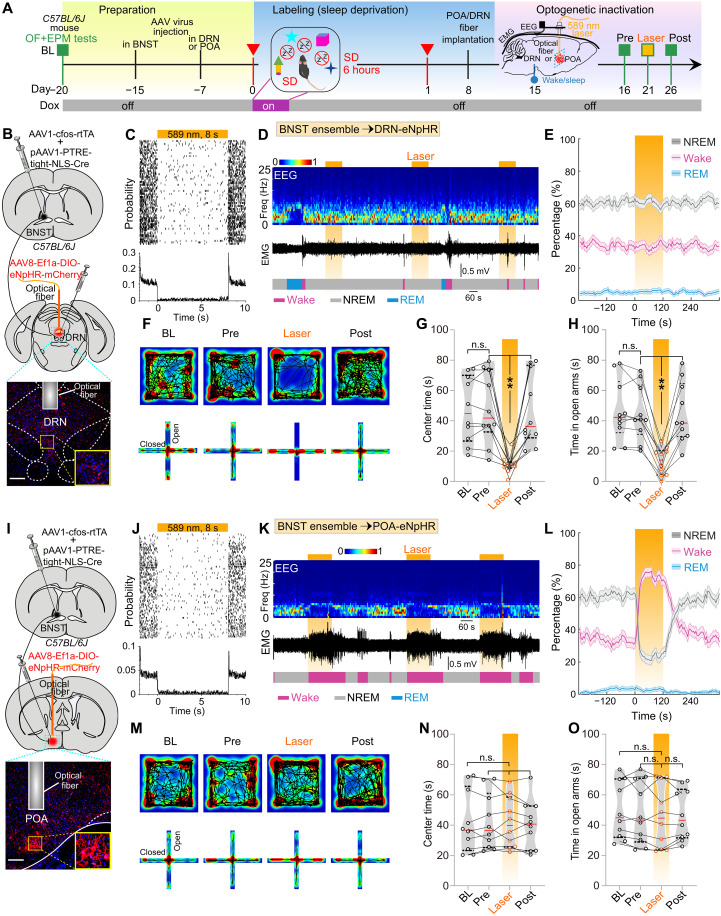
Reducing DRN cells receiving BNST-associated input decreases exposed-area exploration without significantly changing sleep states. Reducing corresponding POA cells decreases NREM and increases wakefulness without equivalent anxiety-like changes. These dissociations reveal selective outcomes at different targets of a shared source population.
Source: Sun H et al. · Science advances · CC BY-NC
Original figure and English caption ↗
Different targets can improve different outcomes
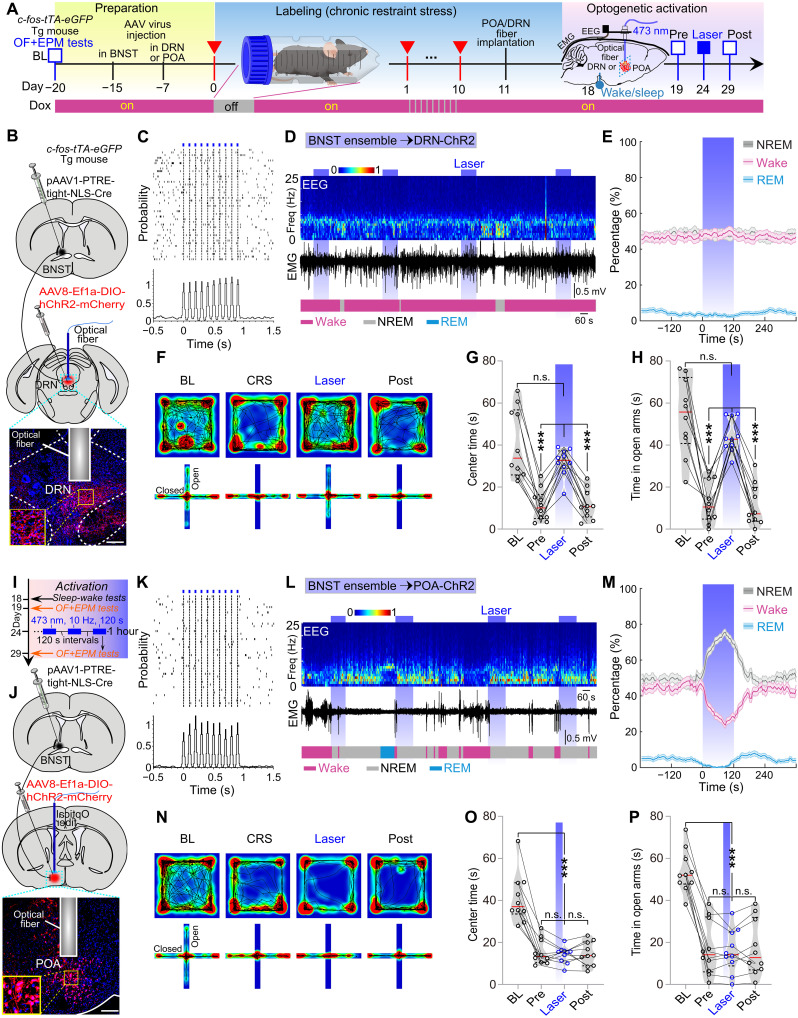
In stressed mice, increasing DRN recipient activity improves exploration without significant sleep changes. Increasing POA recipient activity raises NREM and reduces wakefulness and REM without clear anxiety-like changes. The improvements again reveal specialization, including the fact that increased NREM can accompany reduced REM.
The mouse study offers a layered picture of co-occurring outcomes: stress and sleep loss recruit a shared ensemble, while target identity determines functional emphasis. Anxiety-like behavior and sleep changes can coexist yet be altered separately downstream. Destination matters alongside which cells are recruited.
Source: Sun H et al. · Science advances · CC BY-NC
Original figure and English caption ↗