First meetings and reunions: oxytocin pathways in social memory after sleep loss
CA2 signals favor new partners and prelimbic signals favor familiar ones. A mouse study reveals different timing roles for oxytocin outputs during encoding and retrieval.
Recognizing a partner involves at least two encounters: encoding the individual at first meeting and retrieving that information later. Sleep loss can weaken the link between them. A 2026 Research study follows PVN outputs to hippocampal CA2 and prelimbic cortex (PrL). The same peptide signal has different roles: CA2 oxytocin responses favor new partners, while PrL responses favor familiar ones, with distinct importance at first meeting and reunion. Location and timing both matter.
PVN–CA2 output contributes mainly to social-memory encoding and PVN–PrL output to retrieval. Phase-matched enhancement transiently improves performance after chronic sleep deprivation; broader high-frequency PVN stimulation retains benefit at three-day follow-up.
Contents · 6 sections
Sleep loss changes choices between new and familiar partners
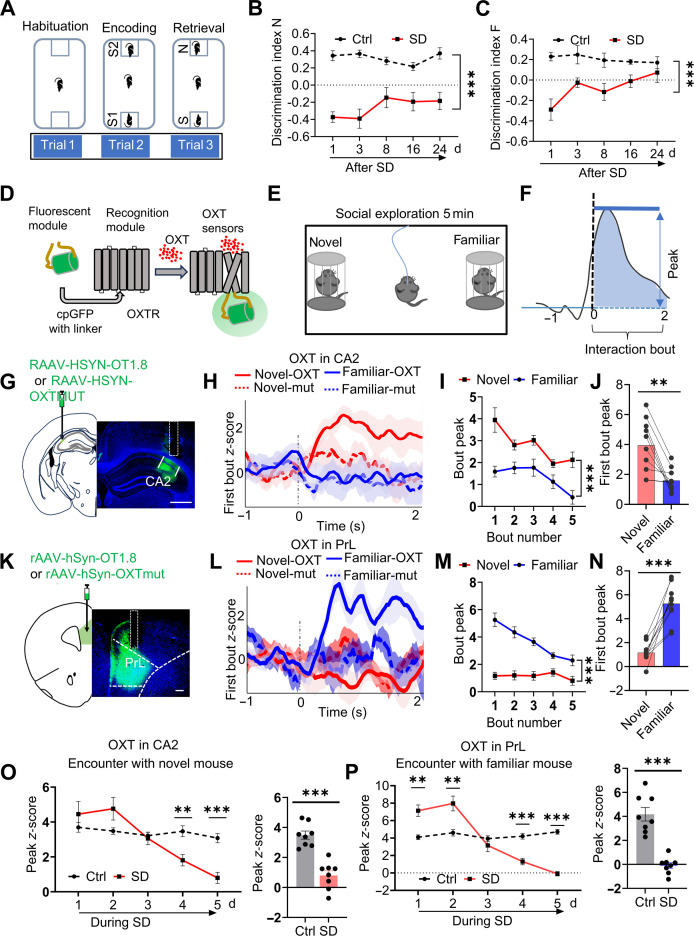
Mice first encountered two unfamiliar partners, then one familiar and one new partner. Controls favored the newcomer and reduced exploration of the repeated individual. Chronic sleep deprivation weakened both differences through at least day 24, whereas acute-deprivation effects recovered by the next day.
Social exploration and general novelty exploration did not show the same impairment. Researchers therefore asked whether information formation at first contact or later retrieval was affected. New-versus-familiar choices reflect both memory and motivation, while following exploration of the same individual across encounters provided another view of recognition.
Source: Liu Y et al. · Research (Washington, D.C.) · CC BY
Original figure and English caption ↗
Two regions respond to different encounters
Local oxytocin signals were stronger for new partners in CA2 and familiar partners in PrL. During chronic deprivation, responses briefly increased before declining; PVN-related calcium activity and spontaneous firing also decreased. Changes from upstream cells to downstream signals connected partner exploration with a distributed peptide system.
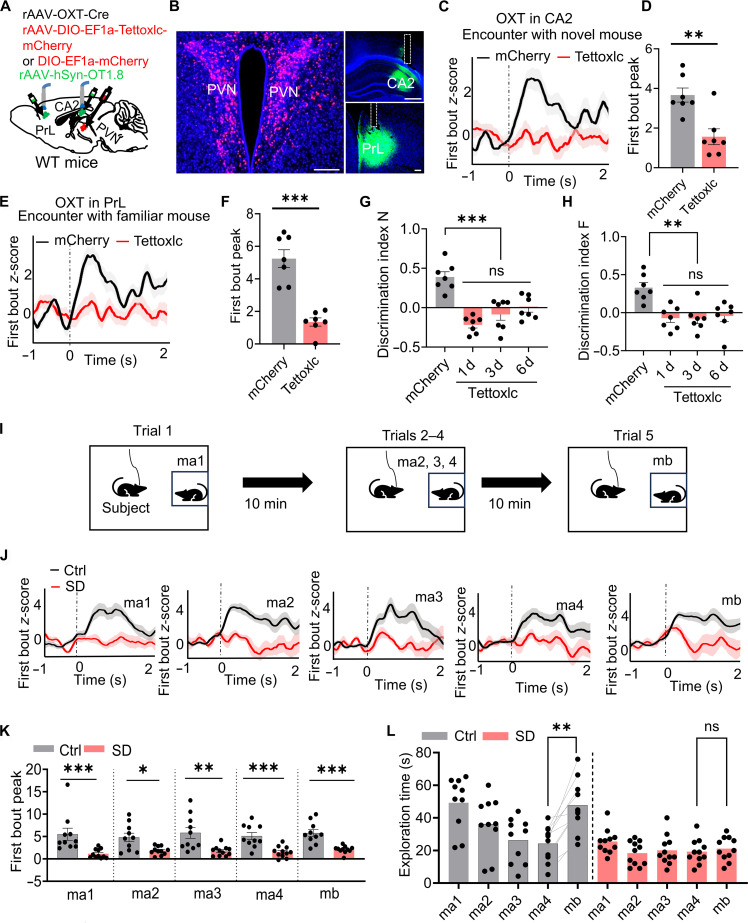
Blocking vesicular release from predominantly oxytocin-expressing PVN cells weakened signals in both regions and recognition performance. The two sites thus shared an upstream source. Their different partner preferences showed how a common source could support targeted responses through distinct outputs.
Source: Liu Y et al. · Research (Washington, D.C.) · CC BY
Original figure and English caption ↗
CA2 helps at first meeting, PrL at reunion
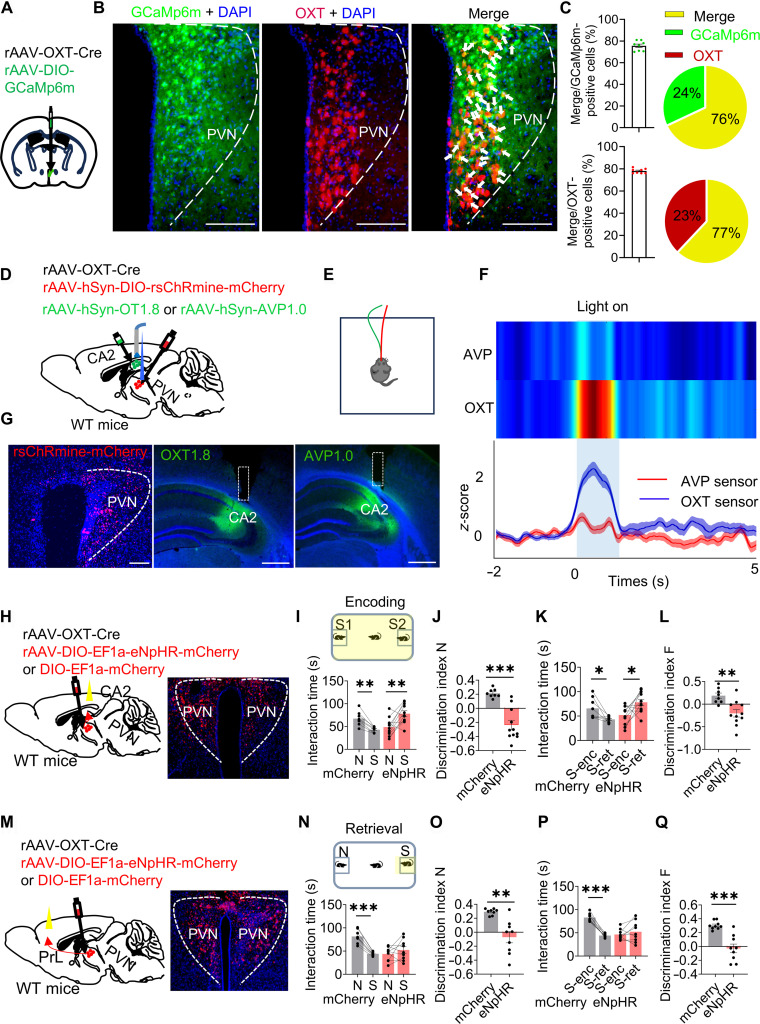
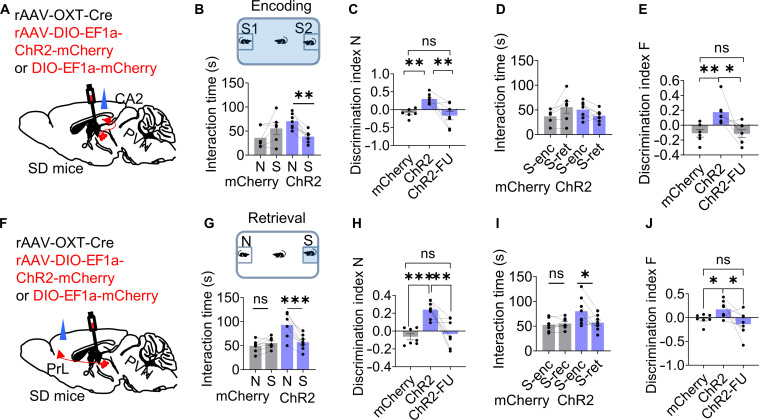
Suppressing PVN–CA2 terminals impaired recognition during encoding but not retrieval. PVN–PrL showed the opposite pattern: retrieval suppression impaired performance, while encoding suppression had no clear effect. Partner preference and timing aligned, with CA2 contributing to new information formation and PrL to familiar-information retrieval.
The upstream populations were largely separate, with some dual projections. Enhancing PrL output during encoding instead impaired memory. A signal delivered at the wrong stage need not help. Partner processing depends on outputs engaging at appropriate times rather than uniformly elevating peptide signals throughout the task.
Source: Liu Y et al. · Research (Washington, D.C.) · CC BY
Original figure and English caption ↗
Matching timing helps, but the benefit fades by the next day
After chronic deprivation, enhancing CA2 output during encoding or PrL output during retrieval improved novelty discrimination and reduced repeated familiar-partner exploration. Both pathways could help when engaged at the matching phase, indicating that processing capacity remained modifiable after prolonged sleep disruption.
The benefit did not persist at 24-hour follow-up, when recognition deficits returned. Transient enhancement helped the current task but left the sleep-affected background in place afterward. This raised a further question: could another form of modulation leave a longer-lasting change in the upstream system?
Source: Liu Y et al. · Research (Washington, D.C.) · CC BY
Original figure and English caption ↗
A different stimulation pattern retains benefit longer
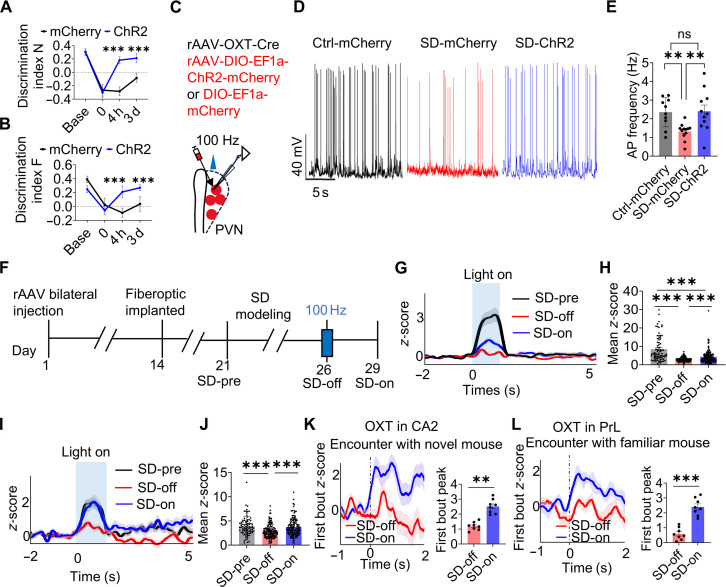
Different PVN stimulation patterns produced different outcomes. Brief hyperpolarization and low-frequency stimulation lacked equivalent benefits; high-frequency stimulation improved behavior at four hours and three days. Spontaneous firing recovered and CA2/PrL peptide responses increased, differing from transient task-phase terminal enhancement.
PVN soma modulation engages broader outputs, so lasting improvement may involve signals beyond the two studied routes. This benefit extends within the observed follow-up, while its cellular basis and eventual duration remain open. Pattern-dependent outcomes make durability an integral part of understanding modulation.
Source: Liu Y et al. · Research (Washington, D.C.) · CC BY
Original figure and English caption ↗
The same signal needs different arrival times
Information formed at first meeting becomes useful at reunion. Linking these moments to different oxytocin outputs depicts recognition as staged cooperation across regions rather than storage and readout within one site. Sleep loss alters that cooperation; timed enhancement can transiently support one stage, while broader pattern modulation yields longer benefits.
The evidence comes from adult male mice in social-recognition tasks. Targeting predominantly labeled oxytocin cells, and vesicular interventions could affect co-transmitters. The clearest findings concern timing roles and the distinction between transient and longer benefits: when a signal arrives matters alongside its amount.