A sound gate during sleep: how cortex connects noise to arousal
Whether noise awakens mice depends on intensity and relates to ongoing brain activity; a temporal association cortex–amygdala connection contributes.

The ears continue receiving sound during sleep, yet the brain does not turn every sound into awakening. The same noise can sometimes interrupt sleep and sometimes pass without arousal. A 2025 Advanced Science study examines the mouse temporal association cortex (TeA): how does this cortical region respond to sound and connect it to arousal systems? The answer involves more than intensity alone, intertwining sleep stage with brain activity before the sound arrives.
TeA excitatory neurons contribute to sound-evoked NREM arousal; reducing their activity or inhibiting the population projecting to BLA/La makes awakening less likely.
Contents · 7 sections
Higher activity does not necessarily mean easier awakening
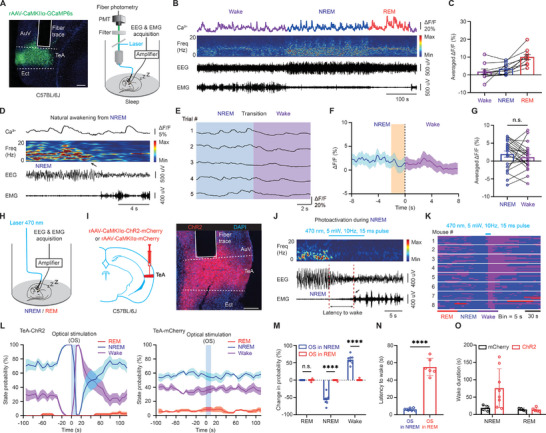
EEG and muscle recordings distinguish sleep stages: non-rapid-eye-movement (NREM) sleep features slow waves, while rapid-eye-movement (REM) sleep has a different EEG rhythm and low muscle tone. Sound encounters a changing background, making comparison between these stages especially informative.
Calcium activity in TeA CaMKIIα-positive neurons is detectable during wakefulness, NREM and REM, and is highest in REM. Yet activating these cells rapidly awakens mice from NREM without a comparable effect during REM. Activity level and the ability to drive awakening are distinct.
Natural NREM-to-wake transitions also lack a clear population calcium increase. The study therefore moves from asking whether all awakenings share one activity change to a more specific question: do these cells play a different role when sound interrupts sleep?
Source: Yu H et al. · Advanced science (Weinheim, Baden-Wurttemberg, Germany) · CC BY
Original figure and English caption ↗
Awakening noise accompanies a stronger cortical response
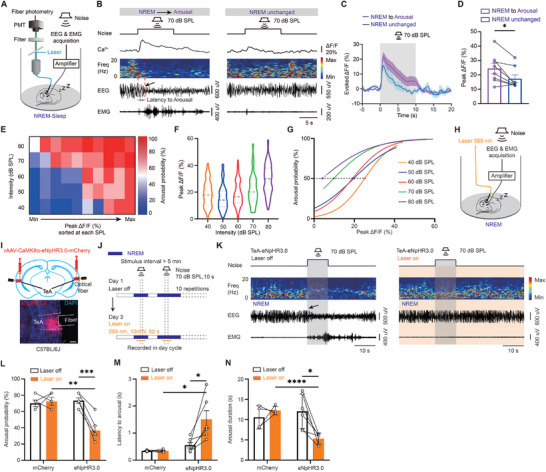
During NREM, noise trials that awaken mice accompany larger TeA calcium responses. Relatively quiet noise can awaken a mouse when the response is high, while loud noise with a low response is less likely to do so. Intensity and cortical response together describe this gate.
In awake mice, single-cell electrical activity and population calcium recordings both show responses generally increasing with sound intensity, while tuning to pure-tone frequencies is weak. The focus is therefore closer to how intensity engages arousal than to fine discrimination of pitch.
Inhibiting TeA neurons during sound delivery reduces arousal probability, delays awakening and shortens the ensuing wake period. Recording and intervention together establish their contribution to sound-evoked arousal.
Source: Yu H et al. · Advanced science (Weinheim, Baden-Wurttemberg, Germany) · CC BY
Original figure and English caption ↗
The gate is already changing
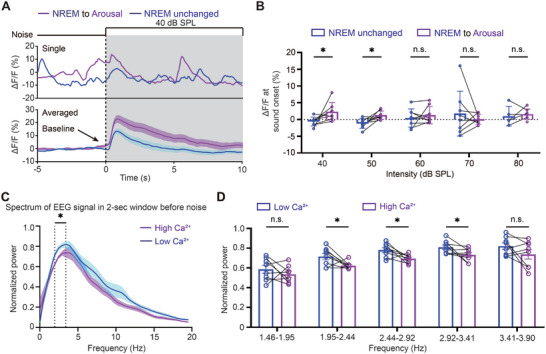
For quieter sounds, trials followed by awakening already show higher TeA baseline calcium activity before sound onset. This baseline difference is not clear for louder sounds. With weak external input, the ongoing brain state is particularly closely related to whether sleep is interrupted.
EEG adds another observation: higher pre-sound power in part of the delta range associates with a smaller ensuing TeA response. This relationship in simultaneous recordings connects sleep slow waves with sensory responsiveness and helps explain why volume alone cannot predict every awakening.
Source: Yu H et al. · Advanced science (Weinheim, Baden-Wurttemberg, Germany) · CC BY
Original figure and English caption ↗
Driving awakening versus responding to sound
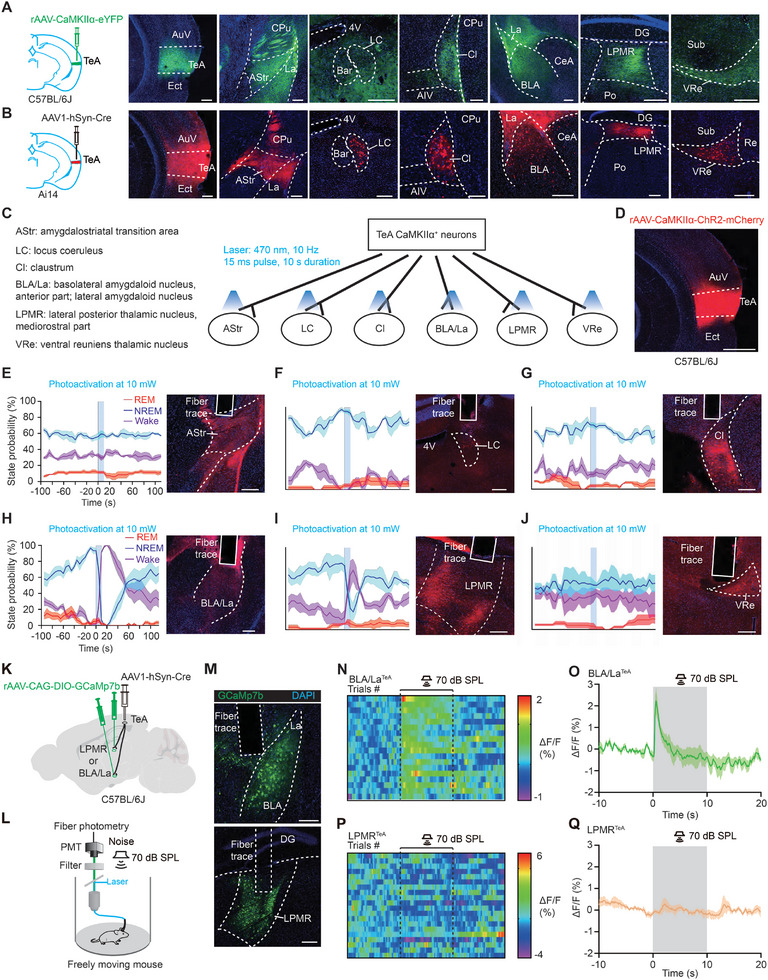
TeA sends outputs to several regions. Activating its terminals in either amygdala BLA/La or thalamic LPMR induces NREM arousal, whereas the other tested targets show no clear effect. Recording sound responses then distinguishes the two effective targets.
BLA/La cells receiving TeA input show noise-evoked calcium responses, while the corresponding LPMR population does not show a clear response. The ability to induce arousal artificially does not mean noise recruits that connection in the same way, directing further investigation toward BLA/La.
Source: Yu H et al. · Advanced science (Weinheim, Baden-Wurttemberg, Germany) · CC BY
Original figure and English caption ↗
Excitatory input from cortex
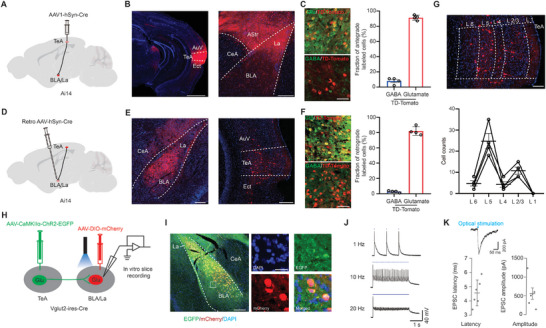
Both ends are predominantly glutamatergic: TeA cells projecting to BLA/La mainly occupy cortical layers two through five, and most BLA/La input-recipient cells are excitatory. The connection thus supports an excitatory relay from cortex to amygdala.
In brain slices, activating TeA terminals evokes excitatory synaptic responses in BLA/La glutamatergic neurons, including action potentials. The anatomical route therefore has functional support: cortical output can drive downstream cells.
Source: Yu H et al. · Advanced science (Weinheim, Baden-Wurttemberg, Germany) · CC BY
Original figure and English caption ↗
Reducing this cortical population makes arousal less likely
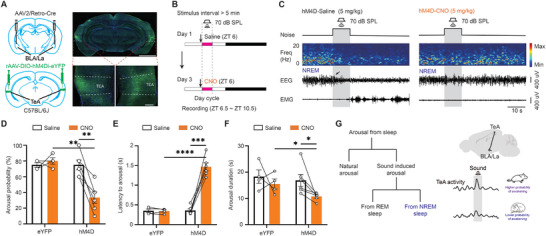
Finally, the study selects TeA cells by their projection to BLA/La and reduces their activity. Sound-evoked arousal becomes less likely, later and shorter. Interventions in TeA more broadly and in this projection-defined population produce convergent behavioral changes.
The intervention changes not only whether awakening occurs but also how quickly it begins and how long wakefulness lasts. Together these changes describe the course of a sound-triggered interruption rather than reducing cortical participation to a yes-or-no outcome.
Sound does not simply travel from ear to awakening in one uninterrupted step. Before engaging arousal networks, it encounters a cortical component whose effects depend on sleep state; the TeA–BLA/La connection is one segment that can alter the outcome.
Source: Yu H et al. · Advanced science (Weinheim, Baden-Wurttemberg, Germany) · CC BY
Original figure and English caption ↗
A gate between hearing and awakening
The study uses adult male mice and primarily noise and pure tones. It reveals how sound intensity, ongoing brain state and a cortical–amygdala connection relate to arousal. Whether natural sounds with different meanings pass through the same gate remains a separate question.