Low-frequency hypothalamic stimulation: shared changes across seizure models
A male-mouse study finds that low-frequency VMH stimulation affects selected measures across induced seizure models, with different changes in glutamatergic-cell responses, seizure progression and electrical duration.
Seizures beginning in different regions may still engage shared nodes. A study published on February 9, 2025 in CNS Neuroscience & Therapeutics examines the ventromedial hypothalamus, VMH. Its activity increases across several induced seizure models in male mice. Low-frequency stimulation raises some induction thresholds, delays progression or reduces selected discharges. Examining VMH glutamatergic cells links their excessive responses to stimulation effects. The measures that improve or remain similar reveal differing contributions of this common node across models.
Low-frequency VMH stimulation changes seizure thresholds, timing or progression in several mouse models; inhibiting glutamatergic cells reproduces some behavioral effects, with differences in electrical measures.
Contents · 7 sections
Different seizure triggers increase VMH activity
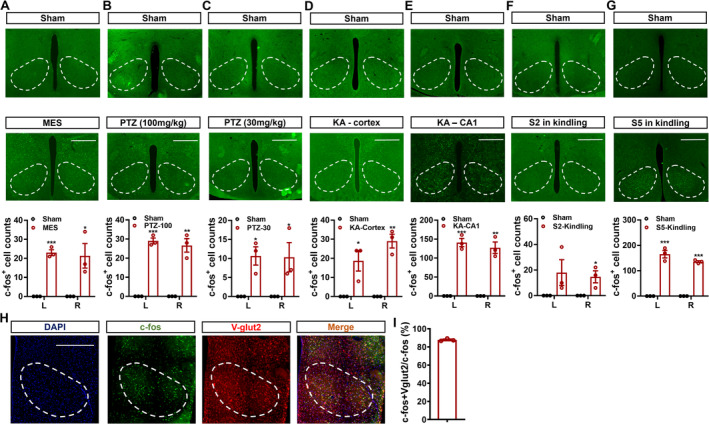
Activity markers increase in VMH across generalized induced seizures, cortical- or hippocampal-origin seizures and repeated hippocampal kindling. Similar changes on both sides show engagement of this small region under different seizure conditions.
In the hippocampal-kindling model, most increased activity markers overlap glutamatergic cells. The study therefore tests VMH stimulation while following this excitatory population, connecting regional engagement with a specific cellular group.
Source: Zou S et al. · CNS neuroscience & therapeutics · CC BY
Original figure and English caption ↗
Induction becomes harder or later without matching duration changes
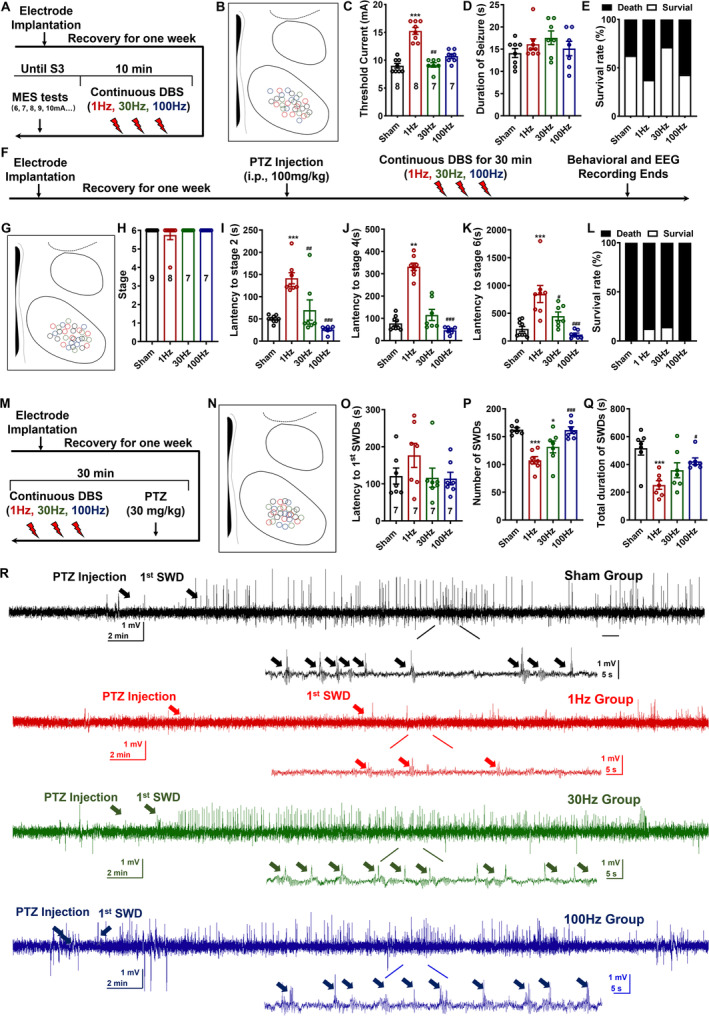
In an electrically induced tonic–clonic model, low-frequency VMH stimulation raises the induction threshold without clear duration or survival changes. In another drug-induced myoclonic-related model, more severe stages appear later, while maximal stage and survival remain similar.
In an absence-like spike–wave model, the low-frequency condition reduces discharge count and total duration, with only a trend toward later first discharge. The intermediate tested frequency also reduces count more weakly. Threshold, timing and duration describe different aspects, and effects vary across frequencies and models.
Source: Zou S et al. · CNS neuroscience & therapeutics · CC BY
Original figure and English caption ↗
Progression changes in focal-origin models
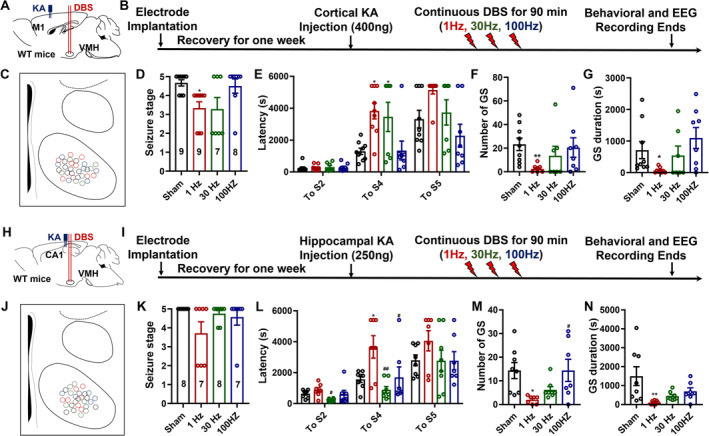
When seizures originate in cortex or hippocampus, low-frequency stimulation reduces maximal stage, delays selected more severe stages and lowers secondary generalized-seizure count and total duration. The intermediate frequency improves some stage measures in the cortical model, whereas clear hippocampal-model gains are concentrated in the low-frequency condition.
Focal onset and subsequent spread are distinct aspects here. Effects across different origins suggest participation in seizure-network propagation or progression rather than association only with events beginning in one region.
Source: Zou S et al. · CNS neuroscience & therapeutics · CC BY
Original figure and English caption ↗
Kindling progresses more slowly, and established responses change
Repeated hippocampal kindling leads to progressively more severe, stable evoked seizures. Low-frequency VMH stimulation slows stage progression and growth of electrical afterdischarge, requiring more kindling trials to reach severe stages. It affects the repeated induction process as well as acute events.
In fully kindled mice, stimulation still lowers average stage and generalized-seizure duration, without clearly changing electrical afterdischarge duration. Behavioral-seizure and electrical measures can therefore diverge at different stages of the same model.
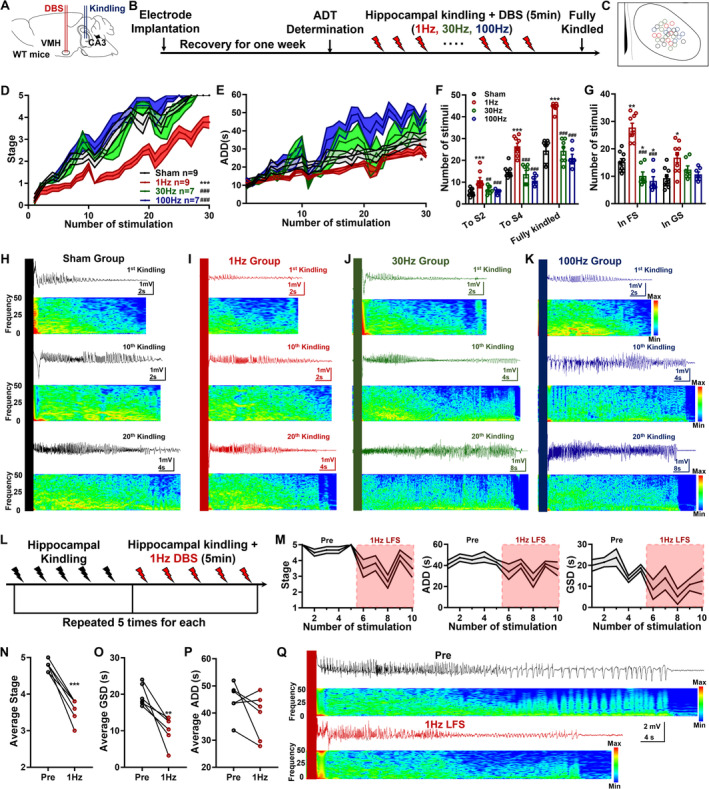
Source: Zou S et al. · CNS neuroscience & therapeutics · CC BY
Original figure and English caption ↗
Excessive responses fall during generalized events
In vivo calcium recordings show increased VMH glutamatergic responses during focal and secondary generalized events. Compared with controls, the low-frequency condition lowers peaks during generalized events but not clearly during focal events. Calcium responses during ordinary free movement also remain broadly unchanged.
The result links stimulation to seizure stage: the same population is affected differently across network states. Low-frequency stimulation accompanies attenuation of selected excessive seizure-related responses rather than a uniform decline across contexts.
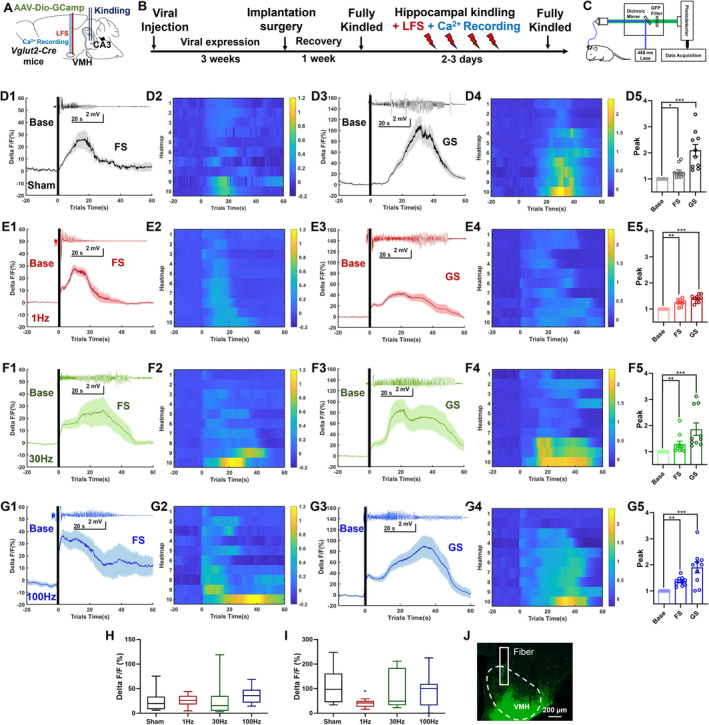
Source: Zou S et al. · CNS neuroscience & therapeutics · CC BY
Original figure and English caption ↗
Direct suppression reproduces some progression changes
Directly inhibiting VMH glutamatergic cells also slows kindling-stage progression and increases the trials required to reach severe stages. The intervention links the cells to behavioral seizures and supports their contribution to regulation.
Cellular suppression does not clearly change afterdischarge duration, unlike stimulation during kindling development. Electrical stimulation affects a regional network, while cellular inhibition focuses on a population; similar behavioral changes coexist with an electrical difference requiring explanation.
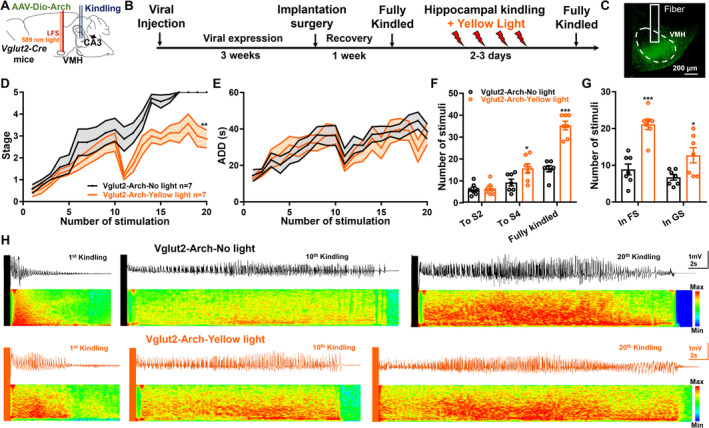
Source: Zou S et al. · CNS neuroscience & therapeutics · CC BY
Original figure and English caption ↗
Shared changes across models point toward network regulation
Axonal tracing shows outputs to hippocampus, thalamus, midbrain, brainstem and parts of cortex. Broad connectivity offers a possible explanation for involvement across models, while the contribution of each output requires separate testing.
This male-mouse study places VMH within a shared network of induced seizures while showing effects that vary with model, stage and measure. Distinguishing cells and subregions within VMH will help explain how one target influences different seizure processes.