Deep-brain calcium recording: separating movement and neural responses
A head-fixed mouse recording demonstration shows population calcium responses in GABA-marked LDT cells and compares free-moving and head-fixed traces from the same mouse. Prominent movement interference is reduced, with limits on signal interpretation.

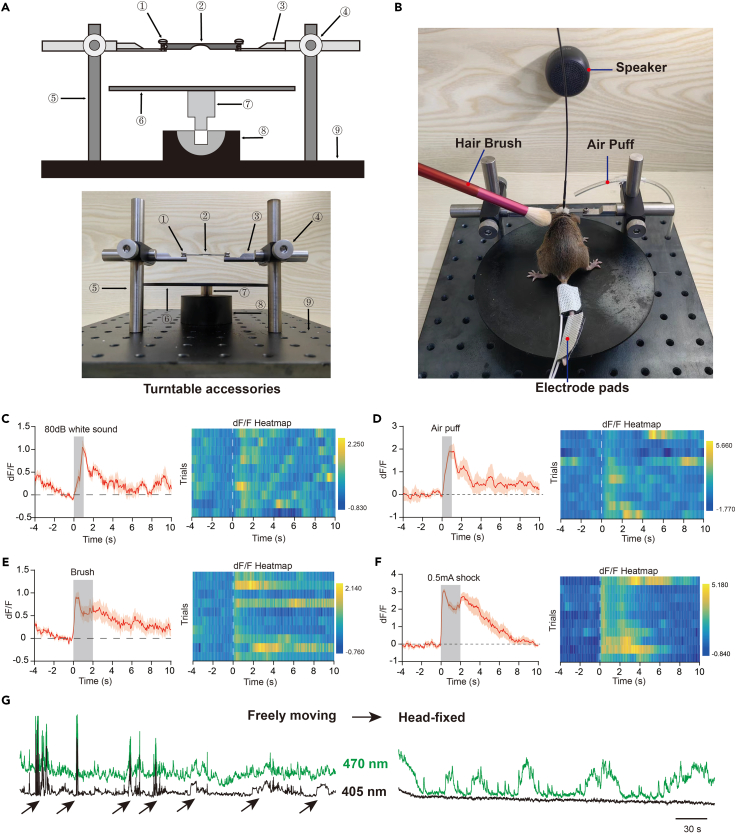
Fluorescence collected through an optical fiber can reveal cellular activity deep in the brain. Movement can also add fluctuations: do they arise from cells or from the animal’s motion? A 2024 STAR Protocols paper demonstrates deep-brain population calcium recording in head-fixed mice. Its outcome figure shows responses of GABA-marked LDT cells to several stimuli and compares raw traces from the same mouse during free movement and head fixation, offering a concrete contrast between signal sources.
GABA-marked LDT populations show calcium responses to tested auditory, air-puff and tactile stimuli. In raw traces from the same mouse, prominent movement-related reference fluctuations diminish with head fixation. This is a recording demonstration, without quantitative evidence of eliminating stress or improving success rates.
Contents · 7 sections
Fluorescence brings population changes into the recording
Fiber calcium recording uses a fluorescent indicator to make intracellular calcium changes optically observable. It follows how a labeled population changes around behavioral events, extending in-vivo observation to deep regions beyond endpoint tissue images.
The paper demonstrates recording in GABA-marked LDT neurons. Labeling defines the observed population, while the fiber collects a pooled signal within its sampling region. The recording places cellular activity and external events on a shared timeline, showing when a population response begins and how it develops.
Optical recordings can change when the animal moves
Free movement preserves behavioral choices but also introduces optical variation. When movement coincides with a stimulus, a fluorescence rise may include both neural responses and movement-related effects. Distinguishing these sources is the central recording question.
The demonstration uses a stable head position while allowing bodily movement. Unlike whole-body restraint, it still permits walking on the platform. This separates head displacement from bodily activity and establishes a context for examining movement-related interference.
The LDT population responds to the tested stimuli
The outcome figure shows LDT-population responses to auditory, air-puff, tactile and electrical stimuli. Average curves summarize event-linked changes, while heatmaps retain variation across recorded trials. Fluorescence rises after the tested stimuli and subsequently declines.
These traces show population responses in the tested contexts. They make deep-cell activity observable relative to events, without resolving every cell’s contribution or the complete behavioral mechanism underlying the responses.
Source: Zhou S et al. · STAR protocols · CC BY-NC-ND
Original figure and English caption ↗
The same mouse provides two recording conditions
In panel 3G, the freely moving reference channel shows pronounced fluctuations, some coinciding with calcium-recording changes. These prominent fluctuations are weaker in the head-fixed trace. The same-mouse comparison directly illustrates a change in visible movement-related interference across recording conditions.
This raw-trace comparison is qualitative; it does not provide a cross-animal percentage reduction in interference or an increase in recording success rate. Calcium-related and reference channels offer different observations, with the latter helping identify additional fluctuations without making the recording a pure single-source signal.
Pooled changes leave individual differences unresolved
A rising population trace represents an aggregate fluorescence change, without showing that every cell responds by the same amount. Cells may be active at different times or change in opposite directions; the pooled trace reflects their combined outcome.
The paper explicitly identifies this limitation: fiber recording follows population activity but does not individually resolve each cell. It addresses when a population changes, while divisions of labor among individual cells concern another observational scale.
Calcium fluorescence differs from individual spikes
The GCaMP6m indicator has its own response kinetics, adding a conversion between calcium changes and fluorescence. Slower optical kinetics can combine adjacent fast activity into a broader trace. Curve duration therefore reflects both biology and the indicator.
The authors also note possible effects on intracellular calcium buffering and photobleaching during extended imaging. The recording observes calcium-related changes through a tool with particular physical and biological properties rather than directly counting action potentials.
Weaker movement interference leaves state effects possible
Head fixation can introduce stress that may affect cellular activity. The paper does not establish stress elimination, and the effects of its heparin-associated auxiliary treatment on neuronal activity and labeling expression remain unevaluated. Reduced optical fluctuation and unchanged physiological state are separate questions.
The demonstration puts stimulus-linked population responses and visible movement effects into a common recording comparison. Deep-brain signals become observable in relation to events while retaining a defined scale and state context. The traces describe population activity alongside the influence of recording conditions.